Setting the Context Health and justice issues are interconnected. - - PDF document

setting the context
SMART_READER_LITE
LIVE PREVIEW

Setting the Context Health and justice issues are interconnected. - - PDF document

12/12/2016 Gathering Wisdom for a Shared Journey Government of British Columbia Justice and Public Safety Sector Richard J.M. Fyfe, QC Deputy Attorney General & Mark Sieben Deputy Solicitor General December 1, 2016 Setting the


slide-1
SLIDE 1

12/12/2016 1

Gathering Wisdom for a Shared Journey

Government of British Columbia Justice and Public Safety Sector Richard J.M. Fyfe, QC Deputy Attorney General & Mark Sieben Deputy Solicitor General December 1, 2016

Setting the Context

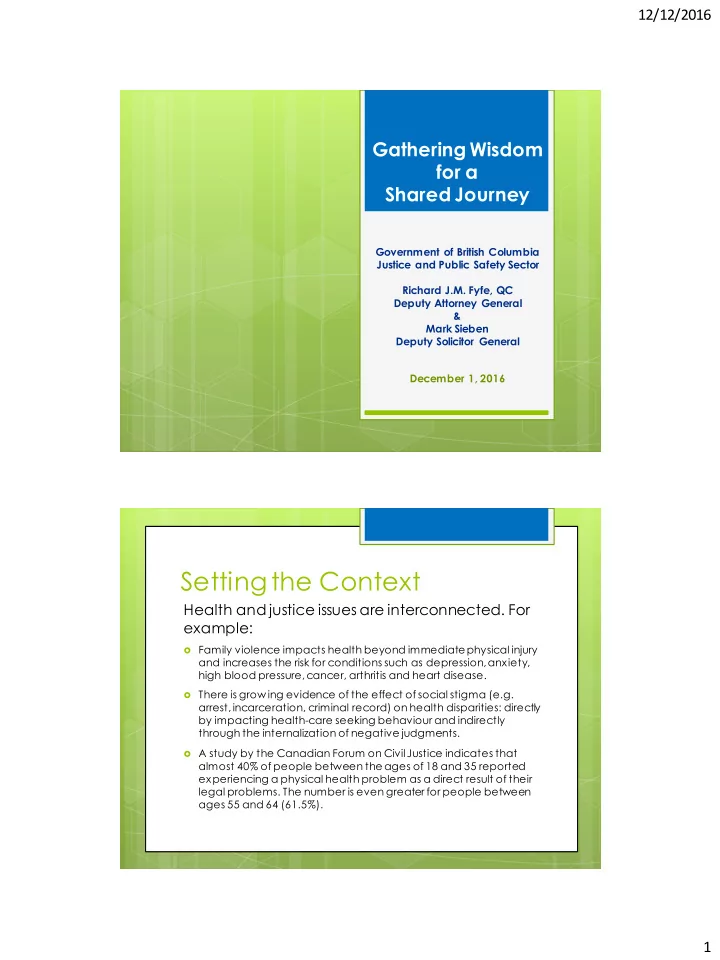
Health and justice issues are interconnected. For example:

 Family violence impacts health beyond immediate physical injury

and increases the risk for conditions such as depression, anxiety, high blood pressure, cancer, arthritis and heart disease.

 There is grow ing evidence of the effect of social stigma (e.g.

arrest, incarceration, criminal record) on health disparities: directly by impacting health-care seeking behaviour and indirectly through the internalization of negative judgments.

 A study by the Canadian Forum on Civil Justice indicates that

almost 40% of people between the ages of 18 and 35 reported experiencing a physical health problem as a direct result of their legal problems. The number is even greater for people between ages 55 and 64 (61.5%).

slide-2
SLIDE 2

12/12/2016 2

Coordinating our Efforts

The Ministry of Justice and the Ministry of Public Safety and Solicitor General are working together to:

 Address over-representation of Indigenous

people in the justice system;

 Improve relationships and advance

reconciliation; and

 Support culturally relevant, community-

based alternatives and/or supports to the formal justice system.

Understanding the Issues

There were key overarching issues that arose at the regional caucuses:

 The need for a coordinated response on mental

health and substance misuse.

 The impact of FASD on families and communities.  The importance of shared decision making,

especially around children in care.

 The need for services to be available in rural and

remote communities areas as well as in urban areas.

 The necessity of cultural safety training.

slide-3
SLIDE 3

12/12/2016 3

Strengthening our Relationship

The regional caucuses created an extraordinary

  • pportunity for dialogue. We will continue to

maintain and strengthen the relationship by:

 Participating in an annual meeting between the

FNHC and Ministers, per the MOU

 Supporting the development of the proposed

social determinants of health strategy

 Organizing an Indigenous justice summit in 2017  Actively seeking out future opportunities for

collaboration with the FNHC and other Indigenous organizations

Committing to Action

 First Nations Court models  Access to justice services in the North and in remote

locations

 Indigenous-specific/culturally relevant family justice

program initiatives

 Supporting MCFD to review the child protection

system for Indigenous peoples

 First Nations policing  Building and strengthening relationships between

First Nations communities/leaders and BC Corrections at local and provincial levels.

 Supporting the National Inquiry on Missing and

Murdered Indigenous Women and Girls

slide-4
SLIDE 4

12/12/2016 4

Building the Future Together

 Remaining engaged and reaching out to

Indigenous leaders on issues of shared concern

 Making provincial initiatives relevant at

regional and/or community levels

 Entrenching our commitment in a ministry

service plan goal

Thank you

Richard J. W. Fyfe, QC Deputy Attorney General Ministry of Justice and Attorney General Mark Sieben Deputy Solicitor General Ministry of Public Safety and Solicitor General