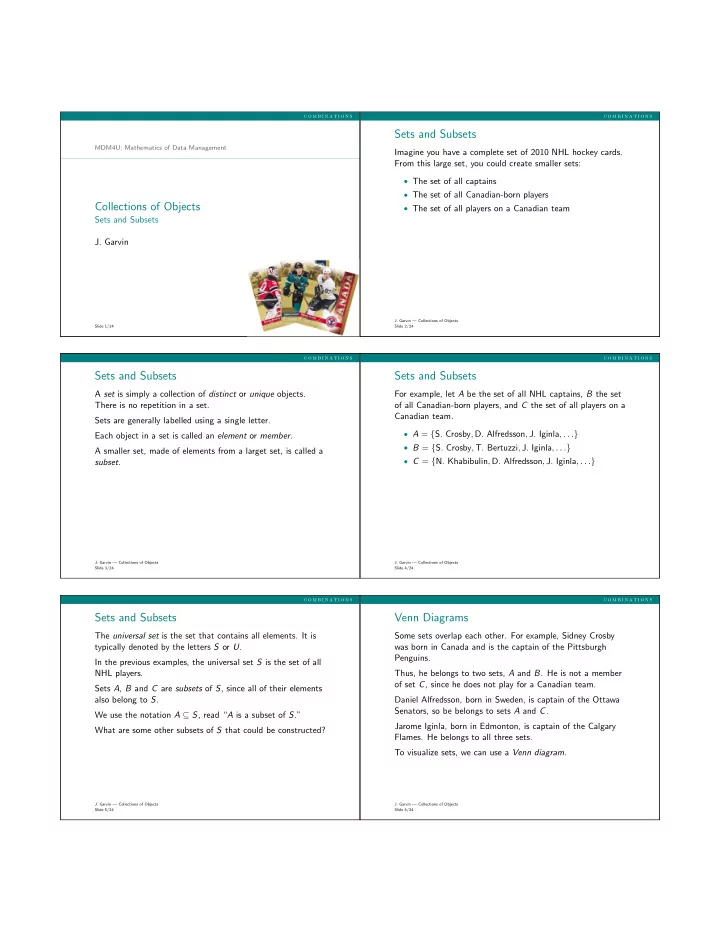
Sets and Subsets MDM4U: Mathematics of Data Management Imagine you - - PDF document

sets and subsets
SMART_READER_LITE
LIVE PREVIEW

Sets and Subsets MDM4U: Mathematics of Data Management Imagine you - - PDF document

c o m b i n a t i o n s c o m b i n a t i o n s Sets and Subsets MDM4U: Mathematics of Data Management Imagine you have a complete set of 2010 NHL hockey cards. From this large set, you could create smaller sets: The set of all captains


slide-1
SLIDE 1

c o m b i n a t i o n s

MDM4U: Mathematics of Data Management

Collections of Objects

Sets and Subsets

  • J. Garvin

Slide 1/24

c o m b i n a t i o n s

Sets and Subsets

Imagine you have a complete set of 2010 NHL hockey cards. From this large set, you could create smaller sets:

  • The set of all captains
  • The set of all Canadian-born players
  • The set of all players on a Canadian team
  • J. Garvin — Collections of Objects

Slide 2/24

c o m b i n a t i o n s

Sets and Subsets

A set is simply a collection of distinct or unique objects. There is no repetition in a set. Sets are generally labelled using a single letter. Each object in a set is called an element or member. A smaller set, made of elements from a larget set, is called a subset.

  • J. Garvin — Collections of Objects

Slide 3/24

c o m b i n a t i o n s

Sets and Subsets

For example, let A be the set of all NHL captains, B the set

  • f all Canadian-born players, and C the set of all players on a

Canadian team.

  • A = {S. Crosby, D. Alfredsson, J. Iginla, . . .}
  • B = {S. Crosby, T. Bertuzzi, J. Iginla, . . .}
  • C = {N. Khabibulin, D. Alfredsson, J. Iginla, . . .}
  • J. Garvin — Collections of Objects

Slide 4/24

c o m b i n a t i o n s

Sets and Subsets

The universal set is the set that contains all elements. It is typically denoted by the letters S or U. In the previous examples, the universal set S is the set of all NHL players. Sets A, B and C are subsets of S, since all of their elements also belong to S. We use the notation A ⊆ S, read “A is a subset of S.” What are some other subsets of S that could be constructed?

  • J. Garvin — Collections of Objects

Slide 5/24

c o m b i n a t i o n s

Venn Diagrams

Some sets overlap each other. For example, Sidney Crosby was born in Canada and is the captain of the Pittsburgh Penguins. Thus, he belongs to two sets, A and B. He is not a member

  • f set C, since he does not play for a Canadian team.

Daniel Alfredsson, born in Sweden, is captain of the Ottawa Senators, so be belongs to sets A and C. Jarome Iginla, born in Edmonton, is captain of the Calgary

  • Flames. He belongs to all three sets.

To visualize sets, we can use a Venn diagram.

  • J. Garvin — Collections of Objects

Slide 6/24

slide-2
SLIDE 2

c o m b i n a t i o n s

Venn Diagrams

  • J. Garvin — Collections of Objects

Slide 7/24

c o m b i n a t i o n s

Venn Diagrams

An element may belong to the universal set, but not to any subsets. For example, Scott Clemmensen was born in Iowa and is the goalie for the Florida Panthers. He does not belong to sets A, B or C.

  • J. Garvin — Collections of Objects

Slide 8/24

c o m b i n a t i o n s

The Null Set

A set may contain no elements at all. For example, let set D be the set of all current NHL players over the age of 80. Set D is known as the null set or empty set, and is usually denoted D = ∅ or D = { }. The null set is always a subset of any set. This is because it is always possible to create a subset that contains no elements from any set – simply take no elements!

  • J. Garvin — Collections of Objects

Slide 9/24

c o m b i n a t i o n s

Disjoint Sets

If two sets do not overlap, they are called disjoint sets. Two sets are disjoint if they have no elements in common. For example, the set G of all goalies and the set W of all wingers do not overlap, because each player plays only one position.

  • J. Garvin — Collections of Objects

Slide 10/24

c o m b i n a t i o n s

Sets and Subsets

Example

Let S be the universal set of all students at Cawthra, and D the set of all students in this Data Management class.

  • Which set is a subset of the other?
  • State some other subsets of S.
  • State some other subsets of D.
  • State two subsets of D that are disjoint.
  • State two subsets of D that have common elements.
  • State a subset of D that is the empty set.
  • J. Garvin — Collections of Objects

Slide 11/24

c o m b i n a t i o n s

Number Systems

In mathematics, we use many different sets of numbers, or “number systems.”

  • The set of natural numbers, N = {1, 2, 3, . . .}
  • The set of whole numbers, W = {0, 1, 2, 3, . . .}
  • The set of integers, Z = {. . . , −2, −1, 0, 1, 2, . . .}
  • The set of rational numbers, Q
  • The set of irrational numbers, Q
  • The set of real numbers, R
  • J. Garvin — Collections of Objects

Slide 12/24

slide-3
SLIDE 3

c o m b i n a t i o n s

Number Systems

  • J. Garvin — Collections of Objects

Slide 13/24

c o m b i n a t i o n s

Number Systems

The set of rational numbers, Q, and the set of irrational numbers, Q, are disjoint, but are both subsets of the real number system, R. Natural numbers, N, whole numbers, W , and integers, Z, are subsets of the rational number system. N ⊆ W ⊆ Z ⊆ Q ⊆ R and Q ⊆ R.

  • J. Garvin — Collections of Objects

Slide 14/24

c o m b i n a t i o n s

Sets

Consider the following sets:

  • S= the positive integers from 1-10
  • E= the set of all even numbers (from S)
  • P= the set of prime numbers (from S)

Each set, then, contains certain elements:

  • S = {1, 2, 3, 4, 5, 6, 7, 8, 9, 10}
  • E = {2, 4, 6, 8, 10}
  • P = {2, 3, 5, 7}
  • J. Garvin — Collections of Objects

Slide 15/24

c o m b i n a t i o n s

Size of a Set

The size of a set, or the number of elements within set A, is typically denoted n(A). Recall that:

  • S= the positive integers from 1-10
  • E= the set of all even numbers (from S)
  • P= the set of prime numbers (from S)

Therefore:

  • n(S) = 10.
  • n(E) = 5.
  • n(P) = 4
  • J. Garvin — Collections of Objects

Slide 16/24

c o m b i n a t i o n s

Compliment of a Set

The compliment of a set, denoted A or A′, contains all of the elements that are not in set A. Again, use the sets:

  • S= the positive integers from 1-10
  • E= the set of all even numbers (from S)
  • P= the set of prime numbers (from S)

Therefore:

  • E = {1, 3, 5, 7, 9}.
  • P = {1, 4, 6, 8, 9, 10}.
  • S = ∅
  • J. Garvin — Collections of Objects

Slide 17/24

c o m b i n a t i o n s

Compliment of a Set

A Venn diagram for P:

  • J. Garvin — Collections of Objects

Slide 18/24

slide-4
SLIDE 4

c o m b i n a t i o n s

Union of Two Sets

The union of two sets, denoted A ∪ B, contains all of the elements that are either in sets A, or in set B, or in both. The key word is or. If E = {2, 4, 6, 8, 10} and P = {2, 3, 5, 7}, then E ∪ P = {2, 3, 4, 5, 6, 7, 8, 10}.

  • J. Garvin — Collections of Objects

Slide 19/24

c o m b i n a t i o n s

Union of Two Sets

A Venn diagram for E ∪ P:

  • J. Garvin — Collections of Objects

Slide 20/24

c o m b i n a t i o n s

Intersection of Two Sets

The intersection of two sets, denoted A ∩ B, contains all of the elements that are in both sets A and B. The key word is and. If E = {2, 4, 6, 8, 10} and P = {2, 3, 5, 7}, then E ∩ P = {2}.

  • J. Garvin — Collections of Objects

Slide 21/24

c o m b i n a t i o n s

Intersection of Two Sets

A Venn diagram for E ∩ P:

  • J. Garvin — Collections of Objects

Slide 22/24

c o m b i n a t i o n s

Compliment of a Set

What about E ∪ P? This is ”not (E or P)”.

  • J. Garvin — Collections of Objects

Slide 23/24

c o m b i n a t i o n s

Questions?

  • J. Garvin — Collections of Objects

Slide 24/24