& session languages Erik Poll Joeri de Ruiter - - PowerPoint PPT Presentation

session languages
SMART_READER_LITE
LIVE PREVIEW

& session languages Erik Poll Joeri de Ruiter - - PowerPoint PPT Presentation

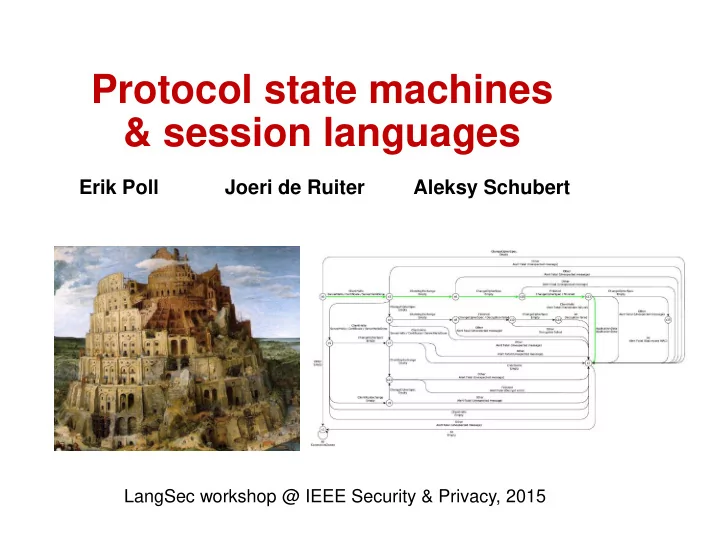
Protocol state machines & session languages Erik Poll Joeri de Ruiter Aleksy Schubert LangSec workshop @ IEEE Security & Privacy, 2015 Input languages: messages & sessions Handling inputs involves language of

slide-1
SLIDE 1

Protocol state machines & session languages

Erik Poll Joeri de Ruiter Aleksy Schubert

LangSec workshop @ IEEE Security & Privacy, 2015

slide-2
SLIDE 2

Input languages: messages & sessions

  • Handling inputs involves language of input messages
  • Often it also involves

language of sessions,

  • ie. sequences of messages
  • Do LangSec principles also apply at this session level?
  • when it comes to specification & implementation?

2

Erik Poll, Joeri de Ruiter, Aleksy Schubert Protocol state machines & session languages

slide-3
SLIDE 3

Session language as message sequence chart

This oversimplifies the session language because it only specifies

  • ne correct, happy flow

3

Erik Poll, Joeri de Ruiter, Aleksy Schubert Protocol state machines & session languages

slide-4
SLIDE 4

Session language as protocol state machine

This still oversimplifies: an implementation will have to be input-enabled, ie in every state every message may be received

4

SSH transport layer

Erik Poll, Joeri de Ruiter, Aleksy Schubert Protocol state machines & session languages

slide-5
SLIDE 5

typical input enabled state machine

Erik Poll, Joeri de Ruiter, Aleksy Schubert Protocol state machines & session languages

5

slide-6
SLIDE 6

Security flaws due to broken state machines

  • MIDPSSH

Open source Java implemention of SSH for Java feature phones No protocol state machine implemented at all.

[Erik Poll at al., Verifying an implementation of SSH, WITS 2007]

  • e.dentifier2

USB-connected device for internet banking Strange sequence of USB commands by-passes user OK

[Arjan Blom et al, Designed to Fail:...., NordSec 2012]

  • TLS

Flawed state machines in many TLS implementations - more to come

[Benjamin Beurdouche et al, A messy State of the union, IEEE Security & Privacy 2015] 6

Erik Poll, Joeri de Ruiter, Aleksy Schubert Protocol state machines & session languages

slide-7
SLIDE 7

Typical prose specifications: SSH 

“Once a party has sent a SSH_MSG_KEXINIT message for key exchange or re- exchange, until it has sent a SSH_MSG_NEWKEYS message, it MUST NOT send any messages other than:

  • Transport layer generic messages (1 to 19) (but SSH_MSG_ SERVICE_REQUEST

and SSH_MSG_SERVICE_ACCEPT MUST NOT be sent);

  • Algorithm negotiation messages (20 to 29) (but further SSH_MSG KEXINIT

messages MUST NOT be sent);

  • Specific key exchange method messages (30 to 49).

The provisions of Section 11 apply to unrecognised messages” … “An implementation MUST respond to all unrecognised messages with an SSH_MSG_UNIMPLEMENTED. Such messages MUST be otherwise ignored. Later protocol versions may define other meanings for these message types.”

Understanding state machine from prose is hard!

7

Erik Poll, Joeri de Ruiter, Aleksy Schubert Protocol state machines & session languages

slide-8
SLIDE 8

Typical implementation: openssh

8

Erik Poll, Joeri de Ruiter, Aleksy Schubert Protocol state machines & session languages

slide-9
SLIDE 9

Typical implementation: openssh 

/** This array contains functions to handle protocol messages. * The type of the message is an index in this array. */ dispatch_fn *dispatch[255]; .... server_init_dispatch_20(void){ dispatch_init(&dispatch_protocol_error); dispatch_set(SSH_MSG_CHANNEL_CLOSE, &channel_input_oclose); dispatch_set(SSH_MSG_CHANNEL_DATA, &channel_input_data); dispatch_set(SSH_MSG_CHANNEL_EOF, &channel_input_ieof); dispatch_set(SSH_MSG_CHANNEL_EXTENDED_DATA, &channel_input_extended_data); dispatch_set(SSH_MSG_CHANNEL_OPEN, &server_input_channel_open); dispatch_set(SSH_MSG_CHANNEL_OPEN_FAILURE, &channel_input_open_failure); dispatch_set(SSH_MSG_CHANNEL_REQUEST, &server_input_channel_req); dispatch_set(SSH_MSG_GLOBAL_REQUEST, &server_input_global_request); dispatch_set(SSH_MSG_KEXINIT, &kex_input_kexinit);

9

Understanding protocol state machine from code is hard!

Erik Poll, Joeri de Ruiter, Aleksy Schubert Protocol state machines & session languages

slide-10
SLIDE 10

LangSec also for session languages!

Protocol state machines deserve to be explicitly specified

Erik Poll, Joeri de Ruiter, Aleksy Schubert

10

Protocol state machines & session languages

slide-11
SLIDE 11

Extracting protocol state machine from code

We can infer a finite state machine from implementation by black box testing using state machine learning

  • using L* algorithm, as implemented in eg. LearnLib

This is effectively a form of ‘stateful’ fuzzing using a test harness that sends typical protocol messages This is a great way to obtain protocol state machine

  • without reading specs!
  • without reading code!

11

Erik Poll, Joeri de Ruiter, Aleksy Schubert Protocol state machines & session languages

slide-12
SLIDE 12

State machine learning with L*

Basic idea: compare response of a deterministic system to different input sequences, eg. 1. b 2. a ; b If response is different, then

  • therwise

The state machine inferred is only an approximation of the system, and only as good as your set of test messages.

12

b a

b b a

… …

Erik Poll, Joeri de Ruiter, Aleksy Schubert Protocol state machines & session languages

slide-13
SLIDE 13

Case study: EMV

13

Erik Poll, Joeri de Ruiter, Aleksy Schubert

  • Most banking smartcards implement a variant of EMV
  • EMV (Europay-Mastercard-Visa) defines set of protocols

with lots of variants

  • Specification in 4 books totalling > 700 pages

Protocol state machines & session languages

slide-14
SLIDE 14

State machine learning of card

14

Erik Poll, Joeri de Ruiter, Aleksy Schubert Protocol state machines & session languages

slide-15
SLIDE 15

State machine learning of card

15

merging arrows with identical response

Erik Poll, Joeri de Ruiter, Aleksy Schubert Protocol state machines & session languages

slide-16
SLIDE 16

State machine learning of card

16

merging arrows with same start & end state

We found no bugs, but lots of variety between cards.

[Fides Aarts et al., Formal models of bank cards for free, SECTEST 2013]

Erik Poll, Joeri de Ruiter, Aleksy Schubert Protocol state machines & session languages

slide-17
SLIDE 17

State machines inferred for flawed & patched device

[Georg Chalupar et al., .Automated reverse engineering using Lego, .WOOT 2014] Movie at http://tinyurl/legolearn 17

Erik Poll, Joeri de Ruiter, Aleksy Schubert

State machine learning of internet banking device

Protocol state machines & session languages

slide-18
SLIDE 18

Scary state machine complexity

18

More complete state machine of the patched device, using a richer input alphabet No flaws found in patched device, but were the developers really confident that this complex behaviour is secure? Or necessary?

Erik Poll, Joeri de Ruiter, Aleksy Schubert Protocol state machines & session languages

slide-19
SLIDE 19

TLS state machine extracted from NSS

Comforting to see this is so simple!

19

Erik Poll, Joeri de Ruiter, Aleksy Schubert Protocol state machines & session languages

slide-20
SLIDE 20

TLS state machine extracted from GnuTLS

20

Erik Poll, Joeri de Ruiter, Aleksy Schubert Protocol state machines & session languages

slide-21
SLIDE 21

TLS state machine extracted from OpenSSL

21

Erik Poll, Joeri de Ruiter, Aleksy Schubert Protocol state machines & session languages

slide-22
SLIDE 22

TLS state machine extracted from JSSE

22

Erik Poll, Joeri de Ruiter, Aleksy Schubert Protocol state machines & session languages

slide-23
SLIDE 23

Which TLS implementations are correct? or secure?

23

[Joeri de Ruiter et al., Protocol state fuzzing of TLS implementations, Usenix Security 2015] Erik Poll, Joeri de Ruiter, Aleksy Schubert Protocol state machines & session languages

slide-24
SLIDE 24

Conclusions

LangSec principles not only apply to language of input messages but also for language of protocol sessions because in practice we see

  • unclear specifications of session languages

without explicit state machines

  • messy & flawed implementations of session languages
  • security flaws as a result of this

Open question: How common is this category of security flaws?

24

Erik Poll, Joeri de Ruiter, Aleksy Schubert Protocol state machines & session languages

slide-25
SLIDE 25

Comparing session languages to message formats

Bad news 1. even less likely to be rigorously specified

  • many specs provide EBNF but no protocol state machine

2. complete specification of state machine is tricky

  • input-enabled state machine becomes messy

3. generating code from spec is harder

  • handling state has to be interpersed with other functionality

(cf. aspect) Good news 1. we can extract state machines from code! to find flaws in program logic, but not malicious backdoors 2. bugs in state machine can cause security problems, but no weird machines?

25

Erik Poll, Joeri de Ruiter, Aleksy Schubert Protocol state machines & session languages

slide-26
SLIDE 26

26

Erik Poll, Joeri de Ruiter, Aleksy Schubert Protocol state machines & session languages