Session: JLUS March 30, 2017 1 Mike Hrapla Vice President - - PowerPoint PPT Presentation

session jlus
SMART_READER_LITE
LIVE PREVIEW

Session: JLUS March 30, 2017 1 Mike Hrapla Vice President - - PowerPoint PPT Presentation

Session: JLUS March 30, 2017 1 Mike Hrapla Vice President Deputy Project Manager Celeste Boccieri - Werner, AICP Vice President Project Manager Matrix Design Group Deputy Project Manager What is a JLUS? A federally funded program to


slide-1
SLIDE 1

1

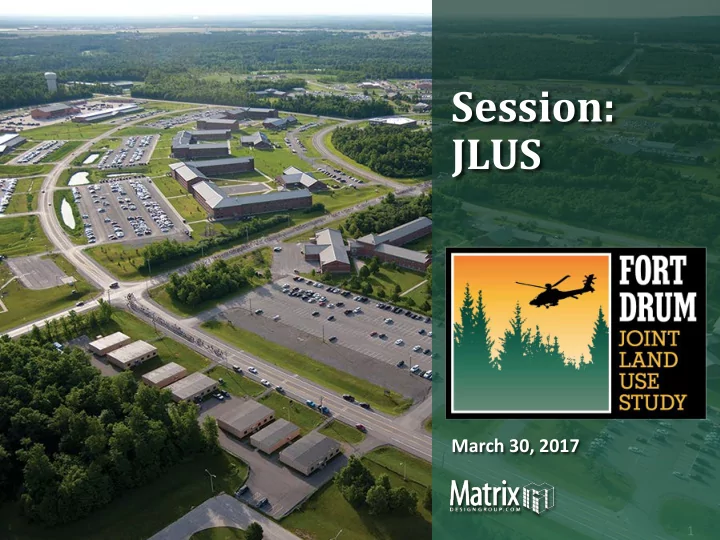
Session: JLUS

March 30, 2017
slide-2
SLIDE 2

Mike Hrapla

Vice President

Deputy Project Manager

Celeste Boccieri - Werner, AICP

Vice President

Project Manager

Matrix Design Group

Deputy Project Manager

slide-3
SLIDE 3

What is a JLUS?

A federally funded program to promote cooperation administered by DOD/OEA A proactive approach to achieve a balance to sustaining missions at Fort Drum and the economic development viability of communities A preventative measure to encourage compatible development

I nitiated in 1 9 8 5 by the Departm ent of Defense ( DOD) Office of Econom ic Adjustm ent ( OEA) Over 1 4 5 JLUSs have been com pleted nationally

3

slide-4
SLIDE 4

JLUS Facts

  • A JLUS IS:
  • a study that recommends appropriate actions for further

consideration

  • a collaborative document
  • a body of information that assists in making more

informed decisions

  • Tailored for each jurisdiction / agency
  • A JLUS IS NOT:
  • a regulatory document
  • an enforceable action
  • To successfully implement, the JLUS will require

follow-on actions by all stakeholders, including appropriate public involvement

4

slide-5
SLIDE 5

Goal: BALANCE

  • The goal of the Fort Drum JLUS is to promote

compatible growth, sustain environmental and economic health, and protect public health / safety / welfare, while protecting the viability of current and future missions at Fort Drum.

5

slide-6
SLIDE 6

Objectives of the JLUS Program

  • Understanding. Increase communication between the

military, local jurisdictions, stakeholders, and the public to promote an understanding of the strong economic and physical relationship between the installation and its neighbors.

  • Collaboration. Promote collaborative planning

between the military, local jurisdictions, and stakeholders to ensure a consistent approach in addressing compatibility.

  • Actions. Develop and implement strategies for

reducing the impacts of existing and future incompatible activities on the community and military

  • perations.

6

slide-7
SLIDE 7

Community

  • Protect the health, safety, and welfare of residents / maintain quality
  • f life
  • Manage development in the vicinity of military installations that would

interfere with the continued operations of these facilities

  • Protect opportunities for new growth in an economically,

environmentally, and socially sustainable manner

  • Maintain the economic vitality of the community / region

Military

  • Protect the health, safety, and welfare of the military and civilian

personnel living and working at or near the military installation

  • Safeguard the ability of the installation to achieve its mission, maintain

military readiness, and support national defense objectives

Objectives of the JLUS Program

slide-8
SLIDE 8

Committee Roles and Process

8

slide-9
SLIDE 9

JLUS Participants

Public officials Military representatives

Sponsor

Development Authority

  • f the North Country

JLUS Steering Committee

Policy direction Study oversight Monitoring Report adoption

JLUS Working Group

Technical issues Alternatives Report development Recommendations Coordination Accountability Grant management Financial contribution Planning staff Engineering staff Technical specialists Special interests

Participants Responsibilities

9

slide-10
SLIDE 10

Public Involvement

10

slide-11
SLIDE 11

Community Engagement - Workshops

  • Charrettes
  • Interactive

Exercises

  • Survey Polling

Devices = REAL TIME RESULTS

slide-12
SLIDE 12

Public Involvement Methods

Public input is essential to the success of the JLUS process and implementation

  • 3 Public Outreach Meetings
  • 3 Informational Brochures 

(Fact Sheets)

  • Project Website

12

slide-13
SLIDE 13

Approach

13

slide-14
SLIDE 14

Study Area

14

slide-15
SLIDE 15

Fort Drum’s Economic Importance

  • Economic Impact of $1.18 billion in fiscal year 2016
  • Fort Drum supports a population of:
  • 15,000 Soldiers
  • 19,000 associated family members
  • 4,000 civilian workers

15

slide-16
SLIDE 16

Fort Drum’s National Importance

  • Fort Drum is designated a Regional Collective

Training Center

  • Provides training to

an additional 25,000 Reserve, National Guard, and other state and federal personnel every year

16

  • Connecticut
  • Delaware
  • Maine
  • Massachusetts
  • New Hampshire
  • New Jersey
  • New York
  • Ohio
  • Pennsylvania
  • Rhode Island
  • Vermont
slide-17
SLIDE 17

Initial Data Collection

Information is requested and identified in the Request for Information (RFI) lists that has been developed. Matrix will conduct a field data collection effort that will consist of:

  • Interview with key leaders

and organizations

  • Tour of the installation
  • Follow-up discussions and /
  • r requests for additional

information

17

slide-18
SLIDE 18

JLUS Approach

  • Characterize and understand military operations
  • Develop the overlay of military operations
  • utside of the installations / ranges
  • Determine military influence areas
  • Assess existing and future development

and land use in the influence areas

  • Assess environmental resource areas
  • Highlight areas of concern
slide-19
SLIDE 19

Compatibility Factors

19

slide-20
SLIDE 20

JLUS Approach

20 Characterize Community Profile Develop Mission Footprints Outside the Base Fence line Identify Existing Compatibility Tools Assessment of Compatibility Issues Develop Set of Recommended JLUS Strategies

DISCOVERY PHASE

slide-21
SLIDE 21

JLUS Approach

21 Characterize Community Profile Develop Mission Footprints Outside the Base Fence line Identify Existing Compatibility Tools Assessment of Compatibility Issues Develop Set of Recommended JLUS Strategies

BACKGROUND REPORT JLUS REPORT

slide-22
SLIDE 22

JLUS Approach Major Strategies to Achieve Compatibility:

  • Information
  • Communication
  • Coordination
  • Policy
  • Regulatory

22

slide-23
SLIDE 23

JLUS Example

23

slide-24
SLIDE 24

The Final Products

Background Report JLUS Report Executive Summary (Project Overview)

slide-25
SLIDE 25

Implementation Plan

slide-26
SLIDE 26

Military Compatibility Area Overlay District (MCAOD)

slide-27
SLIDE 27

Land Use MCA

slide-28
SLIDE 28

Impulse Noise MCA

slide-29
SLIDE 29

Safety MCA

slide-30
SLIDE 30

Light MCA

slide-31
SLIDE 31

W ind Energy Military Com patibility Area ( MCA)

31

slide-32
SLIDE 32

Safety Military Com patibility Area ( MCA)

32

slide-33
SLIDE 33

Questions?

33

slide-34
SLIDE 34

For Questions . . .

Development Authority of the North Country

  • Michelle L. Capone, Director of Regional Development

mcapone@danc.org (315) 661-3200

  • Hartley Bonisteel Schweitzer, Regional Development

hschweitzer@danc.org (315) 661-3200

www.danc.org

34

slide-35
SLIDE 35

JLUS Program

35

slide-36
SLIDE 36

Lessons Learned

  • Committees need to be inclusive
  • Need communication and information exchange to
  • ccur between SC members and TWG members
  • Time is required for information review and policy

development

  • Process needs to be collaborative
  • Need to assess and measure willingness to

implement actions early

  • Ongoing communications need to be developed

throughout the process

36

slide-37
SLIDE 37

Committee Responsibilities

Responsibilities and Roles

  • Use knowledge and expertise

to inform JLUS development

  • Identify and provide insight
  • n community and military

issues

  • Provide outreach to

constituencies

  • Encourage participation
  • Share information and ideas

Time Commitment

  • Assist in data collection

phase by providing key information

  • Review JLUS materials and be

prepared for Committee Meetings

  • Provide required written

comments in a timely manner

  • Present draft implementation

strategies to agency leadership for discussion and buy-in

37

slide-38
SLIDE 38

Public Workshop Ideas

  • Ideas for good locations to hold public

workshops?

  • What is the best way to get the word out?
  • Are there community organizations that can help

spread the word?

38

slide-39
SLIDE 39

How To Respond To Survey Questions?

1.

Presenter will announce polling is open

2.

Press the number / letter that corresponds with the answer you wish to select.

3.

Change your mind? Just click the right one. Your last push will count.

4.

You will see results as responders select their answer.

39