Session 1 Accounting (40 mins) Session 2 Accounting Clinic (40 - - PowerPoint PPT Presentation

session 1 accounting 40 mins session 2 accounting clinic
SMART_READER_LITE
LIVE PREVIEW

Session 1 Accounting (40 mins) Session 2 Accounting Clinic (40 - - PowerPoint PPT Presentation

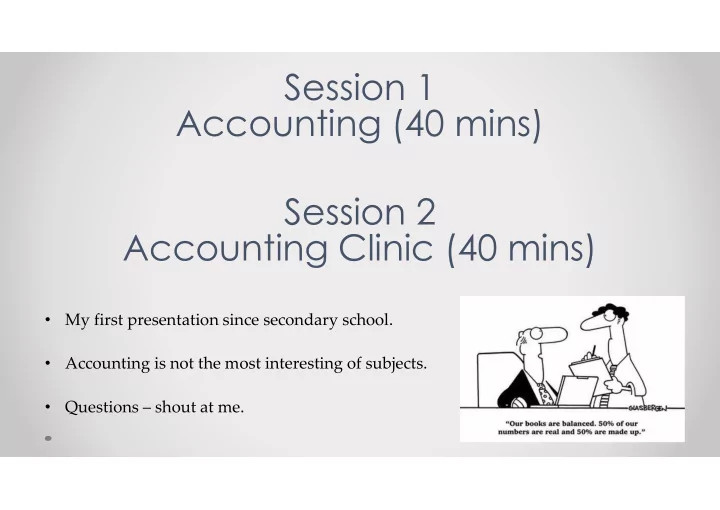
Session 1 Accounting (40 mins) Session 2 Accounting Clinic (40 mins) My first presentation since secondary school. Accounting is not the most interesting of subjects. Questions shout at me. Bit Of Intro You must choose


slide-1
SLIDE 1

Session 1 Accounting (40 mins)

  • My first presentation since secondary school.
  • Accounting is not the most interesting of subjects.
  • Questions – shout at me.

Session 2 Accounting Clinic (40 mins)

slide-2
SLIDE 2

Bit Of Intro

  • You must choose a business structure if you’re starting a business that helps

people or communities (a ‘social enterprise’).

  • If you want to set up a business that has social, charitable or community-

based objectives, you can set up as a:

  • limited company
  • charity, or from 2013, a charitable incorporated organisation
  • co-operative
  • community interest company (CIC)
  • unincorporated
slide-3
SLIDE 3

Why Do I Need To Do Accounts?

Having an accurate record keeping system which you keep up to date will help you:

  • pay the right amount of tax (if applicable)
  • avoid paying any extra tax or penalties (if applicable)
  • keep track of your expenses
  • see quickly what you are owed by others and how much you owe them
  • ask for a bank loan or credit or grant if you need to
  • save time and accountancy costs
  • receive the right amount of benefits or credits
slide-4
SLIDE 4

Boring Bits

  • Standard Accounting Concepts – apply regardless of the status of your

business.

  • Who is responsible for keeping the records in check?
  • Constituted Group = Treasurer or Nominated Responsible Individual
  • Limited Company = Directors
  • Charity = Finance Officer
slide-5
SLIDE 5

The Fundamental To ALL Accounts

Debit (DRrive On Left) Credit (CRrash On The Right) Expenses Liabilities Assets Income Drawings Capital What is Double Entry?

slide-6
SLIDE 6

An Introduction to Bookkeeping

The Process

  • 1. Source Documents
  • 2. Books / Spreadsheets
  • 3. Ledgers
  • 4. Trial Balance
  • 5. Financial Statements
slide-7
SLIDE 7
  • 1. Source Documents
  • Invoices, Receipts, Bank Statements, Petty Cash, Letters, Grants, Agreements,

KEEP EVERYTHING!

  • Keep for 6 years.
  • Date Order / Alphabetical / Digital / Paper / Whatever Suits You!
slide-8
SLIDE 8
  • 2. Books / Spreadsheets
  • Use your bank account! Why? What is the biggest problem with Cash?
  • Best Practice Spreadsheets
  • Bank Control / Bank In / Bank Out / Cash Control / Cash In / Cash Out
slide-9
SLIDE 9
  • 3. Ledgers
slide-10
SLIDE 10
  • 4. Trial Balance
slide-11
SLIDE 11
  • 5. Financial Statements

Scrap the pennies!

slide-12
SLIDE 12
  • 5. Financial Statements (Cont.)

Assets – Liabilities = Reserves

slide-13
SLIDE 13
  • 5. Financial Statements (Cont.)
slide-14
SLIDE 14

Things You Do Normally Need To Worry About

  • True and Fair View
  • Accruals Concept
  • Income and Expenses need to be ‘matched’
  • Revenue Grants should be recognised over the life time of the period
  • Capital Grants should be deducted from the cost of the asset
  • Recognising fixed assets > £250 (or significant size)
  • And yes .. Depreciate them over the Useful Economic Lives! (a non-cash flow)
  • Grant Conditions and Specific Reserves

> Restricted VS Unrestricted

slide-15
SLIDE 15

Things You Don’t Normally Need To Worry About

  • Corporation Tax – income being grants normally tax exempt.
  • VAT
  • Payroll
slide-16
SLIDE 16

Law

  • Limited Companies
  • Companies Act 2006
  • Accounting Framework: FRSSE 2008 or 2015, being replaced FRS 102
  • Charities
  • Charities Act 2011
  • Accounting Framework: Charities SORP (Statement of Recommended

Practice) 2015

slide-17
SLIDE 17

Again is the accounting different?

  • No. Remember, double entry bookkeeping is the same for all entities.
  • Is the presentation different?
  • Yes.
  • Limited Companies – Directors Report & Additional Notes
  • Charities – Trustees Report & Distinction Between ‘Unrestricted Funds’ and

‘Restricted Funds’

slide-18
SLIDE 18

I’ve Heard Of These Things Called CIC’s…

  • Yes, you probably have, it even has it’s own

regulator!! The key thing distinguishing community interest companies is the asset lock. Only 35 per cent of a CIC's distributable profits in any

  • ne year can be paid out in private dividends

to shareholders; the rest is locked in to further the CIC's mission