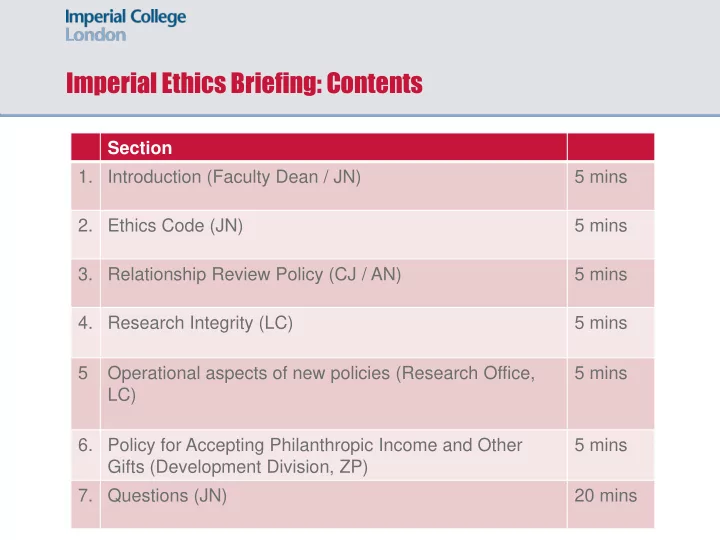
SLIDE 1 Imperial Ethics Briefing: Contents
Section
- 1. Introduction (Faculty Dean / JN)
5 mins
5 mins
- 3. Relationship Review Policy (CJ / AN)
5 mins
- 4. Research Integrity (LC)
5 mins 5 Operational aspects of new policies (Research Office, LC) 5 mins
- 6. Policy for Accepting Philanthropic Income and Other
Gifts (Development Division, ZP) 5 mins
20 mins
SLIDE 2
- 1. Introduction: the Woolf Inquiry into the LSE’s links with
Libya
The Woolf Inquiry concluded that large institutions should have an embedded Ethics Code, supported by rigorous procedures governing ethical review of relationships.
The [LSE] established, in an incremental and piecemeal fashion, a relationship with Libya. Before a global company embarks upon a relationship with a foreign partner, a due diligence assessment should be conducted. No similar exercise took place in this case. The links were allowed to grow, unchecked and to a degree unnoticed, until their effect was overwhelming. (Woolf 1.13) The LSE [...] falls down on the first hurdle in not having an embedded Ethics Code, adopted by the institution. (Woolf 6.11)
SLIDE 3 Introduction: the Imperial Ethics Code and related documents
Approved July 2013, new policies effective from 1 November 2013
- Overall institutional statement on good
ethical behaviour and practice
Imperial College London Ethics Code
- Guidance for establishing relationships
Relationship Review Policy
- Policies and procedures relating to
specific processes or functional areas e.g. Research, gifts, joint degrees etc.
Specific policies with ethical relevance and
SLIDE 4 Introduction: changes to existing policies
Some changes to existing policies and procedures were needed, but these have been kept to a minimum:
- 1. Clearer routes for escalation of ethical issues
- 2. Guidelines for accepting philanthropic income and other gifts – replaced
the Gift Acceptance Policy (May 2012) in July 2013
- 3. Work towards visible ethical review in research administration process.
SLIDE 5
- 2. The Ethics Code: introduction
An overarching statement, written for the whole College community. The Code sets out a number of key principles and behaviours. The Code will be visible externally. Is intended to work with, not to replace, the College’s established policies and procedures relating to ethics It provides for appropriate reporting and accountability at the highest level in cases not falling under other review procedures.
SLIDE 6
The Ethics Code: expected behaviours
1.Be honest and truthful in their dealings with each other and with third parties 2.Manage conflicts in interests in line with the College’s procedures 3.Display transparency and fairness in decision making 4.Behave appropriately 5.Play their part within the College community 6.Treat people with dignity and respect 7.Promote equality of opportunity and diversity 8.Uphold individuals’ freedom of expression 9.Research and educate responsibly 10.Uphold the freedoms to research 11.Manage proposed relationships appropriately 12.Admit, assess and deal with students fairly 13.Manage resources responsibly 14.Foster strong relationships with Alumni 15.Be aware of the College’s ethical policies and procedures 16.Raise matters of ethical concern though the prescribed channels
SLIDE 7 The Ethics Code: escalation routes
It is expected that most issues will be resolved using existing processes, drawing on the experience of staff members, with common sense applied. Where established policies do not resolve ethical issues, and further guidance is sought, the below route is available. HoDs / equivalents to make sure records are kept of information gathered, actions taken and decisions made.
Majority dealt with according to established policies
Identification
Via Head of Central Secretariat
Head of Department / equivalent
Via College Secretary & Registrar
College Cabinet Audit Committee
SLIDE 8 The Ethics Code: a list of current documents with ethical relevance
A.Research Research Integrity College authorisation of research proposals and related agreements Corporate Partnerships guidelines for ethical review of relationships Policy on the use of animals in research Health-related research governance framework
Establishing Collaborative Degree Programmes: Due Diligence Checks Guidelines for Establishing Collaborative Programmes
Acceptance of Gifts and Hospitality Policy Guidelines for accepting philanthropic income and other gifts Ordinance C1, Financial Matters Part 8, Financial Ethics and Conflict of Interest External Interests Policy National Institutes of Health Financial Conflict of Interest Expenses policy Purchasing regulations
SLIDE 9
- 3. Relationship Review Policy: introduction
Is intended: to remind all staff and other members of the College community of the need carefully to consider the relationships they form, and to be alert to ethical issues in connection with proposed and continuing relationships; to highlight the mechanisms under which staff and other members of the College community should raise any ethical concerns; and to explain how the ethical review process dovetails with the existing College review processes in certain areas.
SLIDE 10 Relationship Review Policy: interaction with specific functional areas
- Academic collaborations
- Commercial partnering
- Receipt of philanthropic income and other gifts
- Receipt of research funding and related relationship agreements
- Receipt of other income
- Procurement and supplier relationships
The majority of these areas have existing policies with ethical relevance which dovetail with the relationship review policy.
SLIDE 11
Relationship Review Policy: ethical review
The College must be able to show that proportionate due diligence has occurred when establishing or reviewing relationships. Included in the policy are headline guidelines for reviewing relationships to guide local level due diligence processes. Such due diligence may consider track record with the College, evidence of illegal activity, any recent media or political interest, or where the company is based etc. An element of judgment will be required in some instances. Staff should utilise escalation routes in case of uncertainty. Significant issues arising from current active relationships should be escalated to HoDs as necessary.
SLIDE 12
Relationship Review Policy: overlap
There will be some instances where College needs to consider relationships or the receipt of income, review of which falls within the domain of more than one review regime. If so, the relevant College areas should discuss and agree where the responsibilities for review and any appropriate approvals should lie. Where there is a conflict of opinion which cannot be resolved the matter should be escalated to the Head of Central Secretariat, who will obtain guidance from the College Secretary & Registrar as appropriate.
SLIDE 13
A Research Integrity Portal has been created:
http://www3.imperial.ac.uk/researchstrategy/researchintegrity
This provides recently reviewed, updated and pooled information from across the College relating to Research Integrity. Advice can be found on the following topics:
- Ethics
- Health and Safety
- Research Misconduct – revised policy
- Equipment-Sharing – statement of College Position
- Authorship
- Open Access – statement of College position
- Data Collection and Retention
- Public Interest Disclosures
- Peer Review
- Conflicts Of Interest
- Intellectual Property
- Our Responsibilities
Please send any comments on the content, or suggestions for addtional content to strategicresearch@imperial.ac.uk
SLIDE 14 Research Integrity - other activities
- The Graduate School has developed an on-line Plagiarism Awareness course that is currently
undergoing approval.
- An Open Access Policy Working Group has been created to help the College position itself in this
area.
- Activites to support Equipment Sharing across the College have been taking place including the
development of the Research Facilities Database, Facilities Roadshow and purchases to enable sharing and funding to promote facilities usage by Early Career Researchers.
- Discussion is taking place with other Russell Group Universities to share best practice and
consider opportunities for shared training provision in the area of Research Integrity.
- Advice from the Research Integrity Portal will be summarised in hard copy leaflets that
departments may wish to use at staff induction and to help promote local activities.
- A Research Data Management Working Group is being created to help the College position itself in
this area.
- A review of current practices to support good research conduct (including training) will be
conducted by the Vice-Provost’s Research Advisory Group to identify and share best practice across the College.
SLIDE 15
Ethical review of research funding and research related agreements
- There are a number of existing research policies and processes that
already take account of some ethical considerations in the approval and authorisation of research funding and research related agreements, for example:
- Bid Management Policy
- Approval and Authorisation Policy
The Ethics Code is not intended to replace these.
- The Policy makes it clear that HoDs will continue to hold responsibility for
the approval of research activity within their departments. This will include confirming that they have appropriately considered ethical issues at two points:
- Prior to the submission of research proposals; and
- Prior to research related agreements being entered into.
SLIDE 16 Approach to consideration of ethical issues
- The Research Services teams will provide appropriate advice to
HoDs to enable them to discharge their responsibilities.
- The RO will work with Faculties and Corporate Partnerships to
produce operational guidance. This guidance will take account of how Faculties intend to manage the Relationship Review Policy and how this will be implemented within the responsibilities of Research Services.
- Operational guidance will need to align current policies governing
research activity with the new Relationship Review Policy. Two key aspects will form the focus of the guidance:
- the funding/collaborating organisation, i.e.. a company or funder
- the type/scope of the activity, e.g.. military research
SLIDE 17 Practicalities
- Perception of what is an ethical issue and a risk will be subjective,
and differing perspectives may be held by those involved.
» For example, bribery claims aimed at a bank within Asian markets might not be considered an issue given the College is conducting academic research in the UK. » In such instances Departments will need to take a view on acceptance of risk or whether to escalate an issue for further approval.
- The extent of due diligence that should be conducted, needs to be
tempered with the need to maintain the flow of activity.
SLIDE 18 Practicalities
- Ethical review of research activity is not restricted solely to receipt of
research funding, it also includes unfunded interactions, for example:
collaborative arrangements, material transfers, confidentiality agreements etc. All of these types of interactions need to be bound into ethical review as well.
SLIDE 19
- 6. Guidelines for Accepting Philanthropic Income and
Other Gifts: introduction
Intended to set out the approval and associated due diligence processes for accepting philanthropic income and gifts, including legacies. Supersedes the Gift Acceptance Policy Sets out approval guidelines and thresholds, escalation routes, reporting requirements.
SLIDE 20 Guidelines for Accepting Philanthropic Income and Other Gifts: definitions
What is “philanthropic income”? The benefactor‘s returns are primarily intangible i.e. they do not gain
- wnership of anything, make a financial return or receive a service or
product from which they or their organisation may profit, in return for their gift. E.g. Donation by a company or individual to the Rector’s Scholarship Fund, donations for bursaries, prizes, buildings, research Chairs or centres. “Philanthropic income” may be a financial asset, or a physical asset such as equipment or artwork, or in the form of services.
SLIDE 21
Guidelines for Accepting Philanthropic Income and Other Gifts: operational aspects
All staff at the College should notify the proposed receipt of all gifts to the Development Division so due diligence can be carried out. Different levels of due diligence, proportionate to size of transaction. Standard due diligence is undertaken for transactions between 10k and 50k. Sums in excess of £50k are subject to additional checks including association with human rights, environmental or other ethical controversy.
SLIDE 22 Guidelines for Accepting Philanthropic Income and Other Gifts: standard due diligence checks
- Identity checks, checks for high risk indicators – an internet search
using the prospect’s name and the following terms: tax evasion, fraud, human rights, falsification, falsification of academic research, bribe, bribery, controversy, crime
- Biographical information search – desk research looking at standard
biographical information e.g. family members, career history
- News review
- Business database check - a check on business databases (e.g. FAME
and Hemscott) to analyse how a prospect acquired their wealth.
- Charity Commission review - a check of the charitable organisations
linked to the prospect using the Charity Commission website
- Public records check, including bankruptcy and CCJs - a search of
- nline court papers for outcomes of legal proceedings involving the
prospect and/or associated companies
- College history - a check of the College’s records (e.g. using Raiser’s
Edge and electronic search tools)
SLIDE 23 Guidelines for Accepting Philanthropic Income and Other Gifts: case studies
These are two examples of issues which would need to be reviewed:
- 1. A donor who had previously made a small unsolicited gift to the
College, offered to extend his support through a generous donation to support a PhD scholarship. Searches on the College database revealed that the donor had two children currently in postdoc roles in the department which was the intended recipient of the scholarship.
- 2. The College was fostering a relationship with a charitable
foundation with extensive existing philanthropic links, including to other UK universities. However the foundation had strong links to politically sensitive countries in the Middle East, and had recently been accused by a UK newspaper of strong ties between itself and controversial political regimes.
SLIDE 24 Guidelines for Accepting Philanthropic Income and Other Gifts: philanthropic or research income divide
The College was approached by a large foundation - a philanthropic
- rganisation which promotes good causes by making grants to
charities, voluntary bodies or other defined groups. The foundation wanted make a financial contribution to the College for medical research in a specific area as a philanthropic gesture. While IP generated was to be owned by the College, the foundation stipulated that it should receive a proportion of any return from subsequent income made by the College / Innovations from exploiting resulting IP. As it is in essence philanthropic, the relationship should be reviewed following the Philanthropic Income policy with specific guidance sought on the IP clause from Research Services or the Research Office as necessary.
SLIDE 26
Speaker details
John Neilson College Secretary & Registrar j.neilson@imperial.ac.uk Lynne Cox Director of the Research Office l.cox@imperial.ac.uk Zoe Punaks Head of Advancement Operations, Development Division z.punaks@imperial.ac.uk Alastair Nuttall Management Trainee, Central Secretariat a.nuttall@imperial.ac.uk