Server push and web sockets http://kaazing.com CSCI 470: Web Science - - PowerPoint PPT Presentation

server push and web sockets
SMART_READER_LITE
LIVE PREVIEW

Server push and web sockets http://kaazing.com CSCI 470: Web Science - - PowerPoint PPT Presentation

Server push and web sockets http://kaazing.com CSCI 470: Web Science Keith Vertanen Responsive web apps, v1.0 Problem: Client page needs info from server Solution: AJAX allows client to pull info XMLHttpRequest makes asynchronous


slide-1
SLIDE 1

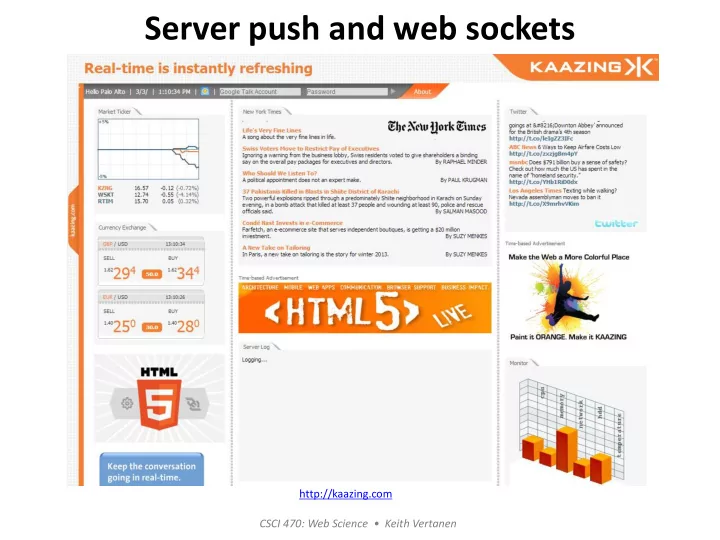
Server push and web sockets

CSCI 470: Web Science • Keith Vertanen http://kaazing.com
slide-2
SLIDE 2

Responsive web apps, v1.0

  • Problem: Client page needs info from server
  • Solution: AJAX allows client to pull info

– XMLHttpRequest makes asynchronous requests

  • Hacks to get around cross-domain restrictions

– Uses standard HTTP request/response protocol

  • Small payload messages have high overhead
  • Latency introduced by HTTP processing

2

slide-3
SLIDE 3

Responsive web apps, v2.0

  • Problem: Server needs to push info to client

– e.g. update stock price, movement of players, etc.

  • Possible solutions:

– Polling: Client makes periodic AJAX requests

  • Works well if you know the correct polling interval
  • Otherwise wastes network/server resources

3

http://jfarcand.wordpress.com/2007/05/15/new-adventures-in-comet-polling-long-polling-or-http-streaming-with-ajax-which-one-to-choose/

slide-4
SLIDE 4

Responsive web apps, v2.0

  • Problem: Server needs to push info to client

– e.g. update stock price, movement of players, etc.

  • Possible solutions:

– Long-polling: Client sends HTTP request, server waits until it has data to send in response

  • Hanging request may have high resource costs

4

http://jfarcand.wordpress.com/2007/05/15/new-adventures-in-comet-polling-long-polling-or-http-streaming-with-ajax-which-one-to-choose/

slide-5
SLIDE 5

Responsive web apps, v2.0

  • Problem: Server needs to push info to client

– e.g. update stock price, movement of players, etc.

  • Possible solutions:

– Streaming: Server maintains open response continuously updated with push events

  • Subject to buffering by agents in network

5

http://jfarcand.wordpress.com/2007/05/15/new-adventures-in-comet-polling-long-polling-or-http-streaming-with-ajax-which-one-to-choose/

slide-6
SLIDE 6

Streaming: HTTP response

  • Response from server

– Status line:

  • Protocol version, status code, status phrase

– Response headers: extra info – Body: optional data

6

HTTP/1.1 200 OK Date: Thu, 17 Nov 2011 15:54:10 GMT Server: Apache/2.2.16 (Debian) Last-Modified: Wed, 14 Sep 2011 17:04:27 GMT Content-Length: 285 <html> …

slide-7
SLIDE 7

Streaming: HTTP response

  • Chunked response

– Each chunk specifies size in hex, last chunk = 0

7

HTTP/1.1 200 OK Date: Thu, 17 Nov 2011 15:54:10 GMT Server: Apache/2.2.16 (Debian) Last-Modified: Wed, 14 Sep 2011 17:04:27 GMT Transfer-Encoding: chunked 29 <html><body><p>The file you requested is 5 3,400 23 bytes long and was last modified: 1d Sat, 20 Mar 2004 21:12:00 GMT 13 .</p></body></html>

slide-8
SLIDE 8

Comet

  • Comet (via polling or streaming)

– Simulate bi-directional communication

  • Using HTTP request/response protocol
  • Often 2 connections: 1 downstream, 1 upstream
  • Resource expensive and error prone to write

8 http://www.websocket.org/quantum.html

slide-9
SLIDE 9

9

slide-10
SLIDE 10

10

slide-11
SLIDE 11

HTML5 Web Sockets

  • Web sockets:

– JavaScript interface for client-side – Full-duplex communication

  • Using a single object, send string or binary data
  • Low latency, low header overhead (strings = 2 bytes)

– Initial handshake over HTTP

  • Upgraded to web socket protocol

– Some proxies may not like and drop the connection

  • Runs on port 80 allowing it to traverse NATs

11

"Reducing kilobytes of data to 2 bytes…and reducing latency from 150ms to 50ms is far more than marginal. In fact, these two factors alone are enough to make Web Sockets seriously interesting to Google."

  • Ian Hickson
slide-12
SLIDE 12

Web socket protocol

  • URL prefix:

– ws:// for normal connections, wss:// for secure

  • HTTP-compatible handshake:

12

GET ws://echo.websocket.org/?encoding=text HTTP/1.1 Origin: http://websocket.org Cookie: __utma=99as Connection: Upgrade Host: echo.websocket.org Sec-WebSocket-Key: uRovscZjNol/umbTt5uKmw== Upgrade: websocket Sec-WebSocket-Version: 13 HTTP/1.1 101 WebSocket Protocol Handshake Date: Fri, 10 Feb 2012 17:38:18 GMT Connection: Upgrade Server: Kaazing Gateway Upgrade: WebSocket Access-Control-Allow-Origin: http://websocket.org Access-Control-Allow-Credentials: true Sec-WebSocket-Accept: rLHCkw/SKsO9GAH/ZSFhBATDKrU= Access-Control-Allow-Headers: content-type

slide-13
SLIDE 13

Web socket protocol

  • After handshake:

– HTTP connection broken down – Replaced by WebSocket connection

  • Over the same TCP/IP connection
  • Upgrade is one way, can't go back to HTTP
  • Framing:

13

http://chimera.labs.oreilly.com/books/1230000000545/ch17.html#_websocket_protocol

slide-14
SLIDE 14

Example messages

  • A single-frame unmasked text message

– 0x81 0x05 0x48 0x65 0x6c 0x6c 0x6f (contains "Hello")

  • A fragmented unmasked text message

– 0x01 0x03 0x48 0x65 0x6c (contains "Hel") – 0x80 0x02 0x6c 0x6f (contains "lo")

  • Unmasked Ping request and masked Ping response

– 0x89 0x05 0x48 0x65 0x6c 0x6c 0x6f (contains a body of "Hello") – 0x8a 0x85 0x37 0xfa 0x21 0x3d 0x7f 0x9f 0x4d 0x51 0x58

(contains a body of "Hello", matching the body of the ping)

  • 256 bytes binary message in a single unmasked frame

– 0x82 0x7E 0x0100 [256 bytes of binary data]

  • 64KiB binary message in a single unmasked frame

– 0x82 0x7F 0x0000000000010000 [65536 bytes of binary data]

14

slide-15
SLIDE 15

Web socket examples

15 http://www.websocket.org/echo.html http://demo.kaazing.com/livefeed/ http://www.youtube.com/watch?v=64TcBiqmVko http://rumpetroll.com/ http://labs.dinahmoe.com/plink/ http://www.html5rocks.com/en/tutorials/websockets/basics/

slide-16
SLIDE 16

[Constructor(DOMString url, optional (DOMString or DOMString[]) protocols)] interface WebSocket : EventTarget { readonly attribute DOMString url; // ready state const unsigned short CONNECTING = 0; const unsigned short OPEN = 1; const unsigned short CLOSING = 2; const unsigned short CLOSED = 3; readonly attribute unsigned short readyState; readonly attribute unsigned long bufferedAmount; // networking attribute EventHandler onopen; attribute EventHandler onerror; attribute EventHandler onclose; readonly attribute DOMString extensions; readonly attribute DOMString protocol; void close([Clamp] optional unsigned short code, optional DOMString reason); // messaging attribute EventHandler onmessage; attribute DOMString binaryType; void send(DOMString data); void send(Blob data); void send(ArrayBuffer data); void send(ArrayBufferView data); };

WebSocket interface

16

slide-17
SLIDE 17

17

<!DOCTYPE html> <html> <head> <meta charset="utf-8" /> <script> function init() { websocket = new WebSocket("wss://echo.websocket.org/"); websocket.onopen = function(e) { onOpen(e) }; websocket.onclose = function(e) { onClose(e) }; websocket.onmessage = function(e) { onMessage(e) }; websocket.onerror = function(e) { onError(e) }; } function onOpen(e) { writeToScreen("CONNECTED"); message = "Hello world!"; writeToScreen("SENT: " + message); websocket.send(message); } function onClose(e) { writeToScreen("DISCONNECTED"); } function onMessage(e) { writeToScreen('RESPONSE: ' + e.data); websocket.close(); } function onError(e) { writeToScreen('ERROR: ' + e.data); } function writeToScreen(message) { document.getElementById("output").innerHTML += message + "<br />"; } window.addEventListener("load", init, false); </script> </head> <body> <h2>WebSocket Test</h2> <div id="output"></div> </body> </html>

Simple text echo client

slide-18
SLIDE 18

Supported data types

  • Send data as:

– Text – ArrayBuffer – Blob

18

// Sending String connection.send('your message'); // Sending canvas ImageData as ArrayBuffer var img = canvas_context.getImageData(0, 0, 400, 320); var binary = new Uint8Array(img.data.length); for (var i = 0; i < img.data.length; i++) { binary[i] = img.data[i]; } connection.send(binary.buffer); // Sending file as Blob var file = document.querySelector('input[type="file"]').files[0]; connection.send(file);

http://www.html5rocks.com/en/tutorials/websockets/basics/

// Setting binaryType to accept received binary as either 'blob' or 'arraybuffer' connection.binaryType = 'arraybuffer'; connection.onmessage = function(e) { console.log(e.data.byteLength); // ArrayBuffer object if binary };

slide-19
SLIDE 19

Client programming in practice

  • WebSockets relatively new

– Browser support is now widespread – W3C candidate recommendation – Network proxies may mess things up

  • Other techniques more mature

– XMLHttpRequest

  • Option: use a 3rd party client library

– Library provides semantics of bi-directional communication, but encapsulates details – e.g. socketio, cometd, Hookbox, orbited

19

slide-20
SLIDE 20

Web socket server

  • The server side

– You need server-side support!

  • Support a large # of open WebSocket Connections
  • Traditional stacks (e.g. LAMP) do not deal well with this
  • Commercial: Kaazing, …
  • Some free options:

– apache-websocket: apache module

  • Develop your own module (in C) for app-specific details

– pywebsocket: apache module / standalone server

  • Requires mod_python

– Jetty WebSocketServlet

20

slide-21
SLIDE 21
  • C/C++
  • libwebsockets
  • Mongoose
  • POCO C++ Libraries
  • Tufão
  • Wslay
  • QtWebsocket
  • Erlang
  • Yaws
  • Go
  • go.net/websocket
  • webrocket
  • Haskell
  • websockets
  • Java
  • Apache Tomcat 7
  • Play Framework
  • Atmosphere
  • Bristleback
  • GlassFish 3.1, Grizzly
  • HLL WebSockets
  • JBoss 7
  • Jetty 7
  • jWebsocket
  • Netty 3.3
  • MigratoryData WebSocket Server
  • .NET Framework
  • Internet Information Services (IIS) 8, ASP.NET 4.5
  • Windows Communication Foundation 4.5 through NetHttpBinding
  • Fleck
  • SuperWebSocket
  • XSockets.NET
  • Clojure
  • http-kit
  • aleph
  • Nginx
  • Proxy (since version 1.3.13)
  • Push Stream (3-rd party module)
  • Node.js
  • Socket.IO
  • WebSocket-Node
  • Objective-C
  • SocketRocket
  • BLWebSocketsServer
  • Perl
  • Mojolicious
  • PocketIO
  • PHP
  • php-websocket
  • Ratchet
  • Python
  • WebSocket-for-Python
  • txWS
  • AutobahnPython
  • Ruby
  • EM-WebSocket
  • Other
  • apache-websocket
  • mod_websocket for lighttpd
  • nginx supports websocket since version 1.3

Other server options…

21

slide-22
SLIDE 22

Summary

  • Responsive interactive web apps

– Often requires low latency bi-directional communication – Existing solutions:

  • Ajax polling, long polling, HTTP streaming
  • Really hacks working with an ill-suited HTTP

request/response protocol

– HTML5 web sockets:

  • Simple client-side API
  • Requires server supporting web sockets
  • You have to develop app-specific logic in some way

– e.g. Apache module, Java servlet, …

22