SEPTIC ARTHRITIS BONE & JOINT INFECTIONS Native Joint Henry F. - - PDF document

septic arthritis bone joint infections native joint
SMART_READER_LITE
LIVE PREVIEW

SEPTIC ARTHRITIS BONE & JOINT INFECTIONS Native Joint Henry F. - - PDF document

SEPTIC ARTHRITIS BONE & JOINT INFECTIONS Native Joint Henry F. Chambers, MD Curr Rheumatol Rep 15:332, 2013; Best Prac Res Clin Rheumatol 25:407, 2011 Case What is the most appropriate initial therapy for this patient? 38 y/o type 2


slide-1
SLIDE 1

BONE & JOINT INFECTIONS

Henry F. Chambers, MD

SEPTIC ARTHRITIS Native Joint

Curr Rheumatol Rep 15:332, 2013; Best Prac Res Clin Rheumatol 25:407, 2011

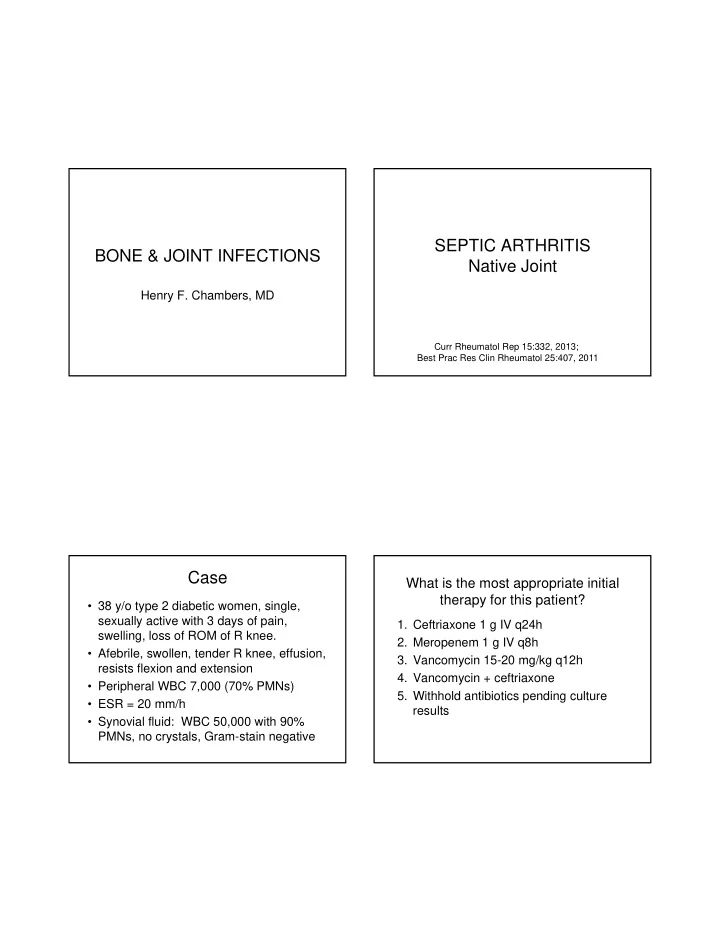
Case

  • 38 y/o type 2 diabetic women, single,

sexually active with 3 days of pain, swelling, loss of ROM of R knee.

  • Afebrile, swollen, tender R knee, effusion,

resists flexion and extension

  • Peripheral WBC 7,000 (70% PMNs)
  • ESR = 20 mm/h
  • Synovial fluid: WBC 50,000 with 90%

PMNs, no crystals, Gram-stain negative

What is the most appropriate initial therapy for this patient?

  • 1. Ceftriaxone 1 g IV q24h
  • 2. Meropenem 1 g IV q8h
  • 3. Vancomycin 15-20 mg/kg q12h
  • 4. Vancomycin + ceftriaxone
  • 5. Withhold antibiotics pending culture

results

slide-2
SLIDE 2

Differential Diagnosis of Acute Arthritis in the Adult

  • Infection (bacteria, fungi, mycobacteria,

viruses, spirochetes)

  • Rheumatoid arthritis, JRA
  • Crystal arthropathy (gout, pseudogout)
  • Reactive arthritis, adult Still’s
  • Systemic lupus erythematosis
  • Osteoarthritis
  • About 10 other things

Joints Affected in Septic Arthritis

Hip 30-40% Knee 40% Ankle 5-10% Wrist, elbow, hand 10-15% Multiple joints 5-10%

Microbiology of Septic Arthritis

  • Staph. aureus (40-

60%)

  • Streptococci (30%)

– S. pneumoniae – GAS

  • Gram-negative

bacilli (5-20%)

– H. influenzae rare

  • Neisseria sp.
  • Staph. aureus (40-

60%)

  • Streptococci (30%)

– GAS – S. pneumoniae

  • Gram-negative

bacilli (5-20%)

– Enterics

  • Neisseria sp.

Children Adults

Culture-negative: 15-30%

Septic Arthritis: Presentation

Joint Pain 85% History of joint swelling 78% Fever 57%

Margaretten, et al. JAMA 297:1478, 2007

slide-3
SLIDE 3

Risk Factors for Septic Arthritis

Factor Likelihood Ratios

Positive Negative Diabetes 2.7 0.93 Recent joint surgery 6.9 0.78 Hip or knee prosthesis + skin infection 15.0 0.77 RA 2.5 0.45

Margaretten, et al. JAMA 297:1478, 2007

Serum Lab Values

Factor Likelihood Ratios

Positive Negative WBC > 10,000 1.4 0.28 ESR > 30 mm/h 1.3 0.17 CRP > 100 mg/L 1.6 0.44

Margaretten, et al. JAMA 297:1478, 2007

Synovial Fluid Studies

Factor Likelihood Ratios

Positive Negative WBC > 100,000 28 0.75 WBC > 50,000 7.7 0.42 WBC > 25,000 2.9 0.32 PMNs > 90% 3.4 0.34

Margaretten, et al. JAMA 297:1478, 2007

Initial Management Of Acute Septic Arthritis

  • Drain the joint (controversy as to which is better)

– Arthrocentesis (knee, ankle, elbow, wrist, hand) – Arthroscopy (hip and shoulder) – Open drainage (hip and shoulder)

  • Obtain cultures

– Blood (~30% to 50% positive) – Synovial fluid, aerobic and anaerobic (consider fungal and mycobacterial if subacute/chronic presentation) – STD risk, or polyarticular signs and symptoms, rash: culture blood, fluid, rectum, cervix/urethra, throat for GC

slide-4
SLIDE 4

Disseminated Gonococcal Infection Initial Antimicrobial Therapy of Septic Arthritis

  • Synovial fluid crystals: withhold antibiotics
  • Gram stain positive

– Gram-positive cocci: Vancomycin 15-20 mg/kg q8- 12h for suspected S. aureus, strep – Gram-negative cocci: Ceftriaxone 1 g q24h – Gram-negative bacilli: Cefepime 2 gm q8h, meropenem 1 gm q8h, or levofloxacin 750 mg q24h

  • Gram-stain negative

– Vancomycin 15-20 mg/kg q8-12h + ceftriaxone 1 g q24h (or as above for Gram-negative bacilli)

Initial Therapy of Culture-Positive Septic Arthritis

  • Staphylococcus aureus

– MSSA: cefazolin 2 g q8h or nafcillin 2g q4h – MRSA: vancomycin 15-20 mg/kg q8-12h

  • Streptococci

– Pen G 2 mU q4h or ceftriaxone 2 g q24h

  • Gonococci

– Ceftriaxone 1 g q24h (plus azithro, doxy, FQ for chlamydia)

  • Gram-negative bacilli

– See previous slide and based on results of susceptibility testing

Duration of Therapy

  • Gonococcal septic arthritis: 7 days
  • Septic arthritis in a child

– 2 weeks (3 weeks if accompanying osteo) (Ped Clin NA 60:425, 2013) – 10 days of therapy probably as effective as a 30- day treatment course (Clin Infect Dis 48:1201, 2009)

  • Septic arthritis in an adult: 2-4 weeks
  • May be a combination of IV (typically ~ 3-7

days) and oral therapy

slide-5
SLIDE 5

Outcomes in Children

  • CRP normalizes in 9-10 days

– Faster resolution in those with needle aspiration versus more invasive drainage procedure

  • WBC and ESR not useful for f/u
  • Relapse or recurrence rare (<1%)
  • Clindamycin and 1st generation ceph

with similar efficacy

Clin Infect Dis 48:1201, 2009; Clin Micro Infect 18:582, 2011

Outcomes in Adults

  • CRP should normalize in 9-10 days

(longer if arthrotomy performed)

  • WBC and ESR not useful for f/u
  • Relapse or recurrence rare (<1%)
  • Except for GC duration of therapy

poorly defined, recommendations vary

Oral Regimens

Agent Comments

Clindamycin 40 mg/kg/d Children, max dose 450 mg qid 1st gen ceph 150 mg/kg/d Children, max dose 1 g qid FQ (e.g., cipro 750 mg bid, levo 750 mg q24h, moxi 400 mg qd) Adult, susceptible Gram-neg. SMX-TMP (10-15 mg/kg/d) Susceptible Gram-neg. SMX-TMP + rifampin 300 mg bid Susceptible MRSA, MSSA FQ + rifampin 600 mg/d Adult, susceptible MRSA, MSSA Amox-clav, linezolid, doxycycline Limited data

Clin Infect Dis 56:e1, 2013; J Antimicrobi Chemother 69:309, 2014

SEPTIC ARTHRITIS Prosthetic Joint Infection (PJI)

Clin Infect Dis 56:e1, 2013; Tsai et al, J Micro Immunol Infect, 2013 J Antimicrob Chemother 65 (Suppl 3): iii45), 2010

slide-6
SLIDE 6

Microbiology of PJI

Organisms Rate Comment

MSSA, MRSA 20-40% Typically early (w/in 3 mo) or late (> 2 years post implantation) Coag-neg. staph 30-40% Typically delayed or late Strep, enterococci, 10-20% Also diphtheroids, P. acnes Gram-neg. bacilli 10-15% Enterics, Ps. aeruginosa Culture-negative 15-20% Hate that!

Diagnosis of PJI

  • Orthopedic referral for

– Sinus tract or persistent drainage – Acutely painful prosthesis – Chronically painful prosthesis

  • ESR, CRP, blood cultures, arthrocentesis

– Stop if no evidence of infection – Suspected infection: Intraoperative exploration for cultures, path, debridement – Avoid empirical therapy if at all possible

Orthopedic Device Related Infections

Cumulative Treatment Failure Rate Ferry et al. Eur J Clin Microbiol Infect Dis 29:171-80, 2009

Orthopedic Device Related Infections

Ferry et al. Eur J Clin Microbiol Infect Dis 29:171-80, 2009 Cumulative Treatment Failure Rate

slide-7
SLIDE 7

Total Knee/Hip S. aureus Infections

Senneville, et al. Clin Infect Dis 53:334, 2011 Cumulative Treatment Failure Rate FQ + rif

  • ther

IDSA Prosthetic Joint Infection Treatment Guidelines

  • Obtain cultures prior to starting Rx
  • Treatment based on surgical option

chosen

– Debridement, hardware retention – 1-stage, direct exchange – 2-stage debridement later re-implantation

Clin Infect Dis 56:e1, 2013

Device Retention vs Removal

Synopsis of IDSA Treatment Guidelines

  • Prosthesis retained

– Staph: use iv/po rif combo for 3-6 mo – Others: iv/po regimen for 4-6 weeks

  • 1-stage procedure

– Staph: use iv/po rif combo for 3 mo – Others: iv/po regimen for 4-6 weeks

  • 2-stage procedure

– Staph: use iv/po rif combo for 4-6 weeks – Others: iv/po regimen for 4-6 weeks

slide-8
SLIDE 8

Culture-Negative Osteoarticular “Infections”

  • Prospective study, 3840 bone and joint samples

from 2308 patients

– Marseille University Hospitals, 2007-09 – 50% had prosthetic devices

  • PCR (16S) performed on culture-neg specimens
  • Culture results

– Positive: 33.1% (S. aureus [33%], CoNS [21%], Gram-neg bacilli [23%] Strep/enterococci [13%] – Negative: 67.9%

  • PCR results

– 6.1% of all patients PCR positive – 9.1% of culture-neg cases PCR positive

Levy, et al, Am J Med 126:e25, 2013

Positive PCR Results in Culture- negative Cases*

Organism % positive (N = 141)

Fastidious organisms 25

  • Staph. aureus§

25 Coag-neg. staph. 21 Streptococci, enterococci 16 Gram-negative bacilli 11 * Prior antibiotic in 42% of cases

§ 65% neg on repeat PCR

Causes of Culture-negative Osteoarticular “Infections”

  • Non-infectious cause
  • False-negative culture

– Low inoculum infection, sampling error – Prior antibiotics – Fastidious organisms

  • Other organisms: fungi, MTB, other

mycobacteria, brucella, nocardia

Oral Regimens for Culture-negative Septic Arthritis

Antibiotic Comments

Moxifloxacin Misses some MRSA, MRCNS, some GNB Clindamycin Misses GNRs, fastidious Gram-negs, enterococci, few to some MRSA Augmentin Misses MRSA, MRCNS, resistant GNB SMX-TMP Misses enterococci, some GNB, anaerobes Linezolid Misses GNBs, anaerobes

slide-9
SLIDE 9

Septic Arthritis - Summary

  • Clinical features and patient risk factors are

useful in assessing likelihood of septic arthritis

  • WBC, ESR, and CRP have limited utility in

diagnosis of septic arthritis

– CRP may be useful for monitoring response

  • Synovial fluid WBC and %PMNs are essential for

assessment of likelihood of septic arthritis

  • IV/oral therapy for 2-3 weeks (less in children) is

probably sufficient

  • Arthrocentesis, repeated prn, is sufficent for

drainage except for hip and shoulder

OSTEOMYELITIS Case

  • 57 y/o newly diagnosed MSSA (Pen R only)

vertebral osteomyelitis

  • What would you recommend for this patient?
  • 1. 12 week course of twice daily IV vancomycin
  • 2. 12 week course of once daily IV daptomcyin
  • 3. 6-8 week course of six times daily IV oxacillin
  • 4. 6-8 week course of IV oxacillin then step-down PO

to levo 750 mg + rifampin 600 mg once daily)

  • 5. Any one of the above with f/u MRI to determine

duration of therapy

Classification

  • Acute osteomyelitis

– First episode at given site – Potentially cured with antibiotics alone within 6 weeks – Bone remains viable

  • Chronic osteomyelitis

– Evolves from acute osteomyelitis – Present > 6 weeks – Often indolent with few systemic signs/symptoms – Fistula formation, dead bone, refractory clinical course

  • Orthopedic device-related osteomyelitis
slide-10
SLIDE 10

Microbiology

  • Staphylococcus aureus (50-60%)
  • Streptococci, coagulase-negative

staphylococci (orthopedic implants), enteric gram-negative rods, Pseudomonas aeruginosa

Diagnosis

Microbiological Confirmation

  • Gold standard=culture of organism from

bone (positive blood culture is acceptable)

  • Histopathology may give dx if cultures

negative

  • Swabs from sinus tracts unreliable for

predicting organism

– Isolation of S. aureus is more predictive but not sensitive

Diagnosis

ESR, CRP, and WBC

  • Case series of patients with osteomyelitis

– ESR “elevated” in apx. 90% of patients – C-reactive protein “elevated” > 90% of patients

  • ESR virtually worthless: less predictive of

clinical course; longer period of elevation

  • CRP levels which are slow to resolve may

predict complicated course

  • WBC: worthless

Diagnosis: Imaging

Palestro, Love, Miller. Best Pract Res Clin Rheumatol 20:1197, 2006. PMID 17127204

slide-11
SLIDE 11

Diagnosis

Conventional Radiography

  • Insensitive (45-75%):

– Normal until at least 10-21 after infection

  • nset

– Lytic changes not seen until extensive (>50%) destruction of bone matrix

  • Non-specific (~75%)

– Early findings

  • Soft tissue swelling
  • Periosteal thickening or elevation
  • Osteopenia

– Prior bone abnormality major limitation

Diagnosis

Radionuclide Scintigraphy

  • 3-phase bone scan with technetium 99m

diphosphonates

1. Flow or angiogram phase 2. Blood pool phase 3. Delayed or bone phase (usually 3, up to 24 hrs.)

  • Osteo uptake phases 1-2 with focal, intense

uptake delayed images

  • Cellulitis uptake phases 1-2 with mild, diffuse

uptake delayed images

  • Useful if multiple sites suspected

Bone Scan Osteomyelitis

Osteomyelitis of the Right Calcaneous Flow phase Blood pool phase Bone phase

Diagnosis

Radionuclide Scintigraphy

  • Indium 111-labeled WBCs often combined

with bone scan to improve specificity

– Process is complex – Takes 24 hours – High dose radiation

  • WBC scan may be more useful in acute

disease; prosthesis, peripheral skeleton - normal axial marrow takes up WBCs

  • Bone scan + WBC scan: one study reports

sensitivity ~70%, specificity ~90%, PPV~90%

Jacobson et al., Am J Roentgenol 1991;157:807-12

slide-12
SLIDE 12

Diagnosis

Magnetic Resonance Imaging

  • T1 weighted images: (dark) signal intensity
  • T2 weighted images: (bright) signal intensity
  • Sensitive because bone marrow appears

abnormal (but imperfect specificity)

  • May show periosteal reaction, cortical

destruction, or joint damage

  • Depending on study, sensitivity 60-100%,

specificity 50-90%

  • Excellent anatomic resolution

MRI for Osteomyelitis

Beware the routine follow-up exam

2 weeks 6 weeks

New Engl J Med 362:1002, 2010 See also: Clin Infect Dis 43:172, 2006; Am J Neuroradiol 28:693, 2007

Treatment

Oral or IV? Drug Serum Bone Bone/MI C

Beta-lactams 50 – 150 5 – 15 2-8 Vancomycin 20 – 40 1 – 4 0.5-2 Daptomycin 40 1 2

IV Antibiotics Achievable Levels (g/ml)

slide-13
SLIDE 13

Drug Serum Bone Bone/MI C

Beta-lactams 5 – 10 0.5 – 1 0.5 Ciprofloxacin 2 – 3 0.75 - 1.5 4-8 Levofloxacin 6 – 8 3 – 6 2-16 Metronidazole 20 – 30 15-30 5-10

Oral Antibiotics Achievable Levels (g/ml)

Drug Serum Bone Bone/MI C

Linezolid 10 – 20 5 - 10 4-8 TMP / SMX 100 – 150 (sulfa) 15 – 20 (sulfa) 4-16 Clindamycin 5 – 10 2 – 5 1-4 Rifampin 2 – 5 1 - 10 2-16

Oral Antibiotics Achievable Levels (g/ml)

Drug Advantage Disadvantage

FQ Good GNR Low pill burden Achilles tendon rupture C-diff TMP-SMX Adequate Staph and GNR Allergic rxn Cytopenias Clindamycin Good Staph Pill burden GI Sx, C-diff Metronidazole Good anaerobes Watch for neuropathy Linezolid Good GPC Marrow and nerve toxic Rifampin “Synergy” Drug interactions & LFTs

Oral Agents: Advantages and Disadvantages

  • No difference in outcome between oral and

parenteral therapy

  • Adverse events rate higher for parenteral

(15.5% vs 4.8%, 95% CI 0.13 -1.22)

  • No recommendations on duration of therapy or

impact of bacterial species or disease severity

  • n outcome

Conclusions Cochrane Review 2009 Treatment of Chronic Osteomyelitis

slide-14
SLIDE 14
  • Retrospective reviews of OP IV Rx for osteo at

an ID private practice from 1982-1998

  • 454 pts evaluated
  • S. aureus 54%, CoNS 14%, Strep spp. 14%,

Pseudomonas 4%, others 14%

Out-Patient IV Therapy of Osteomyelitis

Tice et al 2003 Am J Med, J Antimicrob Chemoth

Out-Patient IV Therapy of Osteomyelitis

  • Rifampin combos consistently superior to single

drug regimens (beta-lactams, macrolide, clindamycin, vancomycin) in animal models of S. aureus osteomyelitis

  • Resistance occurs rapidly if rifampin is used

alone

  • Excellent review or rifampin for treatment of

staphylococcal infection: Perlroth, et al. Arch Intern Med. 168:805-819, 2008

Summary of Animal Model Data

  • Rifampin combo superior to single drug therapy

for staphylococcal osteomyelitis

  • Van derAuwera AAC ’85; Norden South Med J ’86;

Zimmerli JAMA ‘98

  • Oral rifampin + TMP-SMX for 8 weeks

equivalent to IV/PO oxacillin (6+2 weeks)

  • Euba, Antimicrob Agents Chemother 2009; 53:

2672, 2009

  • Oral FQ equivalent to parenteral regimens

(beta-lactams, aminoglycosides)

  • Greenberg Am J Med ’87; Peacock Am J Med ’89;

Gentry AAC ‘90, ’91; Lipsky, CID ’97

Summary Clinical Trials of Osteomyelitis

slide-15
SLIDE 15

Duration of Therapy

Vertebral Osteomyelitis

  • Unblinded, non-inferiority RCT:

– 6 wks (n=176) versus 12 wks (n=175) IV/PO Rx

  • Patients

– 52% febrile – 68% blood culture positive, 20% with endocarditis – S. aureus 41%, CoNS 15%, Strep 18%

  • FQ + rif most frequent oral Rx
  • Cure rates: 91% both groups

– 85% power to detect a 10% difference

Dinh, et al, Abstract # L-338, ICAAC 2013, Denver Co

  • Gram negative oral options*
  • Fluoroquinolone or TMP-SMX
  • Anaerobic oral choice
  • Clindamycin or metronidazole
  • Gram positive oral options
  • TMP-SMX, clinda, linezolid, cipro/levo/moxi (FQ S)
  • Rifampin combination Rx for S. aureus
  • For MSSA IV beta-lactam is preferable to vanco

Conclusions – I

* See oral regimens slide for doses

  • Oral therapy is probably as effective as

parenteral therapy

  • 6 weeks of therapy generally effective in cases
  • f acute/hematogeneous/vertebral osteo

(longer if large undrained abscess, implant)

  • Monitoring response to therapy

CRP: persistently elevated CRP is suggestive of persistent osteomyelitis Routine MRI: findings often do not correlate with clinical status (although worsening soft tissue abnormalities may be significant)

Conclusions - II