
SLIDE 1
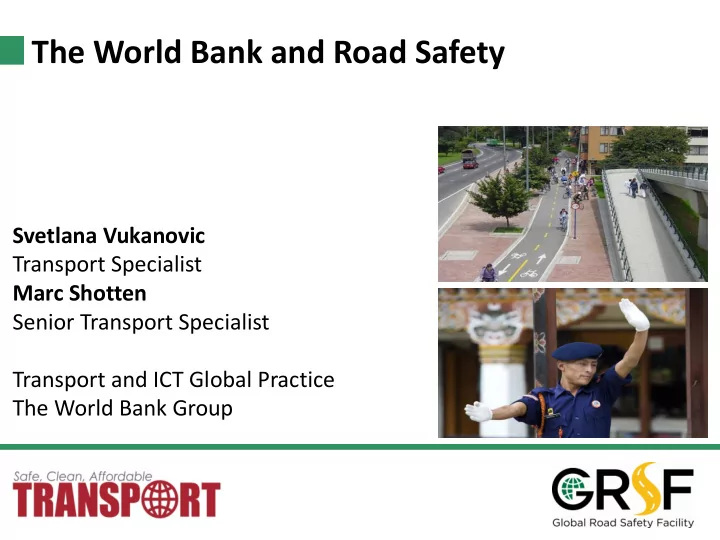
Senior Transport Specialist Transport and ICT Global Practice The - - PowerPoint PPT Presentation
The World Bank and Road Safety Svetlana Vukanovic Transport Specialist Marc Shotten Senior Transport Specialist Transport and ICT Global Practice The World Bank Group The Global Crisis (source Global Burden of Disease Report 2010) # 15-19y
# All ages 1. Ischemic heart disease 2. Stroke 3. COPD 4. Lower respiratory infections 5. Lung cancer 6. HIV/AIDS 7. Diarrheal diseases 8. Road Injury (47% ↑) 9. Diabetes 10. Tuberculosis #
15-19y 20-24y 25-29y 30-34y 35-39y
1. Road Injury (20% ↑) Road Injury (38% ↑) HIV/AIDS HIV/AIDS HIV/AIDS 2. Self-harm Self-harm Road Injury (45% ↑) Road Injury (41% ↑) Road Injury (50% ↑) 3. Interpersonal violence Interpersonal violence Self-harm Tuberculosis Tuberculosis 4. Malaria HIV/AIDS Interpersonal violence Self-harm Ischemic heart disease 5. Drowning Maternal disorders Tuberculosis Interpersonal violence Self-harm 6. Maternal disorders Tuberculosis Maternal disorders Maternal disorders Cirrhosis 7. HIV/AIDS Malaria Lower respiratory infections Ischemic heart disease Interpersonal violence 8. Lower respiratory infections Lower respiratory infections Malaria Lower respiratory infections Stroke 9. Fire Drowning Diarrheal diseases Diarrheal diseases Lower respiratory infections 10. Diarrheal diseases Fire Ischemic heart disease Malaria Maternal disorders
Inadequate legislation: only 28 countries (7% of the world’s population), have adequate laws that address all five risk factors Low & Middle- Income Countries are hardest hit - fueled by rapid motorization and expansion of highway network Half of all deaths are pedestrians (1/3rd), cyclists, and motorcyclists (VRUs) Harmonized Data Collection Systems: Massive underreporting in LMICs
The first major, global report on road safety issued jointly by the World Bank and World Health Organization in 2004.
Recommendations of the World Report 1. Identify a lead agency in government to guide the national road traffic safety effort. 2. Assess the problem, policies and institutional settings relating to road traffic injury and the capacity for road traffic injury prevention in each country. 3. Prepare a national road safety strategy and plan of action. 4. Allocate financial and human resources to address the problem. 5. Implement specific actions to prevent road traffic crashes, minimize injuries and their consequences and evaluate the impact of these actions. 6. Support the development of national capacity and international cooperation.
risk roads and apply engineering measures in mixed-traffic, mixed- speed road environments
partnerships with the civil society, philanthropies and the private sector
(vehicle centric to mobility focus)
planning
institutions and focus on developing national level RS strategy
coordination
between police, transport and health
Middle East – North Africa
Yemen (2010) Egypt (2013)
Europe – Central Asia
Bosnia –Herz. (2007) Montenegro (2008) Kazakhstan (2010) Serbia (2010) Armenia (2011) Poland (2013) Georgia (2013)
Latin America – Caribbean
Minais Gerais (2010) Argentina (2010) Sao Paulo (2012) Colombia (2012) Rio Grande de Sul (Started 2013)
Sub-Saharan Africa
Uganda (2010) Ethiopia (2010) Nigeria (2010) Sierra Leone (2011) Mauritius (2013) Tanzania (2013) Malawi (2013) Zambia (2013)
South Asia
Nepal (2010) Karnataka (2010) Gujarat (2011) Sri Lanka (2011) Rajasthan (2013) Tamil Nadu (2014)
East Asia - Pacific
Indonesia (2007) China (2012)
developed countries) i.e. 10,07 persons per population of 100.000 people(about 3 times more than in most developed countries);
happened on local roads and streets (53.6%)
% of all deaths and 12.6% of serious injuries;
10.3% of all road deaths during the last 2 years (2011 and 2012);
disabled while 50% of such deaths could have been avoided by using a seatbelt;
70.3% of drivers and 65.2% of front seat passengers use seat belts, but only 2.4 % passengers in the rear seat. Child restraints are used in 50% for children < 3 year. Motorcycle drivers are using helmets in 94 % and motorcycle passengers in 56%.
action plan Action plan (identifies specific actions necessary to reduce the number of road deaths)
SUCCESS ONLY IF ALL STAKEHOLDERS COOPERATE FULLY AND DEDICATED TO IMPLEMENT THEIR REQUESTED PARTS OF THE MILTISECTOR ACTION PLAN AND IF NECESSARY RESOURCES ARE MADE AVAILABLE TO DO THE INSTITUTIONAL STRENGHTENING OF KEY GOVERNMENT AGENCISE AND TO IMPLE,MENT THE SPECIFIC ACTIONS PROPOSED. Next steps – adoption of the strategy and action plan; improvement through specific activities in the action plan