Semiconductor Optical Amplifiers: Understanding and Modeling - - PowerPoint PPT Presentation

semiconductor optical amplifiers understanding and
SMART_READER_LITE
LIVE PREVIEW

Semiconductor Optical Amplifiers: Understanding and Modeling - - PowerPoint PPT Presentation

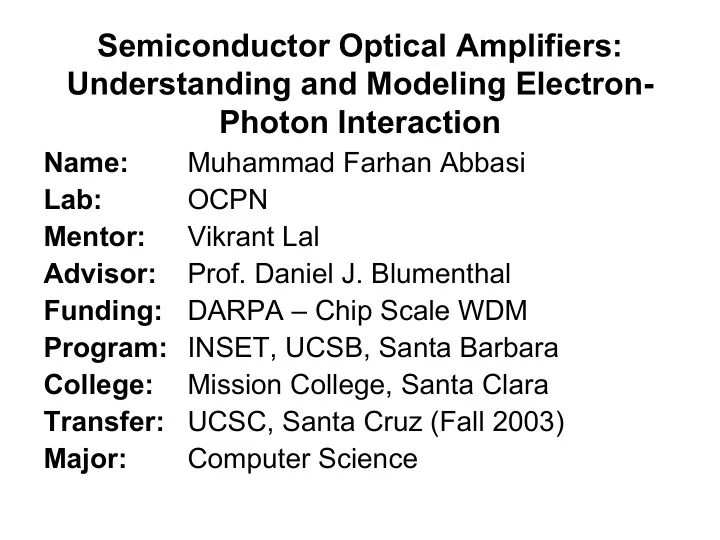
Semiconductor Optical Amplifiers: Understanding and Modeling Electron- Photon Interaction Name: Muhammad Farhan Abbasi Lab: OCPN Mentor: Vikrant Lal Advisor: Prof. Daniel J. Blumenthal Funding: DARPA Chip Scale WDM Program: INSET,


slide-1
SLIDE 1

Semiconductor Optical Amplifiers: Understanding and Modeling Electron- Photon Interaction

Name: Muhammad Farhan Abbasi Lab: OCPN Mentor: Vikrant Lal Advisor:

  • Prof. Daniel J. Blumenthal

Funding: DARPA – Chip Scale WDM Program: INSET, UCSB, Santa Barbara College: Mission College, Santa Clara Transfer: UCSC, Santa Cruz (Fall 2003) Major: Computer Science

slide-2
SLIDE 2

Overview

  • Background of Fiber Optic Networks
  • Significance of SOA’s in Wavelength

Converters

  • My Contribution in the Project :

Simulations and Lab Experiments

  • Future Applications
  • Summary and Acknowledgement
slide-3
SLIDE 3

Semiconductor Optical Amplifiers: Understanding and Modeling Electron- Photon Interaction

  • Fiber Optic Technology and The Present

Internet

  • Wavelength Division Multiplexing (WDM)
  • Fundamental Components of WDM
  • Semiconductor Optical Amplifiers (SOA)

– Building Blocks of the Wavelength Converter

  • The Need of a Single Chip Integrated

Wavelength Converter

slide-4
SLIDE 4

The Objective

  • Significance of an

SOA in Wavelength Converters

  • Understanding and

Modeling an SOA to improve device design

SOA Wavelength Converter Signal Out LASER Signal In

slide-5
SLIDE 5

Part I : My Contribution in the Project

Coded a Simulation Regarding SOA’s in C Language Stage I :

  • Reading Binary Files
  • Computing Root of a Non-Linear Equation
  • Solving Ordinary Differential Equation

using Runge-Kutta method Stage II :

  • Integrating Smaller Parts to Formulate Simulation
  • Running Simulation on Test Data

Stage III :

  • Testing Simulation for Speed and Performance
  • Comparing Results with Existing Simulation

Reference Book : “Numerical Recipes in C” by Press, William H. et. all

slide-6
SLIDE 6

Gain, Input Power, & Applied Current

  • As the Input Power

increases, Gain Decreases (Why?) [Incoming Photons will take away more electrons from conduction band, hence, decreasing electron density]

  • Gain curve drops

much faster with higher Input Current

  • 60
  • 50
  • 40
  • 30
  • 20
  • 10

10 20

  • 0.5

0.5 1 1.5 2 2.5 3 3.5 Gain vs. input Power and Current Input Power (dBm) Gain (dB ) I = 60mA I = 100mA

Data Plot Provided by Vikrant Lal, OCPN, UCSB

slide-7
SLIDE 7

Part II : My Contribution in the Project

Lab Experiments with SOA’s

SOA Laser EDFA Attenuator PC TE Cooler Spectrum Analyzer Current Supply

Gain vs Input Power & Current(100mA)

  • 22.0
  • 21.5
  • 21.0
  • 20.5
  • 20.0
  • 19.5
  • 19.0
  • 15
  • 10
  • 5

5 Input Power (dBm) Gain (dBm)

Gain vs Input Power & Current (150mA)

  • 20.0
  • 19.5
  • 19.0
  • 18.5
  • 18.0
  • 17.5
  • 17.0
  • 15
  • 10
  • 5

5 Input Power (dBm) Gain (dBm)

slide-8
SLIDE 8

Future Applications

  • This simulation will be helpful in improving

the structure of the existing wavelength converter

  • Understanding the working of SOAs in

combinations would be easier with this simulator

  • Various designs of wavelength converters

and SOAs can be investigated in broader detail

slide-9
SLIDE 9

Summary

  • Present fiber optic networks will improve

their performance by using such devices that overcome electronic speed

  • Semiconductor optical amplifiers play a

vital role in fiber optic networks

  • Simulations are important tools for

understanding semiconductor optical amplifiers and related devices like wavelength converters

slide-10
SLIDE 10

Acknowledgement

I would like to thank

  • University of California, Santa Barbara
  • INSET
  • Prof. Daniel J. Blumenthal & Vikrant Lal of

the Department of Electrical & Computer Engineering & the OCPN team