
SLIDE 1
Craig Chambers 96 CSE 401
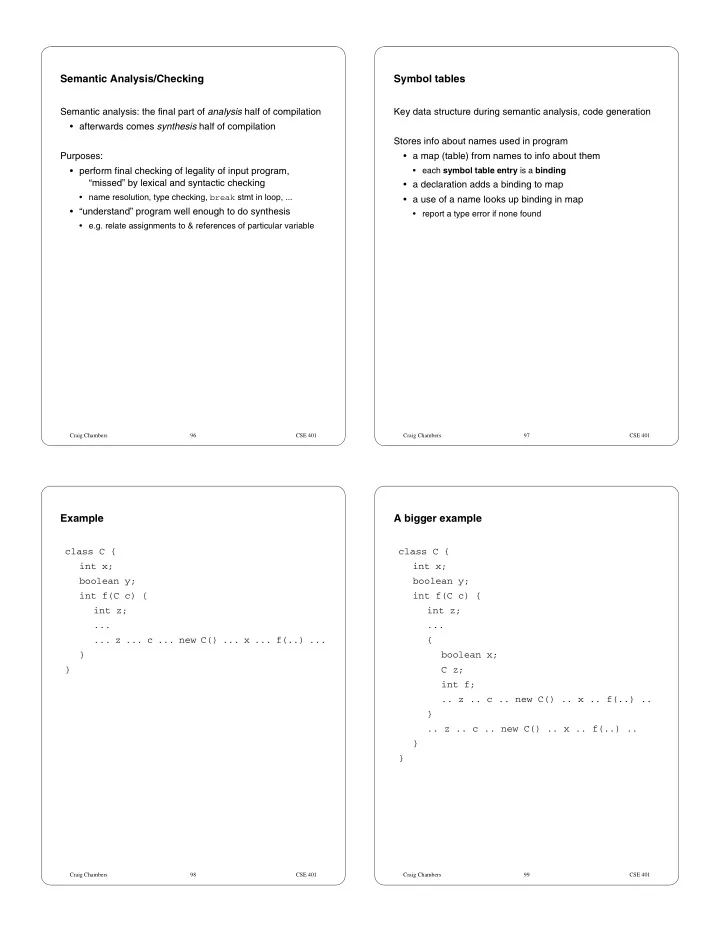
Semantic Analysis/Checking
Semantic analysis: the final part of analysis half of compilation
- afterwards comes synthesis half of compilation
Purposes:
- perform final checking of legality of input program,
“missed” by lexical and syntactic checking
- name resolution, type checking, break stmt in loop, ...
- “understand” program well enough to do synthesis
- e.g. relate assignments to & references of particular variable
Craig Chambers 97 CSE 401
Symbol tables
Key data structure during semantic analysis, code generation Stores info about names used in program
- a map (table) from names to info about them
- each symbol table entry is a binding
- a declaration adds a binding to map
- a use of a name looks up binding in map
- report a type error if none found
Craig Chambers 98 CSE 401
Example
class C { int x; boolean y; int f(C c) { int z; ... ... z ... c ... new C() ... x ... f(..) ... } }
Craig Chambers 99 CSE 401
A bigger example
class C { int x; boolean y; int f(C c) { int z; ... { boolean x; C z; int f; .. z .. c .. new C() .. x .. f(..) .. } .. z .. c .. new C() .. x .. f(..) .. } }