Semantic Actions This is what we will use to construct ASTs Each - - PowerPoint PPT Presentation

semantic actions this is what we will use to construct
SMART_READER_LITE
LIVE PREVIEW

Semantic Actions This is what we will use to construct ASTs Each - - PowerPoint PPT Presentation

Semantic Actions This is what we will use to construct ASTs Each grammar symbol may have attributes An attribute is a property of a programming language construct For terminal symbols (lexical tokens) attributes can be


slide-1
SLIDE 1

7

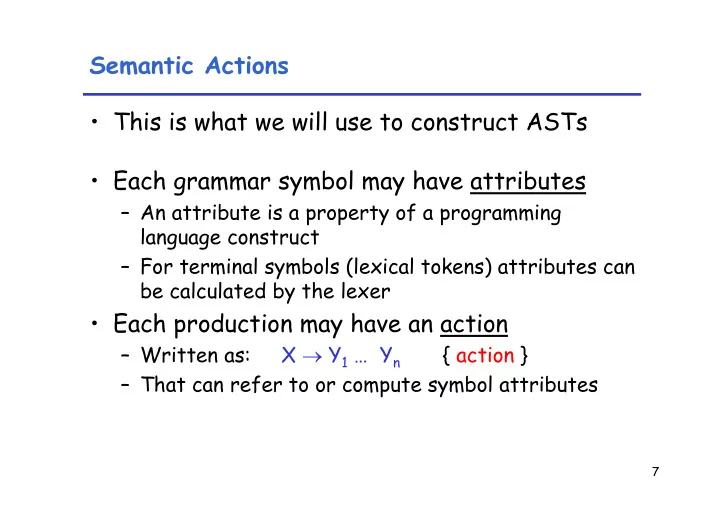
Semantic Actions

  • This is what we will use to construct ASTs
  • Each grammar symbol may have attributes

– An attribute is a property of a programming language construct – For terminal symbols (lexical tokens) attributes can be calculated by the lexer

  • Each production may have an action

– Written as: X → Y1 … Yn { action } – That can refer to or compute symbol attributes

slide-2
SLIDE 2

8

Semantic Actions: An Example

  • Consider the grammar

E → int | E + E | ( E )

  • For each symbol X define an attribute X.val

– For terminals, val is the associated lexeme – For non-terminals, val is the expression’s value (which is computed from values of subexpressions)

  • We annotate the grammar with actions:

E → int { E.val = int.val } | E1 + E2 { E.val = E1.val + E2.val } | ( E1 ) { E.val = E1.val }

slide-3
SLIDE 3

9

Semantic Actions: An Example (Cont.) Productions Equations

E → E1 + E2 E.val = E1.val + E2.val E1 → int5 E1.val = int5.val = 5 E2 → (E3) E2.val = E3.val E3 → E4 + E5 E3.val = E4.val + E5.val E4 → int2 E4.val = int2.val = 2 E5 → int3 E5.val = int3.val = 3

  • String: 5 + (2 + 3)
  • Tokens: int5 ‘+’ ‘(‘ int2 ‘+’ int3 ‘)’
slide-4
SLIDE 4

10

Semantic Actions: Dependencies Semantic actions specify a system of equations

– Order of executing the actions is not specified

  • Example:

E3.val = E4.val + E5.val – Must compute E4.val and E5.val before E3.val – We say that E3.val depends on E4.val and E5.val

  • The parser must find the order of evaluation
slide-5
SLIDE 5

11

Dependency Graph

E E1 E2 ( E3 ) + E4 + int5 int2 E5 int3 + + 2 5

  • Each node labeled with

a non-terminal E has

  • ne slot for its val

attribute

  • Note the dependencies

3

slide-6
SLIDE 6

12

Evaluating Attributes

  • An attribute must be computed after all its

successors in the dependency graph have been computed

– In the previous example attributes can be computed bottom-up

  • Such an order exists when there are no cycles

– Cyclically defined attributes are not legal

slide-7
SLIDE 7

13

Semantic Actions: Notes (Cont.)

  • Synthesized attributes

– Calculated from attributes of descendents in the parse tree – E.val is a synthesized attribute – Can always be calculated in a bottom-up order

  • Grammars with only synthesized attributes

are called S-attributed grammars

– Most frequent kinds of grammars

slide-8
SLIDE 8

14

Inherited Attributes

  • Another kind of attributes
  • Calculated from attributes of the parent

node(s) and/or siblings in the parse tree

  • Example: a line calculator
slide-9
SLIDE 9

15

A Line Calculator

  • Each line contains an expression

E → int | E + E

  • Each line is terminated with the = sign

L → E = | + E =

  • In the second form, the value of evaluation of

the previous line is used as starting value

  • A program is a sequence of lines

P → ε | P L

slide-10
SLIDE 10

16

Attributes for the Line Calculator

  • Each E has a synthesized attribute val

– Calculated as before

  • Each L has a synthesized attribute val

L → E = { L.val = E.val } | + E = { L.val = E.val + L.prev }

  • We need the value of the previous line
  • We use an inherited attribute L.prev
slide-11
SLIDE 11

17

Attributes for the Line Calculator (Cont.)

  • Each P has a synthesized attribute val

– The value of its last line P → ε { P.val = 0 } | P1 L { P.val = L.val; L.prev = P1.val }

  • Each L has an inherited attribute prev

– L.prev is inherited from sibling P1.val

  • Example …
slide-12
SLIDE 12

18

Example of Inherited Attributes

  • val synthesized
  • prev inherited
  • All can be

computed in depth-first

  • rder

P

ε L

+ E1 = E2 + int2 E3 int3 + + 2 3 P

slide-13
SLIDE 13

19

Semantic Actions: Notes (Cont.)

  • Semantic actions can be used to build ASTs
  • And many other things as well

– Also used for type checking, code generation, …

  • Process is called syntax-directed translation

– Substantial generalization over CFGs