Self-presentation in regards to research, teaching, and - - PDF document

self presentation
SMART_READER_LITE
LIVE PREVIEW

Self-presentation in regards to research, teaching, and - - PDF document

Magorzata Lipowska, Ph. D. Gdansk, 20 November 2011 University of Gdansk Institute of Psychology Department of Clinical Psychology Self-presentation in regards to research, teaching, and organizational service 1. Education, scientific career


slide-1
SLIDE 1

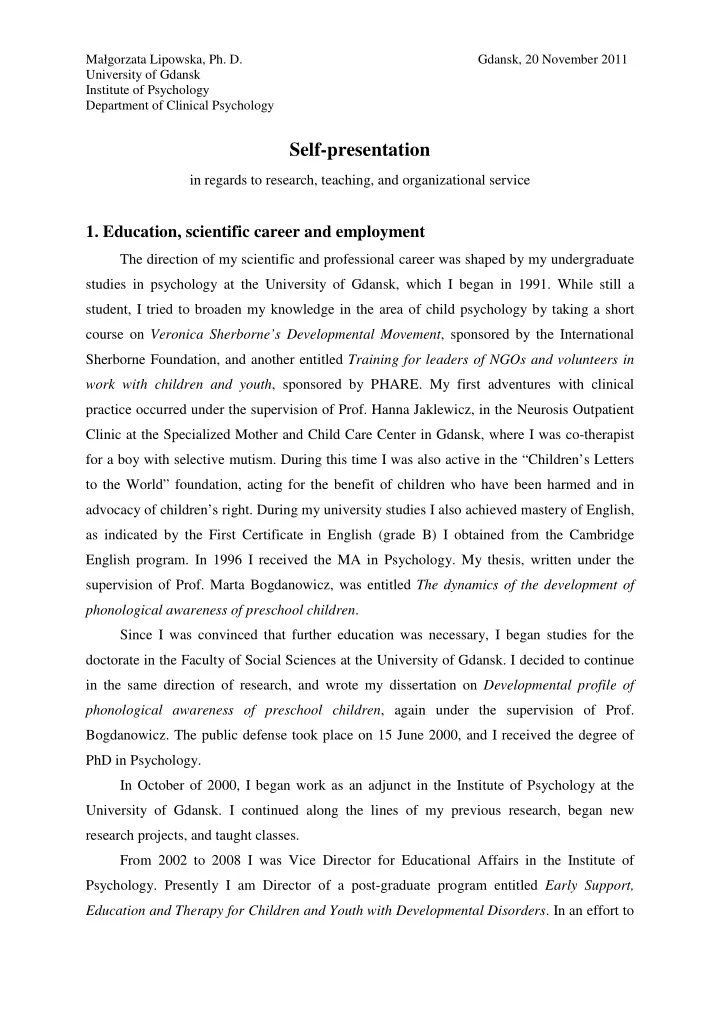
Małgorzata Lipowska, Ph. D. Gdansk, 20 November 2011 University of Gdansk Institute of Psychology Department of Clinical Psychology

Self-presentation

in regards to research, teaching, and organizational service

  • 1. Education, scientific career and employment

The direction of my scientific and professional career was shaped by my undergraduate studies in psychology at the University of Gdansk, which I began in 1991. While still a student, I tried to broaden my knowledge in the area of child psychology by taking a short course on Veronica Sherborne’s Developmental Movement, sponsored by the International Sherborne Foundation, and another entitled Training for leaders of NGOs and volunteers in work with children and youth, sponsored by PHARE. My first adventures with clinical practice occurred under the supervision of Prof. Hanna Jaklewicz, in the Neurosis Outpatient Clinic at the Specialized Mother and Child Care Center in Gdansk, where I was co-therapist for a boy with selective mutism. During this time I was also active in the “Children’s Letters to the World” foundation, acting for the benefit of children who have been harmed and in advocacy of children’s right. During my university studies I also achieved mastery of English, as indicated by the First Certificate in English (grade B) I obtained from the Cambridge English program. In 1996 I received the MA in Psychology. My thesis, written under the supervision of Prof. Marta Bogdanowicz, was entitled The dynamics of the development of phonological awareness of preschool children. Since I was convinced that further education was necessary, I began studies for the doctorate in the Faculty of Social Sciences at the University of Gdansk. I decided to continue in the same direction of research, and wrote my dissertation on Developmental profile of phonological awareness of preschool children, again under the supervision of Prof.

  • Bogdanowicz. The public defense took place on 15 June 2000, and I received the degree of

PhD in Psychology. In October of 2000, I began work as an adjunct in the Institute of Psychology at the University of Gdansk. I continued along the lines of my previous research, began new research projects, and taught classes. From 2002 to 2008 I was Vice Director for Educational Affairs in the Institute of

  • Psychology. Presently I am Director of a post-graduate program entitled Early Support,

Education and Therapy for Children and Youth with Developmental Disorders. In an effort to

slide-2
SLIDE 2

Małgorzata Lipowska Self-presentation

2 improve my skills and qualifications as a therapist and a teacher, I have attended many training courses, including the following:

– 2nd-degree specialization in the Sherborne Developmental Movement Method

(International Sherborne Foundation, 1995);

– a CE course on Developmental dyslexia: diagnosis and therapy (Polish Dyslexia

Society, 1997);

– training for instructors in the School for Parents and Teachers (Center for Teacher

Education, 1999);

– post-graduate program in Speech Therapy (University of Gdansk, 2006); – a short course on Short-Term Therapy Focused on Solutions (Crisis Intervention Center,

Polish Red Cross, 2001);

– 3rd-degree (International) specialization in the Sherborne Developmental Movement

Method (International Sherborne Foundation);

– a post-graduate program in Early Support, Education and Therapy for Children and

Youth with Developmental Disorders (University of Gdansk, 2010);

– an instructor course for educational workshops in Siblings without Rivalry (Center for

the Development of Education, 2011). Based on my clinical experience, I was licensed as a clinical psychologist in 2009 by the Minister of Health.

  • 2. Scientific research

My research interests cover five main areas:

1.

developmental psycholinguistics;

2.

psychological moderators of the perception of physical attractiveness;

3.

cognitive and social functioning of children with ADHD-spectrum behavioral disorders;

4.

cognitive and emotional processes in children with neurodevelopmental and neurological disorders;

5.

cognitive functioning of children with comorbidity of dyslexia and AHDH, from the perspective of developmental neuropsychology. What follows is a more detailed discussion of these five research areas.

  • 2. 1. Developmental psycholinguistics

My first endeavors in scientific research were closely related to the problems I took up in my MA thesis and doctoral dissertation. My research on the development of language in children was made possible to a large extent by a grant awarded by the Scientific Research

slide-3
SLIDE 3

Małgorzata Lipowska Self-presentation

3 Commission (KBN) as part of a research project (1HO1F02117). This research was conducted in the field of developmental psycholinguistics, and the primary goal was to establish the level of development of phonological competence in children of preschool age in successive age brackets. While preparing the grant proposal I modified a research tool for diagnosing the level of phonemic listening, developed by M. Bogdanowicz: Unknown Language and Polish Language in a verbal and pictorial version. I also constructed a Test of Rhymes and Alliteration, based on linguistic and pictorial material, used to specify the level of a child’s ability to identify “intrasyllabic” segments of words. The results I obtained confirmed two inter-related assumptions: that the level of phonological competence increases with age, and that the level of phonological processing in children at a given age level depends on the kind of linguistic material presented. My model

  • f the problem made it possible to confirm empirically Gombert’s metalinguistic concept,

which explains the developmental differences between the various subcomponents of phonological competence. Thanks to this data, it proved possible to give a detailed description of the skills characteristic for children of preschool age in terms of their phonological functioning. Phonemic listening is the first to develop; since it is responsible for identifying particular linguistic sounds, it is a factor that conditions the acquisition of the skills needed to communicate with the environment. I was able to show that this skill is developed in three- year-olds to a degree that enables them to communicate verbally with the environment, but it cannot be said to be fully developed. It is only the six-year-old child who is able to differentiate words on the basis of phonological information alone, without using any semantic hints. At about age 4 children are able to analyze and synthesize the syllables in words. The role of analysis and synthesis is essential, since during these operations the child first realizes that a word can be divided into smaller elements, which is a condition for mastering the skills

  • f reading and writing. Four-year-olds are also read to differentiate paronyms originating

from Polish and transmitted exclusively in verbal form. At age five, children are able to identify alliteration. Differentiating the pronounced elements of a word is the next step to mastering the skills of free manipulation of the smaller phonological units of words. At age six, even though children now differentiate nonsense paronyms, and recognize monosyllabic and polysyllabic rhymes, they have still not fully mastered the skills involved in the syllabic analysis and synthesis of nonsense words, the performance of any operations on phonemes, or the removal of syllables from a given word.

slide-4
SLIDE 4

Małgorzata Lipowska Self-presentation

4 The analysis of these results also provides evidence for the rebuttal of some conclusions advanced in the world literature on this topic, or even convictions generally accepted by the

  • public. My results did not confirm the differentiating impact of gender on the degree of

development of phonological competence, or the relation between the level of phonological competence and speech defects. In my opinion, these relations can appear only when there are development deficits (e. g. dyslexia), and do not constitute a population norm in the developmental sense. One useful effect of my research proved to be the possibility of establishing some developmental norms in respect to phonological competence, which in turn facilitates early detection of developmental disharmonies in this respect and appropriate therapeutic responses. Prior to the publication of my results, there was no literature in Poland on the phonological competence of such young children. Most of the research conducted in Europe

  • n this topic dealt with the skills of reading and writing, and for that reason were focused on

children very near school age. One indication of the lack of publications that would refer data from world literature on phonological competence, based primarily on research in English, to the specific problems of the Polish language is the frequency with which the results of my

  • wn research are cited in publications by Polish authors dealing with the development of

language (see, for example, works by Bogdanowicz, Krasowicz-Kupis or Sochacka). Portions of my research results were presented at two international and seven national conferences, and in an article that appeared in a journal of national circulation (Rhymes and alliterations as an index of the level of phonological development in preschoolers, Psychologia Rozwojowa, 2001). The entirety of my research results were published in a monograph, Developmental profile of phonological awareness of preschool children (Cracow 2001).

  • 2. 2. Psychological moderators of the perception of physical attractiveness

The next area of research I investigated dealt with the social psychology of

  • development. While conducting research under a university grant entitled The image of

partner relations in the eyes of young people (BW 7400-5-0304-1), my attention was drawn to the extraordinarily important role an attractive appearance already plays in the minds of young schoolchildren. To follow up on this, I designed research intended to verify the assumption that in the case of preschool children, the person of the mother, who provides the first model for patterns

  • f behavior consistent with social and gender roles, is also the first benchmark for beauty
  • preferences. Unfortunately, my results indicated that as early as the preschool years children
slide-5
SLIDE 5

Małgorzata Lipowska Self-presentation

5 use a schematic image of beauty. For the children I studied, a beautiful face was that of Barbie or a Disney princess, and not the image of the child’s own mother. These data are disquieting, since extraordinarily high, or even unrealistic standards of beauty appearing at such a young age can intensify dissatisfaction with one’s own appearance during the maturation process. Knowledge regarding one’s own appearance evolves with age: initially, the dominant convictions deal with body image, and are not emotionally overladen, but rather serve to describe the appearance. Until early adolescence, knowledge of the body has a cognitive character, but as the child enters into maturation, the attitude towards one’s own body becomes emotional: instead of a prosaic acknowledgement of fact (I have a fat belly), there appears a dislike for this state of affairs and a motivation to change it. There are many reports in world literature indicating that the subjective estimate of the dimensions of particular body parts and the attitude towards one’s own body, based on cognitive, behavioral, and emotional components, constitute two relatively independent elements of the body image. This became the inspiration for a research proposal, developed in cooperation with Prof. Mariusz Lipowski from the Department of Health Psychology at the Gdansk University of Physical Education and Sport, intended to discover the most common criteria for the evaluation of physical attractiveness, both one’s own and that of the partner. One essential element of the research was also an exploration of the psychosocial moderators of both the perception of beauty and role it is assigned in social life. The data we obtained pointed to several general rules underlying the principles by which the criteria for beauty are established. Attention should be drawn to the high degree of correspondence between the features prominently mentioned by women and those preferred by men, which indicates that women correctly assess men’s expectations in respect to female

  • beauty. Men, however, when they wish to emphasize their own attractiveness, mention

features different from those that women prefer: they focus on their physical strength. Women regard as essential characteristics associated with grooming, hygiene and health, and (as would follow logically) higher social status. Among the moderators of the role ascribed to the category of beauty one should mention first of all the gender and age of the subjects, but also the intensity of such personality traits as neuroticism and extraversion, along with the level of self-evaluation. Gender should be regarded as a very particular moderator of the perception of one’s own

  • appearance. In the case of women, the conviction that one is fat is often the source of

dissatisfaction with one’s own appearance; much more often than men, they are dissatisfied with many aspects of their own appearance, and body mass has become virtually a determinant in the shaping of body image. For this reason they often resort to various kinds of

slide-6
SLIDE 6

Małgorzata Lipowska Self-presentation

6 diets as soon as they perceive an esthetic defect in their own attractiveness. Moreover, diets are applied the moment the feeling of obesity occurs, even if there are no objective reasons for concern. Paradoxically, this general rule is most clearly operative in adolescent girls and young women. The major changes that take place in the bodies of young girls often cause unrealistic expectations in respect to one’s own appearance, which are further intensified by

  • advertising. The lack of an objective and realistic body image drastically reduces satisfaction

with one’s own attractiveness. Interestingly enough, among women age seems to be a mitigating factor: the self-image becomes more realistic, and reduced susceptibility to the impact of advertisements increases women’s acceptance of their own appearance and its actual or imagined imperfections. It should be emphasized that the gender of the subjects also differentiates the role of personality moderators of the perception of physical attractiveness. Our research results indicate that neuroticism in women is a trait that significantly differentiates the evaluation of

  • ne’s own appearance and that of the partner. This general rule does not seem to apply to
  • men. Among male subjects, in turn, extraversion is a feature that differentiates how one’s own

appearance is evaluated, while there was no analogous dependency among the female subjects. I have presented the results of this research at five international and nine national

  • conferences. I was also co-author of four articles published in a national journal, Psychologia

Rozwojowa (Youth’s self-esteem and their preferences for particular determinants of their partner’s physical attractiveness, 2004; Evaluation of female facial beauty by preschool children, 2006; Level of optimism and acceptance of own body by adolescence women, 2006 Locus of control and body image in young women and effectiveness of dieting, 2006) and five book chapters (in Perception of one’s own appearance by students at different universities, Szczecin 2002; Body image in young women and effectiveness of dieting, Gdansk 2005; The evaluation of own attractiveness by females of different age, Cracow 2006; Personality variables in perceiving physical attractiveness, Cracow 2008; Determinants of physical attractiveness among Polish and Spanish youth, Cracow 2008).

  • 2. 3. Cognitive and social functioning of children with ADHD – spectrum behavioral

disorders While exploring issues related to the social psychology of development, I did not abandon my practice as a clinical psychologist. My work with the parents of children displaying difficulties in functioning at school made it clear to me that there was a problem with the pervasive use by teachers of the label “hyperactive child” in relation to pupils who were causing problems. Thanks to a university grant entitled The perception of psychomotor

slide-7
SLIDE 7

Małgorzata Lipowska Self-presentation

7 hyperactivity by teachers: a specific personality profile or a disturbance? (BW 7400-5-0170- 4), I was able to conduct research on the role played by temperament in the inaccurate classification of children as hyperactive. My concern was particularly aroused by the fact that in a group of almost 50 teachers, who were evaluating a total of nearly 1000 pupils from the first years of primary school, the percentage of children labelled “hyperactive” amounted to almost 30%. My research provided some empirical confirmation of the congruence of the behavior traits of children perceived as “hyperactive” with the profile of the “difficult temperament” according to Thomas and Chess. If more teachers were aware of the nature of psychomotor hyperactivity and were able to differentiate it from the kind of behavior that results from certain temperament traits, many pupils could avoid the stigma of being labeled as a person with a disturbance and the negative consequences that entails. It is not only temperament, however, but also the preferred cognitive style that differentiates children perceived as hyperactive. I was able to demonstrate that these children manifest a field- dependent cognitive style, which is associated with a tendency to appeal to external indicators, and this is what makes them more prone to distraction and difficulties in maintaining attention. Research I conducted in a group of children with a proper diagnosis of ADHD also confirmed that a specific personality profile tends to occur in these children. What is particularly noteworthy, in my opinion, is the result for the level of sociability, understood as a temperament trait. This trait is associated with a search for the reinforcements provided by social interactions, including the very presence of other people, shared activities, attention paid by the group to the individual, interaction (that is, the mutual reaction to each other) and initiating social contacts. After analyzing the way answers had been given to the questions comprising the Sociability Scale in the EAS-C Temperament Scale by Buss and Plomin, I pointed to the discrepancies between the items pertaining to “the desire to be with others,” where 70-90% of the respondents marked the answers “probably yes” and “yes,” and those which assess “skill in making contacts,” where over 80% of the respondents answered “probably no” or “no. ” This inconsistency in the answers results from a discrepancy between wants and possibilities. The need to be with other people remains unmet in children with ADHD, due to the fact that a low level of ability to observe the rules of functioning in a group and impulsive, thoughtless statements cause hyperactive children to be socially isolated and lonely. An analysis of difficulties in recognizing facial and vocal signs of emotion also indicates inadequate reaction to emotional situations in children with ADHD. Two causes lie at the base of this problem: incorrect interpretation of the emotional signals received from

  • ther people and the high emotional lability of these children. Reception of the emotional
slide-8
SLIDE 8

Małgorzata Lipowska Self-presentation

8 dimension of the message largely determines the interpretation of the sender’s intentions towards the receiver; interpretational difficulties hinder the understanding of the sense of the transaction: the child may treat the message sent as insignificant. It should also be remembered that adult users of Polish, such as teachers, rather often use sarcasm in correcting their pupils, such as Well, you sure did a good job on this one or nice, nice, good work, relying on tone of voice and facial expression to make it clear that the statement is ironic. The results of my research clearly indicate that this type of message can be taken by ADHD children as authentic encouragement to continue on the same line. Adults treat this as extraordinary insubordination, whereas the child feels more and more lost in a world which keeps on sending contradictory messages. I hope that my research will make at least some small contribution to improving the effectiveness of educational and therapeutic activities undertaken by parents and teachers in respect to children with ADHD. I have presented the results of my empirical research on this problem at 3 international and 8 national conferences, and published them as author or co-author in 4 articles published in journals of national circulation (Locus of control of children with ADHD syndrome, Psychologia Rozwojowa 2004; Cognitive style in children perceived by their teachers as hyperactive, Acta Neuropsychologica 2007; Perception of facially and vocally expressed emotions in children with ADHD, Acta Neuropsychologica 2008; Temperamental components of impulsivity in ADHD? Psychiatria i Psychologia Kliniczna 2010) and in three book chapters (in Hyperactivity in the eyes of the teachers – temperament or disorder? Cracow 2003; Liveliness, or psychomotor hyperactivity – the teachers’ perception of students’ behaviours, Szczecin 2004; Temperament determinants of children’s physical activeness, Szczecin 2005).

  • 2. 4. Cognitive and emotional processes in children with neurodevelopmental and

neurological disorders While conducting the research on ADHD described above, I noticed that teachers were not the only ones to show a tendency to overstate the frequency of this disturbance. This is a larger problem, however, associated with the often inadequate diagnostic procedure in many developmental disorders. It seemed to me worthwhile, then, to shift the axis of my research in the direction of a neuropsychological approach. In this field I began to cooperate in 2005 with the Cracow Rehabilitation Center, under the supervision of Prof. Maria Pąchalska, which resulting in my becoming co-author of an article published in a journal from the Philadelphia List (Neuropsychological diagnosis and treatment after closed-head injury in a patient with a psychiatric history of schizophrenia, Medical Science Monitor 2008). Since that time I have been conducted intensive research on cognitive and emotional processes, focusing on children

slide-9
SLIDE 9

Małgorzata Lipowska Self-presentation

9 with neurodevelopmental disorders or recovering from traumatic brain injury (TBI). This has been made possible by volunteer work at the Gdansk Center for Neuropsychological

  • Research. The Center accepts applications from parents of children with TBI or a serious

neurological disorder, or referrals from physcians. The results of this research have been presented at 2 international and 3 national conferences. I was also co-author of an article published in a journal of national rank (Specific language impairment: neuropsychological and neurolinguistic aspects, Acta Neuropsychologica 2007), and of an article published in a journal from the Philadelphia List (Speech intelligibility in children with cerebral palsy attending an art therapy program, Medical Science Monitor 2010). I also published a book chapter (in Brain plasticity in children with post-stroke aphasia, based on data from functional magnetic resonance imaging, Lublin 2010). Pursuing further my interest in the neuropsychological approach to cognitive functioning, I was also co-author of a theoretical article on this subject, published in a journal

  • f national rank (Towards a process neuropsychology: microgenetic theory and brain science,

Acta Neuropsychologica 2007) and two book chapters (in The neuropsychology of metaphors, Wrocław 2006; Memory, perception, time and language: a neuropsychological perspective, Katowice 2009). I am still cooperating with the Gdansk Center for Neuropsychological Research, and am now preparing publications, in cooperation with Anna Rasmus, Ph. D. , on the cognitive and social functioning of children who have suffered neurological trauma.

  • 2. 5. Cognitive functioning of children with comorbidity of dyslexia and AHDH, from

the perspective of developmental neuropsychology Although I have explored several different areas of research, my greatest achievement, in my view, has been the formation of a neuropsychological model of the memory deficits in children with comorbidity of dyslexia and ADHD, based on the microgenetic theory of the symptom. Both my work with hyperactive children and the experience I gained in studying children and adults with neurodevelopmental and neurological problems provided the foundation for taking up the challenge of the comorbidity of developmental disorders in

  • children. The phenomenon of “comorbidity” is rather often the object of analysis in medicine,

but in the sphere of mental disorders it is a major challenge for research. The authors of the DSM-V, which is now in preparation, have pointed to this problem as one of the foremost diagnostic problems, especially in relation to children. As a clinical psychologist with years of experience working in the Polish Dyslexia Society, I first noticed how many children with specific learning difficulties are also afflicted

slide-10
SLIDE 10

Małgorzata Lipowska Self-presentation

10 with psychomotor hyperactivity. I was able to confirm my clinical observations, pointing out that developmental dyslexia and ADHD are the most commonly diagnosed developmental disorders among school-aged children. Despite the growing interest among researchers, clinicians, and educators in both topics, dyslexia and ADHD, resulting in numerous publications on either topic, there have still been no comprehensive analyses of the comorbidity of these childhood disorders. Both my clinical experience and the theoretical knowledge I acquired during my post- graduate studies on “Early Support, Education and Therapy for Children and Youth with Developmental Disorders,” as well as my analysis of world literature, indicated clearly that

  • nly a neuropsychological perspective will enable us to make a deeper analysis of the

comorbidity of dyslexia and ADHD. It was my feeling that developmental neuropsychology, thanks to the integration of knowledge concerning the functioning of the brain and the behavior of children in the course of ontogeny, would make it possible to understand the specific path of development of a child with a double diagnosis. I began my exploration of the comorbidity of dyslexia and ADHD by constructing a research plan. In order to be able to draw conclusions, theoretical or practical, I examined a group of children (n = 240) in the fourth to sixth year of primary school, whom I assigned to particular research groups, using a carefully selected set of neuropsychological tests. I took great care to classify the children correctly in the respective clinical groups. Since I was aware

  • f the very broad range of problems with the accuracy of diagnosis in neurodevelopmental

disorders, neuroimaging results constituted one of the inclusion criteria for the respective clinical groups. By developing not one, but three clinical groups, homogenous in respect to age, IQ and the male/female ratio, I was able to increase the predictive power of the research results I

  • btained.

I have presented the research results at 2 international and 11 national conferences, and portions were published in a journal of national rank (Language skills in children with ADHD and dyslexia, Acta Neuropsychologica 2008) and in a journal from the Philadelphia List (Visuospatial deficits of dyslexic children, Medical Science Monitor 2011). I also published two theoretical analyses of the comorbidity of dyslexia and ADHD (Modern hypotheses of comorbidity between developmental dyslexia and ADHD, Cracow 2008; Genetic background

  • f comorbidity between ADHD and developmental dyslexia, Psychiatria i Psychologia

Kliniczna 2010). A comprehensive presentation of the results, however, can be found in my monograph, Dyslexia and ADHD – comorbidity of developmental disorders. The neuropsychological analysis of memory deficits (Warsaw 2011).

slide-11
SLIDE 11

Małgorzata Lipowska Self-presentation

11 The cardinal problem of this work is the search for the specific nature of the functioning

  • f memory among children with comorbidity of dyslexia and ADHD. The theoretical

foundation was provided by microgenetic theory, especially the theory of the symptom. This is an evolutionary, process-oriented approach to the functioning of the brain and the mind, thanks to which we can better understand the dynamics of the formation of the symptoms of neurodevelopmental disorders. In view of the fact that comorbidity involves the summation,

  • r even overlapping of the symptoms of two or more disorders, I chose microgenetic theory

because it seemed to me to take into account the mutability of symptoms over time, and at the same time to provide an accurate picture of the development path of a child with a double diagnosis. The monograph consists of ten inter-related chapters. The argument, assuming the perspective of developmental neuropsychology, begins with a consideration of normal change and how it is transformed into developmental disorders. The microgenetic concept of the formation of the symptom is carefully examined at this point. In view of the preoccupations

  • f the monograph, as announced in the title, dyslexia and ADHD are discussed in greater

detail in chapter 2. The next chapter presents, for the first time in the Polish literature, rival hypothetical models explaining the comorbidity of developmental disorders, with particular attention to contemporary conceptions of the comorbidity of dyslexia and ADHD. In the next two chapters (4 and 5), after a presentation of the neuropsychological approach to the issue of memory, I describe the specific nature of memory processes in the course of normal and abnormal development. In the empirical part, I present an analysis of the picture of verbal and non-verbal memory deficits in the four research groups: children with dyslexia, children with ADHD, and children with both, with normal, healthy children as a control group. A better understanding of the specific nature of memory functions in children with a double diagnosis also required the identification of the cognitive moderators of memory processes, i. e. attention, language, executive functions, and cognitive style. In searching for similarities and differences, relations and correlations, in an attempt to find the specific nature of the memory problems experienced by children with comorbidity of dyslexia and ADHD, I made a effort to sketch a neuropsychological model of the memory disorders in children from the criterion group (comorbidity of dyslexia and ADHD), based on the microgenetic theory of the symptom. The monograph ends with a summary of the results, which verify the microgenetic theory of symptom formation, and the presentation of my own neuropsychological model of memory deficits in children with a double diagnosis, based on that theory. The directions of further research are also indicated.

slide-12
SLIDE 12

Małgorzata Lipowska Self-presentation

12 I would like to emphasize that the microgenetic interpretation of the comorbidity of dyslexia and ADHD is the first attempt of its sort, not only in Poland, but in the world.

  • 2. 6. Research programs

I was able to conduct my research on developmental psycholinguistics thanks in large part to a grant awarded by the Scientific Research Commission, as part of a research project entitled Developmental profile of phonological awareness of preschool children (1 HO1F 021 17), realized in 1999-2000. Portions of my research were conducted under four research programs funded by the University of Gdansk:

– 2001 – The image of partner relations in the eyes of young people (BW 7400-5-0304-1);

project director.

– 2004 – The perception of psychomotor hyperactivity by teachers: a specific personality

profile or a disturbance? (BW 7400-5-0170-4); project director.

– 2007 –The specific nature of cognitive disturbances in children with developmental

dyslexia and ADHD (BW 7400-5-0368-7); project director.

– 2007 – Validation and normalization of the Wechsler Memory Scale III (BW 7400-5-

0370-7); team member. In addition, I am a member of a research team led by Prof. Maria Pąchalska, as part of the QOLIBRI (Quality of Life after Brain Injury) European Research Project. Our part of QOLIBRI involves translating the QOLIBRI questionnaire and manual into Polish, and adapting it to Polish conditions. QOLIBRI is a joint endeavor, carried out by an international group and sponsored by several organizations and societies, including:

– European Brain Injury Society (EBIS) – Euroacademia Multidisciplinaria Neurotraumatologica (EMN) – National Brain Injury Research Training and Treatment Foundation (NBIRTTF) – European Brain and Behaviour Society (EBBS) – The Polish Neuropsychological Society (PTNeur).

  • 2. 7. Activity in scientific institutions, organizations and societies, in Poland and abroad

I have realized my own research projects in co-operation not only with the Gdansk Center for Neuropsychological Research, but also the Medical University of Gdansk, where I am a member of a research team on The evaluation of functional disturbances in women after they have born a stillborn child, under the direction of Prof. Krzysztof Preis.

slide-13
SLIDE 13

Małgorzata Lipowska Self-presentation

13 I belong to four scientific societies, including one international society, and in all of these I have fulfilled or am still fulfilling an organizational function:

  • 1. Polish Dyslexia Society – since 1996 (1998-2002 member of the Executive Board);
  • 2. Polish Psychological Society – since 1996 (2001-2004 Deputy Chair of the Gdansk

Branch); – Developmental Section of the Polish Psychological Society – since 1996 (2001-2003 Treasurer);

  • 3. European Society of Developmental Psychology – since 1998;
  • 4. Polish Neuropsychological Society – since 2004 (Treasurer since 2006).

I have also been active in the editorial boards of two journals. Since 2006 I have been a member of the Editorial Board of Acta Neuropsychologica, the official journal of the Polish Neuropsychological Society, and since 2011 I am a member of the Editorial Board of Psychologia – Neuropsychologia – Neurolingwistyka, published under the patronage of the Polish Neurolinguistics Society.

  • 2. 8. Publications

Since completing my doctorate I have published 2 monographs, 18 articles in journals recognized by the Ministry for Science and Higher Education (including 3 in journals from the Philadelphia List, for a total impact factor of 4. 912). I have been editor or co-editor of 3 books of national rank. I have also contributed 12 chapters to books, including 3 in books published in English (see the List of Scientific and Research Accomplishments). In the last two categories I have generally been the organizer of the research and the author of the research proposal. I also gathered the materials, analyzed the references, and prepared the individual contributors’ chapters for print. In many cases I was also responsible for the financial aspect of the project (details provided in the List of Scientific and Research Accomplishments).

  • 2. 9. Information regarding the representation of Polish science: active participation in

meetings, conferences and symposia Since completing my master’s degree in psychology in the Institute of Psychology at the University of Gdansk, I have participated actively in scientific meetings and conferences, reading plenary and session papers, and displaying posters at 22 international and 39 national conferences (cf. Information Regarding Educational Achievements, Promotion of Science and International Cooperation).

slide-14
SLIDE 14

Małgorzata Lipowska Self-presentation

14

  • 3. Teaching

I have taught classes primarily in the Institute of Psychology at the University of Gdansk and the Faculty of Education at Ateneum University in Gdansk. Most of my classes have involved childhood psychology. Among the most important are the following:

  • 1. classes for the major in psychology at the University of Gdansk

Introduction to child clinical psychology (lecture );

Development of child language and speech (lecture);

ADHD among children and adolescents (lecture);

Developmental psychology (exercises);

Leading Parenting Schools (workshops).

  • 2. classes for the major in education at Ateneum University in Gdansk

Developmental psychology (lecture);

Clinical psychology (lecture and exercises);

Development of child language and speech (lecture);

The pupil with special educational needs (lecture). For all these classes I have developed original programs. I also supervise theses for the master’s degree (majors in psychology and education) and the bachelor’s degree (majors in

  • education. Since 2002 I have supervised 46 masters’ theses in the Institute of Psychology at

the University of Gdansk, and 65 bachelors’ theses at Ateneum University in Gdansk. At present 24 masters’ theses are in preparation in both major fields. Moreover, since 2006 I have been lecturing for students of the post-graduate program in Early Support, Education and Therapy for Children and Youth with Developmental Disorders at the University of Gdansk, and since 2008 I have been co-operating with the Medical University of Gdansk, lecturing in their program of post-graduate studies in Clinical Psychology (a detailed list of all my classes can be found in the document entitled Information Regarding Educational Achievements, Promotion of Science and International Cooperation).

  • 4. Organizational service

Since first employed in the Institute of Psychology at the University of Gdansk (in October of 2000), I have been very active in service to the university. For two terms I was Vice Director for Educational Affairs in the Institute of Psychology (2002-2008). During this time I initiated program modifications in the psychology major, which allowed for greater mobility of students, augmented the competitive position of our graduates on the job market, and gave future psychologists the opportunity to acquire pedagogical preparation, in

slide-15
SLIDE 15

Małgorzata Lipowska Self-presentation

15 accordance with the Executive Order of the Minister of National Education and Sport of 10 September 2002 (published in Dz. U. 2002, No. 155, item 128, paragraphs §1. 3 and §6. 2). From 2003 to 2006 I was the sponsor of the Anima club for students of psychology, which achieved the highest marks in the University for its activities. I am presently director fo the post-graduate program entitled Early Support, Education and Therapy for Children and Youth with Developmental Disorders. While serving as Vice Director, I was a member of the Faculty Council in the Faculty

  • f Social Studies, and of the Institute Council in the Institute of Psychology, where I am still a

member. I have also been a member of the scientific committee and/or program committee for 17 conferences organized or co-organized by the Institute of Psychology at the University of Gdansk (a detailed list of all these conferences can be found in the document entitled Information regarding educational achievements, promotion of science and international cooperation).

  • 5. Awards and distinctions

In recognition of my academic achievements during my undergraduate studies I received academic scholarships funded by the Mayor of Gdynia (1994/1995) and the Minister of National Education (1995/1996), and received the Rector’s Prize, First Class (1994). In 2006 I was honored by the Polish Neuropsychological Society with the award Virtuti Medicinali, in recognition for my role in promoting the neurosciences in Poland. A year later the same society awarded me its highest recognition, the Copernicus Prize 2007. In 2008, I was awarded the Bronze Medal by the President of the Republic of Poland for my activity, both scientific and organizational.

  • 6. Summary

My publication list since the doctorate (2000) includes two monographs: A profile of the development of phonological competence in preschool children (Cracow 2001) and Dyslexia and ADHD – comorbidity of developmental disorders. The neuropsychological analysis of memory deficits) (Warsaw, 2011). I have been guest editor for two thematic issues of journals

  • f national rank: Psychologia Rozwojowa (2004, volume 9, no. 4) and Acta

Neuropsychologica (2008, volume 6, no. 4). I am also co-editor of a book entitled Family, educational and psychological determinants of development (Cracow 2008). In addition I have published 18 articles (including 3 with impact factors) in specialized scientific journals and have contributed 12 book chapters (including 3 in English).

slide-16
SLIDE 16

Małgorzata Lipowska Self-presentation

16 I have presented the results of my scientific work at 61 conferences, national and

  • international. I have completed two programs of post-graduate studies and many specialized

training courses involving support for development, diagnosis and therapy of developmental disorders in children. My clinical experience was confirmed by the Minister of Health, who licensed me as a clinical psychologist in 2009. I am an active member of 4 scientific societies (3 national and 1 international). I am also an active member of the editorial boards of two journals of national rank. I have been co-

  • rganizer of 17 scientific conferences, often as Chair of the Organizing Committee and

Member of the Program Committee. I served two terms as Vice-Director for Educational Affairs in the Institute of Psychology at the University of Gdansk, and I am presently the director of the post-graduate program entitled Early Support, Education and Therapy for Children and Youth with Developmental Disorders. My most important scientific accomplishment, in my opinion, is the creation, based on my own research results, of a neuropsychological model of the symptom based on microgenetic theory, which facilitates the understanding of the comorbidity of dyslexia and

  • ADHD. This model was published in the monograph Dyslexia and ADHD – comorbidity of

developmental disorders. The neuropsychological analysis of memory deficits (Warsaw, 2011).