
SLIDE 1
SELF-DETERMINATION
Training for Consumers/Guardians and Staff
Consumer Fiscal
Intermediary (FI)
Primary Clinician
Paid Providers Natural/
Community
Supports LifeWays
Revised April 2016
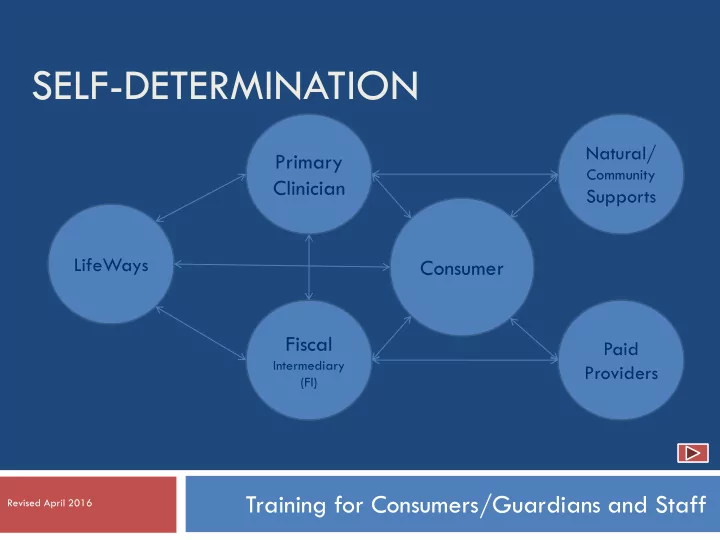
SELF-DETERMINATION Natural/ Primary Community Clinician Supports - - PowerPoint PPT Presentation
SELF-DETERMINATION Natural/ Primary Community Clinician Supports LifeWays Consumer Fiscal Paid Intermediary Providers (FI) Training for Consumers/Guardians and Staff Revised April 2016 Contents (click on link to move to that page)
Consumer Fiscal
Intermediary (FI)
Primary Clinician
Paid Providers Natural/
Community
Supports LifeWays
Revised April 2016
Self-Determination Philosophy Definitions Funding & Supports Medicaid Basics Overlapping Services Process Roles/Responsibilities Authorizations Self-Determination Budget Amendments to IPOS Required Agreements Service Documentation Requirements Required Training & Resources Monitoring Services Provided under Self-
Determination
Medicaid Fraud & Abuse Conflict of Interest Poor Practices Code of Ethics Resources Training Confirmation
Previous Page Next Page
Revised October 2014
A philosophy that people with disabilities have the right to control their own lives.
Under a Self-Determination arrangement, you can hire your own workers and manage your services within a set budget.
Four main principles:
and eligible services)
within a budget (based on Individual Plan of Service)
money to purchase support services based on your Individual Plan of Service, and to use public funds wisely
Budget: dollars that can be used for services. The budget amount is calculated based on the Individual Plan of
Service which is developed through a Person-Centered Planning process
Fiscal Intermediary (FI): a company that, for a fee, helps the consumer-employer develop a budget based on
authorized services, handles payroll responsibilities and prepares a monthly budget status report.
Individual Plan of Service (IPOS): A document that describes what goal(s) the consumer wants to work on, what
supports are needed, and the responsibilities of everyone participating in the plan. Also called “Treatment Plan” or “Person-Centered Plan”.
LEO: LifeWays Electronic Medical Record Medical Necessity: the scope (what kind), amount (how much and how often), and duration (for how long) of
services a person needs based on their current mental health condition. There must be written proof that without the requested service(s), the consumer’s condition would worsen.
Payer of Last Resort: Medicaid is the “payer of last resort”. That means all other natural & community supports
must be used before Medicaid will pay for a service. Examples of other supports may include: Department of Human Services’ chore provider or home help services, Community Action Agency literacy services, and Michigan Rehabilitation Services’ supported employment.
Person-Centered Planning (PCP): A process by which the IPOS is developed. The consumer says what their
goals for treatment are, and those goals are built into an IPOS.
Primary Clinician: A case manager or supports coordinator who helps the consumer access needed services
and resources and coordinates care with other providers.
Specialty Services: paid for by Medicaid, including Skill Building, Community Living Supports, etc. Utilization Management (UM): A department of LifeWays that reviews and approves or denies requests for
service authorization.
Back to Table of Contents
Revised October 2014
Public Dollars
SSI/SSDI/Social Security/Medicaid rules still apply
Private Dollars
From employment Family contributions
Revised October 2014
Medicaid pays for services that are medically necessary:
To screen and assess the presence of mental illness, developmental disability
To assist with attaining or maintaining sufficient functioning level to achieve
goals
Encourages community inclusion and participation Based upon personal and clinical information Provided by trained professionals (or staff supervised by trained
professionals as appropriate)
Based upon person-centered planning Provided within standards of timeliness Sufficient in amount, scope and duration to achieve identified purpose
(goals)
Revised October 2014
Medicaid is the “payer of last resort”. That means all other natural
and community supports must be used before Medicaid will pay for a service.
Services are defined in Section 3 of the Mental Health/Substance
Abuse chapter of the Medicaid Provider Manual.
Specialty services and supports cannot supplant (be used instead of)
State plan services.
For example: Home Help (State Plan) must be used before Community Living Supports
(Specialty Service)
The Individual Plan of Service (IPOS) that results from person-
centered planning specifies consumer goals and the amount (how much and how often), scope (what kind) and duration (for how long)
Revised October 2014
As a rule, Medicaid services cannot
you are receiving, this information can be found in your Individual Plan of Service. As an employer under a choice voucher arrangement, you are responsible for ensuring services do not overlap
responsible for paying the employee for services provided during the overlap period.
Revised March 2015
1. Consumer expresses interest in Self-Determination to primary clinician 2. Primary clinician contacts Self-Determination Coordinator to set-up informational meeting with consumer/guardian, supports and primary clinician 3. Primary clinician facilitates development of Individual Plan of Service (IPOS) 4. Primary clinician submits IPOS to LifeWays Utilization Management for review 5. LifeWays Self-Determination Coordinator communicate authorized services/budget (based on IPOS) to primary clinician and Fiscal Intermediary. Written denial, including appeal rights, is sent to consumer/guardian for any services not authorized. 6. Primary clinician facilitates scheduling of enrollment meeting with Fiscal Intermediary (FI) 7. FI attends enrollment meeting to provide orientation & facilitate completion of required documents PRIOR to initiation of Self-Determination arrangement 8. Consumer begins receiving services under Self-Determination arrangement AFTER completion of ALL required agreements (see Required Agreements). NOTE: ALL employment requirements must be completed by employees (see Employee Eligibility) PRIOR to providing services. 9. FI issues monthly budget report to primary clinician, consumer and LifeWays Self-Determination Coordinator 10. Consumer/guardian, primary clinician and FI monitor service/budget utilization 11. Ongoing communication between consumer, primary clinician, FI and LifeWays
Revised January 2016
Participate in Person-Centered Planning process
Complete required paperwork (Choice Voucher agreement, employer forms, agreements with providers)
Complete required training
Hire qualified employees
Schedule staff to work ONLY AFTER all required paperwork has been completed and FI has verified employee eligibility for hire
Ensure completion of required training by employees and provide evidence to FI
Verify services provided [e.g. sign timesheets and ensure there is documentation (support note) of services provided]
Monitor utilization of services
Monitor budget. NOTE: If services are provided outside of budget approval, the employer holds responsibility for payment
Revised June 2015
Revised October 2014
Complete agreements and forms required
Complete required training and provide
Provide services according to IPOS Document services provided in a timely
Provide service documentation and
Submit accurate time sheets to employer
Revised October 2014
Complete Criminal Background Checks (before
employee begins working) and notify employer
Facilitate completion of required documents Process timesheets and pay consumers’
employees
Manage payroll (Workers’ Compensation,
employment taxes)
Compile & distribute monthly budget reports to
participant, primary clinician and LifeWays Self-Determination Coordinator
Communicate with participant and LifeWays
Self-Determination Coordinator regarding budget concerns
Provide customer support related to FI functions
Revised October 2014
Revised October 2014
Once services are authorized: Service Budget Determination Summary is prepared by the LifeWays Self- Determination Coordinator (The completed Service Budget Determination Summary is reviewed with consumer/guardian by the primary clinician). It includes:
Consumer name & case number
Diagnosis
IPOS end date
Primary Clinician
Services authorized, LifeWays authorized rate, effective/end dates of each service authorization and authorization number
Authorized service budget amount per service type
Total authorized service budget for authorized period. Note: Non-service related costs such as employment costs (like training and workers’ compensation) & Fiscal Intermediary costs are not part of the calculated service budget. These costs come from the authorized budget. The Service Budget Determination Summary is sent to the Fiscal Intermediary and Primary Clinician by LifeWays Self-Determination Coordinator and is maintained in the consumer’s clinical record and Fiscal Intermediary records
Revised January 2016
Revised October 2014
Revised October 2014
Revised October 2014
All agreements must be in place BEFORE consumer begins receiving services through a Self-Determination arrangement. Employees/providers cannot begin providing services until all required agreements are completed and eligibility for employment has been verified by the Fiscal Intermediary
Self-Determination Agreement (a.k.a. Choice Voucher Agreement)
Between LifeWays & Consumer
Outlines purpose of Self-Determination & defines responsibilities of parties Employment Agreement or Staffing Agency Agreement with Service Description Attachment
Between consumer and chosen provider/employee
Outlines services to be provided, rate of reimbursement, employee/employer responsibilities (must be updated when there are changes) Job Description
Signed by employee
Describes services to be provided, standard requirements of employment & essential job functions Medicaid Provider Agreement
Between LifeWays and provider/employee
Outlines provider responsibilities per Medicaid regulations & LifeWays standards Ethical Standards for Self-Determination Providers
Attestation of agreement with LifeWays defined ethical standards
Revised October 2014
Self-Determination Support Note: submitted
IPOS maintained in LEO Progress Note maintained in LEO
(LEO: LifeWays Electronic Medical Record)
Revised October 2014
Revised October 2014
Revised January 2016
One of the hallmarks of Self-Determination is the active role of the consumer (or their guardian if one has been appointed) in choosing and monitoring the providers who will serve them and the services provided. This includes responsibility for reviewing Support Notes and approving provider time sheets. In some cases, the guardian may choose to delegate this
Guardians who delegate responsibility for signing timesheets still hold the risk related to potential Medicaid Fraud and/or Abuse as it is ultimately the guardian’s responsibility to ensure all requests for reimbursement are properly documented and accurately reflect services provided. Click here to review the “guardian responsibility for timesheet approval under self-determination” instructions and the required delegation form.
Submitted to Fiscal
Employee will not be
Revised October 2014
1.
2.
3.
4.
5.
Revised April 2016
6.
Revised April 2016
7.
Description: Write a narrative about what occurred during your shift and the consumer’s response. Remember that this narrative must include what was done to work on goals/objectives that shift. NOTE: Written narrative about checklist items at the top of the Support Note is not required.
8.
Complete check boxes at the left of each narrative to indicate what kind of support you provided to the consumer, including supports identified in the task chart.
intervention/assistance
the behavior or completion of a task
place when the person has become largely independent. In observing, staff are alert to the need for reminders, guidance or other interventions
not to do something.
Revised April 2016
9.
10.
Revised April 2016
Must be accompanied by progress notes that provide evidence of service delivery when submitted to the Fiscal Intermediary
Time sheet must be signed by the consumer or legal representative if one is appointed (i.e. guardian)
Revised January 2016
Revised January 2016
Click here to view LifeWays Self-Determination
Other training (depending on the type of
Employee must provide evidence of training to
Costs for training come from the consumer’s
Revised January 2016
Service Utilization
Monitored by Primary Clinician & Consumer/Guardian Over/Under (medical necessity) Should be in alignment with IPOS Some fluctuations are expected, but dramatic fluctuations or changes in
usage that are expected to continue require communication to LifeWays Utilization Management Budget
Monitored by FI, Primary Clinician and Consumer/Guardian FI provides monthly reports Rates paid for services must agree with Employment Agreement or
Staffing Agency Agreement Attachment AND cannot exceed LifeWays authorized rate (included in Budget Determination Summary)
Important to consider employment costs (training, fiscal intermediary fees,
worker’s compensation which are not included in budget calculations) when determining rates of payment to providers of service
Revised October 2014
Revised October 2014
As a person receiving services that are
Signing a timesheet you know is wrong Billing for services that were not provided Poor or no documentation to support services
Forging a signature Purchasing an asset (like a vehicle) or making
Revised October 2014
Consequences
Repayment of funds Exclusion from participating in Federal
Criminal charges
Reporting fraud & abuse
LifeWays Corporate Compliance
Revised October 2014
Revised October 2014
NEVER sign blank documents. This includes, but is not limited to time sheets, employment agreements and wage change forms. Employers: NEVER adjust or complete a timesheet on behalf of or in lieu of an employee or provider Employees and Staffing Agency Providers: NEVER “cut and paste” from previous documentation or use generic descriptions when documenting
Employees and Staffing Agency Providers: ALWAYS ensure documentation supports the length of service provided (i.e., a couple
Always make sure roles in relationship to the participant are clear and separate to avoid conflict of interest and the potential for Medicaid fraud or abuse (i.e., what is the role of the employee, of the employer,
Revised October 2014
Revised October 2014
STATE:
Medicaid Provider Manual: http://www.mdch.state.mi.us/dch- medicaid/manuals/MedicaidProviderManual.pdf
Center for Self-Determination: www.self-determination.com
Michigan Department of Community Health: http://www.michigan.gov/mdch
Department of Human Services: www.michigan.gov/fia
Centers for Medicare and Medicaid Services: www.cms.hhs.gov
Social Security Administration: www.ssa.gov LOCAL:
LifeWays: (517) 780-3332 or (866) 630-3690 www.lifewayscmh.org
ARE: Jackson (517) 788-9147; Hillsdale (517) 439-5210
www.dropincenters.org
Revised October 2014
By my signature below, I acknowledge that I have completed the LifeWays SELF-DETERMINATION SELF-STUDY “TRAINING FOR CONSUMERS/GUARDIANS & STAFF”. I understand that I will be accountable for the information contained in this training. If I have questions I may contact LifeWays for clarification. I also understand that this signed training acknowledgement must be provided to LifeWays and that it will be maintained as evidence of my completion of Self-Determination Training. Name of person completing training(please print):_________________________________________________ Check One: Consumer/Guardian Staff My signature below indicates that I: Completed the Self-Determination “Self-Study Training for Consumers/Guardians” on _______/_______/_________. Understand that if I have any questions regarding the training subject matter I may contact LifeWays for clarification. Have achieved functional competency in the training subject matter. Signature of person completing training:_________________________________ Date:______________ Employer Signature (if applicable):_________________________________ Date:______________
Revised June 2015