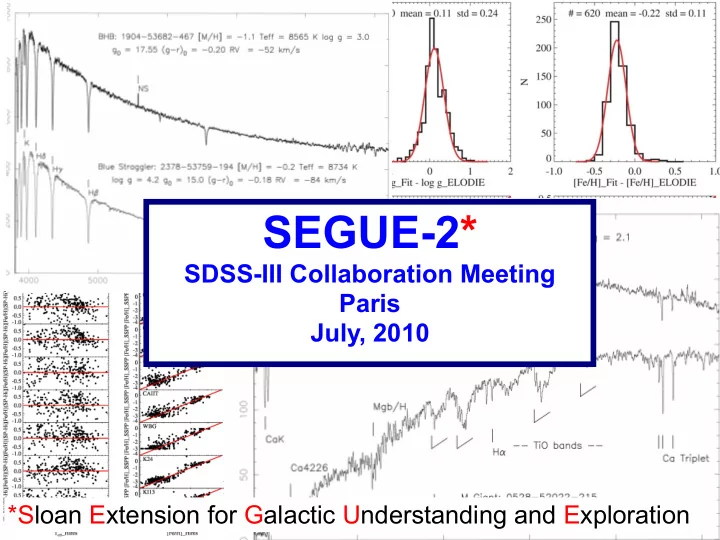
SEGUE-2* SDSS-III Collaboration Meeting Paris July, 2010 *Sloan - - PowerPoint PPT Presentation

segue 2
SMART_READER_LITE
LIVE PREVIEW

SEGUE-2* SDSS-III Collaboration Meeting Paris July, 2010 *Sloan - - PowerPoint PPT Presentation

SEGUE-2* SDSS-III Collaboration Meeting Paris July, 2010 *Sloan Extension for Galactic Understanding and Exploration Survey Description Old Milky Way stellar populations, Galactic archaeology: see science talks this meeting Use


slide-1
SLIDE 1

SEGUE-2*

SDSS-III Collaboration Meeting Paris July, 2010 *Sloan Extension for Galactic Understanding and Exploration

slide-2
SLIDE 2

Survey Description

  • Old Milky Way stellar populations, Galactic

archaeology: see science talks this meeting

  • Use wide field, high throughput of the SDSS

survey telescope, fiber spectrographs

  • moderate resolution
  • many lines of sight
  • in situ old thin and thick disk, halo stars
  • SEGUE-2 observations: all dark time 1st year of

SDSS-III (shared w/ BOSS imaging)

  • will release with DR8, Jan 2011
slide-3
SLIDE 3

Survey Data

  • R=1800 spectra, 3800Å - 9000Å
  • 7 sq. deg lines of sight
  • non-contiguous
  • targets selected from SDSS ugriz imaging,

USNOB proper motions (Munn et al. 2004)

  • 14 < g < 20
  • more distant than RAVE
  • Builds on the SEGUE-1 survey (Yanny et al. 2009)
  • done in parallel with finishing the original

SDSS galaxy survey, part of DR7

  • data from both survey processed, released

and documented together for DR8

slide-4
SLIDE 4

SEGUE -2

202 Lines of Sight 124,000 science spectra Observations complete Focus on faint/distant targets Improved selection of metal-poor stars, halo giants and BHBs based on SEGUE-1 experience

slide-5
SLIDE 5

Spectroscopic Targets

  • ld stellar populations:

low-metallicity, ultra- cool white dwarfs, high proper motion dwarfs, high velocity,

  • ld MS turnoff
  • ne “deep” plate per

line of sight

  • in-situ tracers of substructure, mass profile in the outer

halo: K-giants, BHBs, M-giants

  • all candidates get fibers: sample limitation is survey area
  • Galactocentric distances to 80 kpc
slide-6
SLIDE 6

SEGUE-1

260,500 science spectra 157 field pointings 16 pointings on known substructure 11 “low latitutde” pointings 8º<|b|<20º ugriz imaging stripes : 3500 deg2 @ |b|<35° and through the Galactic plane

SEGUE @DR7, July 2008 http://www.sdss.org/dr7 Yanny et al. 2009

slide-7
SLIDE 7

SEGUE-1 Targets

  • two plates per pointing, bright and faint
  • larger fraction of fibers given to targets selected in

slices of g-r to spread fibers over the old MS warmer than 4000K

  • stars in the coolest

slice are to d~ 2 kpc, w/ good USNOB +SDSS proper motion data

  • the MSTO UV-

excess selection reaches 15-20 kpc

slide-8
SLIDE 8

SEGUE Stellar Parameters Pipeline

For 5000K<Teff<7500K , S/N > 10 / 1Å pix: σ(Teff) 157K σ([Fe/H]) 0.29 σ(logg) 0.24 σ(RV) < 4 km/s for g<18

SSPP: Lee et al (2008) a,b Allende Prieto et al. 2008 RVs from Schlegel/Loomis/ Gunn spectro pipeline

Multiple methods, valid in specific ranges of S/N, g-r Applied to all stellar data taken with SDSS spectrographs Main DR8 improvements: robust combination of estimators, accuracy @ [Fe/H] > -0.5

slide-9
SLIDE 9

Spectroscopic Calibration Sample

SEGUE-1 + SEGUE-2 special calibration plates

  • n cluster stars:

M92 M13 M15 M2 NGC 2420 M67 M71 NGC 6791 Be 29 Field stars: 100+ stars observed with SEGUE and high resolution spectrographs on HET, Keck, VLT, Subaru, ... (Allende Prieto et al. 2008)

slide-10
SLIDE 10

Globular Cluster Photometry and Fiducial Sequences

An et al. 2008 Before:

  • utskirts only After:

Full area,

  • Calib. to

field SDSS (carefully) M3

slide-11
SLIDE 11

Status

  • Observations, data processing complete
  • no substantive changes to the extraction, flux

calibration, RV pipelines

  • new, improved version of the SSPP
  • Spectra, RVs, SSPP outputs available to the

collaboration as fits binary tables

  • Spectra, RVs, SSPP outputs loaded into a “pre-DR8

CAS” sql database, available to the collaboration

  • matched to a copy of DR7 imaging data
  • improvements vs. DR8 to make queries easier
  • documentation is the next big task, including the

SEGUE-2 paper