d 1 g g = . d d 2 x d d AND Use indices , , etc., - - PowerPoint PPT Presentation

d 1 g g
SMART_READER_LITE
LIVE PREVIEW

d 1 g g = . d d 2 x d d AND Use indices , , etc., - - PowerPoint PPT Presentation

Alan Guth, Black-Body Radiation and the Early History of the Universe, 8.286 Lecture 15, October 31, 2013, p. 1. Summary of Leture 14: 8.286 Leture 15 THE SPACETIME GEODESIC EQUATION Otober 31, 2013 d x d x BLACK-BODY


slide-1
SLIDE 1

Alan Guth, Black-Body Radiation and the Early History of the Universe, 8.286 Lecture 15, October 31, 2013, p. 1.

8.286 Le ture 15 O tober 31, 2013 BLACK-BODY RADIATION AND THE EARLY HISTORY OF THE UNIVERSE Summary
  • f
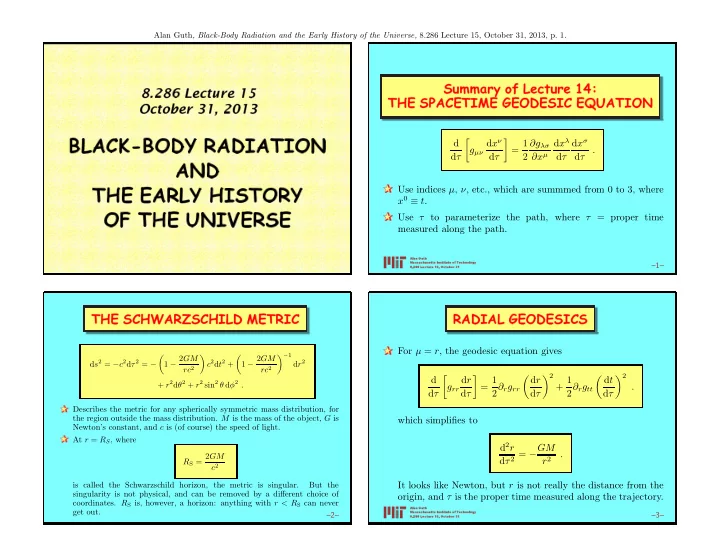
Le ture 14: THE SPACETIME GEODESIC EQUATION

d dxν 1 ∂g g d

µν

=

λσ dxλ dxσ

. τ dτ 2 ∂xµ dτ dτ

  • Use indices µ, ν, etc., which are summmed from 0 to 3, where

x0 ≡ t. Use τ to parameterize the path, where τ = proper time measured along the path.

Alan Guth Massa husetts Institute
  • f
T e hnology 8.286 Le ture 15, O tober 31

–1–

THE SCHWARZSCHILD METRIC

2 ds2 = −c2dτ 2 = −

  • GM

2GM 1 −

  • c2dt2 +
  • −1

1 d rc2 − rc2

  • r2

+ r2dθ2 + r2 sin2 θ dφ2 . Describes the metric for any spherically symmetric mass distribution, for the region outside the mass distribution. M is the mass of the object, G is Newton’s constant, and c is (of course) the speed of light. At r = RS, where 2GM RS = c2 is called the Schwarzschild horizon, the metric is singular. But the singularity is not physical, and can be removed by a different choice of

  • coordinates. RS is, however, a horizon: anything with r < RS can never

get out. –2–

RADIAL GEODESICS

For µ = r, the geodesic equation gives d d 1 d

2 2

r r 1 dt g d

rr

= ∂ τ dτ 2

rgrr

+ ∂ dτ 2

rgtt

. dτ

  • which simplifies to

d2r GM = dτ 2 − . r2 It looks like Newton, but r is not really the distance from the

  • rigin, and τ is the proper time measured along the trajectory.
Alan Guth Massa husetts Institute
  • f
T e hnology 8.286 Le ture 15, O tober 31

–3–

slide-2
SLIDE 2

Alan Guth, Black-Body Radiation and the Early History of the Universe, 8.286 Lecture 15, October 31, 2013, p. 2.

Solving the Radial Infall Equation

The proper time τ needed to reach radial variable r is r τ(r) =

  • 2GM
  • r0 tan−1
  • r0 − r

r

  • +

r(r0 − r)

  • .
  • The infalling object will be ripped apart by the singularity at

r = 0 in a finite amount of the object’s proper time. But from the outside, it will take an infinite amount of coordinate time t before the object reaches the horizon.

Alan Guth Massa husetts Institute
  • f
T e hnology 8.286 Le ture 15, O tober 31

–4–

slide-3
SLIDE 3

MIT OpenCourseWare http://ocw.mit.edu

8.286 The Early Universe

Fall 2013 For information about citing these materials or our Terms of Use, visit: http://ocw.mit.edu/terms.