Security Handshake Pitfalls Slide 1 Login with Shared Secret: - - PDF document

security handshake pitfalls
SMART_READER_LITE
LIVE PREVIEW

Security Handshake Pitfalls Slide 1 Login with Shared Secret: - - PDF document

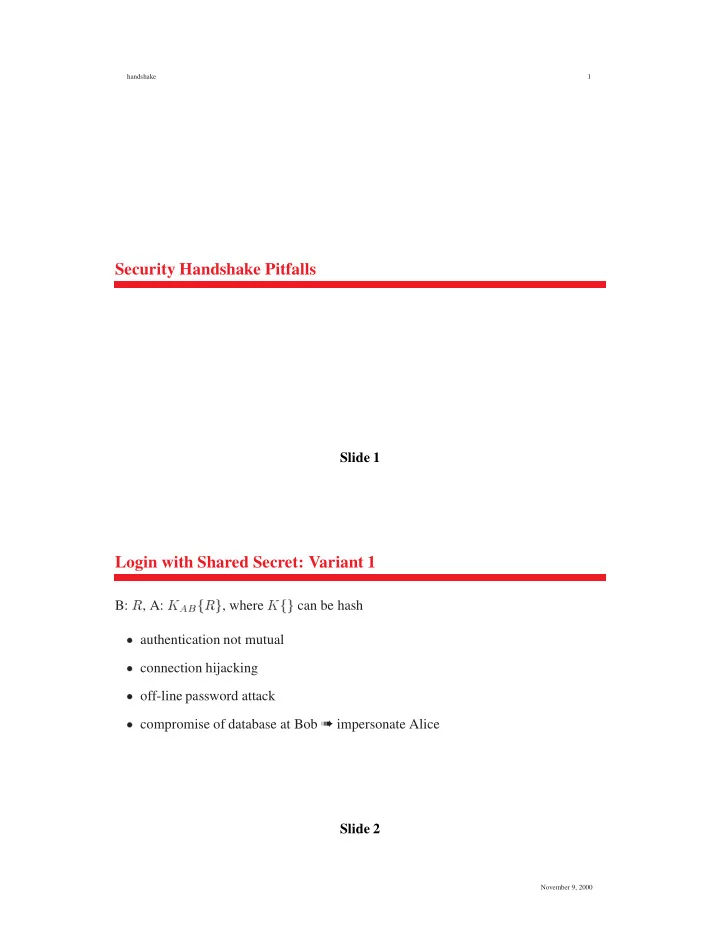
handshake 1 Security Handshake Pitfalls Slide 1 Login with Shared Secret: Variant 1 B: R , A: K f R g , where K fg can be hash AB authentication not mutual connection hijacking off-line password attack compromise of database


slide-1
SLIDE 1

handshake 1

Security Handshake Pitfalls

Slide 1

Login with Shared Secret: Variant 1

B:

R, A: K AB fRg, where K fg can be hash authentication not mutual connection hijacking
  • ff-line password attack
compromise of database at Bob ➠ impersonate Alice

Slide 2

November 9, 2000

slide-2
SLIDE 2

handshake 2

Login with Shared Secret: Variant 2

B:

K AB fRg, A: R where K fg is reversible (DES) T: get K without eavesdropping ➠ off-line guessing weakness of Kerberos 4 if R has non-random part (e.g., timestamp), Alice can authenticate Bob

Slide 3

Login with Shared Secret: One Way

A:

K Ali eBob ftimestampg requires synchronized clocks piggyback on password scheme stateless replay attacks ➠ remember messages within clock skew window replay attack: several servers with same secret ➠ include server name need to protect Bob’s clock from being set back ➠ secure NTP

use MD instead of encryption ➠ include timestamp in the clear Slide 4

November 9, 2000

slide-3
SLIDE 3

handshake 3

One-Way Public Key

A: hi; B:

R; A: [R℄ Ali e ➠ A signs R

A: hi; B:

fRg Ali e; A: R ➠ A signs R database at B only write-locked, not read-locked either signature (DSS, RSA) or encryption (RSA) can trick Alice into signing or decrypting message ➠ new protocol can compromise old! impose structure on message for different uses ➠ PKCS

Slide 5

Lamport’s Hash

safe from eavesdropping, database reading no public key cryptography Alice (human + workstation): password Bob (server): username, n (decremented on login), hash n(pw)

Authentication:

Alice: name ! Bob; Bob: n ! Alice Alice: send x = hash n1(pw) Bob: compare hash( x) with database Bob: store new value new password: transmit unencrypted

Slide 6

November 9, 2000

slide-4
SLIDE 4

handshake 4

Lamport’s Hash, Salted

random number r (seed, salt), stored at Bob transmit hash n (pjr ) different r for different servers re-install with different seed value avoids precomputation of hashes from dictionary, comparing with database

Slide 7

Lamport’s Hash – Small

n Attack no mutual authentication Bob sends small n, say, 50 Alice sends hash 50 ➠ Bob can generate hash 51 ; hash 52 ; : : : ➠ Alice has to check if next lower n

pencil-and-paper Slide 8

November 9, 2000

slide-5
SLIDE 5

handshake 5

S/KEY and OTP

Karn (Bellcore): S/KEY RFC 2289 (Feb. 1998)

– Lamport with alphanumeric salt – hash: MD4, MD5, SHA1 – challenge: otp-md5

n seed

– 64-bit hash: MD5(pw

j seed) X O R ! 64-bits

– use either 16 hex digits or six words (1 to 4 letters, 11 bits) for key – race condition: finish before legitimate user Slide 9

Mutual Authentication: Shared Secret (simplified)

A ! B

I’m Alice,

R 2 B ! A R 1, K AB fR 2 g A ! B K AB fR 1 g

Slide 10

November 9, 2000

slide-6
SLIDE 6

handshake 6

Mutual Authentication – Reflection attack

T ! B

I’m Alice,

R 2 B ! T R 1, K AB fR 2 g

Second login by Trudy:

T ! B

I’m Alice,

R 1 B ! T R 3, K AB fR 1 g

Fixes:

different keys for Alice, Bob (derived key) ➠ T can’t get B to encrypt something

using A’s key

different-type challenges for initiator and responder “initiator first to prove identity” password guessing: don’t reveal K (R), R chosen by T

Slide 11

Mutual Authentication: Public Keys

A ! B

I’m Alice,

fR 2 g B B ! A R 2, fR 1 g A A ! B R 1

variant: sign instead of encrypt

get signed public key (third party, Alice) from Bob Bob stores his public key encrypted with Alice’s password

Slide 12

November 9, 2000

slide-7
SLIDE 7

handshake 7

Mutual Authentication: Timestamps (Shared Secret)

A ! B

I’m Alice,

K AB ftg B ! A K AB ft + 1g t + 1 ➠ Trudy can impersonate Alice ➠ include direction flag

Slide 13

Session Keys

limits exposure of secrets to semi-trusted components

– shared secrets – public keys – Bob knows Alice’s public key, Alice knows private key – Alice knows password, Bob knows

n and hash n(pw)

Slide 14

November 9, 2000

slide-8
SLIDE 8

handshake 8

Session Key: Shared Secret

A ! B

I’m Alice

B ! A R A ! B K AB fRg use (K AB + 1)fRg as session key or f (K AB )fRg
  • K
AB (R + 1) bad ➠ Trudy can record and then challenge with R + 1 ➠ not quantity encrypted with K AB

Slide 15

Session Key: Two-Way Public Key

A ! B: fRg B weakness: T can send own fR g to B A ! B: [fRg B ℄ A can record conversation, break into B, decrypt Alice forgets R ➠ overrunning A doesn’t help

A:

R 1, B: R 2 A ! B: fR 1 g B; B ! A: fR 2 g A ➠ key R1
  • R2
T needs to overrun both T needs to decrypt one ➠ no need to sign

Diffie-Hellman with signing ➠ no bucket-brigade attack Slide 16

November 9, 2000

slide-9
SLIDE 9

handshake 9

Privacy and Integrity

replay attack ➠ long sequence numbers sequence number space rollover ➠ key rollover

Slide 17

Mediated Authentication

KDC sends shared session key encrypted with destination key avoid race conditions: KDC sends “ticket” to A

A wants B KDC

K A fK AB g K B fK AB g

Slide 18

November 9, 2000

slide-10
SLIDE 10

handshake 10

Needham-Schroeder

nonce: number used once ➠ seq. no., random number

1.

A ! KDC: N 1, Alice wants Bob

2.

K A fN 1 ; “Bob”; ticketg ➠ N 1 to authenticate KDC

ticket =

K B fK AB ; “Alice”g ➠ KDC ensures Bob that it’s Alice

3.

A ! B: challenge Bob with K AB fN 2 g, send ticket

4.

B ! A: K AB fN 2
  • 1;
N 3 g ➠ B proves knowledge of K AB

5.

A ! B: K AB fN 3
  • 1g ➠ A proves knowledge of
K AB

Slide 19

Needham-Schroeder: Reflection Attack

B ! A: K AB fN 2
  • 1;
N 3 g assume: N i multiple of encryption blocksize ECB ➠ message splicing: put together own plus revealed with CBC, no need to decrement N 2 ; N 3

Slide 20

November 9, 2000

slide-11
SLIDE 11

handshake 11

Needham-Schroeder: Limit Compromise

Trudy steals Alice’s key ➠ can impersonate Alice until key change. Alice changes key ➠ ticket to Bob stays valid also: T steals old key of Alice fix:

1.

A ! B: hello!?

2.

B ! A: K B fN B g, N B made part of ticket ➠ B knows

Slide 21

Otway-Rees

5 messages, no use of stale tickets suspicious party should generate challenge
  • 1. nonce
N C
  • 2. KDC checks if
N C the same in both ➠ Bob p
  • 3. give ticket; ensures that KDC and Bob are legit
  • 4. B hands (unreadable to B) ticket to A
  • 5. A proves knowledge of
K AB; A trusts KDC to authenticate B

Slide 22

November 9, 2000

slide-12
SLIDE 12

handshake 12

Kerberos V4

based on Needham-Schroeder, but with timestamps save exchange of nonces

Slide 23

Bellovin-Merritt

prevent password guessing when T has R, K fRg eavesdropping or address faking of A, B Diffie-Hellman exchange, encrypted with shared secret ➠ agree on common key finally, prove possession of common key can’t guess key from D-H: random numbers!
  • K is just session key
avoid reflection attack

Slide 24

November 9, 2000

slide-13
SLIDE 13

handshake 13

Bellovin-Merritt, with Hash

Bob only stores hash of A’s password and private key encrypted with password
  • K
AB = hash(pw) D-H ➠ shared secret K based on hash Alice proves knowledge of K (=hash) by encrypting R Bob encrypts Alice’s encrypted private key Alice signs R, Bob verifies using public key Bob needs to keep encrypted password secret!

Slide 25

Avoiding Password Guessing

Don’t send encrypted version and plaintext protection against active and passive attacks another attack: impersonate Bob
  • 1. send to anyone ➠ active attack
  • 2. prove knowledge of Alice’s secret
  • 3. encrypt (2) via session key
  • 4. encrypt (2) with secret or public key for Bob
  • 5. use Bellovin-Merritt, then (1) or (2)

Slide 26

November 9, 2000

slide-14
SLIDE 14

handshake 14

Nonce Types

timestamp ➠ synchronized clocks large random number ➠ cannot predict, guess sequence number ➠ non-volatile state

Slide 27

Nonce Types: Sequence Numbers

A ! B

I’m Alice

B ! A K AB fRg B ! A (K AB + 1)fRg R just has to be non-repeating

Slide 28

November 9, 2000

slide-15
SLIDE 15

handshake 15

Random Numbers

needed for:

cryptographic keys challenges IVs per-message secrets for El-Gamal/DSS

random: unpredictable ( ) or unguessable pseudorandom: deterministic algorithm

thermal (noise diode), video, audio noise keyboard timing, disk seek times current clock bits

Slide 29

process number, system load, number of users, ... packets seen, sent hardware id

Slide 30

November 9, 2000

slide-16
SLIDE 16

handshake 16

Generating Random Numbers

start with random seed, then hash pseudorandom number generator:
  • 1. hash of seed
  • 2. hash of (previous output
j seed)

Slide 31

Performance

Computation: bytes hashed, private key

> public key; parallelization?

Delay: message exchanges Cacheability: for repeated authentication Slide 32

November 9, 2000