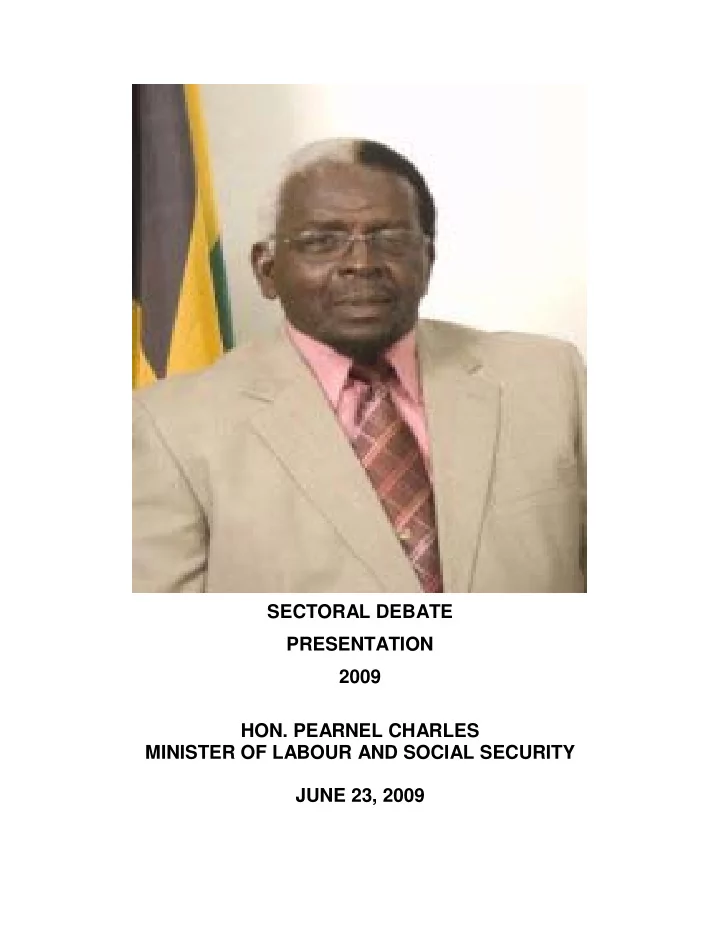
SLIDE 1 SECTORAL DEBATE PRESENTATION 2009
MINISTER OF LABOUR AND SOCIAL SECURITY JUNE 23, 2009
SLIDE 2 2
"...........the global financial crisis has exposed the artificial
and tenuous nature of the international economic system........” “...........But, in a crisis there are only two (2) options available - FI GHT or FLI GHT. Mr. Speaker, in our case, there is really only one feasible option at this time. We must
necessity
FI GHT
for the survival
OUR
nation..................”
Pearnel Charles, 2009 Sectoral Debate, 23 June, 2009
SLIDE 3
3
TABLE OF CONTENTS
I NTRODUCTI ON__________________________________ 6 HUMAN RESOURCE DEVELOPMENT ___________________ 8
Special Youth Employment And Training Project ______________ 8 The Youth Empowerment Strategy (YES) Project ____________ 10 The Steps to Work Project ______________________________ 11 A Special Loan Facility for Displaced Workers _______________ 12
MANPOWER SERVI CES ___________________________ 13
The Overseas Employment Programme ____________________ 13 Canadian Farm Work Programme_________________________ 14 Canadian Low-Skilled Programme ________________________ 14 The United States Farm Work Programme _________________ 16 J-1 programme _______________________________________ 16 Earnings ____________________________________________ 17 Overseas Workers Family Service _________________________ 17 Work Permit _________________________________________ 18
SLIDE 4
4
CARICOM Single Market and Economy (CSME) ______________ 19 Employment Agencies __________________________________ 20
THE NATI ONAL I NSURANCE SCHEME & FUND __________ 23 EXPANDI NG THE SCOPE OF THE PROGRAMME OF ADVANCEMENT THROUGH HEALTH AND EDUCATI ON (PATH) _____________________________________________ 27 LABOUR MANAGEMENT RELATI ONS _________________ 29
Redundancies ________________________________________ 30 Essential Services _____________________________________ 34 Conciliation __________________________________________ 37 The Industrial Disputes Tribunal (IDT)_____________________ 38
The I nternational Programme for the Elimination of Child Labour (I PEC) __________________________________ 40 FLEXI BLE WORK ARRANGEMENT ___________________ 41 LABOUR MARKET REFORM ________________________ 43
Labour Relations and Industrial Disputes Act (LRIDA) _________ 43 Restructuring of the Ministry of Labour and Social Security ____ 44
SLIDE 5
5
Labour Market Information ______________________________ 44 Occupational Safety and Health __________________________ 45 Flexible Work Arrangements _____________________________ 45 Training and Education _________________________________ 45 Other Areas __________________________________________ 46
REVI TALI ZI NG JAMAI CA’S LABOUR LAWS ____________ 47 Legal Enforcement _____________________________ 49 CONCLUSI ON ___________________________________ 50
SLIDE 6 6
I NTRODUCTI ON
- Mr. Speaker, the global financial crisis has exposed the artificial and
tenuous nature of the international economic system. Most countries felt their respective economies were thriving, sustainable and prosperous. However, recent events have demonstrated that this is not the reality. Initial assessment of the crisis indicates that worldwide, over one hundred and four (104) million people will lose their jobs and an estimated one billion will be pushed below the poverty line.
- Mr. Speaker, in Jamaica, we have begun to experience the
devastating effects of this fall out. There has been a spate of business contractions and closures, lay-off and redundancies in major sectors of the economy, which were once considered to be strong and stable. But, in a crisis there are only two (2) options available - FIGHT or
- FLIGHT. Mr. Speaker, in our case, there is really only one feasible
- ption at this time. We must of necessity FIGHT for the survival of
OUR nation. This must be a time when we begin to build new social networks for national co-operation and solidarity. A time when we must re-examine
- ur individual comfort zones, and give serious consideration to the
SLIDE 7 7
cause of the common good. This is the time when we must deliberately resolve to put an end to divisiveness and strive for unity.
- Mr. Speaker, this is the time when we must build on the strength and
resilience of the Jamaican people. Last year, I told this House that the Ministry would reposition itself to focus on Human Resource Development, instead of the usual pre-
- ccupation with Labour Management issues.
Most of what we set out to do we have achieved. I invite Members to examine the details of the Ministry’s performance as outlined in the Annual Report 2008-2009, which has been tabled. While we continue these strategies, the major focus this year will be to cushion the effects of hardship on the most vulnerable. In doing so
- Mr. Speaker, there will be an emphasis on developing and
empowering these persons to help themselves. In other words, the resources of the Ministry will be strategically directed to enable them to take responsibility.
SLIDE 8 8
HUMAN RESOURCE DEVELOPMENT
Special Youth Employment And Training Project The Special Youth Employment And Training Project (SYEAT) was launched in October last year. This programme targets youngsters between 18-25 years old, who are considered at risk and unattached. This initiative represents a strategy to further the national policy of human resource development, where young workers are integrated into the labour market through apprenticeship arrangements. A unique feature of this project is that work experience is linked to academic learning and career guidance, as well as other life skill
- measures. The project utilizes a cost-sharing approach, where
employers provide ‘on- the- job’ training with a stipend no less than the national minimum wage. It is aimed at providing decent and productive work and will target 10, 000 persons over the next four years. A number of agencies are partnering with the Ministry in the implementation of this programme. These include HEART/Trust NTA, Jamaica Foundation for Lifelong Learning (JFLL), Jamaica Employers’ Federation, Jamaica Confederation of Trade Unions and Incorporated Master Builders’ Association.
SLIDE 9 9
To date:
- 2,451 applications to the programme have been received and
processed.
- Approximately, 1,000 persons have been trained in numeracy,
literacy and employability skills.
- Approximately 200 persons have been placed with 40
companies involved in hospitality, manufacturing, construction and automotive industries. On the successful completion of training, participants are awarded certification in at least one skill area by HEART, which will position them to compete in the local and overseas job market. In this year’s budget $37 Million has been provided by the government to fund this programme. Again Mr. Speaker, the work permit fees are being utilised to assist in the training and certification
- f our youngsters.
- Mr. Speaker, I want to use this opportunity to thank those employers
who have joined us in this national endeavour and encourage others to come on board.
SLIDE 10 10
The Youth Empowerment Strategy (YES) Project
- Mr. Speaker, another initiative being pursued by the Ministry is the
Youth Empowerment Strategy. This project is specifically designed to target deportees and gangsters ages 16 to 30 years, who are at risk
- f becoming involved in criminality. The Ministry is working very
closely with the police to identify persons who can benefit from this project. In the first phase, low income communities such as Allman Town, and Denham Town (both in Kingston) and Summerfield in Clarendon have been selected. So far, over 260 individuals have been registered for this programme and 21 projects have been funded in the amount of $1.5 Million. The activities funded include:
- Education and training
- Light manufacturing
- Entrepreneurship
- Agriculture
For this year, another $5 Million has been provided in the budget.
SLIDE 11 11
The Steps to Work Project Steps to Work, a new dimension to the PATH Programme, is currently being piloted in Kingston and St. Andrew, Clarendon, Manchester, St. James and Trelawny. The aim of this Programme is to wean beneficiaries of the PATH Programme into training, employment and entrepreneurship. Skills training for suitable adults from PATH households will be undertaken by HEART, in collaboration with the Ministry, which will identify and monitor the progress of these participants. Persons will be encouraged and assisted to establish micro-
- businesses. This will involve business development, project and
financial management and marketing to ensure the success of their ventures. In this financial year, 3,000 PATH beneficiaries will be assisted at a cost of $33 Million.
SLIDE 12 12
A Special Loan Facility for Displaced Workers The Ministry will target dislocated workers through the National Insurance Fund Credit Facility. One Billion was dedicated to small and medium enterprises to encourage entrepreneurship. Under this facility $650 Million has already been disbursed. Three hundred and seventy-one businesses have benefited and 2,810 jobs created or sustained. The balance of $350 Million from this facility will be used to target displaced workers. These funds will be made available through participating financial institutions, which will conduct their own due
- diligence. These institutions will bear the credit risk for the loans.
All beneficiaries must register under the National Insurance Scheme. It is projected that over 1,000 jobs will be created.
- Mr. Speaker, as I have often said, the Ministry has to re-position itself
if it is to remain relevant in the constantly changing environment. No longer can we be totally pre-occupied with industrial relation matters, settling strikes and providing ameliorating services to assist the
- vulnerable. Human resource development has to be a major focus of
this Ministry. The initiatives outlined above represent a practical demonstration of this vision. It is a vision that is clearly embraced by this Government as illustrated in the Prime Minister’s announcement
- f the Young Entrepreneurship Programme.
SLIDE 13 13
MANPOWER SERVI CES
The Overseas Employment Programme The Overseas Employment Programme is highly dependent upon the fortunes of the economies of the United States and Canada, which are the main countries to which we have been sending Jamaicans to work over the past 60 years. This means that whenever there is a downturn in the economies of these countries, the impact on the programme is immediately felt. In recent months, we have witnessed one of the worst financial crises resulting in the loss of millions of jobs worldwide. Unemployment is now a national emergency in the U.S. Recent reports have shown a rapid deterioration in the job market. The state
- f Michigan, for example, where most of our hospitality workers go
from year to year is experiencing an 11.6 per cent unemployment rate, up from 7.3 per cent the previous year. The unemployment rates in California, Rhode Island and South Carolina, which are also traditional markets for our workers also experienced a steep rise in excess of 10 per cent in January. During the 2008/09 financial year, a total of 11,814 persons participated in the overseas employment programme. This represents a decline of 11% compared to 2007/08.
SLIDE 14 14
The Canadian programme experienced an increase in the number of Jamaicans who were able to take advantage of employment
- pportunities during the year. However, the US programme
experienced a decline. A total of 6,449 persons participated in the Canadian programme compared to 6,069 in the previous year. Under the US programme, 5,332 workers benefited compared to 7,311 during 2007/08. Canadian Farm Work Programme Over the years, this programme has grown from strength to strength. Notwithstanding the situation with regard to the global financial crisis, the programme has remained strong with a total of 6,053 persons travelling this year. Canadian Low-Skilled Programme In addition to the traditional Farm Work Programme, the Ministry has been exploring other areas for job opportunities. For example, Hydroponics, Forestry and the Fast food industry. These areas accounted for over 300 new workers last year.
- Mr. Speaker, there is also a new dimension to the overseas
employment programme. The Ministry has been forging partnerships with a number of training institutions in Canada to enhance competencies and for Canadian accreditation and certification.
SLIDE 15 15
We have established Memorandum of Understandings with the following institutions in western Canada.
- Sprott Shaw University, British Columbia
- Red River Community College, Manitoba
- College of North Atlantic, Newfoundland
- Okanagan College, British Columbia
The areas being pursued are:
- Hospitality and Tourism
- Culinary Arts
- Practical Nursing and Residential Care Attendants
- Automotive Repairs
- Heavy Duty Mechanics
- Commercial Drivers
Recently, 26 heavy duty mechanics completed their training, received their ‘Red Seal’ Certification and are now employed to Coast Mountain Bus Company, one of the largest bus companies in Canada which operates a fleet of 600 buses. In the other areas, over 250 students participated and are taking advantage of employment
- pportunities in these provinces.
- Mr. Speaker, I just want to share that the students did not struggle in
their studies. For the most part, they excelled.
SLIDE 16
16
The United States Farm Work Programme For the US programme we are experiencing some challenges. Last year, 4,123 farm workers travelled to work on United States farms, which represents a slight increase above the total for 2007/08. However, for the Hospitality Programme, there was a sharp decline in the numbers, from 3,262 to 1,151. Essentially, there are two factors responsible for this decline. Firstly, there was a downturn in the US economy and the shrinking in the demand for workers in the hospitality sector. The second relates to the number of H2B visas under which our hospitality workers travel. Each year the US issues 66,000 H2B visas worldwide. This number is often exhausted before all our Jamaican hospitality workers are recruited. In the past, workers who previously travelled for three years were exempted from the 66,000 allocated. This is because the US Save Our Seasonal and Small Business Act was not amended to allow for this exemption as was done in previous years. J-1 programme Although we suffered a decline in the regular Hospitality programme we recorded some improvements in the J-1 work and travel progamme that facilitates full-time University students to experience American business and social culture while being gainfully employed. Over 100 students participated last year and for this year Mr. Speaker, we are guaranteed placement for another 300 students.
SLIDE 17 17
Earnings From the US programmes, Jamaican workers earned approximately US$50 Million last year and from the Canadian programmes, they earned C$60 Million. Mr. Speaker, this translates to J$9 Billion in one season alone.
- Mr. Speaker, I will not relent in my efforts to secure additional job
- pportunities for the Jamaican worker whereever these may be.
Overseas Workers Family Service
- Mr. Speaker, workers who leave our shores each year to work
- verseas do so at great sacrifice to their families. There is evidence
that the separation of families often result in instability in families. Children not only record poor attendance in schools, but many of them drift into delinquency largely because of the absence of parental supervision. Last year, the Ministry introduced a family service programme to provide emotional and psychological support to the families of migrant workers. More specifically, 14 trained social workers were employed and deployed to ensure the health, welfare and economic well being of the families. Through their intervention the following were achieved:
SLIDE 18 18
- Improved school attendance
- Registration of over 200 families on PATH
- Registration of 50 youngsters at HEART
- Training of 20 young persons through the SYEAT programme
- Ten young men were assisted by RADA to establish agricultural
projects
- Elderly persons were registered and are receiving JADEP/NHF
benefits
- Building of houses with the assistance of Food for the Poor
- Mr. Speaker, we have observed that the workers have become far
more mature and responsible towards their families. Most of their earnings are now being channelled towards improving their living conditions, furthering the education of their children and the acquisition of real estate and entrepreneurship. Work Permit Last year Mr. Speaker, I informed this Honourable House that there would be a new regime in the administration of the work permit system. The objective is to protect the jobs of the Jamaican labour force, while encouraging investment and development. Where the skills are not available locally we have absolutely no objection to foreign workers being employed. However, we must ensure that the
SLIDE 19
19
knowledge, skills and technology can be transferred to the local workers. In 2008, there was a five percent reduction in the number of work permits granted from 4,917 in the previous year to 4,680. While there has been a reduction in the number of work permits granted, the fees generated increased from $247 Million to $621 Million. This was a result of the revision of the fee structure. As I indicated, the fees generated must be used to improve the Jamaican labour force through training and certification to better position our workers to compete for jobs locally and overseas. The investigative and monitoring capacity of the Ministry has also been strengthened to ensure full compliance under the Foreign Nationals and Commonwealth Citizens (Employment) Act. A sum of $100 Million of the fees collected have been allocated to fund the restructuring of the work permit unit and to finance the recently introduced human resource development programmes. CARI COM Single Market and Economy (CSME) Under the CSME, Jamaica is honouring its obligation in respect of the facilitation of free movement of workers and the rights of CARICOM nationals to establish businesses, move capital and offer services within the region.
SLIDE 20 20
Since the inception of the CSME, the Ministry has issued 1,480 skills certificates to Jamaican and other CARICOM nationals. CARICOM nationals have also established businesses in Jamaica. The Foreign Nationals and Commonwealth Citizens (Employment) Act is being amended to recognise the rights of CARICOM nationals. The Caribbean (Movement of Skilled Persons) Act is also to be amended to expand the categories of workers who are entitled to move freely in the region.
- Mr. Speaker, this will provide Jamaicans with certain HEART certified
skills with an opportunity to seek employment anywhere in the CARICOM region. Employment Agencies
- Mr. Speaker, under the Employment Agencies Regulation Act, private
employment agencies are licensed by the Ministry to recruit workers for both the local and overseas markets. Over the years, these employment agencies have been making an invaluable contribution in alleviating the problem of unemployment. Each year they recruit and find employment for thousands of workers. However, there are a few unscrupulous operators who are guilty of exploiting innocent and unsuspecting applicants. Many of these
- perators have managed to evade the law by moving from place to
SLIDE 21 21
place or operate on street corners, in parks and other non-specific addresses. Activities in which they engage include:
- Charging exorbitant sums and asking that these be remitted
through money transfer agencies.
- Operating without a licence or not operating within the
requirements of the licence granted by the Ministry.
- Using only e-mail addresses for contact with the persons who
they are recruiting. During the last financial year, the capacity of the Employment Agency Unit was expanded to facilitate greater enforcement of the law. The Unit:
- Embarked on a drive to encourage persons operating without a
licence to voluntarily come in and have their status regularized.
- Collaborated with the police to close down illegal operations.
- Inspected records and investigated all complaints received to
ensure compliance.
- Expanded the list of requirements to include more background
information on operators and their overseas agents.
- Amended the legislation to increase fines and penalties.
- Collaborated with the US Embassy to ensure compliance with
the new US regulations.
SLIDE 22 22
New regulations were recently issued by the United States to provide protection to both US and foreign workers and to enhance the integrity of the H2B programme. Employers and recruiters are now prohibited from imposing fees on prospective H2B workers, as a condition of securing employment. This means that operators of employment agencies will no longer be able to charge members of the public a fee in order to provide them with an overseas job. It is the employer’s responsibility to meet the cost of recruitment. Last month, I met with all foreign recruitment agencies to advise them
- f the new regulations and the implication for Jamaica if there is a
- breach. We are also proposing that all H2B workers are brought
under the auspices of the Jamaican Liaison Services in the US, so that the services and protection offered by this organization can be extended to them. All workers recruited by private employment agencies will be required to satisfy the criminal and medical tests of the Ministry. The information on their place of employment and duration of contract will also form a part of the Ministry’s database. While they are overseas they will be supervised by our Liaison Services in the US and Canada, to make sure that there is proper medical insurance, housing and other arrangements.
SLIDE 23 23
THE NATI ONAL I NSURANCE SCHEME & FUND
- Mr. Speaker, the National Insurance Scheme (NIS) continues to be a
major component of the Government’s Social Protection Programme. At present the Scheme provides benefits to approximately 90,000
- pensioners. The projection is that this number will increase
substantially in the coming years. The latest Actuarial Evaluation shows that by 2015, the number of pensioners is projected to be 121,000 and by 2035, it will be 200,000 persons. This Mr. Speaker, is a result of the demographic changes that we are experiencing with an increase in life expectancy and an ageing population. The impact of the maturity of the Scheme is already evident in the fact that we are currently paying out more in benefits than we are collecting from contributions. In the last fiscal year (2008/2009), we collected $5.5 Billion in contributions and paid out $8.5 Billion in benefits, a net deficit of $3 Billion. As a result, we have had to depend more on investment income to close the gap. For fiscal year 2008/2009, the Fund earned net investment income of $5.251 Billion. The total value of the Fund as of March 31, 2009 was $52.47 Billion. If the current trend continues, the Actuaries project that the National Insurance Fund could be completely eroded in 20 years.
SLIDE 24 24
The question that could rightly be asked is how did we get to this position? Over the past 13 years, there have been generous increases in benefit levels aimed at enhancing the value of the pension to our beneficiaries. Increases in benefits were granted in 2001, 2003, 2006 and 2008. This moved the full-rate benefit of $300 per week in 1996 to the current $2,000 per week. This represents an increase of 666 2/3%
- ver the 13 years.
- Mr. Speaker, during this same period only two adjustments were
made in the contribution rates. We are therefore faced with a situation in which we must, as a matter of urgency, take corrective action. One option available to us is to lift the NIS Insurable Wage Ceiling (IWC) from its present level of $500,000. The lifting of the wage ceiling will provide a net surplus to the Fund, which can be invested for the benefit of the current NIS pensioners, as well as the contributors who will one day become pensioners. I will soon be making a submission to the Cabinet on the proposed increase in the NIS contributions.
SLIDE 25 25
- Mr. Speaker, I want to strongly emphasise that the NIS is NOT a tax.
It is a Trust Fund administered by the Government on behalf of the workers/contributors. It is a saving programme that workers and employers must embrace. Too many of us have failed to invest properly for our retirement. As the Prime Minister has said, we must all take personal responsibility for ourselves. It is a heart-rending experience Mr. Speaker, to see the number of persons who visit or write to me needing a pension, but there are no contributions in the system for them. When we are physically active and working, we may not see the need for retirement planning – but before we know it time catches up with us. Another major reform of the NIS which we will have to address during this financial year is the disparity in the retirement age for males versus females.
- Mr. Speaker, this anomaly has persisted for too long, and must be
- corrected. In many other jurisdictions across the world, the
adjustment of the retirement age has been an integral part of their pension reform in light of the fact that people are living longer, and even moreso our women.
SLIDE 26 26
Pending the recommendations of the Actuary, we intend to unify the retirement age for both men and women under the NIS at age 65. This is to ensure that persons are properly able to plan for their
- retirement. However, any upward adjustment of the retirement age
must be implemented on a gradual basis.
- Mr. Speaker, the NIF remains well diversified and strong. Even in this
challenging market environment, we expect that there will be growth in investment income. In the current economic environment, the Fund has to be strategic in its investment programme to take advantage of opportunities when they arise. This will require further diversification of our portfolio to include assets, which in the long term will yield returns to adequately meet the needs of our contributors. I have instructed the Board and the management of the Fund in this regard.
SLIDE 27 27
EXPANDI NG THE SCOPE OF THE PROGRAMME OF ADVANCEMENT THROUGH HEALTH AND EDUCATI ON (PATH)
The latest Planning Institute of Jamaica Poverty Report indicates that poverty declined from 14.3 per cent in 2006 to 9.9 per cent in 2007. This means that the number of persons below the poverty line decreased from 380,000 to 270,000 over the corresponding period. Since 2008, over 15,000 redundancies/lay-offs have been reported to the Ministry. Other economic conditions such as inflation and reduction of remittances suggest that poverty may have increased since the last survey. At present, there are 310,000 beneficiaries registered under PATH and the Government has provided in this year’s budget $3 Billion for the programme. This is an increase of $770 Million over last year’s
- provision. This amount will allow the Ministry to add another 50,000
beneficiaries to the programme. The Beneficiary Identification System has been modified to make it more responsive to needy persons, especially in urban areas. Additionally, 5,000 seniors and persons with disabilities who were excluded because they “are assets rich” but are “income poor” will be specifically targeted for inclusion in the programme.
SLIDE 28
28
The Ministry is working assiduously to have the programme fully subscribed during this financial year. A Ministry Paper which provides further details has been tabled.
SLIDE 29 29
LABOUR MANAGEMENT RELATI ONS
- Mr. Speaker, the forging of a more co-operative and consensual
relationship between government, management and labour for greater productivity and industrial harmony continues to be a key focus of the Ministry. We recognize that in the pursuit of industrial harmony, the Government has to work in partnership with other stakeholders - workers’ representatives, employers’ organizations and members of civil society. This is especially critical in light of the current global economic environment. In the latter part of last year, I established a multi-sectoral committee to consider strategies to mitigate the fallout in employment. This committee is chaired by Professor Neville Ying. A report has been submitted with recommendations which are being considered in the National Social Partnership discussions. Among the recommendations of the committee are:
- The establishment of a framework to ensure that displaced
workers move to employability. The Jamaica Business Development Corporation (JBDC), HEART Trust/NTA and the
SLIDE 30 30
Jamaica Productivity Centre are collaborating to develop this framework.
- Capturing information on the skills of displaced workers and
using it to make decisions regarding re-deployment, re-training and re-skilling.
- Mr. Speaker, we have also been exploring new employment
- pportunities for Jamaican workers in non-traditional markets in
Central America. The tripartite committee working on this project is
- ptimistic about the employment prospects, given the number of
mega construction developments taking place in that region. Redundancies The global financial crisis has severely impacted many companies in Jamaica, requiring them to restructure their operations in order to remain viable. While some companies were forced to resort to redundancies or lay-offs, there are others who have agreed to take measures to mitigate the impact on workers. These include:
- Reduction of the work week
- Voluntary separation
- Staff rotation
- Job sharing
SLIDE 31 31
I want to commend companies, such as Berger Paints Jamaica Limited and the bauxite companies, and their worker representatives for negotiating such innovative strategies. Despite these initiatives, during the period of October 2008 and April 2009, 15,000 redundancies were reported to the Ministry. The majority of these workers came from the mining, agriculture, communication and transport sectors, with agriculture accounting for 8,727 persons. As I indicated, rationalization of operations may be necessary for the survival of an entity. However, the strategy seems to be to cut jobs in
- rder to reduce costs. Mr. Speaker, I am suggesting that the
emphasis should be on cutting costs to save jobs.
- Mr. Speaker, the worst thing that could happen to any ambitious and
responsible individual is to be separated from his or her job. The loss
- f a job can be a degrading and traumatic experience to a worker.
What we need to understand is that wealth does not create jobs. On the contrary, it is jobs that create wealth. Jobs create goods and services and provide the population with the effective demand for the goods and services produced.
- Mr. Speaker, jobs are the centrepiece of the economy, and should be
preserved as much as possible. At the recently concluded International Labour Organization (ILO) Conference in Geneva, there was a special summit on the global
SLIDE 32 32
financial crisis. Seven Heads of State were invited to this summit - the Presidents of Argentina, Brazil, France, Poland, Mozambique, The Republic of Togo and our Prime Minister.
- Mr. Speaker, I want to take this opportunity to commend the Prime
Minister, not just for his articulation, but the substance of his presentation at the summit. Recommendations coming out of the summit will be made to the leading international financial institutions such as the World Bank, the International Monetary Fund and the G20 group of countries. It was agreed that the provision of credit from these institutions should focus
- n the creation and preservation of jobs.
For example, Mr. Speaker, you will recall that prior to the crisis, Argentina had experienced serious economic challenges. Through prudent fiscal, monetary and economic policies they were able to recover and were able to record significant levels of growth. In spite of the crisis, Argentina reported that they have not had even
- ne job loss and continue to record growth. The strategy adopted is
not foreign to us, it is the same set of principles that we have been encouraging – job sharing, reduction of work hours and staff rotation. Most significantly, they have also adopted a policy of wage restraint – not only among rank and file workers but also among executives. This is just one example of how we should proceed as a nation in these difficult times. Mr. Speaker, large scale job losses is not the
- remedy. The ripple effect can be catastrophic to our families,
SLIDE 33 33
communities and the nation. So there has to be a jobs pact among the social partners – government, employers, workers’ representatives and civil society.
- Mr. Speaker, on a separate but related issue, last year there was
some controversy surrounding the amendment to the Employment Termination and Redundancy Payments Act (ETRPA). This relates to the timeframe within which employers should inform the Ministry of any decision to make a worker redundant. This amendment was indeed timely as we are now able to indicate with some certainty the number of workers being affected by the economic crisis. We are better able to plan mitigating strategies and assist the parties to find viable alternatives. There is another issue under the ETRPA, which I would like to
- mention. This concerns the one-off redundancy payment to displaced
- workers. Employers’ representatives have been advocating a change
to the Act to make it less burdensome on them, especially in times when they are experiencing difficulties and have to take necessary action to remain viable. On the other hand, the one-off payment to a worker in many instances does not provide the social protection which the redundancy payment is intended for. Some displaced workers invest their redundancy payments prudently, whilst others fall into a state of destitution due to mismanagement of the funds.
SLIDE 34 34
The view is that redundancy benefits should be so structured to provide a realistic safety net through periodic payments over a longer period of time. This also means that the employer would not be obligated to find these large sums to effect one-off redundancy payments, but would instead contribute to a Fund over time from which benefits would be paid. This matter Mr. Speaker, will be given serious consideration at the next meeting of the Labour Advisory Committee, where the views of the employers and the worker representatives would be fully aired. Essential Services
- Mr. Speaker, this Minister is committed to the process of dialogue. I
also have a commitment to the protection of the national interest. Industrial action can seriously disrupt economic activity causing undue suffering and hardship on the people of any country. I have always invited persons with grievances to come to the bargaining table. The Ministry has demonstrated the capacity to assist disputing parties to arrive at amicable solutions, without resorting to industrial action. Under the law the machinery exists for the orderly resolution of
- disputes. There is therefore no need for strikes or lock outs.
SLIDE 35 35
- Mr. Speaker, I wish to point out that the Labour Relations and
Industrial Disputes Act (LRIDA) is quite specific on what sectors are regarded as essential services. These are:
- Water
- Electricity
- Health
- Hospital Services
- Correctional Services
- Overseas Telecommunication Services
- Services connected with the loading and unloading of ships
- All the operations connected with docks or wharves
- Services connected with oil refining and the loading and
distribution of petroleum
- Civil Aviation Services
- Mr. Speaker, these services were not arbitrarily determined. Industrial
action in any of these services is likely to be injurious to the national interest. In recent times, we have noticed a tendency to resort to industrial action in these areas. Section 9 of the LRIDA makes provisions for the Minister to deal with disputes involving workers employed in these Essential Services.
SLIDE 36
36
Let me make it clear that before any industrial action is contemplated, the parties should consult with the Ministry. The Ministry has the capacity – trained professional officers who are willing and able to facilitate resolution of disputes. However, if persons see it fit to take industrial action particularly in the essential services, I wish to make it clear that this Minister will not sit idly by and accommodate or facilitate any situation that is going to disrupt economic activity or induce pain and suffering on the Jamaican people. The armed forces are excluded from the application of the LRIDA and are therefore not specifically designated as essential services. Let me however, hasten to point out that there are established principles and conventions of the International Labour Organization relating to freedom of association and collective bargaining which Jamaica has ratified. Whilst we appreciate that the Police and the Army are not specifically included in the list of essential services as it appears in the LRIDA, the better view is that the restrictions on the right to strike apply to these groups on the basis of the social utility of the services they provide. I therefore, appeal to these groups to act responsibly and not to send the wrong signal to persons who may be inclined to engage in activities that are injurious to the national interest.
SLIDE 37 37
Conciliation The leadership of the trade union movement and employers’
- rganizations have over the years have shown a level of maturity,
which can only redound to the benefit of the country. Gone are the days when the Industrial Relations process was largely adversarial. Nowadays, one can hardly make a distinction between the thinking of management and workers. Even though styles and strategies may differ, the common goals are the same. The LRIDA is being amended to allow for non-unionised workers to access the services of the Industrial Disputes Tribunal (IDT). We envisage that as a result of this amendment there will be a significant increase in the number of cases being referred to the Ministry, which will require us to move more expeditiously. The Ministry will have to become more proactive at the level of conciliation to ensure timely resolution of disputes and to maintain the confidence of the parties in the process. The Ministry does not want to dictate or impose settlements. In fact, the best settlements are arrived at by negotiation and mutual
- agreement. The process has become protracted at times and
involves huge costs to the Government and the other parties. I will be asking the Labour Advisory Committee to make recommendations.
SLIDE 38 38
The I ndustrial Disputes Tribunal (I DT)
- Mr. Speaker, the IDT was established in 1975 and it has served its
purpose well. The loss of thousands of man hours and productive time, together with the associated costs, has been avoided over the years due to its intervention. Most of the Tribunal’s decisions are upheld in the highest courts and this is a testament to its sterling work. Despite these accomplishments, an organization in existence for 35 years, in this rapidly changing world, must of necessity, assess its relevance and effectiveness. Disputes referred by the Minister to the IDT are taking inordinately long periods to be settled. This is due to a number of factors, chief among them being the failure of the parties to work within the timeframes stipulated to produce briefs, and making themselves available to hear cases. These delays invariably increase costs and undermine the integrity of the dispute resolution process. The Tribunal has to regulate itself, and must take the necessary action. The initial concept of the IDT was that all workers would have access to it. However, since the landmark court decision of West Indies Yeast in 1985, workers who are not represented by a union were excluded from approaching the IDT.
SLIDE 39 39
- Mr. Speaker, this state of affairs is untenable especially, since by
conservative estimates, approximately 80% of the workforce is non- unionized. During this legislative year, I will be tabling a Bill in this Honourable House to amend the Labour Relations and Industrial Disputes
- Act. This is to empower the Minister to refer industrial disputes which
relate to non-unionized workers to the IDT for settlement. The amendments will also make provisions for an increase of the personnel at the Tribunal in anticipation of the increased workload.
SLIDE 40 40
The I nternational Programme for the Elimination of Child Labour (I PEC)
- Mr. Speaker, arising out of discussions I had with representatives of
the International Labour Organization (ILO), while attending the annual conference in Geneva last year, Jamaica has been selected as one of 11 countries to participate in a new initiative funded by the European Union (EU) to address child labour through education. Consequently, the Government of Jamaica in collaboration with the ILO and the EU launched a new project “Tackling Child Labour through Education” (TACKLE). Through this partnership, Jamaica will benefit from an inflow of US$1 Million for the duration of this
- project. The project aims to:
- Further strengthen the existing legal framework and policies.
- Build capacity to improve the implementation of interventions
- n child labour and education.
- Enhance the knowledge base and network on child labour and
education. While we have made some strides in addressing the problem of child labour, we cannot become complacent. We must continue to be vigilant until this scourge is eliminated.
SLIDE 41 41
- Mr. Speaker, I would like to take this opportunity to thank the ILO and
the EU for their support. Flexible Work Arrangement
- Mr. Speaker, flexible work arrangement remains an important labour
market issue. Given the current economic situation, the need for greater flexibility at the work place is becoming increasingly relevant. We must work smarter and find ingenuous ways to improve our productivity which will enable us to compete in the local, regional and international marketplace. Several meetings have been held at various levels with stakeholders and other interest groups towards the formal introduction of flexi-work arrangements in Jamaica. During these discussions consensus has been reached on many of the thorny issues. However, there are still a few areas that are outstanding, namely:
- Days of worship and family time.
- Maximum hours of work in each day.
- Protection from religious and gender discrimination with an
avenue of redress through arbitration.
- Mr. Speaker, I think it is important to emphasize that flexi-work
arrangements is not new to the Jamaican Labour Market. In fact, it is being practiced by a number of institutions for some time. There will not be a Flexi Work Arrangement Act, but what is proposed is an
SLIDE 42 42
amendment to various existing Acts to facilitate and accommodate the operation of flexi- work. The dialogue continues at the level of the Joint Select Committee of
- Parliament. It is my intention as Chairman of this Committee to work
assiduously to arrive at a consensus before the end of this Parliamentary session.
SLIDE 43 43
LABOUR MARKET REFORM
In 1996, an evaluation of the labour market was commissioned by the then government. The objective was to identify areas which needed reform in preparation for the new economic order – globalization. The Eaton Report (1996) identified 10 areas for labour market reform:
- Review of the Labour Relations and Industrial Disputes Act
(LRIDA);
- Restructuring of the Ministry of Labour and Social Security
- Labour Market Information
- Occupational Safety and Health
- Flexible Work Arrangements
- Training and Education
- National Pension Scheme
- Transportation
- Physical Security
- Gender Issues
In respect of the areas for which the Ministry of Labour and Social Security has direct responsibility, I would like to report on the achievements and what remains to be done. Labour Relations and I ndustrial Disputes Act (LRI DA) Several major amendments to the LRIDA have been completed:
SLIDE 44 44
- The right not to be part of a trade union
- The obligation of the Ministry to take representational rights
polls
- Voluntary recognition of trade unions
- The definition of “worker” was expanded to make a clear
distinction between worker and contractor
- The IDT was given additional powers to order the re-
instatement of workers unjustifiably dismissed
- Increases in fines and penalties for discrimination against a
worker who chooses to join a trade union
- Access to the services of the IDT by non-unionized workers.
Restructuring of the Ministry of Labour and Social Security The institutional capacity of the Ministry has been significantly
- improved. A Legal Unit has been established which is staffed by four
attorneys-at-law. The IDT was relocated to better facilities and the staff complement
- expanded. A National Productivity Centre has been established and
is now fully staffed with trained technical officers. A multi-sectoral Board oversees its operations. The aim is to improve productivity in the public and private sectors. Labour Market I nformation
SLIDE 45
45
An electronic Labour Market Information System (LMIS) was established and is now fully operational. The LMIS has a job placement component which links job seekers with employers. Occupational Safety and Health A new Occupational Health and Safety Bill is in the draft stage and is expected to be completed in this legislative year. This new law will retain some provisions of the existing Factories Act. Flexible Work Arrangements I have already made reference to the matter of Flexible Work Arrangements, and very soon a Joint-Select Committee of Parliament will be re-convened to complete the deliberations. Training and Education In addition to the Ministry’s traditional responsibilities for Industrial Relations, we are also focusing on development of the workforce through training and education. We have to constantly review the requirements of the labour market and take the necessary steps to position Jamaica as a competitive source of labour. What is required is greater coherence among our training institutions. To this end, the Ministry has collaborated with various institutions to train and place workers in jobs both locally and overseas. The Ministry’s Labour Market Information System seeks to provide the
SLIDE 46 46
empirical data to guide curriculum development at the various levels
Other Areas The Ministry of Labour and Social Security will continue to work with
- ther government departments and agencies on areas such as a
national pension scheme, transportation, physical security and gender issues. The establishment of a national pension scheme is very important as it facilitates workers’ ability to maintain and transfer pension benefits when they change jobs. This is especially important in the current global environment, where there is increased mobility across countries and jobs. We will have to continue reviewing and improving our transportation and physical security systems, which will have implications for the introduction of flexible work arrangements. Workers need to be able to get adequate transportation if the work hours are to be staggered and they need to feel safe.
SLIDE 47 47
REVI TALI ZI NG JAMAI CA’S LABOUR LAWS
- Mr. Speaker, I have taken a keen interest in modernising our labour
legislation in an effort to make them more relevant in the context of
- ur current environment, whilst protecting the Jamaican worker.
The Employment Termination and Redundancy Payments Act (ETRPA) has been amended to expand the jurisdiction of the courts to hear cases for non-payment of notice and redundancy
- entitlements. Workers can now claim up to $1Million, an improvement
- ver the previous $7,000. This is making a significant difference to
many dismissed workers. The Ministry is currently in the process of amending the Holidays with Pay Act and Holidays with Pay Order to provide workers with a specific cause of action for non-payment of vacation and sick leave
- entitlements. The fines and penalties under the Act are also being
upgraded to make them more relevant and have a deterrent effect on
- employers. The amendments have already been drafted and will be
tabled in this Honourable House shortly. Mr Speaker, in order to protect the safety and health of the workforce and to encourage a culture of participation in the formulation of safety policies, the Occupational Safety and Health Act (OSHA) is being
- drafted. The gestation period for this law has been long, but this is
attributable to the complex issues and concerns that surround such a
SLIDE 48 48
far reaching and comprehensive piece of legislation. We have been assured by the Parliamentary Counsel’s Office that the draft is being given priority and should be delivered to the Ministry shortly. In the mean time, the Occupational Safety and Health section has been promoting voluntary compliance schemes using the tenets of the new law. Work is also being done on an MOU with other Government agencies to formulate the technical aspects of the new law. An important aspect of these discussions is the HIV Workplace Policy that has been discussed in this Honourable House during the previous legislative year. This issue is of critical importance and it is envisioned that the legal framework for this policy will be dealt with under the OSHA. To complement this new legislation, amendments are currently being made to the Factories Act and Regulations to upgrade the fines and penalties for non-compliance. These amendments will also be tabled in this Honourable House during the current legislative year. In recent times, we have seen a resurgence of the debate on maternity leave. This is an important aspect of the social fabric of any
- country. The Ministry will therefore, be reviewing the operations of the
Maternity Leave Act, with a view to proposing meaningful changes in line with Jamaica’s international obligations and of course, the unique conditions of our labour market.
SLIDE 49 49
Legal Enforcement
- Mr. Speaker, this Ministry has always sought to work with the social
partners to ensure that an equitable balance is struck between the protection of workers’ rights and the right of employers to operate businesses and to make a profit. Indeed, if a business is unprofitable there will hardly be a job for the worker. But, we do not exist in a perfect world and there is need for laws. It is therefore imperative that the Ministry turns its attention to an issue which is of critical importance, if any of the legislative interventions proposed are to be effective. This is the matter of enforcement. The Labour Officers Powers Act currently provides the legal framework for the Ministry’s labour officers to conduct inspection of workplaces to ensure compliance with various labour legislations. This Act is however, in need of amendment to upgrade the derisory fines and penalties. We are already working closely with the Director
- f Public Prosecutions in formulating a policy to target errant
employers when efforts at voluntary compliance prove unsuccessful.
SLIDE 50 50
CONCLUSI ON The efforts of the Ministry of Labour and Social Security to implement effective strategies for job creation, employment and social protection will depend on the success of the Jamaican economy, as well as the economies of our major trading partners. Collaboration at both the international and local levels will be of critical importance. At the international level, the support of institutions such as the IMF, the World Bank, the IDB and the ILO will be important. At the local level, the combined efforts, commitment and co-operation of both the public and private sectors and the social partners – government, trade unions, employers and civil society- are going to be crucial to the process. The Government is creating a road map designed to meet the social economic and financial challenges, as we search for new
- pportunities and the way out of the present grave economic and
financial crises.
SLIDE 51 51
I call on employers to use the Government economic stimulus package as presented by the Prime Minister Bruce Golding along with the worker’s proposals as presented by their unions, which could see reduced wage packages, reduced work week, and reduced benefits and hours of work, instead of separation through lay- off and redundancy of the workers in the search for early recovery in this global financial crisis. I call for the cutting of cost to save jobs rather than cutting jobs to save cost as the way
- forward. Jobs create wealth, wealth does not necessarily create
- jobs. We must put public interest before profits. The Government
is willing to participate in on-the-job training, re-skilling of workers design to increase production and rescue failing industries as we work for an upturn in business. I want to encourage employers to move to the multi-shift systems in an effort to maximize production and increase employment. A five-day 40-hour work week, leaving machine and man hours idle for almost two third of each day, should become a thing of the past. My Ministry pledges Government full support as presented by the Prime Minister and call for a partnership between Government, Employers and Workers, as we face the greatest financial and
SLIDE 52 52
economic fallout the world has seen in our lifetime. There are great opportunities that can come out of these great challenges. I want to congratulate the employers for the sacrifices they are making in the building of this country. I also congratulate the workers as they face the challenges with courage. A change has come to Jamaica. We have had changes before. We changed sides, changed seats, one party leads and the other follow. We have had changes, but have not defeated the great challenges and it has been an opportunity loss for many decades. We talk about change, we wish change, but we are fearful to make change happen. At this critical juncture, of our nations’ history we have a new leader with new energy to serve all the people - serving all the people, in national interest not necessarily the next election. Now, we have the greatest challenge mankind has faced in many
- decades. We can face it, and turn it into the greatest privilege we
have in making a change from the old order to a new order giving
- pportunity to all. This Government will create the change in
education, health and security, quality leadership, selfless leadership and before God and man this Government pledges to
SLIDE 53
53
make that change, seek out the possible opportunities and find success for our people. THE END