Tuesday, May 20, 2014 Gordon House Kingston, Jamaica SECTORAL - - PDF document

tuesday may 20 2014 gordon house kingston jamaica
SMART_READER_LITE
LIVE PREVIEW

Tuesday, May 20, 2014 Gordon House Kingston, Jamaica SECTORAL - - PDF document

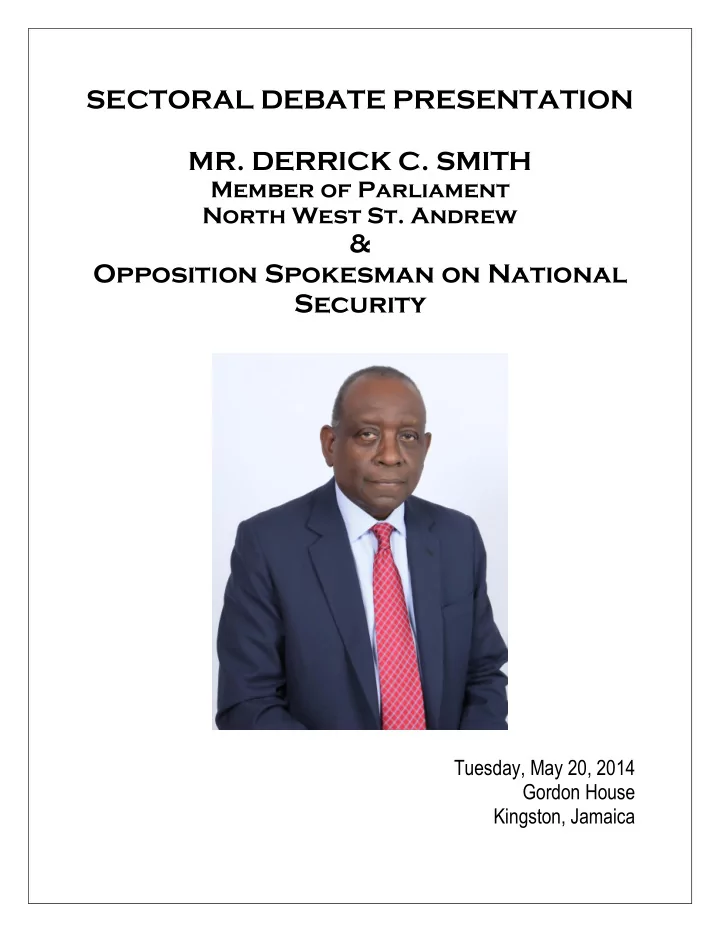
SECTORAL DEBATE PRESENTATION MR. DERRICK C. SMITH Member of Parliament North West St. Andrew & Opposition Spokesman on National Security Tuesday, May 20, 2014 Gordon House Kingston, Jamaica SECTORAL DEBATE PRESENTATION MR. DERRICK C.


slide-1
SLIDE 1

SECTORAL DEBATE PRESENTATION

  • MR. DERRICK C. SMITH

Member of Parliament North West St. Andrew

& Opposition Spokesman on National Security

Tuesday, May 20, 2014 Gordon House Kingston, Jamaica

slide-2
SLIDE 2

2

SECTORAL DEBATE PRESENTATION

  • MR. DERRICK C. SMITH

Opposition Spokesman on National Security Tuesday, May 20, 2014 INTRODUCTION

  • Mr. Speaker, I welcome the opportunity to participate in another Sectoral Debate in this House.

This, this year marks my 30th anniversary as a member of this Parliament and I am grateful to my constituents in North West St. Andrew, my councilors, my family and my party leaders, members and colleagues, who have kept faith in me through the years and continue to give me support and guidance. I thank the staff of the House of Parliament – including the clerks, the Hansard Team, the Marshal and the Orderlies, the general staff, the security and those who work in the lounge and other areas who see to our personal comfort. I also would like to pay tribute to you, Mr. Speaker, for your impartiality and your efforts to maintain the decorum of the House, despite your many challenges. PARLIAMENT And now, MR SPEAKER, I would like to turn to the first area of responsibility that I would like to address today, which is that of Leader of Opposition Business in the House of Representatives. MR SPEAKER, the Government boasts that it was able to deliver on more than 40 pieces of legislation during 2013/14. This is very commendable, of course. However, both the Leader of the House and the Leader of Government Business in the Senate, seem to conveniently ignore the fact

slide-3
SLIDE 3

3

that, without the cooperation of the Opposition, the Government could not have achieved that target. It is our strong commitment to Jamaica’s growth, development and prosperity, as well our maturity as an able Opposition which led us to take the position that we took, which we felt was in the best interest of the nation, socially or economically. However, the Government should recognize by now that, as the Leader of the Opposition said in the budget debate, while we will continue to behave as a democratic and patriotic force in this House, we will not abdicate our responsibility to protect the interests and the rights of the Jamaican people. As the Opposition, we express the view of a significant section of the electorate, and we help to ensure that the concerns of the various groups and interests not represented in government are either forgotten or trampled upon. We will continue to serve as a vent for the pent-up expression of those whose grievances and whose voices would otherwise not be heard. This role, we believe, builds the confidence of the people in our democracy, and reassures them that their concerns and interests are always ably expressed and protected in this Parliament. This side is concerned about the way the Government has abused our cooperation, in terms of how it has handled the tabling and consultation on these bills, in a manner which is should be far more efficient and transparent manner than what we have been experiencing. Bills that constantly miss their deadlines, or have to be withdrawn within days of being tabled and the failure to meet more often, do not reflect an image of an effective and efficient government.

slide-4
SLIDE 4

4

I am appealing to the Leader of the House to see that there is an improvement in the programme, going forward, to you Mr. Speaker, to ensure that the House find ways and means to facilitate these important meetings. THE OFFICE OF THE LEADER OF OPPOSITION

  • MR. SPEAKER, to me one of the most disgraceful features of the government’s treatment of

Parliament in the Estimates of Expenditure, has been the allocations made for the housekeeping expenses of the Office of the Leader of the Opposition. The Office was not conceived by us as sort of shrine to our democracy. It is one of the most tangible evidence of our democracy, and was established as an expression of the country’s strong belief in its democratic process. It was, therefore, inconceivable that even the utilities at this office would have become the subject

  • f media reports, in cases where they are either cut off by the utility company are in danger of

being cut off because of unpaid bills. The Minister of Finance and Planning, in addressing the issue in the Standing Finance Committee,

  • bviously did not recognize the value of this Office when he suggested that it be treated like any
  • ther office of Government.

That was not the position that prompted us, as government, to establish this Office. I think that the public agrees with us that some special consideration should be given to the Office of the Leader of the Opposition, because it represents a large and important element of the democratic process. It is a beacon of our democracy and should be treated as such, and I am still awaiting a response from the Leader of the House, on the basis of his undertaking in the Standing Committee meeting, to address the issue.

slide-5
SLIDE 5

5

NEW PARLIAMENT BUILDING The government has taken a decision that it will not proceed with the plan of the previous government to expand the current premises by acquiring neighbouring properties and renovating them. However, the government has taken that decision in a context in which it is very unlikely that it will proceed with the project, in light of the cost, the economy and the tight budget situation. We have a genuinely strong democracy and a Parliament building that can accommodate our work and become the nucleus of our parliamentary process is essential for it to work properly. Our main challenge, over the years, has been the fear of successive governments of going ahead with this project, in light of public concerns about the spending of such a large sum of money on a new parliamentary building. Since the government has chosen to target the construction of a new building, I hope that they have the guts to go through with the proposal on an urgent basis, because, as the chairman of the Economy and Production Committee noted last week, we cannot continue to function like this. At least the previous government, despite its fears, had an interim plan. Having dispensed with that plan, the Government must now give us a timeline for construction of the new building, or tell us what is their interim plan. MINISTRY OF NATIONAL SECURITY Now MR. Speaker I would like to turn to the main subject of my presentation, which is the performance if the Ministry of National Security and its projections for the next 12 months.

slide-6
SLIDE 6

6

BUDGET MR SPEAKER, looking at the Estimates of Expenditure for 2014/15 as they relate to the Ministry, I noted that the Minister said that it works out to approximately 9.7 percent of the total budget, after debt repayment for the financial year, which is less than the 10.5 percent that the ministry received in 2013. And taking into consideration that inflation was just above 8 percent since last year, it is quite

  • bvious that there is absolutely nothing suggesting that any improvement in the capacity or the

capabilities of the ministry, its departments and agencies is possible this year. The most important announcement, in terms of policy development, seems to be the merger of the Island Special Constabulary Force (ISF) with the Jamaica Constabulary Force (JCF). But, this is a move which has been years in making and probably would have been completed prior to now without the personality conflicts between the two arms of the police force. We understand that the merger has now been completed, but we were not satisfied that it was done as seamlessly as it could have been. We suggest that the government pay attention to the possibility of profiling, which could affect the relationship between personnel and ultimately affect the morale of the force. OTHER BUDGET ISSUES The Minister has also promised significant developments in terms of investment in equipment, including the force’s telecommunications system and the automated palm and fingerprint identification system.

slide-7
SLIDE 7

7

While we welcome these developments, and we agree that they will increase the operational efficiency of the force and enhance its investigative capacity, we recognize that these are very basic improvements which should have been done from last year. We recognize the importance of these improvements to the Minister’s programme to contain crime and violence. But, we need to see how effective these systems will be in the context of his crime- fighting policy. CRIME FIGURES (CHECK AGAINST DELIVERY) I am not afraid to repeat what I have stated outside of Parliament before, that crime has risen under every PNP administration since Independence. It is an indisputable fact that It is only under a JLP government that the country has seen significant reductions in crime. The country knows the PNP is soft on crime, probably because of its populist politics, and no amount of intellectual gymnastics can change that fact. Consider that in 1980 the murder rate was approximately 800, but by 1989 it fell to 400. It increased by 400 per cent under 18 years of PNP government, between 1989 and 2007, but between 2010 and 2011, the JLP managed another significant reduction in the murder rate. Last year the murder rate began to peak again, and the Minister cannot afford to be complacent now, because there are some reductions in the statistics this year. Instead, he should remember that last year, less than a month after he was in the House gloating

  • ver a downward trend that started under our administration and continued into early 2013, that

murders suddenly took off again and that spike continued into early 2014.

slide-8
SLIDE 8

8

So minister, in making your projections you should not confuse seasonal changes with the results

  • f your measures, because we are fast approaching that period again when murders seem to rise,

annually, and I hope you are better prepared to handled the situation than last year and focused a more on a scientific response to the problem rather than simply hoping for a divine intervention. I challenge the government to talk, fair and square, to the public in the interest of saving lives and changing the perception of wanton crime and corruption of our country. I challenge the government to focus on creating a safer society, in which we can all prosper rather than performing public relations contortions to try to shift the blame from their failures. INDECOM MR SPEAKER, I believe that the Independent Commission of Investigations (INDECOM) has been doing a very good job in dealing with the issue of police brutality. We have to recognize that change always come with teething problems, and it is important that we give INDECOM our full support as lawful citizens while it matures. I have no doubt that all decent, law abiding members of the security forces welcome the presence

  • f INDECOM, because they too want to remove perception of a corrupt, violent force which has no

regard for the human rights of our citizens. We note the recent attempt to suggest that crime and violence increased suddenly in Clarendon, because some policemen had been arrested in connection with some murders and were refused bail, and that this de-motivated the police in the parish. We could never accept that suggestion, because we believe that the vast majority of members of the security forces are decent, law abiding officers, who welcome the oversight, and who know they have nothing to fear as long as they operate within the confines of the law.

slide-9
SLIDE 9

9

The JLP introduced INDECOM to protect civilians against abuse at the hands of the police, and we are proud of it, and we will continue to defend its existence. We know that decent police and soldiers are proud to be part of a law enforcement body that protects itself against the excesses of a few, and that law abiding citizens observers looking on are happy that we had the guts to establish it as a mechanism to protect the rights and freedoms of our people, and to help remove perceptions that have tainted the force for decades. SCIENCE AND TECHNOLOGY

  • MR. SPEAKER, in 2008 we made a commitment to a greater use of science and technology in our

efforts to solve crime, including the increased use of DNA technology. We gave an undertaking to table and have passed legislation to enable the establishment of a DNA database in Jamaica, and to allow for the admission of DNA evidence into our criminal justice system. We do not claim to be the initiators of this effort to introduce DNA technology into the system. The DNA Bill was first promised by the current minister of finance and planning from as far back as 2006, when he led the security ministry. The first draft of a Cabinet submission was done in mid-2007 and passed, and drafting instructions issued in mid-2008. In light of all this, it surprises me that the current Minister told the nation that the first time he received a draft of the Bill was in November 2012. Where was the Bill for a whole year? Albeit that the government changed in 2007, we continued the process to the stage where the Bill was ready to be tabled. However, since returning to office the Government seems to be having second thoughts about introducing it.

slide-10
SLIDE 10

10

The Minister, himself, in a response to our questions in the recent Standing Finance Committee meetings, admitted that there was no allocation in the Estimates to further the process, and that it will take some time.

  • Mr. Minister, it has taken close to 10 years already, including the period of conception. One whole

decade of increased crime and violence, and government is still showing an inability to have the Bill tabled in Parliament! The minister gave the country an assurance last year that it would come to Parliament in January this year. Five months later, we are being told by the Minister that he is still waiting on the Office of the Chief Parliamentary Counsel to provide the final document. Certainly, we agree with the Minister that the Bill is not a panacea, but after some many years of investing in this process and the related promises, it is time for it to be tabled, now. We have had enough of the delays. The development of forensic science and the ability to obtain genetic matching on minute samples of blood, skin, saliva or hair has become an essential ingredient of forensic crime-fighting. And Jamaica, with its record of crime and violence, cannot continue to ignore the value of this important scientific input. The government needs to stop “pussyfooting” with this piece of legislation and let us have it tabled, now. I am also concerned about the delays in introducing the ShotSpotter, and the fact that the Minister has given us no update on the introduction of body cameras. For those members who may not recall, the ShotSpotter is gunshot-detection system, or a gunshot-sensor system, designed to detect the sonic boom of a bullet that travels faster than the speed of sound. The ShotSpotter relies on an acoustics-based, GPS-equipped system that automatically locates the origin of the shot and notifies authorities.

slide-11
SLIDE 11

11

Police officials in Washington D.C., who have used it, say that it cuts the "shots fired" response time in half. ShotSpotter also records all detected gunfire and corresponding locations for later forensic use. The cost of implementation for the ShotSpotter system can range from hundreds of thousands of dollars for a small area to millions of dollars to cover an entire city the size of D.C., but it has become an essential technology in fighting crime. In 2012, the Commissioner of Police made a request for the police to be armed with this important device and, in fact, publicly stated that discussions were ongoing with the Minister of National Security. The Minister said then, and I quote from the daily newspapers: “We have looked at it in several places. It has a record of significantly reducing gun crimes and gunfire in the range of 40 to 60 per cent in some areas where it has been used. We believe that if this capability is built out in many of our crime-prone communities, it could immediately and significantly enhance public security.” The Commissioner made another appeal in 2013 for its acquisition. The Minister should, at least, let us know what is his government’s position on the acquisition of this technology. The Minister did not say a single word either about the acquisition of body cameras for the JCF. In January this year, the Minister announced, at post cabinet briefing, plans for select police units to wear body cameras, to deal with allegations of extra-judicial killings and professional misconduct by members of the force. The Daily Gleaner reported on May 13 that the promised the newspaper to be more definitive about the implementation of the equipment when he spoke in the sectoral on that very day.

slide-12
SLIDE 12

12

The newspaper stated: “Bunting has not said much since making the announcement, but yesterday, in response to Gleaner queries, he signalled that he will be shedding light on the use of body cameras today when he makes his contribution to the Sectoral Debate in the House of Representatives”. The Minister said in January that the project would commence rollout in the second half of the year. We haven’t reached the second half of the year yet, but the fact that he didn’t even mention it in his sectoral speech raises a red flag. MR Speaker, I am sure that like the rest of us, the Minister was excited about the fact that HD CCTV played a very important role in the quick capture of the 2 “Boston Bombers” in 2013. I too was impressed with the speed with which they were apprehended and this has increased my interest, as well as the interest of many people around the world who are interested in apprehension, in the use of High Definition CCTV Networks. MR SPEAKER, I believe that the increased use of CCTV, paired with the increasing availability of smart phones, is going to play a very critical role in our crime-fighting programme in the future. The idea of CCTV is obviously not a new one in Jamaica, and I welcome the announcement that there will be increased financing for CCTV this year. However, the Minister has not been really straightforward as to exactly what he plans to do and how it is being financed. I hope that sometime in the near future he will realize the need to be more inclusive and transparent in terms of his programmes and not leave the nation to be speculative about his intentions. He needs to take the Opposition and the public more into his confidence, consult and discuss the issues, if he expects to have the full support of the law abiding population for his policy. Yes Mr. Minister, crime like education and health are not issues which can remain secretive.

slide-13
SLIDE 13

13

These are issues which affect all Jamaicans- JLP, PNP or no P- and therefore we need to approach them in a manner in which Jamaicans can make informed comments on the decisions that are taken. I remember at his inauguration in 2011 as Prime Minister of Jamaica, albeit for a brief stint, the current Leader of the Opposition suggested to the current Prime Minister and then Opposition Leader that they walk together through the garrison communities, as a symbol of cooperation in removing the stigma of garrison politics. The then Leader of the Opposition and now PM refused and he was even ridiculed for making the proposal. Now I am happy to see that this Minister of National Security has embraced that suggestion in his anti-crime strategy and has been leading bipartisan peace marches throughout crime hit garrison committees. I welcome the transformation, but I just needed to show him how simple cooperation against crime can be, if we remove the political blinkers and look at the problems and solutions with open minds. UNITE FOR CHANGE The Minister has even taken the suggestion much further, under the new Unite for Change

  • programme. He is engaged in a number of social events –football matches, shows, pageants,

etcetera – to attract the attention of the residents of these garrison committees. I have nothing against these efforts. Everything has to be tried, in a mix, to increase the profile of social interventions. But, I warn the minister to exclude partisanship. Find people on both sides of the divides- whether it is the political divide, the religious divide or even the colour/class divide- to

  • serve. Do not limit to a few chosen lieutenants in whom you are politically pleased.
slide-14
SLIDE 14

14

I note the contemplation to grade the communities. There are questions about who will be doing the grading and how transparent and inclusive that process will be. Every effort should be made to ensure balance in how you allocate the resources, especially in choosing the communities to benefit. My discussions with people show that very little is known about this programme among both civilians and the security forces. I think you need to rev up the public relations, as well. NATIONAL SECURITY POLICY (NSP) This leads me, Mr. Speaker, to take note of the tabling of the National Security Policy by the National Security Policy Co-ordinating Unit. I must confess that I have not fully digested the document, but there are some issues which have been highlighted that have attracted my attention. For example, I am very concerned about the suggestion that crime is benefiting from a higher level

  • f tolerance of criminals and their activities within the society.

I am sure the Minister must be concerned, himself, and in fact every member of both Houses of this Parliament. I would like to quote one paragraph from the report from the section dealing with “Threats Relating to Crime”, which states: "The level of crime has increased over the years and, consequently, the pattern of criminal activities reflects a greater degree of organisation and coordination. The situation has worsened by what appears to be an increased tolerance of crime and criminals within the wider society.”

slide-15
SLIDE 15

15

Now, MR SPEAKER, we all have to admit that this is a very, very serious indictment of us as political leaders of this nation. It is an indictment on the Church, as the moral leaders of our society; civil society leaders; our crime-fighting mechanisms, including its personnel; our student institutions; our family institutions; and our society, in general. In fact, it is so critical an issue that it requires the immediate and full recognition of our Prime Minister as a major priority, in terms of the government’s planning and policy direction. We cannot afford to ignore a culture that is becoming increasingly tolerant of crime and criminals. I hope that we are not just having this policy document tabled and ignored. It demands immediate attention if we have any faith whatsoever in the arguments that are raised in this document. We must increase our efforts to undermine the criminal “dons” and their organizations which continue to impress the poor with their ability to achieve and distribute wealth, and to use it as means of escaping the law and luring our young people into their activities. I agree with the sentiment that law enforcement activities alone cannot provide an adequate response to the problems. We need to do something urgently about the court system. The long delays in trials are seriously affecting the confidence of the people and it promoting “jungle justice”, which the criminal gangs thrive on. We need to ensure that the legislation that we are passing are effective and in use. We can’t afford to pass legislation and then you hear nothing more about them. Where are the legislation to improve the court environment in terms of witness protection and modern technology for videoing evidence? I have not heard a word about these for the past two years!

slide-16
SLIDE 16

16

I have always advocated that sustainable reductions in crime will require deliberate and focused strategies, coordinated law enforcement, justice and social development programmes at the national, community and individual levels to address the causal factors and prevent further spread, as is stated in the Ministry Paper. It is obvious that the government alone, and in particular this government, cannot handle the crime issue and, having realized that, the criminal elements are making a mockery of the government’s efforts. The minister should take note of the statement, recently reported in the press, from Lotto scammers, who claim that despite the legislation and renewed efforts to destroy their activities they will continue. We must unite, not just for change in garrison communities, but for a total change in how we approach the issues of reducing crime, penalizing criminals, protecting witnesses and giving Jamaicans renewed confidence in our ability to secure them from harm and protect when they come forward to give information or as witnesses in the courts. We must reassure the nation of our ability to secure and protect them from the criminals and crime, as the motto of the JCF, implies, if we are to remove this threat of tolerance. That is the change that we really need.

  • end-