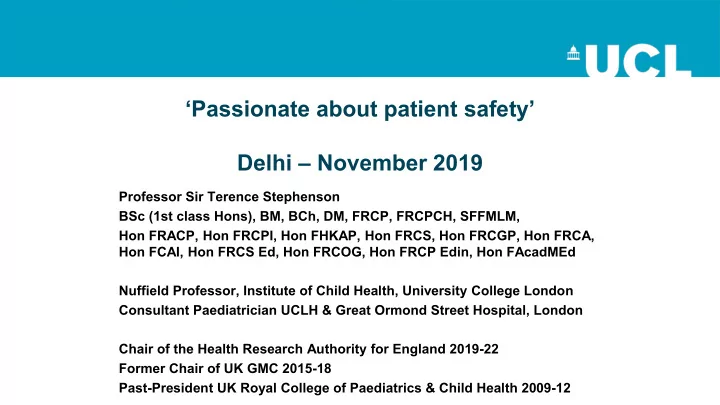
Passionate about patient safety Delhi November 2019 Professor Sir - - PowerPoint PPT Presentation

passionate about patient safety delhi november 2019
SMART_READER_LITE
LIVE PREVIEW

Passionate about patient safety Delhi November 2019 Professor Sir - - PowerPoint PPT Presentation

Passionate about patient safety Delhi November 2019 Professor Sir Terence Stephenson BSc (1st class Hons), BM, BCh, DM, FRCP, FRCPCH, SFFMLM, Hon FRACP, Hon FRCPI, Hon FHKAP, Hon FRCS, Hon FRCGP, Hon FRCA, Hon FCAI, Hon FRCS Ed, Hon


slide-1
SLIDE 1

Professor Sir Terence Stephenson BSc (1st class Hons), BM, BCh, DM, FRCP, FRCPCH, SFFMLM, Hon FRACP, Hon FRCPI, Hon FHKAP, Hon FRCS, Hon FRCGP, Hon FRCA, Hon FCAI, Hon FRCS Ed, Hon FRCOG, Hon FRCP Edin, Hon FAcadMEd Nuffield Professor, Institute of Child Health, University College London Consultant Paediatrician UCLH & Great Ormond Street Hospital, London Chair of the Health Research Authority for England 2019-22 Former Chair of UK GMC 2015-18 Past-President UK Royal College of Paediatrics & Child Health 2009-12

‘Passionate about patient safety’ Delhi – November 2019

slide-2
SLIDE 2

Why is this talk so relevant to India today?

  • The Indian government has moved towards

proprietary standards for identification and traceability

  • The need for globally harmonised standards is

crucial as healthcare becomes a global industry and the world becomes a global village

  • I will give some positive experiences when using

them to improve patient safety

  • Identification of pharmaceuticals also helps counter

fraud

  • GS1 standards are one leading example of globally

harmonised standards

slide-3
SLIDE 3
slide-4
SLIDE 4
slide-5
SLIDE 5

Is the NHS safe?

  • Of the top 20 risk factors for all deaths, adverse in-hospital healthcare

events come eleventh – above alcohol, drugs, violence and road traffic accidents.

  • In the NHS each year there are: 624 million prescriptions, 300 million

GP visits, 13 million OPD visits, 5.3 million admissions, 2.9 million emergency ambulance calls, and an estimated 900,000 adverse events.

  • Every week – two wrong site surgeries and two operations with kit

wrongly left inside. NEVER EVENTS 2016/17= 400

  • wrong site/retained foreign body/wrong implant = 79%; Medication

error causing harm = 12%

  • Adverse events (unintended injury caused by medical management

rather than disease) lead to an additional three million NHS bed days. Costing at least £1 billion a year.

slide-6
SLIDE 6
slide-7
SLIDE 7
slide-8
SLIDE 8
slide-9
SLIDE 9
slide-10
SLIDE 10

Wayne Jowett died following an inadvertent intrathecal vincristine injection, the 23rd such incident reported worldwide (and the 14th in 15 years in the United Kingdom)

slide-11
SLIDE 11
slide-12
SLIDE 12

Advisor to the National Patient Safety Agency, 2003-2006:

slide-13
SLIDE 13
slide-14
SLIDE 14
slide-15
SLIDE 15

Problems with identification of intravenous infusions

slide-16
SLIDE 16
slide-17
SLIDE 17
slide-18
SLIDE 18
slide-19
SLIDE 19

Computerised prescribing with computerised decision support can decrease serious medication errors by 55% - 64%

slide-20
SLIDE 20

2010 MHRA safety alert: metal-on-metal hip replacements 2010 MHRA safety alert: PIP silicone implants Barcoding allows tracking of: Patient Product (UDI) Place

slide-21
SLIDE 21
slide-22
SLIDE 22
slide-23
SLIDE 23
slide-24
SLIDE 24

Reducing the % – worthwhile?

If 99.9% were good enough…

  • Major plane crash every 3 days
  • 12 babies given to wrong parents every day
  • 37,000 ATM errors every hour

Institute for Healthcare Improvement (data relate to US population)

slide-25
SLIDE 25
slide-26
SLIDE 26

FINISHED FILES ARE THE RESULT OF YEARS OF SCIENTIFIC STUDY COMBINED WITH THE EXPERIENCE OF MANY YEARS

slide-27
SLIDE 27
slide-28
SLIDE 28

Do you want to be a patient in a hospital where safety is not taken as seriously as your next airline flight?

slide-29
SLIDE 29

THANK YOU

slide-30
SLIDE 30