SLIDE 1
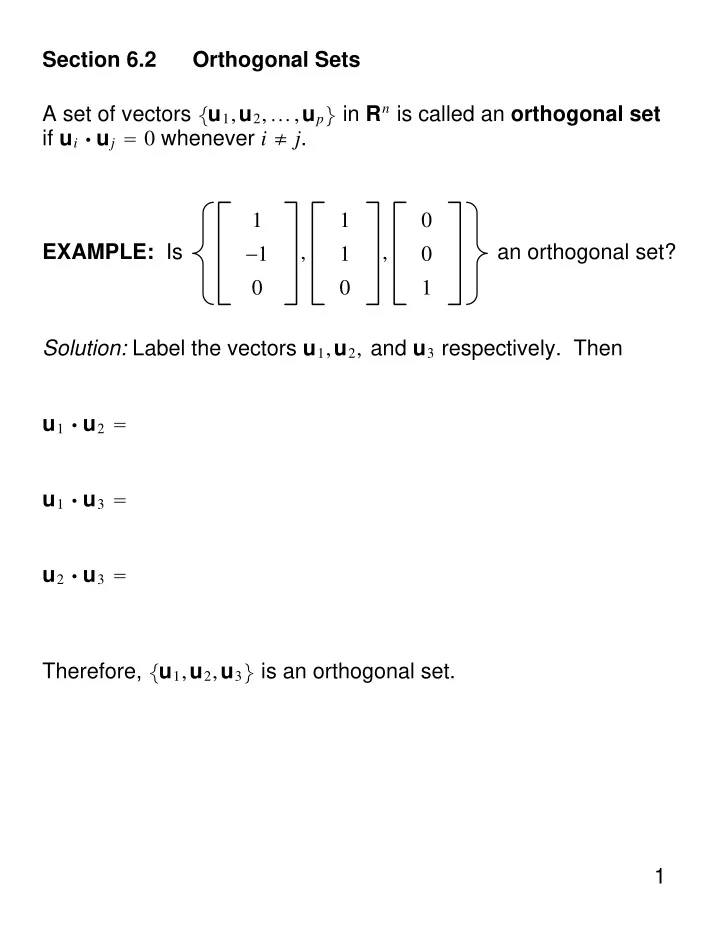
Section 6.2 Orthogonal Sets A set of vectors u1,u2,…,up in Rn is called an orthogonal set if ui ⋅ uj = 0 whenever i ≠ j. EXAMPLE: Is 1 −1 , 1 1 , 1 an orthogonal set? Solution: Label the vectors u1,u2, and u3 respectively. Then u1 ⋅ u2 = u1 ⋅ u3 = u2 ⋅ u3 = Therefore, u1,u2,u3 is an orthogonal set. 1
SLIDE 2
THEOREM 4 Suppose S = u1,u2,…,up is an orthogonal set of nonzero vectors in Rn and W =spanu1,u2,…,up. Then S is a linearly independent set and is therefore a basis for W. Partial Proof: Suppose c1u1 + c2u2 + ⋯ + cpup = 0 c1u1 + c2u2 + ⋯ + cpup ⋅ = 0 ⋅ c1u1 ⋅ u1 + c2u2 ⋅ u1 + ⋯ + cpup ⋅ u1 = 0 c1u1 ⋅ u1 + c2u2 ⋅ u1 + ⋯ + cpup ⋅ u1 = 0 c1u1 ⋅ u1 = 0 Since u1 ≠ 0, u1 ⋅ u1 > 0 which means c1 = ____. In a similar manner, c2,…,cp can be shown to by all 0. So S is a linearly independent set.■ An orthogonal basis for a subspace W of Rn is a basis for W that is also an orthogonal set. 2
SLIDE 3 EXAMPLE: Suppose S = u1,u2,…,up is an orthogonal basis for a subspace W of Rn and suppose y is in W. Find c1,…,cp so that y =c1u1 + c2u2 + ⋯ + cpup. Solution: y ⋅ =c1u1 + c2u2 + ⋯ + cpup ⋅ y ⋅ u1=c1u1 + c2u2 + ⋯ + cpup ⋅ u1 y ⋅ u1=c1u1 ⋅ u1 + c2u2 ⋅ u1 + ⋯ + cpup ⋅ u1 y ⋅ u1=c1u1 ⋅ u1 c1 =
y⋅u1 u1⋅u1
Similarly, c2 = , c3 = ,…, cp = THEOREM 5 Let u1,u2,…,up be an orthogonal basis for a subspace W of
- Rn. Then each y in W has a unique representation as a linear
combination of u1,u2,…,up. In fact, if y =c1u1 + c2u2 + ⋯ + cpup then cj =
y⋅uj uj⋅uj
j = 1,…,p 3
SLIDE 4 EXAMPLE: Express y = 3 7 4 as a linear combination of the
1 −1 , 1 1 , 1 . Solution:
y⋅u1 u1⋅u1 = y⋅u2 u2⋅u2 = y⋅u3 u3⋅u3 =
Hence y =_____u1 + ______u2 + ______u3 4
SLIDE 5
Orthogonal Projections For a nonzero vector u in Rn, suppose we want to write y in Rn as the the following y = multiple of u + multiple a vector ⊥ to u y − αu ⋅ u =0 y ⋅ u − αu ⋅ u=0 α = y= y⋅u
u⋅u u
(orthogonal projection of y onto u) and z = y − y⋅u
u⋅u u
(component of y orthogonal to u) 5
SLIDE 6
6
SLIDE 7
EXAMPLE: Let y = −8 4 and u = 3 1 . Compute the distance from y to the line through 0 and u. Solution: y= y⋅u
u⋅u u =
Distance from y to the line through 0 and u = distance from y to y = ‖ y − y‖ = 7
SLIDE 8
Orthonormal Sets A set of vectors u1,u2,…,up in Rn is called an orthonormal set if it is an orthogonal set of unit vectors. If W =spanu1,u2,…,up, then u1,u2,…,up is an orthonormal basis for W. 8
SLIDE 9
Recall that v is a unit vector if ‖v‖ = v ⋅ v = vTv = 1. Suppose U = u1 u2 u3 where u1,u2,u3 is an orthonormal set. Then UTU = u1
T
u2
T
u3
T
u1 u2 u3 = = It can be shown that UUT = I also. So U−1 = UT (such a matrix is called an orthogonal matrix). 9
SLIDE 10 THEOREM 6 An m × n matrix U has orthonormal columns if and only if UTU = I. THEOREM 7 Let U be an m × n matrix with orthonormal columns, and let x and y be in Rn. Then
- a. ‖Ux‖ = ‖x‖
- b. Ux ⋅ Uy = x ⋅ y
- c. Ux ⋅ Uy = 0 if and only if x ⋅ y = 0.
Proof of part b: Ux ⋅ Uy = 10