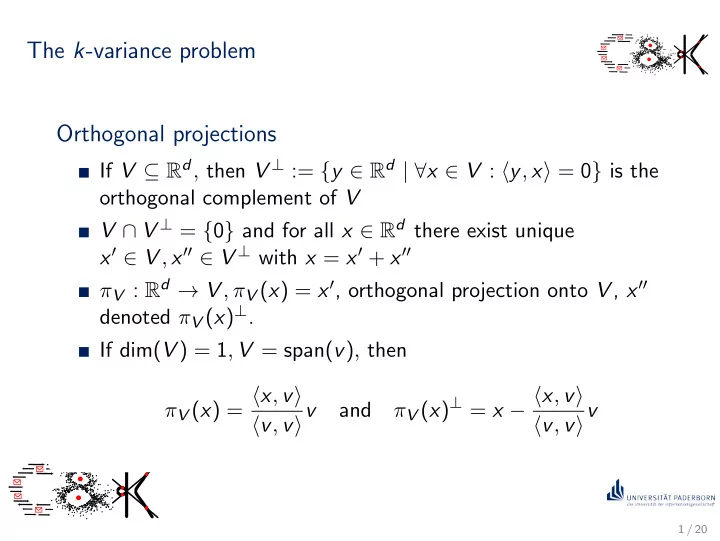
SLIDE 1 The k-variance problem Orthogonal projections
If V ⊆ Rd, then V ⊥ := {y ∈ Rd | ∀x ∈ V : y, x = 0} is the
- rthogonal complement of V
V ∩ V ⊥ = {0} and for all x ∈ Rd there exist unique x′ ∈ V , x′′ ∈ V ⊥ with x = x′ + x′′ πV : Rd → V , πV (x) = x′, orthogonal projection onto V , x′′ denoted πV (x)⊥. If dim(V ) = 1, V = span(v), then πV (x) = x, v v, vv and πV (x)⊥ = x − x, v v, vv
1 / 20
SLIDE 2 The k-variance problem Problem 5.1 (k-variance problem)
Given P ⊂ Rd, |P| = n and k ∈ N, Find the k-dimensional subspace Vk that minimizes D(P, V ) :=
p − πV (p)2. The subspace Vk is called the (k-dimensional) singular value decomposition of P.
2 / 20
SLIDE 3 Characterization of optimal subspace Lemma 5.2
For all P ⊂ Rd Vk = argminV :dim(V )=k{D(P, V )} ⇔ Vk = argmaxV :dim(V )=k
πV (p)2 . More generally, for every subspace V ⊆ Rd D(P, V ) =
q2 −
πV (q)2.
3 / 20
SLIDE 4
Complexity and relation to k-means Theorem 5.3
For every P ⊂ Rd and k ∈ N the subspace Vk minimizing D(P, V ) can be computed efficiently.
Lemma 5.4
For every P ⊂ Rd and k ∈ N D(P, Vk) ≤ optk(P).
4 / 20
SLIDE 5
Spectral algorithms Spectral algorithms
Given P ⊂ Rd,
1 compute the singular value decomposition Vk, i.e. the
subspace minimizing D(P, V ),
2 solve your favorite clustering problem with your favorite
algorithm on input πVk(P) := {πVk(p) : p ∈ P},
3 return the solution found in the previous step.
5 / 20
SLIDE 6 Orthonormal bases Definition 5.5
Let V ⊆ Rd be a k-dimensional subspace of Rd and let B = {v1, . . . , vk} be a basis of V . Basis B is an orthonormal basis (ONB) of V if
1 vi = 1, i = 1, . . . , k 2 vi, vj = 0 for i = j, i, j = 1, . . . , n.
Theorem 5.6
Every subspace V ⊆ Rd has an orthonormal basis. Moreover, any
- rthonormal basis of V can be extended to an orthonormal basis of
Rd.
6 / 20
SLIDE 7
Length-preserving linear maps
V ⊆ Rd subspace with orthonormal basis BV = {v1, . . . , vk}. U ∈ Rk×d matrix with rows vT
1 , . . . , vT k .
ΠV denotes function ΠV : Rd → Rk, x → U · x
Theorem 5.7
The linear function ΠV has the following properties:
1 ΠV is surjective. 2 ΠV is length-preserving on V , i.e. for all
x ∈ V : x = ΠV (x).
7 / 20
SLIDE 8
Spectral algorithms revisited Spectral algorithms
Given P ⊂ Rd,
1 compute the singular value decomposition Vk, i.e. the
subspace minimizing D(P, V ),
2 solve your favorite clustering problem with your favorite
algorithm on input πVk(P) := {πVk(p) : p ∈ P}, i.e. compute an orthonormal basis for Vk and apply your favorite clustering algorithm on the set ΠVk(πVk(P))
3 return the solution found in the previous step.
8 / 20
SLIDE 9 k-variance and k-means Lemma 5.8
Let P ⊂ Rd and let V be an arbitrary k-dimensional subspace of
- Rd. Then
- ptk(πV (P)) ≤ optk(P),
where optk(P) denotes the cost of an optimal solution of k-means with input P.
9 / 20
SLIDE 10 k-variance and k-means Lemma 5.9
Let P ⊂ Rd and let V be an arbitrary k-dimensional subspace of
C = { ˆ C1, . . . , ˆ Ck} is a k-clustering of πV (P) and denote by C := {C1, . . . , Ck} with Ci := {p ∈ P : πV (p) ∈ ˆ Ci}, the corresponding k-clustering of P. Then cost(πV (P), ˆ C) ≤ cost(P, C) ≤ cost(πV (P), ˆ C) + D(P, V ).
10 / 20
SLIDE 11
Approximation guarantees for spectral algorithms Spectral algorithms
Given P ⊂ Rd,
1 compute the singular value decomposition Vk, i.e. the
subspace minimizing D(P, C),
2 solve your favorite clustering problem with your favorite
algorithm on input πVk(P) := {πVk(p) : p ∈ P},
3 return the solution found in the previous step.
Theorem 5.10
Let P ⊂ Rd and let Vk be the k-dimensional subspace of Rd minimizing D(P, V ). If ˆ C is a γ-approximate k-clustering for πVk(P), then the corresponding k-clustering C as defined in the previous lemma is a (γ + 1)-approximate k-clustering for P.
11 / 20
SLIDE 12 An excact algorithm for k-means
Exact-k-Means(P, k)
Compute the set K of sets of t hyperplanes with k ≤ t ≤ k
2
hyperplane contains d affinely independent points from P; for S ∈ K do check that S defines an arrangement of exactly k cells; for all assignments aS of points of P on hyperplanes in S to cells do for all cells do compute the centroid of points of P in the cell; end CS,as := set of centroids computed in the previous step; end CS := argminCS,aS {D(P, CS,aS )}; end return argminCS {D(P, CS)};
12 / 20
SLIDE 13 An excact algorithm for k-means Theorem 5.11
Algorithm Exact-k-Means solves the k-means problem
- ptimally in time O
- ndk2/2
.
13 / 20
SLIDE 14 A spectral approximation algorithm
Spectral-k-Means(P, k) Compute Vk := argminV :dim(V )=k{D(P, V )}; ¯ C := Exact-k-Means(πVk(P), k); return ¯ C;
Theorem 5.12
Spectral-k-Means is an approximation algorithm for the k-means problem with running time O
and approximation factor 2.
14 / 20
SLIDE 15 Matrix representation of point sets
P = {p1, . . . , pn} ⊂ Rd matrix A ∈ Rd×n with columns pi called matrix representation
rows of AT ∈ Rn×d are pT
i
for every v ∈ Rd:
AT · v = (p1, v, . . . , pn, v)T ∈ Rn AT · v2 = v T · A · AT · v = n
i=1pi, v2
15 / 20
SLIDE 16 Characterization of k-variance solutions Theorem 5.13
For every set of points P ⊂ Rd, |P| = n, with matrix representation A ∈ Rd×n : argmaxV :dim(V )=k
πV (p)2 = argmaxONB B : |B| = k
vT · A · AT · v
SLIDE 17 Eigenvalues and eigenvectors Definition 5.14
Let M ∈ Rd×d, λ ∈ R and v ∈ Rd, v = 0.Then λ is called an eigenvalue of M to eigenvector v (and vice versa) if M · v = λ · v.
Theorem 5.15
For every A ∈ Rd×n the matrix M = A · AT ∈ Rd×d has non-negative eigenvalues λ1 ≥ · · · λd ≥ 0. Moreover, there is an
- rthonormal basis B = {v1, . . . , vd} such that λi is an eigenvalue
- f M to eigenvector vi, i = 1, . . . , d.
17 / 20
SLIDE 18
Solutions to the k-variance problem Theorem 5.16
Let P ⊂ Rd be a finite set of points with matrix representation A ∈ Rd×n and k ∈ N. If A · AT has eigenvalues λ1 ≥ · · · ≥ λd and B = {v1, . . . , vd} is an orthonormal basis consisting of eigenvectors, i.e. vi is an eigenvector to eigenvalue λi, i = 1 . . . , d, then span{v1, . . . , vk} = argminV :dim(V )=k{D(P, V )}.
18 / 20
SLIDE 19
Singular values and vectors
M ∈ Rn×d, case d = n: v ∈ Rd eigenvector to eigenvalue σ if M · v = σ · v generalization to n = d? can one compute eigenvectors and eigenvalues of A · AT without computing the matrix product?
Singular vectors and singular values
σ ∈ R is called singular value of M with corresponding singular vectors v ∈ Rd, u ∈ Rn if
1 M · v = σ · u 2 uT · M = σ · vT.
19 / 20
SLIDE 20
Eigenvectors and singular vectors Lemma 5.17
Let M ∈ Rn×d. Then σ ∈ R is a singular value of M with corresponding singular vectors v ∈ Rd and u ∈ Rn if and only if
1 σ2 is an eigenvalue of MT · M, 2 v is a right eigenvector of MT · M to eigenvalue σ2, 3 uT is a left eigenvector of M · MT to eigenvalue σ2.
20 / 20