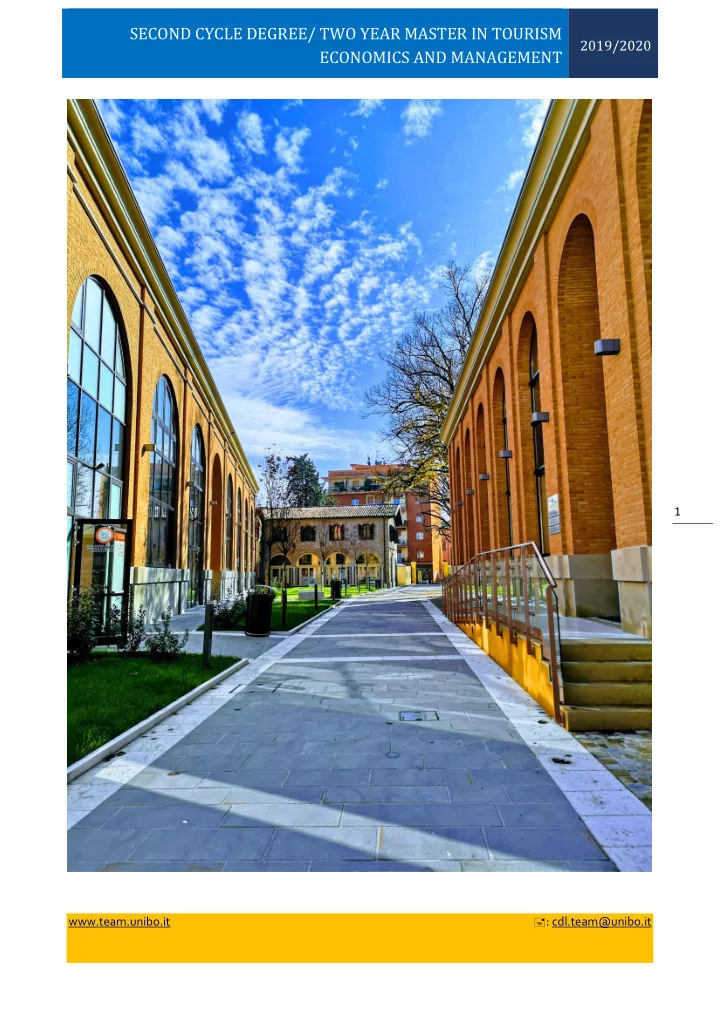
SLIDE 1
SECOND CYCLE DEGREE/ TWO YEAR MASTER IN TOURISM ECONOMICS AND MANAGEMENT
2019/2020
www.team.unibo.it : cdl.team@unibo.it 1
SLIDE 2 SECOND CYCLE DEGREE/ TWO YEAR MASTER IN TOURISM ECONOMICS AND MANAGEMENT
2019/2020
www.team.unibo.it : cdl.team@unibo.it 2 The European Master of Science (Laurea Magistrale) in Tourism Economics and Management (TEaM) is a two-year postgraduate degree. The program prepares managers and professionals that are able to tackle the global challenges of contemporary tourism: being, at the same time, engine for economic growth, key player of strategy and marketing functions inside global tourism companies, promoter
entrepreneurship in digital, ethical, sustainable and cultural tourism business. Students of TEaM live in Rimini, which is one of the most exciting tourism destinations in Europe, hosting about 15 million overnight stays every year. It is a home for the School of Economics, Management and Statistics, University of Bologna (Rimini Campus), which is a leading institution in tourism studies, known for the high quality of its teaching programmes (certified by the UN World Tourism Organization – TedQual) and its research
- publications. It represents the place where the
excellence of the most ancient university in the western world meets the ability of local entrepreneurs and the public administration in developing a flourishing tourism sector. Indeed, the perfect place to study tourism economics and management. This booklet provides a description
the
- rganization of study in Section 1, and the details of
the study programme for the 2019/2020 edition in Section 2. Further information about TEaM and the 2019/2020 Call for applications can be found at the following link: www.team.unibo.it.
Contacts
- 1. TEaM Director: Manuela Presutti
: manuela.presutti@unibo.it
manuela-presutti
- 2. Programme Coordinator: Valeria Macchini
: cdl.team@unibo.it
valeria.macchini TEAM International Degree Programme- Rimini Unibo International Desk:
campusriminin.internationaldesk@unibo.it
SLIDE 3 SECOND CYCLE DEGREE/ TWO YEAR MASTER IN TOURISM ECONOMICS AND MANAGEMENT
2019/2020
www.team.unibo.it : cdl.team@unibo.it 3
Table of contents
Contacts 2
4 1.1 Introduction 4 1.2 Programme Structure 5 1.3 Tuition Fees and Scholarships 9 1.4 Orientation for students and graduates 10 1.5 Studying at the University of Bologna 11 1.6 Living in Rimini 12
- 2. Study programme in detail
13 2.1 Crash courses 13 2.2 First year, first semester 13 2.3 First year, second semester 13 2.4 Second year, first semester 14 2.5 Second year, second semester 15 2.6 Elective courses 15 2.7 Final dissertation 18
SLIDE 4 SECOND CYCLE DEGREE/ TWO YEAR MASTER IN TOURISM ECONOMICS AND MANAGEMENT
2019/2020
www.team.unibo.it : cdl.team@unibo.it 4
1.1 Introduction The supply of tourism services, even in the complexity of global competition, pivots around three specific factors:
- rganizational, natural and cultural resources. The TEaM
program brings these factors at the core of its educational mission. An efficient management of firms and destinations needs strong organizational skills, from the definition of effective pricing and booking policies, to the implementation of branding and corporate strategies, to the effective management of human
- resources. The sustainable management of natural
resources allows tourism destinations and firms to improve their competitiveness, fuelling at the same time a virtuous circle of economic, social, and environmental
- development. TEaM addresses all these topics,
searching for the right balance between economic, managerial and quantitative skills. A continuous
events, laboratories, seminars, workshops with entrepreneurs, institutions players, managers in different positions and roles and stakeholders, assures the right balance between theoretical and practical economic and managerial concepts. 1.1.1 Pre-requisite knowledge The diverse experience, provenance, and study background of TEaM students are one of the strength of the programme. TEaM is open to graduates of any discipline with major in economics, business or tourism- related studies is valued in the application procedure (see the Call for Applications, Section 4 for more details). To provide students with the basic tools and pre- requisites needed to attend the TEaM programme successfully, some crash courses in Economics, Statistics and Mathematics will be organized (see Section 2.1 for more details). As for English knowledge, candidates must have a good command of it, equivalent to the B2 European level (see the Call for Applications, Section 3 for more details). 1.1.2 Admission requirements Admission to the 2nd cycle degree programme in Tourism Economics and Management is open to EU and NON-EU citizens (maxi 50). All candidates shall meet the following general requirements:
- 1. First cycle degree or equivalent bachelor level
achieved in any subject, awarded by an Italian
- r an accredited foreign university or university-
level institution.
Additionally, all candidates shall meet specific conditions for TEaM programme as follows: Knowledge of fundamental elements in the area
business, economics, law and mathematical-statistical disciplines; English language requirement, at least B2 level Annual It is strongly recommended to check and read carefully the requirements and useful deadlines regarding application procedure in the “Call for application” that will be available on February 2019. There are three possibility to apply for the course and the intakes will take place as follow:
Intake Online applicati
Deadlin e Results NON-EU Applica nts EU Applica nts A 06/02/20 19 04/04/20 19 12/04/20 19 YES YES B 15/04/20 19 04/07/20 19 12/07/20 19 YES YES C 15/07/20 19 29/08/20 19 05/09/20 19 YES, under condition ** YES
SLIDE 5 SECOND CYCLE DEGREE/ TWO YEAR MASTER IN TOURISM ECONOMICS AND MANAGEMENT
2019/2020
www.team.unibo.it : cdl.team@unibo.it 5 1.1.3 Learning outcomes and career /job opportunities Given the interdisciplinary approach of the different several teaching activities, TEAM graduates develop significant skills mainly in economics and management, jointly with a deep knowledge of law, quantitative methods, sustainable tourism, entrepreneurship issue, finance and organization concepts. At the same time, TEaM graduates will develop advanced study methods and learning abilities, which will allow them to continue the study in a Ph.D., or enabling them to produce independent analysis. Most of the competitive advantages of the TEAM degree program lie in the efficient and profitable network of tourism firms and institutions developed over time aimed to assure a practical education of TEAM graduates, completing the theoretical background matured during the classes. Many international hotel chains (i.e. Sheraton and Hilton), incubators and accelerators of companies (i.e. Rimini Innovation Square, Association of Tourism Start- ups, Almacube Bologna), digital marketing companies (i.e. Musement, Teamwork, Easymarket) boutique, sustainable and luxury hotels (i.e. Hotel Card, Duomo Hotel, Grand Hotel, CrossCondotti Hotel), travel agencies and tour operators (i.e. Eden Viaggi, Booking), frequently meet students presenting their successful case studies, offering significant positions for internship, but also organising game competition activities. Consequently, students will be prepared for statistical and economic market analysis, territorial planning, micro and macro analysis of tourism flow and advanced quantitative methods. At the same time, TEAM graduates possess all strategic and economic skills necessary to work inside a tourism company, from the definition of effective pricing and booking policies, to the implementation of branding and corporate strategies, to the effective management of human resources and cultural activities. Upon graduation, this tourism degree allows students to pursue a career in many interconnected businesses of the tourism sector: accommodation and food service
- perations, digital tourism companies, international
travel and tourism organizations, visitor bureaus and conventions, tourism development agencies, recreational businesses, cruise ships, resorts, theme significant career opportunities in tourism sector are assured to TEAM graduates such as parks and airlines. Many significant career opportunities in the tourism sector are assured to TEAM graduates such as: start- upper, project manager, marketing and financial director, managing director of tourism companies, destination manager, event manager, travel agent, conference and exhibition manager, hotel general manager and so
https://corsi.unibo.it/2cycle/team/prospects 1.2 Programme Structure The programme is divided in four semesters (two years), granting to the successful student 120 credits (European Credit Transfer System - ECTS). The programme consists of coursework (102 ECTS), seminars (3 ECTS) and the writing and the discussion of a final dissertation (15 ECTS). Most courses consist of lectures and laboratory sessions, and employ a proactive teaching methodology so that students are stimulated to develop critical thinking and acquire independent research skills. In the following table, the study plan for students enrolling in the Academic Year 2019/20 is
- utlined. A full description of each course is
presented in Section 2.
SLIDE 6 SECOND CYCLE DEGREE/ TWO YEAR MASTER IN TOURISM ECONOMICS AND MANAGEMENT
2019/2020
www.team.unibo.it : cdl.team@unibo.it 6 Period ECTS Hours First year, first semester
Tourism Macroeconomics 12 60 (+ 24 lab) Part I: The Impact of Tourism in the Economy Part II: Tourism, Growth and Sustainability. Managerial Accounting and Reporting in Sustainable Tourism 12 60 Part I: Managerial Accounting and Reporting in Tourism Entities Part II: Social and Environmental Accounting and Reporting for Sustainable Tourism Mathematics for Social Sciences 6 30 (+ 15 lab)
First year, second semester
Tourism Management 12 60 (+30 lab) Part I: Introduction to Management Part II: Tourism Management Tourism Microeconomics 12 60 Part I: Analysis of Tourism Demand Part II: Industrial Organization and Market Structure in Tourism Statistics for Social Sciences 6 30 (+ 15 lab)
SLIDE 7 SECOND CYCLE DEGREE/ TWO YEAR MASTER IN TOURISM ECONOMICS AND MANAGEMENT
2019/2020
www.team.unibo.it : cdl.team@unibo.it 7 Period ECTS Hours Second year, first semester
Empirical Methods in Tourism Economics 6 30 Organization and Finance in Tourism 12 60 Part I - Organization of Tourism Enterprises Part II - Corporate Finance for Travel and Tourism Industry Seminars 3
Second year, second semester
Destination Marketing and Management 6 30 International Tourism Legislation and Organization 6 30
Second year - Elective courses for 12 ECTS
Innovation in Cultural Tourism 12 60 Part I – New Cultural Tourism Products Part II – Local Development and Cultural Routes Regional and Transport Economics 6 30 Web and Revenue Management in Tourism 6 30 Environmental Economics 6 30 Managing diversities in internationalization processes 6 30 Project management 6 30 Business Simulation 6 30 Web Communication 9 45 Internship 12 Final Dissertation 15
SLIDE 8 SECOND CYCLE DEGREE/ TWO YEAR MASTER IN TOURISM ECONOMICS AND MANAGEMENT
2019/2020
www.team.unibo.it : cdl.team@unibo.it 8 1.2.1 The academic calendar The academic year at the School of Economics, Management and Statistics is composed of two
- semesters. Each semester is divided into two terms of six
weeks each, with an interval of one week for mid-term
- assessments. The academic year starts in mid-
September with the first semester, which ends before
- Christmas. Lectures of the second semester start in mid-
February and finish at the end of May, with one week of interval for mid-term assessments and one week of holiday for Easter. Apart from weeks in which mid-term assessments are scheduled, exams are organized in three sessions: the winter session (at the end of first semester through mid February), the summer session (end of May - July) and the autumn session (first two weeks of September). The exact academic calendar 2019/2020 is published on the TEaM website. https://corsi.unibo.it/2cycle/team/studying 1.2.2 Performance assessment To attain credits, students have to take compulsory and elective courses and pass their respective exams. The programme ends with the writing and the defence of a final dissertation. Although students at the University of Bologna are free to take their exams either at the exam session scheduled right at the end of each teaching activity or later on during the academic year, it is strongly recommended that TEaM students follow instead the "proposed" schedule, giving each exam right upon the end of the corresponding course. Such schedule ensures that students complete course requirements in the most appropriate order and in due time, allowing them to dedicate a relevant part of the fourth semester to work on the final dissertation. Students’ performance is assessed in a variety of different ways (written and oral exams, short essays, lab projects, oral presentations). The teacher in charge of each course defines the type of assessment (for example, it can be a written or an oral test, it may include midterm assessments, homework, class presentations and essays). Courses (and professors) also avail of a tutor, who is available for office hours. Students are invited to meet tutors for help and information. Exams are marked with a grade between 0 and 30, plus, possibly, the Laude. The minimum passing grade is 18/30. If a student fails an exam, he/she has the opportunity to retake it in a following date. For each course, there are three exam dates during the academic year. Coordination ensures that, in the same day, there are no exam dates for courses of the same academic year. Seminars, which consist of 3 ECTS, do not have a grade but only a "pass" mark. On completion of all exams and seminars (105 ECTS), the average mark (weighted by the number of ECTS of each course) is transformed out of 110 points (for example, an average mark of 27/30 is equivalent to 99/110). On top of that mark, the student adds 1 point if he/she graduates within the December session in the second year, 0.33 points for each laude awarded and, finally, from 0 to 7 points can be added for the discussion of the final dissertation in front of a
- commission. These points are awarded by the
commission jointly with the thesis's supervisor. If the student reaches the maximum mark of 110, the commission can unanimously award the Laude. 1.2.3 Faculty The web pages of our current full-time Faculty are accessible from the TEaM website (http://corsi.unibo.it/2cycle/team/Pages/Faculty. aspx) and are available in the University of Bologna portal http://search.unibo.it/CMSUniboWeb/UniboSear ch/Rubrica.aspx?lang=en). Visiting Professors and Professional Experts complete the teaching organization of TEaM with regular course teaching, additional lectures, seminars and
- workshops. The updated list of visiting professors is
available on the TEaM website.
SLIDE 9
SECOND CYCLE DEGREE/ TWO YEAR MASTER IN TOURISM ECONOMICS AND MANAGEMENT
2019/2020
www.team.unibo.it : cdl.team@unibo.it 9 1.2.4 International mobility and networks TEaM strongly advises students to spend one semester abroad, studying at one of the many international partner universities of the University of Bologna. TEaM is involved in many international programmes of student exchange and cooperation, such as Erasmus, Erasmus Mundus, Overseas, and Tempus. We believe that international mobility enriches the student's experience and provides wider horizons. More details are available on the TEaM website and on the University of Bologna web page for International mobility: http://www.unibo.it/en/international/index.html. In addition, TEaM is member of the international network ACEEPT (https://aceept.jimdo.com/). Every year, one of the participating partners organizes a project week in which students conduct an in-depth research on a tourism related theme. Selected TEaM students have participated to this event since 2015. 1.3 Tuition Fees and Scholarships The tuition fee in 2019/2020 is up to € 2,402.00 per academic year. Students will pay according to ISEE (family income). Up to € 23,000.00, ISEE is no tax area, thus no tuition fees. Above this limit and up to € 30,000 of ISEE, the tuition fee is calculated according to specific tax breaks for lower incomes. Students with low incomes are entitled to get allowances and partial exemptions (more information on the ER.GO website http://www.er-go.it/index.php?id=5963) . Other scholarships are available for the academic year 2019/2020 for talented students. 1.3.1 Study grants for international students- Unibo Action 1&2 – 2019/2020 The University of Bologna offers study grants to talented international students who wish to register for first cycle, second cycle or single cycle Degree Programmes at the University of Bologna in 2019/2020. If you are an international student of any nationality in possession of (or about to obtain) a bachelor degree (or equivalent) from an institution outside of the Italian system, you may apply for an annual study grant of €11,000 gross (Unibo Action 2) or tuition fee waivers (Unibo Action 1 - the waiver covers the whole tuition fee, except from the government tax of € 349.65). These study grants are awarded on the basis of the results of the GRE test (http://www.ets.org/gre/). The test can be sat in authorised centres, in various countries around the world and it is held in English. You must enrol for the test on the websites of the authorised organisations. To send the results, the GRE code for UNIBO is 7850. Warning: you must have sat the GRE test by the deadline for receipt of applications. Applications opening: January 2019 Applications deadline: 31 March 2019 at 12.00 pm (noon, CET) Publication of results: April 2019 See for further details: http://www.unibo.it/en/services-and-opportunities/study- grants-and-subsidies/grants-for-international-students- unibo-action2 Please note that the application for scholarships is independent from the application to TEaM (i.e., students also have to apply for TEaM following the guidelines highlighted in the Calls of Applications).
SLIDE 10 SECOND CYCLE DEGREE/ TWO YEAR MASTER IN TOURISM ECONOMICS AND MANAGEMENT
2019/2020
www.team.unibo.it : cdl.team@unibo.it 10 1.3.2 Prize for newly enrolled students 2019/2020 In order to incentivize the enrolment of international students, the Department of Economics will award 4 prizes of 3.000€ each, distributed as follows:
- 3. 1 prize for EU and NON EU students applying in
the first intake,
- 4. 2 prizes for EU and NON EU students applying
in the second intake,
- 5. 1 prize for EU and NON EU students applying in
the third intake Each prize amounts to € 2765 gross of taxes. The prize is granted for one academic year. Prizes that are not assigned in one intake will be assigned in the following intakes. Prizes not assigned after all intakes have taken place will be assigned in the following academic year. The Prizes are reserved to EU and NON EU students who have graduated in a non-Italian University, willing to enrol in the Laurea Magistrale in Tourism Economics and Management – TEaM in academic year 2019/20 and that have been admitted with a minimum score of 85 points. 1.3.3 Other opportunities Other funding schemes might be available and will be posted on the TEaM website. For more information on scholarships, please visit the following page: http://www.eng.unibo.it/PortaleEn/Students/Services+an d+facilities/Scholarships-for-students-Bologna.htm and https://corsi.unibo.it/2cycle/team/scholarships-for- team-students 1.4 Orientation for students and graduates The TEAM program provides a tutor, who is a useful reference point to help students in their relations with lecturers and, more in general, to organize their study
- activities. Many teaching assistants are also available to
support students in specific areas.in cooperation with professors. Indeed,
the web site https://almaorienta.unibo.it/ it is possible to collect information for generic orientation to students. Finally, many meetings with the Director are organized to exchange ideas and opinions about classes and exams. For Postgraduate orientation, two main kinds of support are available. Job counselling (https://www.unibo.it/en/campus-cesena/campus- services/counselling-service), the service provided by the Campus of Rimini, to help graduating students and graduates in the job search; and Job placement https://jobplacement.unibo.it/en, provided by the University of Bologna.
SLIDE 11
SECOND CYCLE DEGREE/ TWO YEAR MASTER IN TOURISM ECONOMICS AND MANAGEMENT
2019/2020
www.team.unibo.it : cdl.team@unibo.it 11 1.5 Studying at the University of Bologna The University of Bologna was probably the first University in the Western world (in the nineteenth century a committee of historians, led by Giosuè Carducci, attributed the birth of the University to the year 1088). Its history is one of great thinkers in science and the humanities, making it an indispensable point of reference in the panorama of European culture. The institution that today we call “University” began to take shape in Bologna at the end of the eleventh century, when masters of Grammar, Rhetoric and Logic began to devote themselves to the law. In 1158 Frederick I promulgated the Constitutio Habita, in which the University was legally declared a place where research could develop independently from any other power. Dante Alighieri, Francesco Petrarca, Nicolaus Copernicus, Paracelsus, Raymond of Penyafort, Albrecht Dürer, St. Charles Borromeo, Torquato Tasso, Carlo Goldoni, Luigi Galvani, Giosuè Carducci and Giovanni Pascoli, among the others, all spent time at the University of Bologna. On the 18th September of 1988, in Bologna's main square (Piazza Maggiore), the Rectors of 430 universities signed the Magna Charta Universitatum Europaeum. The Magna Charta, which has been signed by other 400 Rectors, affirmed the autonomy of the University, the essential link between teaching and research activities which transcend the limits imposed by "any geographical or political border". The signing took place as part of the ninth centennial of the University of Bologna, which was formally recognised as the Alma Mater of all universities. Since 1989, the Alma Mater has carried out the largest decentralisation programme in the history of Italian universities, establishing new University Campuses in four towns of Romagna (Cesena, Forlì, Ravenna and Rimini). In 1998, the University also inaugurated a branch in Buenos Aires (Argentina). On the 19th of June 1999, in the Aula Magna of the University of Bologna, 29 European Ministers of Higher Education signed the so-called Declaration of Bologna, which defines the "most relevant objectives for the creation of a European Area of higher education" and the promotion of this system in the world. To meet these objectives, European Union members have been restructuring their university systems following the guidelines known as the Bologna Process. Today there are about 85,000 students enrolled at the University of Bologna, making our University one of the largest in Italy (with about 3,000 professors and lecturers). In 2017/18, the 11 Schools offered 92 Bachelor degrees and 110 European Master Degrees. The attention to carrier opportunities for future graduates has led the University to stipulate over 3,500 agreements with businesses and public organisations, leading to some 13,000 students carrying out a period of internship every year. According to a recent report made by the National Committee for the Evaluation of the University System, the University of Bologna is today the most internationalised of all Italian universities. The number of foreign students regularly enrolled is above 5,000, while another 2,000 arrive every year on international mobility programmes such as Erasmus and Overseas. The University of Bologna is ranked 2nd in Italy by the 2018 QS ranking of universities.
SLIDE 12 SECOND CYCLE DEGREE/ TWO YEAR MASTER IN TOURISM ECONOMICS AND MANAGEMENT
2019/2020
www.team.unibo.it : cdl.team@unibo.it 12 1.6 Living in Rimini Rimini is a pleasant middle-sized city of about 150,000 inhabitants facing the Adriatic Sea, and one of the most exciting tourism destinations in Europe, hosting about 15 million overnight stays each year. It is home for one of the campuses of the University of Bologna and therefore it is the place where the excellence of the most ancient university in the western world meets the ability of local entrepreneurs and of the public administration in developing a flourishing tourism sector. The Rimini Campus of the University of Bologna has approximately 5,000 students and:
More than 5000 square meters of teaching rooms; 7 computer rooms, with a total of 170 personal
computers
52 European university partners and 131 Erasmus
scholarships
WiFi connection all over campus (Almawifi) University library (open until 10 pm) Bars and restaurants with student discounts
For more information about Rimini, see: http://www.riminiturismo.it/ http://www.comune.rimini.it 1.5.1 The Students' Residence The students' residence "Palace Hotel" is located in front of the Rimini Railway Station, which is very close to the Campus buildings. There are 5000 square meters to house 90 students in 76 rooms arranged on four floors: 14 double rooms, 57 single rooms, 5 rooms for disabled students fully equipped with television, internet connection, air conditioning, kitchenette and private bathrooms. It also offers a wide range of common areas, as dining rooms on each floor, a large foyer, internet point, television and music room, fitness centre with locker room, a library, study halls and meeting rooms. The residence is also equipped with a motorcycle garage and bike parking area, a laundry and an ironing room. Admission to the “Palace Hotel" requires particular conditions, as provided by lodging announcements of the Regional Grants Committee (ER.GO). More details are available on the web site: www.ergo.it For further assistance about accommodation please contact: campusrn.foreignstudents@unibo.it
campusrn.studenti@unibo.it. The most common way to live in Rimini for students is, however, to rent bedplaces / rooms / apartments in the private market. Once in Rimini, students can easily browse the many noticeboards (within or
- utside the University) or local newspapers in order to
find a suitable accommodation.
SLIDE 13 SECOND CYCLE DEGREE/ TWO YEAR MASTER IN TOURISM ECONOMICS AND MANAGEMENT
2019/2020
www.team.unibo.it : cdl.team@unibo.it 13
- 2. Study programme in detail
The full syllabus of each course unit, together with the teaching material and other useful information can be found
at http://corsi.unibo.it/2Cycle/team/Pages/CourseS tructure.aspx 2.1 Crash courses Crash courses are fully integrated into the official timetable, although they do not give any credit to the attending students. For the academic year 2019/20, the crash courses are organized as follows: i) Crash course in Economics (30 hrs) ii) Crash course in Mathematics (15 hrs) iii) Crash course in Statistics (15 hrs) iv) Crash course in Job placement in the tourism sector (12 hrs) 2.2 First year, first semester TOURISM MACROECONOMICS (12 ECTS - 60 hours
- f Lectures + 24 hours of laboratory)
At the end of the course, students will know recent macroeconomic models and their application to
- tourism. Moreover, students will know the literature
- n the impact of tourism on economic development,
- n foreign investments, on sustainability. More
specifically, students will be able to critically evaluate the relationship between tourism specialisation and economic growth in an international context, to compare theoretical results with empirical evidence, to develop autonomous ability in undertaking empirical research in tourism macroeconomics. Part I: The Impact of Tourism in the Economy (30 hrs)
Part II: Tourism, Growth and Sustainability (30 hrs)
Laboratory: searching, cleaning and analysing economic data with a statistical software (30 hrs) MANAGERIAL ACCOUNTING AND REPORTING IN SUSTAINABLE TOURISM (12 ECTS – 60 hrs) At the end of the course, the student knows the recent developments of accounting theory and the theory of the firm in sustainable tourism. The student is able to: i) apply the management reporting systems and the proper tools of general accountancy for sustainable tourism systems, ii) define the economic, financial, social, environmental and sustainable aspects of the business transactions and iii) translate them into the accounting system. More specifically, the student is able to evaluate the systems of social and environmental accounting and reporting that are developed for sustainable tourist enterprises. Part I: Managerial Accounting and Reporting in Tourism Entities (30 hrs) Part II: Social and Environmental Accounting and Reporting for Sustainable Tourism (30 hrs) MATHEMATICS FOR SOCIAL SCIENCES (6 ECTS - 30 hours of Lectures + 15 hrs of laboratory) At the end of the course, students will learn the basic and multivariate calculus ropes. These mathematical tools allow the student to set up and solve models arising in social sciences, as well as in tourism, that are connected to unconstrained optimization for functions
- f one and several variables and to linear constrained
- ptimization. Some up to date applications inherent to
the tourism sector are analysed in the laboratory. 2.3 First year, second semester TOURISM MICROECONOMICS (12 ECTS – 60 hrs) At the end of the course, students will know some advanced models of microeconomic theory and their application to tourism. Moreover, students will know how to interpret the tourist's behaviour, the
SLIDE 14 SECOND CYCLE DEGREE/ TWO YEAR MASTER IN TOURISM ECONOMICS AND MANAGEMENT
2019/2020
www.team.unibo.it : cdl.team@unibo.it 14 characteristics of tourism demand and supply. More specifically, students will be able to: critically evaluate recent studies of microeconomics, with particular reference to the economic problems of tourism firms and destinations, their product and pricing strategies and the organization of tourism markets; to compare theoretical results with empirical evidence; to develop autonomous ability in undertaking empirical research in tourism microeconomics.
Part I: Analysis of Tourism Demand (30 hrs)
Part II: Industrial Organization and Market Structure in Tourism (30 hrs) TOURISM MANAGEMENT (12 ECTS - 60 hours of Lectures + 30 hours of laboratory) At the end of the course, students will develop skills and technical abilities related to: strategies of business development, innovation, and internationalization in the tourism sector. More specifically, students will be able to: apply the proper analytical tools to the tourism sector; to competently evaluate the technological and
- rganizational process of change within the firm; to
critically evaluate the management
internationalization.
Part I: Introduction to Management (30 hrs)
Part II: Tourism Management (30 hrs)
Laboratory: Business Plan with a professional software (30 hrs) STATISTICS FOR SOCIAL SCIENCES (6 ECTS - 30 hours of Lectures + 15 hrs of laboratory) This course aims to provide basic statistical techniques for the investigation of socio-economic phenomena, with specific attention to the tourism domain. Particular emphasis is addressed to the descriptive and inferential techniques for data analysis also in a multidimensional
- context. At the end of this course, the student will be
able to: i) collect and organize tourism data; ii) arrange a sample survey and build a questionnaire for his/her own research purposes; iii) perform statistical analysis in the tourism field. 2.4 Second year, first semester EMPIRICAL METHODS IN TOURISM ECONOMICS (6 ECTS – 30 hrs) The aim of the course is to introduce students to various econometric techniques for tourism, both in micro and macroeconomic context. The course is applied in nature. At the end, the student is able to: i) formulate tourism-related economic problems in a way that allows application to empirical data; ii) identify the appropriate econometric technique for the problem at hand; iii) perform econometric analysis using software packages; iv) understand and interpret results both statistically and economically. ORGANIZATION AND FINANCE IN TOURISM (12 ECTS) Part I - CORPORATE FINANCE FOR TRAVEL AND TOURISM INDUSTRY (30 hrs) At the end of the course, students will be able to evaluate the financing and investment choices of firms
- perating in the tourism sector, with more emphasis on
international markets. More specifically, students will be able to: develop skills for medium- and long-term planning; decide the financial structure of the firm; use the different models of the theory of finance to evaluate the capital budgeting decisions and the risk associated to investment projects; understand the strategic role of corporate finance in the management of tourism firms. Part II - ORGANIZATION OF TOURISM ENTERPRISES (30 hrs) What are the most relevant organizational changes shaping the tourism sector? Which theoretical approach may be effectively adopted to discuss and interpret such changes? The course aims at answering to these questions and at introducing the student to the general framework of the tourism organization. To achieve such goals, the teaching activity will be structured around three macro-areas. Firstly, the concept of tourism organization will be analysed, highlighting how the organization theory
SLIDE 15 SECOND CYCLE DEGREE/ TWO YEAR MASTER IN TOURISM ECONOMICS AND MANAGEMENT
2019/2020
www.team.unibo.it : cdl.team@unibo.it 15 may support the analysis of the tourism activities. Secondly, the course will focus on the analysis of the relationships between information and communication technology and organization, in order to explain how the innovation in the ICT field affects the organization of tourism enterprises. The final section of the course will be devoted to the subject of inter-firm cooperation and coordination in the tourism sector. SEMINARS (3 ECTS) Students must attend some seminars chosen from a list
- f seminars and workshops organized by the School of
- Economics. Some of them can be self-organized by
students on topics of their interest. Seminars account for 3 ECTS, provided that the student writes a short report
- n the content of the attended seminars.
2.5 Second year, second semester DESTINATION MARKETING AND MANAGEMENT (6 ECTS – 30 hrs) At the end of the course, the student: will know the relevance of destination management for the tourism sector; will be able to identify and critically evaluate the marketing tools available for tourism destinations; will know how to interpret and evaluate the organizational models of coordination, control and marketing implemented by the destination authorities to effectively manage the tourism activities. INTERNATIONAL TOURISM LEGISLATION AND ORGANIZATION (6 ECTS – 30 hrs) At the end of the course, students will know the public
- rganization of the tourism sector at the international
and European level, together with the principles of the international laws regulating the tourism sector. Moreover, the student is able to critically evaluate the different administrative models of organization of the tourism sector at the local level. 2.6 Elective courses Students will choose 12 ECTS among the course units
- ffered in the current academic year. In 2019/20, the
available elective courses in TEaM will be: INNOVATION IN CULTURAL TOURISM (12 ECTS)
Part I – NEW CULTURAL TOURISM PRODUCTS (30 hrs) The student shall have a deep knowledge of the relationship between cultural heritage and tourism and the ability to design products for cultural tourism. The evolution of heritage concept, the emerging of new kinds of cultural and urban tourism and the strategies adopted in different destinations during the 20th century will be analysed in order to make students familiar with the concepts
Interpretation, Edutainments, Cultural sustainability and Networking. At the end of the course, the student should develop skills in designing new cultural products based on material and immaterial heritage, as well as on industrial brands or agricultural specializations.
Part II - LOCAL DEVELOPMENT AND CULTURAL
ROUTES (30 hrs) At the end of the module, students will be familiar with the concepts of cultural and heritage tourism, tangible and intangible cultural heritage, cultural tourism destinations and products; cultural routes, clusters and local systems of tourism supply, management of tourism in cultural sites. The international charts and conventions (UNESCO, ICOMOS, CoE, etc.) concerning tourism and cultural heritage as well as the cultural values underpinning them (Outstanding Universal Value - OUV, European Shared Identity), will allow students to deal with territorial/local and regional labels for tourism promotion. Particular attention will be paid to the capability of students in designing cultural tourism based products and projects aiming at local development in a transnational perspective.
SLIDE 16 SECOND CYCLE DEGREE/ TWO YEAR MASTER IN TOURISM ECONOMICS AND MANAGEMENT
2019/2020
www.team.unibo.it : cdl.team@unibo.it 16 WEB AND REVENUE MANAGEMENT IN TOURISM (6 ECTS – 30 hrs) At the end of the course, the student will know the importance of the use of technology and web management strategies, with particular reference to the systems of travel and hospitality reservation (Global Distribution Systems, GDS), and the management software used by tourism firms (the students will train using Amadeus GDS). In particular, the student will be able to: know the main strategies of revenue management applied in tourism; know the architecture and the functionality of a GDS and of a travel web portal; use ICT to manage tourism companies and destinations. ENVIRONMENTAL ECONOMICS (6 ECTS – 30 hrs) The purpose of this course is to enable students to rigorously apply appropriate resource evaluation and decision-making methodologies. In particular, as regards evaluation methods where decisions have marginal impacts in a non-competitive market, theories and applications will be shown in case of tradable and non- tradable resources: in the sub-case of tradable resources, the concept of shadow exchange rate will be introduced; while in the sub-case of non-tradable resources, the concepts of “willingness to pay” and “opportunity costs” will be discussed. Evaluation methods where decisions have non-marginal impacts will also be presented. Regarding evaluation methods where there is no market, both production approaches (e.g., response method, replacement cost, opportunity cost, preventive cost) and utility approaches (e.g., revealed preferences and stated preferences) will be discussed. Students will also be taught about recent theories and applications of evaluation methods as dependent
available information such as (fuzzy or crisp) Cost Effectiveness Analysis, (fuzzy or crisp) Multi-Criteria Analysis, (fuzzy or crisp) Threshold Analysis, (fuzzy or crisp) Cost-Benefit
- Analysis. Next, as for decision-making methods, as
dependent on the appropriate evaluation methods, the choice of a strategy or some strategies will be tackled, by
- ptimising or non-optimising, ranking or combining
them, within constrained or non-constrained problems. Students will also be taught about recent theories and applications
decision-making methods under uncertainty or risk, time spans, space interactions, indirect effects, and distributive effects. REGIONAL AND TRANSPORT ECONOMICS (6 ECTS – 30 hrs) After the course, students will have the necessary background for understanding and analysing well-known economic problems tied to regional and transport
- modelling. In particular, they will be able to formulate the
main models regarding urban agglomeration, regional growth, and transportation choice modelling, and to discuss real-world case studies from the scientific
- literature. A specific focus, in this regard, will be on the
interactions of economic agents in space and on environmental and sustainability issues. MANAGEMENT OF DIVERSITIES IN INTERNATIONALIZATION PROCESSES (6 ECTS – 30 hrs) At the end of the course, students should be able to: identify major diversities involved in the internationalization processes; structure decisional flow charts of the organizations willing to expand their
- perations abroad; analyse the impact of the cultural,
religious, geographical, economical and legislative diversities on HRM, sales, marketing and manufacturing policies of the enterprises; develop strategic marketing, sales and HRM internationalization plans; design effective
- rganizational structures aimed to support the expansion
- f the companies in other countries.
PROJECT MANAGEMENT (6 ECTS – 30 hrs) At the end of the course, the student is able to manage a
- project. In particular, the student knows the basic
principles of project management and the approaches usually used, from the traditional ones up to the iterative
SLIDE 17 SECOND CYCLE DEGREE/ TWO YEAR MASTER IN TOURISM ECONOMICS AND MANAGEMENT
2019/2020
www.team.unibo.it : cdl.team@unibo.it 17 and adaptive approaches typical
the agile
- methodologies. Moreover, the student knows some tools
to support the project management and some practical aspects. BUSINESS SIMULATION (6 ECTS – 30 hrs) One of the most critical skills a manager needs to develop as he/she moves upward in the organizational hierarchy is the ability to align various organizational departments and functions into a common goal. Specialization gives place to a multidisciplinary approach. The goal of the simulation days is to foster and facilitate the integration of knowledge acquired during the courses across functional areas, to avoid common silos-driven visions and assure a global business perspective. WEB COMMUNICATION (9 ECTS – 45 hrs) The course aims to transfer knowledge and techniques required to be able to define, manage and verify tourism business activities on the web in order to achieve a proper communication strategy and online promotion. To that end, the course will focus on the performance and use of the main platforms of online communication and will treat about editing, social media, corporate website, brand reputation and everything to do with web communication, with practical examples and best
- practices. At the end of this course, students will be able
to organize the content of web sites and portals, manage brand reputation and social media accounts, track and share information about online traffic. INTERNSHIP (12 ECTS) Internships in private companies, public bodies, destination management organizations and private companies in Italy and abroad can be chosen instead of elective courses, or used as part of the final thesis, according to the University regulations. TEAM offers study grants to students during their internship activity far from Rimini and outside of the Emilia Romagna Region. To provide students with many profitable opportunities for internship project but also job placement activity, TEAM has signed an agreement with Hosco (www.hosco.com), the world’s leading hospitality network. TIDE PROJECT TEaM students can also participate to a project of career
- rientation and skills matching with tourism companies
(TiDE). The project, which has started in 2013/14 on a limited number of students, is composed of three steps, which are fully explained as follows. As a first step, students are invited to attend the crash course of "Job Placement in the Tourism Sector". On the basis of the final evaluation of this activity, a limited number of students (around 15-20) is selected to carry out the second step of the project, in which students undergo interviews in order to define skills, abilities, competencies and career goals of the students. The goal of the second step is to prepare a global evaluation form for each of the
- students. This form is then used in the third step of the
project, that is the process of selecting a company which would suit the student's skills / competencies / career goals and which will host the student for the internship. More information on TIDE project and other Internship
- pportunities can be found at:
http://corsi.unibo.it/2cycle/Team/Pages/tide- project.aspx http://corsi.unibo.it/2cycle/Team/Pages/internship- and-stage.aspx
SLIDE 18 SECOND CYCLE DEGREE/ TWO YEAR MASTER IN TOURISM ECONOMICS AND MANAGEMENT
2019/2020
www.team.unibo.it : cdl.team@unibo.it 18 2.7 Final dissertation During the second year, each student writes a thesis under the guidance of a supervisor, chosen by the student among the teaching staff. The topic of the dissertation is associated with either a core subject or a specialist
- subject. Students meet the supervisor to discuss an
- utline of the topic, the use of appropriate data and
methods of analysis, the relevant literature and drafts of the dissertation. When the student is near to completion
- f the final draft of his/her thesis, he/she chooses the title
and, with the supervisor’s approval, communicates it to the University administration. The School of Economics and Management and the TEaM director will set the date for defence. The final dissertation accounts for 15 ECTS.
SLIDE 19
SECOND CYCLE DEGREE/ TWO YEAR MASTER IN TOURISM ECONOMICS AND MANAGEMENT
2019/2020
www.team.unibo.it : cdl.team@unibo.it 19