Searches for RPV-SUSY and Long-Lived particles in ATLAS Monica - - PowerPoint PPT Presentation

searches for rpv susy and long lived particles in atlas
SMART_READER_LITE
LIVE PREVIEW

Searches for RPV-SUSY and Long-Lived particles in ATLAS Monica - - PowerPoint PPT Presentation

Searches for RPV-SUSY and Long-Lived particles in ATLAS Monica DOnofrio University of Liverpool GGI Meeting, Florence, 23 Oct. 2012 Searches for SUSY @ ATLAS Broadly and deeply cover the SUSY signature space 10/23/2012 2 Monica


slide-1
SLIDE 1

Searches for RPV-SUSY and Long-Lived particles in ATLAS

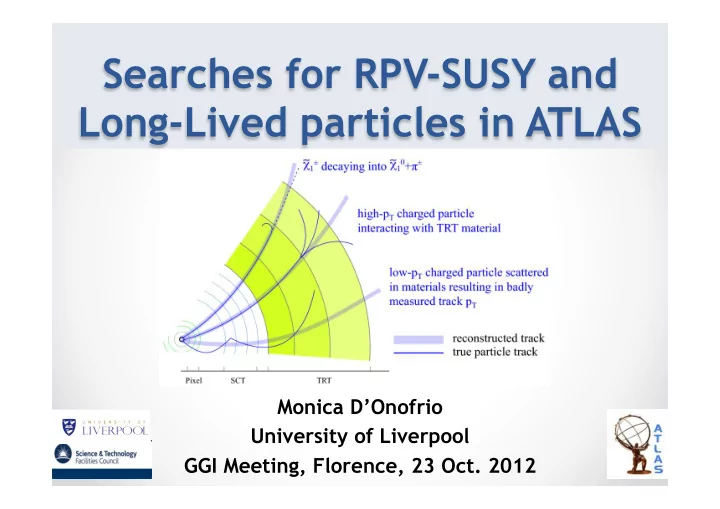
Monica D’Onofrio University of Liverpool GGI Meeting, Florence, 23 Oct. 2012

slide-2
SLIDE 2

Searches for SUSY @ ATLAS

  • Broadly and deeply cover the SUSY signature space

10/23/2012 Monica D'Onofrio, GGI, Florence 2

slide-3
SLIDE 3

Searches for SUSY @ ATLAS

Giacomo’s talk yesterday

10/23/2012 Monica D'Onofrio, GGI, Florence 3

this talk

slide-4
SLIDE 4

R-parity

10/23/2012 Monica D'Onofrio, GGI, Florence

! Define R-parity = (-1)3(B-L)+2s

"

R = 1 for SM particles

"

R = -1 for MSSM partners

4

If conserved (RPC), sparticles pair produced and Lightest SUSY Particle is stable (MET signatures)

! If$not$conserved$(RPV)!$different$terms,$couplings$constraint$by$proton$decay! Pletora(of(new(couplings,(only(partially(constraints((m/100(GeV)(< ΔL(=1,(9(λ(couplings,(27(λ’(couplings<

slide-5
SLIDE 5

RPV scenarios

10/23/2012 Monica D'Onofrio, GGI, Florence

  • Many final states to

explore and not yet searched for:

  • LSP no longer stable

5

  • Something like > 700

possibilities, with final state signatures involving leptons and/or jets

  • If λ,

, λ’,λ’’ very small, can lead to long-lived LSP

slide-6
SLIDE 6

Long-Lived particles in SUSY

  • Several new physics models could give raise to new, massive particles

with long-lifetime. Long-lived (LL) particles in RPC scenarios:

  • If ΔΜ(chargino-neutralino) ≈ 100 MeV (eg. in AMSB):
  • Long-lived charginos # disappearing tracks
  • If very heavy squarks mediate gluinos decay (strong virtuality ):
  • Long-lived gluinos # R-hadrons (eg. Split SUSY)
  • If NLSP-gravitino GMSB couplings are weak: long-lived sleptons

10/23/2012 Monica D'Onofrio, GGI, Florence 6

slide-7
SLIDE 7

10/23/2012 Monica D'Onofrio, GGI, Florence 7

  • ‘prompt’ RPV SUSY:
  • Leptonic RPV (production and/or decay):
  • search for multilepton final states
  • emu resonances and continuum
  • Hadronic RPV:
  • search for 2x3jet resonances
  • search for 2x2jet resonances (currently

focusing on scalar gluons searches)

  • Long-lived SUSY:
  • Displaced vertex
  • Disappearing tracks
  • R-hadrons and sleptons
slide-8
SLIDE 8

10/23/2012 Monica D'Onofrio, GGI, Florence 8

  • ‘prompt’ RPV SUSY:
  • Leptonic RPV (production and/or decay):
  • search for multilepton final states
  • emu resonances and continuum
  • Hadronic RPV:
  • search for 2x3jet resonances
  • search for 2x2jet resonances (currently

focusing on scalar gluons searches)

  • Long-lived SUSY:
  • Displaced vertex
  • Disappearing tracks
  • R-hadrons and sleptons
slide-9
SLIDE 9

RPV@decay: Multilepton

  • Signature expected in case of RPV

in the lepton sector

  • High pT leptons, possibly non

large missing ET

10/23/2012 Monica D'Onofrio, GGI, Florence 9

  • Two SR defined based on MET and

total tranverse energy (m_eff)

  • Validation regions used for SM

background checks:

  • Reducible bkg (fakes, from data)
  • Irreducible bkg (ZZ, ttZ, ttWW): from MC
slide-10
SLIDE 10

Multilepton: background

  • Reducible background (WZ, ttW,tt,WW):
  • Events with 3 real and one fake leptons, or 2 real and 2 fake (3,4 fakes negligible)
  • Estimated with a weighting method
  • Irreducible background:
  • ZZ, ttZ, ttWW

10/23/2012 Monica D'Onofrio, GGI, Florence 10

Fake ratio: # lS and lL: signal and loose leptons # i: type of fakes (HF ,conversion) # j: process category # fij : fake rate of fake type I process j F weighted for the fractional contribution

  • f each process
slide-11
SLIDE 11

Multilepton: results

  • Major uncertainties:
  • Irreducible bkg: generator

uncertainties on ZZ MC modeling

  • Reducible bkg: dominated by unc. on

contributions from each process

10/23/2012 Monica D'Onofrio, GGI, Florence 11

slide-12
SLIDE 12

Multilepton: interpretation

  • Interpretation in simplified models for chargino pair

production as well as mSUGRA/cMSSM breaking models

10/23/2012 Monica D'Onofrio, GGI, Florence 12

stau(LSP< Low ΔR(leptons) and low m(ll)

slide-13
SLIDE 13

RPV@Production

  • Look for excess in the tail of

different flavor di-leptons

  • In this case: eµ invariant mass
  • No jets, low ET

miss

10/23/2012 Monica D'Onofrio, GGI, Florence 13

slide-14
SLIDE 14

e-mu resonances: sneutrinos

10/23/2012 Monica D'Onofrio, GGI, Florence 14

RPV couplings at production and decay

  • SM background dominated by fakes and ttbar

Scan in eµ mass

slide-15
SLIDE 15

10/23/2012 Monica D'Onofrio, GGI, Florence 15

  • ‘prompt’ RPV SUSY:
  • Leptonic RPV:
  • search for multilepton final states
  • emu resonances and continuum
  • Hadronic RPV:
  • search for 2x3jet resonances
  • search for 2x2jet resonances (currently

focusing on scalar gluons searches)

  • Long-lived SUSY:
  • Displaced vertex
  • Disappearing tracks
  • R-hadrons and sleptons
slide-16
SLIDE 16

‘Hadronic’ RPV: 2x3jets

  • UDD couplings least constrained

via collider experiments

  • Very hard given the all-hadonic decays and
  • verwhelming multijet bkg
  • Several interesting possibilities:
  • Here, consider 2 x 3jets for gluino pair

production focusing on uds λ’’couplings

10/23/2012 Monica D'Onofrio, GGI, Florence 16

2 analyses:

  • Resolved
  • Boosted
slide-17
SLIDE 17

2x3jets: resolved

  • signal discriminated from multijet background by

exploiting the large pT of jets produced in gluino decays.

10/23/2012 Monica D'Onofrio, GGI, Florence 17

  • pT of 6th leading jets used to

discriminate signal from bkg:

  • Three selections used: > 80 GeV, 120

GeV and 160 GeV

  • Multijet bkg estimated using

normalization procedure from low to high N jets

  • Tested from 3j / 4j # 5j (signal depleted)
  • Final estimate using 3 jets # ≥ 6 jets
slide-18
SLIDE 18

2x3jets: resolved (II)

  • Good agreement between

data and SM expectation

  • Systematic uncertainties

mostly from JES and JER, followed by PDF

  • Systematics on color flow and

QCD radiation not considered due to the poor knowledge in case of RPV-vertex

10/23/2012 Monica D'Onofrio, GGI, Florence 18

slide-19
SLIDE 19

2x3jets: boosted jets

  • Jet shape variable sensitive to the N-body structure from jets

containing boosted-gluino decay products.

  • τ32 = τ3 /

/ τ2

# if ≈ 1(0), jet well described by 2(3)-subjets

After that, the trimming procedure is applied:

  • Soft radiation removed
  • Invariant mass of the jet

considered (if τ32<0.7)

10/23/2012 Monica D'Onofrio, GGI, Florence 19

N?subjeAiness!

slide-20
SLIDE 20

2x3jets: boosted (II)

  • Select events with two

massive large-R jets and τ32<0.7

  • High normal jet

muliplicity also required to reduce multijet bkg

  • Use ABCD method

10/23/2012 Monica D'Onofrio, GGI, Florence 20

α(=(correlation(factor(,(evaluated(from(MC<

Agreement with data is tested looking at correlations of 1st and 2nd leading jet M Data$! MC$(POWHEG+PYTHIA)$

slide-21
SLIDE 21

2x3jets: results

  • Boosted analysis sensitive for m(gluinos) up to 300 GeV
  • Resolved analysis excludes m(gluinos) < 670 GeV

10/23/2012 Monica D'Onofrio, GGI, Florence 21

Resolved( Boosted(

slide-22
SLIDE 22

2x2jets

  • Searches for 2jets resonances potentially sensitive also to

RPV sparticle production (#jj final states)

  • In this case, search for pair-produced massive coloured scalars in four-jet
  • Background estimate using ABCD method:
  • Regions defined by m1,m2 and scattering angle, cos(θ*)

10/23/2012 Monica D'Onofrio, GGI, Florence 22

Exclude(sgluons( between(150(and( 290(GeV<

slide-23
SLIDE 23

10/23/2012 Monica D'Onofrio, GGI, Florence 23

  • ‘prompt’ RPV SUSY:
  • Leptonic RPV:
  • search for multilepton final states
  • emu resonances and continuum
  • Hadronic RPV:
  • search for 2x3jet resonances
  • search for 2x2jet resonances (currently

focusing on scalar gluons searches)

  • Long-lived SUSY:
  • Displaced vertex
  • Disappearing tracks
  • R-hadrons and sleptons
slide-24
SLIDE 24

To make it possible: ATLAS detector

  • Tile calorimeter
  • Monitored Drift Tubes

(MDTs)

  • Resistive Plate

Chambers (RPCs)

24

25m<

Can measure time-of-flight

Several sub-detectors with excellent time resolution, including (but not only):

10/23/2012 Monica D'Onofrio, GGI, Florence

slide-25
SLIDE 25

The ATLAS Inner Detector (ID)

  • Pixel detector
  • Semiconductor

Tracker (SCT)

  • Good for finding vertices
  • Transition Radiation

Tracker (TRT) # a

continuous tracker

  • Can detect kinked or

disappearing tracks

25

All(within(a(2T(solenoidal(BPfield<

10/23/2012 Monica D'Onofrio, GGI, Florence

slide-26
SLIDE 26

dE/dx measurements

Pixel detector can measure ionization energy loss dE/dx via charge deposited

(calculated from Time-over- Threshold)

26

TRT can also measure dE/dx via Time-over- Threshold

26 10/23/2012 Monica D'Onofrio, GGI, Florence

slide-27
SLIDE 27

The ATLAS Calorimeters

  • Both LAr and Tile

calorimeters can also measure dE/dx by summing energy deposits over path length.

27 10/23/2012 Monica D'Onofrio, GGI, Florence

slide-28
SLIDE 28

The ATLAS Muon Spectrometer

  • Precision muon

chambers can reconstruct “standalone” tracks

  • i.e. can find particles that

did not leave tracks in Inner Detector (e.g. decay products of LLPs)

  • MDTs can also measure

dE/dx (similar principle to TRT).

28 10/23/2012 Monica D'Onofrio, GGI, Florence

slide-29
SLIDE 29

Displaced vertices in ID

  • Particles with lifetimes of order a few

picoseconds could decay within the inner tracking detector, giving rise to displaced vertices

29

# Here: consider muon+jets topology, i.e. from RPV neutralinos decay with a non-zero (but small) λ’

211 coupling

– Presence of a muon useful for triggering and background rejection – High track multiplicity helps vertex reconstruction

10/23/2012 Monica D'Onofrio, GGI, Florence

slide-30
SLIDE 30

track and vertex reconstruction

  • Standard ATLAS tracking is highly optimized for tracks

coming from the primary interaction point (IP)

  • To increase efficiency for secondary tracks

# re-run Silicon-seeded tracking algorithm, with looser cuts on transverse impact parameter, using “left-over” (shared) hits from Standard tracking.

30

  • Vertex-finding algorithm based
  • n an iterative disambiguation

process

  • then splits/merges/refits

vertices until no tracks are shared between vertices.

10/23/2012 Monica D'Onofrio, GGI, Florence

Signal(example<

slide-31
SLIDE 31

Displaced vertices – selection

  • Events triggered by high-pT muon trigger, with no ID track requirement.
  • Use tracks with |d0|>2mm, pT>1 GeV as input to vertexing
  • Look in fiducial volume roughly corresponding to Pixel barrel
  • Require at least 5 tracks in vertex, and mass > 10 GeV.
  • Require high-pT muon passing within 0.5mm of reco vertex

31

# Veto vertices reconstructed in regions with high material density

10/23/2012 Monica D'Onofrio, GGI, Florence

slide-32
SLIDE 32

Displaced vertices – backgrounds

  • Two sources of background vertices considered:
  • Purely random combinations of tracks inside the beampipe (where

vacuum is good, but track density is high).

  • High-mass tail of distribution of real vertices from hadronic

interactions with gas molecules.

  • Particularly if vertex is crossed by random (real or fake) track at large

angle.

32

  • Use different data-

driven method for each source: total estimate is (4 ± 60)*10-3 vertices

10/23/2012 Monica D'Onofrio, GGI, Florence

slide-33
SLIDE 33

Displaced vertices – results

  • Zero vertices

passing selection requirements

  • bserved in 4.4 fb-1

data sample.

33 10/23/2012 Monica D'Onofrio, GGI, Florence

slide-34
SLIDE 34

Displaced vertices – interpretation

  • Exclusion limits set on squark pair production
  • Assume squark decays directly to LL neutralino, which decays

to muon plus jets.

  • Three combinations of squark and neutralino

masses considered, to study the effect of LLP mass and boost on reconstruction efficiency

34

efficiencyPvsPcτ<

cτ' [mm]' 78' 101' 82 '

10/23/2012 Monica D'Onofrio, GGI, Florence

slide-35
SLIDE 35

Disappearing tracks

  • In AMSB model, could have long-lived

charginos decaying to neutralino and soft pion

  • Look for production processes as:

35

  • Resulting final state:

– High pT jet + large missing ET

– High-pT disappearing track (or “kinked” track):

  • Isolated tracks that stop in outer TRT

Use(jet(from(ISR(to( trigger(on(events<

10/23/2012 Monica D'Onofrio, GGI, Florence

slide-36
SLIDE 36

Disappearing tracks - selection

  • Event selection:
  • missing ET > 90GeV and ≥ 1 jet with pT > 90GeV
  • Jets well separated from missing ET direction in φ (Δφ > 1.5)
  • Veto events with reconstructed ele or µ candidates.
  • Disappearing track candidate selection:
  • Track must be isolated
  • have pT > 10GeV,
  • at least 1 Pixel hit and 6 SCT hits,
  • originate from primary vertex,

and point to TRT barrel (but not region around |η|=0)

  • Fewer than 5 hits in TRT outer module

36 10/23/2012 Monica D'Onofrio, GGI, Florence

slide-37
SLIDE 37

Disappearing tracks - backgrounds

  • Potential background sources are:

37

Electrons surviving lepton veto, undergoing bremsstrahlung Charged hadrons interacting with detector material (80%) Obtain pT spectrum for both sources of background using data control samples

10/23/2012 Monica D'Onofrio, GGI, Florence

slide-38
SLIDE 38

Disappearing tracks - results

  • Use signal+background

likelihood fit to track pT spectrum, to test different signal hypotheses

38

  • No significant excess found #

Set limits on chargino mass and lifetime and charg-neut ΔM:

For(AMSB(most(prob(value( 160(170)(MeV(#(chargino(mass(( excluded(up(to(103((85)(GeV<

10/23/2012 Monica D'Onofrio, GGI, Florence

slide-39
SLIDE 39

Stable Massive Particles (SMPs)

  • SMPs predicted in SUSY several other

BSM scenarios

  • Stable # cτ ≥ size of detector
  • Produced with β<1
  • Within SUSY:
  • l and χ+
  • q/g (bound states)

10/23/2012 Monica D'Onofrio, GGI, Florence 39

~" ~"

~" ~"

Colored sparticles can hadronise into long-lived bound hadronic states

R-hadrons

q" q"

t"

~"

Light quark system (LQS)

Heavy parton carrying most of the momentum

slide-40
SLIDE 40

SMPs: how-to

  • Particles with cτ ≥ size of detector:
  • If neutral and weakly interacting # missing ET
  • If charged (at any point!) or strongly interacting # can

detect them directly

  • If massive, could be produced with low velocities: β < 1
  • Mass of SMPs:

40

  • measure charged particle momentum p in ID and MS
  • measure energy loss dE/dx in several subdetectors
  • For these analyses, use Pixel
  • dE/dX is related to relativistic boost factor βγ
  • measure time-of-flight in several sub-detectors
  • For these analyses, use Tile, RPC, MDT
  • Can measure velocity β

p=βγm<

10/23/2012 Monica D'Onofrio, GGI, Florence

slide-41
SLIDE 41

β measurements and bkg

  • Use Z#µµ events to calibrate β measurements
  • If β measurements from different systems are > 0.2 and internally

consistent # combined in a weighted average.

41

Main background are high-pT muons with mismeasured β.

  • Exploit fact that mis-measurements of β or βγ in different subdetectors are

uncorrelated.

  • Use data-driven method based on randomly sampling β or βγ values from CR

distributions.

10/23/2012 Monica D'Onofrio, GGI, Florence

slide-42
SLIDE 42

Long-lived sleptons - selection

  • “Heavy muons”-like, releasing energy throughout detector
  • Use single µ trigger (70-85% efficiency for GMSB slepton events):
  • Efficiency for particles arriving late at MS estimated from MC signal
  • 2 µ candidates per event, pT loose(tight) > 50(70) GeV.

42

  • Either two loose candidates or
  • ne must pass tight selection.
  • Bkg estimate: from iterative

procedure based on muon-β PDF:

  • Assume bkg is due to

measurement resolution

  • Apply cut on candidate mass

mβ=p/γβ (depending on stau mass

hypothesis: 122 – 465 GeV range)

10/23/2012 Monica D'Onofrio, GGI, Florence

slide-43
SLIDE 43

Slepton search - results

  • No excess above background expectation

43

  • Constraints on stau mass in

GMSB scenario

  • Constraints in tanβ vs Λ in

GMSB scenario

– Direct sleptons production dominate around limit

10/23/2012 Monica D'Onofrio, GGI, Florence

slide-44
SLIDE 44

R-hadrons - selection

  • Undergo interactions with detector material

$can also change charge as it moves through detector

  • If β is too low, particle might be associated with following

bunch crossing by the time it gets to MS.

  • Due to both these effects, efficiency for single muon

trigger can be quite low.

$use also missing ET trigger

  • Exploit possible additional jets from ISR/FSR
  • Three different analyses:
  • “Full detector”
  • “ID only”
  • “MS agnostic”

44

Cover$the$lack$of$knowledge$of$R?hadron$interactions$$ with$the$detector$and$$the$lifetimes$for$which$they$ would$not$reach$the$calorimeters!

10/23/2012 Monica D'Onofrio, GGI, Florence

slide-45
SLIDE 45

R-hadrons - selection (2)

  • All three analyses require

good quality, isolated, high- momentum ID track.

  • “MS agnostic”:
  • missing ET triggers
  • calorimeter-only timing

measurement #require ID trk pT>140 GeV

  • “ID only”:
  • Offline missing ET cut
  • Tighter cuts on isolation and

number of silicon hits

45

Data$ minimum$bias!

10/23/2012 Monica D'Onofrio, GGI, Florence

slide-46
SLIDE 46

R-hadron searches - results

  • MS-agnostic and FD: final selection based on requirements on βγ and β'
  • ID-only: selection based on exceeding

dE/dx thresholds

46 10/23/2012 Monica D'Onofrio, GGI, Florence

slide-47
SLIDE 47

R-hadron searches - results

  • gluino R-hadrons:

47

  • No(excess(above(background(expectation(seen(

in(any(of(the(three(analyses<

<

  • Limits(set(by(counting(N(events(passing(modelP

dependent(mass(cuts(< <&985&GeV"

10/23/2012 Monica D'Onofrio, GGI, Florence

slide-48
SLIDE 48

R-hadron searches - results

  • squark (stop & sbottom) R-

hadrons:

48 10/23/2012 Monica D'Onofrio, GGI, Florence

slide-49
SLIDE 49

Other searches for LL particles

Several New Physics models (well beyond SUSY) could give rise to new massive particles, with long lifetimes:

  • Hidden sector interacts with SM via (heavy) Communicator particle(s)
  • light Higgs-to-LLP search:
  • look for displaced vertices at larger radii, near outer radius of hadronic

calorimeter, or in the MS

  • Use specially developed trigger algorithm, and specialized tracking and vertexing,

to reconstruct vertices in MS

  • Higgs decay to hidden-sector fermions # decay to a (potentially long-lived) neutral

hidden-sector particle γd and a stable hidden sector fermion

  • those escape detection
  • Decay of γd could give rise to collimated pairs of leptons
  • Magnetic monopoles:
  • Experimental signature # large, localized energy deposit in EM calorimeter,

associated with region of high ionization in TRT .

10/23/2012 Monica D'Onofrio, GGI, Florence 49

slide-50
SLIDE 50

Conclusions

  • Several SUSY models lead to hard to constrain or

‘unconventional’ signatures:

  • RPV multilepton or multijet scenarios
  • Long-lived particles
  • Wide range of analyses, looking for many different signatures,

sometimes using the detector in interesting and “non-standard” ways.

  • No sign of New Physics so far….
  • BUT:
  • All these analyses are being updated (and improved) with 2012 data.
  • More to come

Doing our best to cover as much parameter space as possible, as well as and get maximum possible value out of our fantastic ATLAS detector

50 10/23/2012 Monica D'Onofrio, GGI, Florence