
SLIDE 1
- M. SHIRCHENKO, N. SKROBOVA ON BEHALF OF DANSS COLLABORATION (ITEP, JINR)
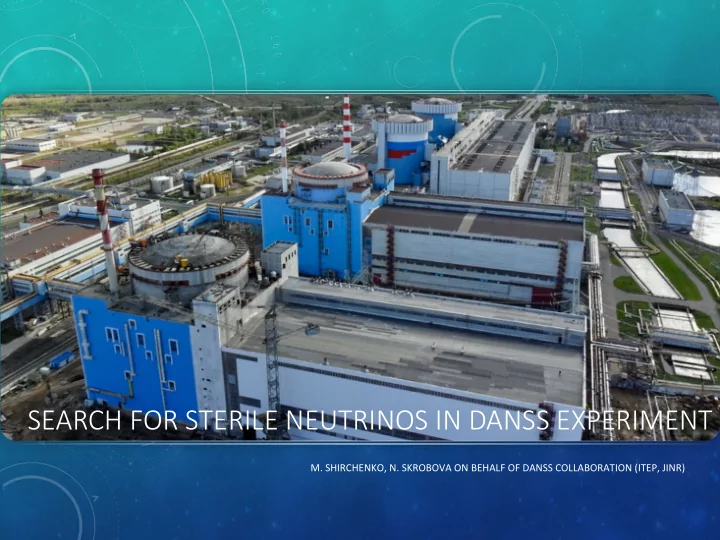
SEARCH FOR STERILE NEUTRINOS IN DANSS EXPERIMENT M. SHIRCHENKO, N. - - PowerPoint PPT Presentation
SEARCH FOR STERILE NEUTRINOS IN DANSS EXPERIMENT M. SHIRCHENKO, N. SKROBOVA ON BEHALF OF DANSS COLLABORATION (ITEP, JINR) DANSS Solid state scintillator aimed to detection of the industrial power reactor antineutrinos KNPP 285 km JINR 370 km
"" #$ % = 1 − )*+#(2Θ/))*+#(1.27 345 # 67# %[4]
$<[=67]
#
Inversed beta-decay in plastic scintillator interlayed with Gd
5 10 15 20 25 30 35 40 1 10 100
N = 5281 / 30 min X3Z3 & Y3Z3
248Cm
Time (Prompt – Delayed), μs
Prompt - delayed time distribution
CH 2
1000 2000 3000 4000 100 200 300 400 500 600 700 800 900 1000 3He + n g t + p
BG (g)
500 1000 1500 2000 2500 0.01 0.1 1 10 100 1000 10000 6500 7000 7500
40K 60Co 137Cs 56Fe(n,g)
SE DE E, keV Count rate, cnt / keV / hour
A336 @ KNPP Lab @ JINR
45 90 135 180 225 270 315 0 2 4 6 8 101214
Z = 30o Z = 45o
Positioning with respect to the reactor core: 10.7m (Up), 11.7m (Middle), 12.7m (Down) Detector movement: 3 times per week (Down -> Up -> Middle -> Down)
DANSS COLLABORATION
20 30 40 50 60 70 80 90
N p.e.
µ
1.5 2 2.5 3 3.5 4 4.5 5
Deposited energy, MeV
0.5 − 0.5
Deviation [%]
Cm
Experiment MC
Cosmic muons:
radioactive sources well Radioactive sources:
source
PPNS 2018
s µ Time, 5 10 15 20 25 30 35 40 45 50 Events
3
10
4
10
All events after cuts Accidental background IBD events s µ Cut at 2
Building Pairs
Neutron candidate: 3.5-15 MeV total energy (PMT+SiPM), SiPM multiplicity > 3 Search positron 50 µs backwards from neutron Positron candidate: 1-20 MeV in continuous ionization cluster No other signals in the vicinity of IBD signal
Accidental coincidence background
Fake one of the IBD products by uncorrelated triggers Background events from data: search for a positron candidate where it can not be present — 50 µs intervals far away from neutron candidate (5, 10, 15 etc ms) Enlarge statistics for accidentals by searches in numerous non-overlapping intervals Accidental rate is smaller but comparable to IBD rate Mathematically strict procedure, does not increase statistical error Cuts for the accidental coincidence exactly the same as for physics events Selection of cuts to reduce accidental contribution → smaller statistical error
PPNS 2018
Positron energy, MeV 1 2 3 4 5 6 7 8 9 Events / day / 0.25 MeV 50 100 150 200 250 300 350 400
11 / day ± Top: 4910 11 / day ± Middle: 4101 8 / day ± Bottom: 3490
3 detector positions Pure positron kinetic energy (annihilation photons not included) About 5000 neutrino events/day in detector fiducial volume of 78% (‘Up’ position closest to the reactor)
PPNS 2018
1 2 3 4 5 6 7 8 Positron energy, MeV 0.75 0.8 0.85 0.9 0.95 1 Events/(day*0.25 MeV) DANSS data Monte Carlo
Normalized ratio before shutdown / after shutdown
Ratio of positron energy spectra collected during the last 3 months of the reactor campaign in 2017 and during the 2nd − 4th months from the beginning of the next campaign. The average 239Pu fission fractions for these periods are 37.7% and 27.1% correspondingly. The stars are the Huber-Mueller MC model prediction.
PPNS 2018
Comparison of reactor power and DANSS rate
31/1031/1202/0302/0502/0701/0931/1031/1202/03
Date day/month
200 400 600 800 1000 1200 1400 1600 1800
310 ×
Accumulated events
Up Middle Down Total
Statistics accumulation
On power graph: Points at different positions equalized by 1/r 2 Normalization by 12 points in November-December 2016 Adjacent reactor fluxes subtracted (0.6% at Up position) Spectrum dependence on fuel composition is included Statistics @100% power, ∼222 days after QA (oct 16 - oct 17)
PPNS 2018
For every ∆m2 and sin2(2θ) e+ spectrum was calculated for Up and Down detector positions taking into account:
and GEANT4 MC simulation identical to data analysis) Ratio of Down/Up spectra was calculated and compared with experiment (independent on ν spectrum, detector efficiency, and many other problems!)
1 2 3 4 5 6 7 8 9 10
Energy, MeV
500 1000 1500 2000 2500 3000 3500 4000
Arbitrary units Reconstructed energy
+
e
1 2 3 4 5 6 7
Positron energy, MeV
0.64 0.66 0.68 0.7 0.72 0.74 0.76 0.78
spectra ratio (Down/Up)
+
e (NDF = 24) = 35
ν 3 2
χ RAA best point = 0.14 θ 2
2
, sin
2
= 2.3 eV
2
m ∆ = 83
ν 4 2
χ
Most plausible parameter set from Reactor and Galium anomalies is excluded!
PPNS 2018
Exclusion region was calculated using Gaussian CLs method (X.Qian et al. NIMA, 827, 63 (2016)). CLs method is more conservative than usual Confidence Interval method Systematics studies include variations in: Burning profile in reactor core Energy resolution ±10% Level of cosmics background 0.5% Energy intervals used in fit (1.5-6)MeV Systematics is small A large fraction of allowed parameter region is excluded by preliminary DANSS results using only ratio of e+ spectrum at different L (independent
to include into analysis all available data
PPNS 2018
∆m2 = 1.4 eV2, sin2 2θ = 0.05, χ2
4ν = 21.9, χ2 3ν = 35, ∆χ2 = 13.1 1 2 3 4 5 6 7
Positron energy, MeV
0.64 0.66 0.68 0.7 0.72 0.74 0.76 0.78
spectra ratio (Down/Up)
+
e
Significance will be estimated using Feldman and Cousins method with systematic uncertainties
PPNS 2018
DANSS records about 5000 antineutrino events per day with cosmic background <3% DANSS counting rate consistent with reactor power within ∼2% During reactor shutdown it is consistent with 0 after subtraction of ∼3% cosmic background and 0.6% flux from adjacent reactors Antineutrino spectrum and counting rate dependence on fuel composition is clearly observed Preliminary DANSS analysis based on 662 thousand IBD events excludes a large and the most interesting fraction of available parameter space for sterile neutrino using only ratio of e+ spectra at two distances (with no dependence on ˜ νe spectrum and detector efficiency!) Significance of the best fit point will be evaluated using more elaborated methods and more statistics We plan to collect more data, to improve MC for perfect description of detector response, to refine detector calibration, to continue systematic studies, to include all available statistics into analysis.
Thank you!
The work is partially supported by the State Corporation «RosAtom» through the state contracts Н.4х.44.90.13.1119 and Н.4х.44.9Б.16.1006 and by Russian Science Foundation, grant 17-12-01145
PPNS 2018