
SLIDE 1
Simona Rolli - Tufts University
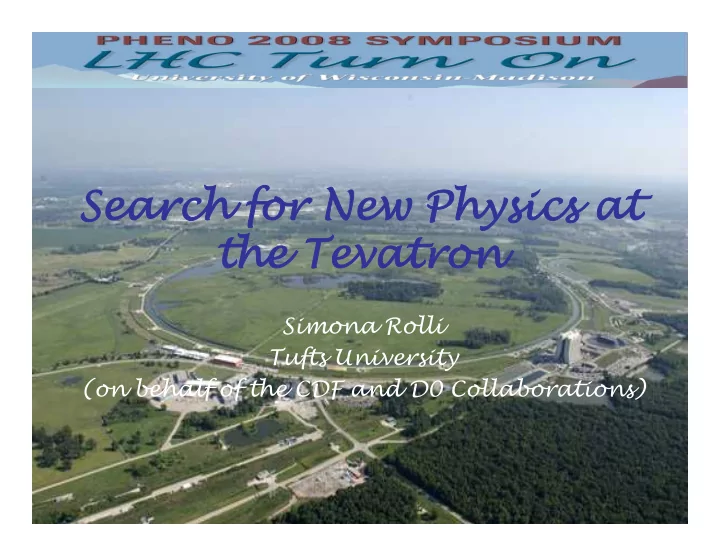
Search for New Physics at the the Tevatron Simona Rolli Tufts - - PowerPoint PPT Presentation
Simona Rolli - Tufts University Search for New Physics at the the Tevatron Simona Rolli Tufts University (on behalf of the CDF and D0 Collaborations) Outline of the talk Simona Rolli - Tufts University s n o r t c e l E Muons
Simona Rolli - Tufts University
2
Simona Rolli - Tufts University
– from simple objects to complex final states
tracks)searches
– Specific model testing and global searches
E l e c t r
s
Muons
Jets
Photon M i s s i n g ET Tracks H.F.
3
Simona Rolli - Tufts University
Delivered Lumi. > 3.6 fb-1 Good for analysis ~ 3. fb-1
4
Simona Rolli - Tufts University
Leptons-only final states
e/µ identification well
understood
τ id a little more complex Straightforward and highly
efficient approach to search for anomalies
… + Missing Energy and
Photons
Wealth of models and exotic
processes
Need accurate understanding of
detector effects
… + Jets and heavy flavors
More complex signatures
Maintaining high S/√ B
We study physics processes organizing them by their signature
When a signature-based approach is advocated, final results are generally interpreted in terms of specific models (typical case dilepton searches, MET + jets) When the analysis is model driven and results are presented as testing of a specific model, there is always a check on control regions, defined in terms of the process signature (blind analyses)
The two approaches are usually pursued in a balanced and complementary way
5
Simona Rolli - Tufts University
6
Simona Rolli - Tufts University
At CDF the dielectron mass spectrum is scanned in search for excesses in above 150 GeV/c2
well understood
The probability of observing a background fluctuation with significance equal to or greater than 3.8 anywhere in the mass range of 150-1,000 GeV/c2 is about 0.6%, corresponding to a 2.5 σ significance. The most significant region of excess for an e+e- invariant mass window of 240 GeV/c2 3.8 standard deviations above the SM prediction Excess is monitored (data period) Cross-check in muons
7
Simona Rolli - Tufts University
Once the data spectrum is well understood in terms of SM background, from MC, the acceptances for resonant states for different spin particles are derived (Z’, RS Graviton) and the expected number of BSM events is calculated. In the absence of an excess of data, 95% CL limits on production cross-sections and mass of the particles are set.
µµ channel analyzed with the same strategy. Update to 2fb-1 in progress
Exclude at 95% CL RS Gravitons below 900 GeV for k/MPl = 0.1 (CDF limit 850 GeV) PRL 100, 091802 (2008)
8
Simona Rolli - Tufts University
Ditaus final states are selected where
–Other tau hadronic (and ντ) –One or three tracks (Σqtrk = ±1), opposite to lepton –CDF : isolation 30°, shrinking τ cone (10° → 3°) –DØ : three types (π±, π±π0, 3-prong), NN score
–pT > 15 GeV/c (1-prong), 20 GeV/c (3-prong)
isolation
9
Simona Rolli - Tufts University
Higgs neutral sector simplifies at high tanβ
degenerate
cross section
(slight excess for CDF in 2007)
for a single mass peak (φ)
twin h/H, at high tanβ decays into bb (90%) and ττ (10%) dominate
10
Simona Rolli - Tufts University
Interpret σ x BR limits as limits on tanβ vs mA in MSSM benchmark scenarios
11
Simona Rolli - Tufts University
Chargino Neutralino cascade decay results in a signature of (3 leptons or 2 leptons + track) and MET Similar cuts at D0
12
Simona Rolli - Tufts University
13
Simona Rolli - Tufts University
FERMILAB-PUB-08/058-E
14
Simona Rolli - Tufts University
Observation of excited states of quarks
and leptons might confirm the hypothesis that they are not elementary particles , but composite states
At Tevatron, e* /µ* can be produced via contact interactions or gauge mediated interactions Select events with eeγ (µµγ) in the final state and look for resonance in M(eγ) or M(µγ)
No CI Interactions
15
Simona Rolli - Tufts University
The search for new particles decaying to diphotons uses the RS graviton model to express sensitivity to Kaluza-Klein graviton resonances (spin 2 resonance) Combined with dilepton searches
16
Simona Rolli - Tufts University
Nominal high ET object identification and kinematic selections are used. The observed event counts is reported as well as SM prediction for various kinematic distributions
17
Simona Rolli - Tufts University
1 χ0 1
1→ γ G
18
Simona Rolli - Tufts University
19
Simona Rolli - Tufts University
Hadronic jets are reconstructed using several algorithms: Cone,Midpoint, KT etc..
Measured jet energies are corrected to scale them back to the final state particle level jet . Additionally there are corrections to associate the measured jet energy to the parent parton energy, so that direct comparison to the theory can be made. Currently the jet energy scale is the major source of uncertainty in the measurement of the top quark mass and inclusive jet cross section
B-jet identification is implemented via:
20
Simona Rolli - Tufts University
21
Simona Rolli - Tufts University
A Kaluza-Klein graviton is produced in association with a jet (or photon). The graviton escapes detection, leaving a monojet (monophoton) signature in the detector
FERMILAB-PUB-08/061-E
22
Simona Rolli - Tufts University
D0,PLB 660, 449 (2008), L=2.1fb-1
23
Simona Rolli - Tufts University
24
Simona Rolli - Tufts University
The analysis is a counting experiment examining two different kinematic regions (each region being more sensitive to different models). Cuts are not optimized for a specific model. Data driven prediction
CDF Run II Preliminary, 2fb-1
LQ interpretation
25
Simona Rolli - Tufts University
26
Simona Rolli - Tufts University
If the sbottom is significantly lighter than the other squarks, the two body decay of gluino into bottom/sbottom is kinematically allowed The sbottom decays into a bottom and LSP, giving rise to a final state with 4 b-jets and missing energy The analysis is optimized for 2 points in the SUSY parameter space:
27
Simona Rolli - Tufts University
Fermilab-PUB-08/063-E
28
Simona Rolli - Tufts University
Search for resonant tb(+cc) pair production In W+2 jets and +3 jets channels (semileptonic W), look for unexpected structure in M(Wjj)
Extra W gauge boson decaying into eν
29
Simona Rolli - Tufts University
b quark pT >20 GeV/c, |η|<2
b b φ0 Inclusive H → bb is too hard due to QCD background Require one additional bottom quark jet besides the two from Higgs decay
“3b” channel best compromise between signal and background rates Search in mass of two lead jets m12 No excess observed
30
Simona Rolli - Tufts University
A handful of exotic processes would give rise to a final state signature comprising γ+b+jets+MET Many anomalies could be reduced to detector mis-measurements.
Low energy SUSY with radiative decay
Selection: One high ET photon ≥ 2 jets ≥ 1 tagged jet Large MET (> 25 GeV) Topological cuts Main background is dominated by fake γ or b. Calculated using MC or data
CDF Run II Preliminary, 2 fb-1
31
Simona Rolli - Tufts University
The goal is to perform a model-independent global search of high PT data:
Physics objects are categorized and events selected and partitioned into ~400 exclusive final states
Pythia and MadEvent are used to implement the SM theoretical prediction (CdfSim emulates the detector response) Many correction factors are used to obtain the true SM predictions (shouldn’t a global search work globally?)
theory k-factors etc experimental efficiencies and Scale Factors, fake rates etc
Currently observed discrepancies are explained in terms of incorrect MC modeling The whole high PT region is monitored at
32
Simona Rolli - Tufts University
33
Simona Rolli - Tufts University
34
Simona Rolli - Tufts University
35
Simona Rolli - Tufts University
36
Simona Rolli - Tufts University
37
Simona Rolli - Tufts University
38
Simona Rolli - Tufts University
39
Simona Rolli - Tufts University