Sea earch of E threshold in 70 70 Ni E1 1 strenght around th Ni - - PowerPoint PPT Presentation

sea
SMART_READER_LITE
LIVE PREVIEW

Sea earch of E threshold in 70 70 Ni E1 1 strenght around th Ni - - PowerPoint PPT Presentation

Sea earch of E threshold in 70 70 Ni E1 1 strenght around th Ni O.Wieland, A.Bracco, R. Avigo, F. Camera, H. Baba, N. Nakatsuka, Y. Togano et al. INFN sez. Milano, RIKEN-RIBF, Kyoto Uni., Tokyo IT, et al. Goal: Search and Measurement of


slide-1
SLIDE 1

«Sea

earch of E

E1 1 strenght around th threshold in 70

70Ni

Ni»

O.Wieland, A.Bracco, R. Avigo, F. Camera, H. Baba, N. Nakatsuka, Y. Togano et al. INFN sez. Milano, RIKEN-RIBF, Kyoto Uni., Tokyo IT, et al.

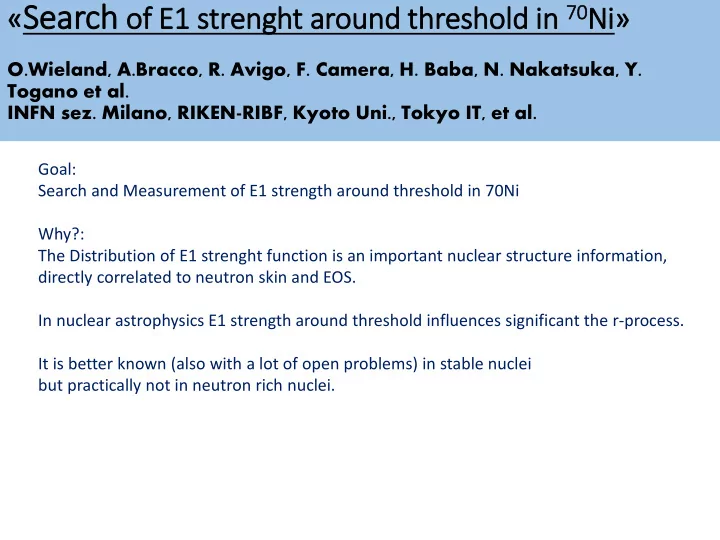
Goal: Search and Measurement of E1 strength around threshold in 70Ni Why?: The Distribution of E1 strenght function is an important nuclear structure information, directly correlated to neutron skin and EOS. In nuclear astrophysics E1 strength around threshold influences significant the r-process. It is better known (also with a lot of open problems) in stable nuclei but practically not in neutron rich nuclei.

slide-2
SLIDE 2

PDR states in nuclei

What We know

  • Pygmy Dipole States are strongly correlated with the size of the neutron skin (or proton skin)
  • Pygmy Dipole Resonance (PDR) is a «collective» excitation of the least bound neutrons (or protons
  • PDR is mostly of Electric Dipole (E1) character
  • PDR is relevant for astrophysical r-process

What we want to know:

  • Level of collectivity ?
  • How (collective) properties change with neutron number ?
  • How isospin changes mean field ?
  • In exotic nuclei: does PDR strength exist also below neutron threshold and to which extend ?
  • No High resolution/statistics measurements available
  • Present in all nuclei and mass regions ?
  • Effect of deformation ?
  • Proton Pygmy, still to proof ?
  • ”Picture“ of PDR, toroidal mode
  • from pygmy strength deduce dipole polarizability over more nuclei
  • Isovector and Isoscalar mode
slide-3
SLIDE 3

PDR is measured in stable nuclei With different probes (in different Labs):

  • real photons

(scattering γ,γ, dissociation γ,γ γ,n γ,p)

  • p,α,17O,…

(p,p’); (α, α’); (17O, 17O') … (p,p’,γ); (α, α’,γ); (17O, 17O‘,γ) …

But in unstable nuclei relevant for the r-process ?

LNL, OSAKA, KVI…

ISOSCALAR part of Pygmy (n & p behave similar)

slide-4
SLIDE 4

RQRPA dashed RQTBA solid

Theoretical prediction Litvinova, Ring 2012 PRL

E1

Experimental Method @ RIBF: Relativistic Virtual Photon Scattering under coulomb excitation conditions

Using a fast (260AMeV) 70Ni beam on thick 2g/cm2 Au target, we strongly excites E1 IV states, E2 and other states are much less excited, nuclear contributions are strongly supressed Theoretical Predictions in exotic nuclei ….. In 70Ni Alternatives for exotic nuclei (in part):

  • C. break-up/missing mass

(R3B, Samurai) Talk of K. Boretzky

  • Oslo/MSU beta method

«Search of E1 strenght around threshold in 70Ni»

slide-5
SLIDE 5

Virtual photon excitation

and decay of GDR + PYGMY + E1 states

Relativistic Virtual photon scattering for PDR search in n-rich

nuclei high selectivity for dipole E1 excitation

Coulex

γ g.s.

n-knockout 1 mbarn

⋅ =

πλ πλ πλ

γ γ

σ σ *) ( *) ( * 1 * E E N E dE d

C

b>b

min

virtual photon

γ emission

γ

Ni PDR region 5-11MeV 2+ 0+ GS 1- GDR region 15MeV

very small angle

To excite Dipole states one needs:

  • High beam energy
  • Large cross sections
  • Large σGDR/σGQR ratio

To Select projectile PDR one needs:

  • High beam energy
  • Large Doppler effects

Background REDUCTION

  • Good Zproj/Ztarget ratio
slide-6
SLIDE 6

400 MeV/u 68Ni + 197Au (May 2004) 600 MeV/u 68Ni + 197Au (April 2005) 400 MeV/u 64Fe + 208Pb (October 2012) 430 MeV/u 62,64Fe + 197Au (April 2014) 280 MeV/u 70Ni + 197Au (October 2014) 280 MeV/u 72Ni + 197Au (future) … GSI RIKEN GSI

Euroball+BaF2 AGATA*+LaBr3:Ce DALI2+LaBr3:Ce

Talk of R. Avigo This presentation

68Ni

* With half of HPGe material as EB and 5 times less intense beam

See also

Complementary Talk of K. Boretzky

slide-7
SLIDE 7

Worldwide largest

  • Inelastic alpha scattering on 128/132Sn (T. Aumann,…)
  • Inelastic alpha scattering + coulomb excitation on 20/22/24O (H. Baba, N. Nakatsuka,…)
  • Coulomb excitation on 70Ni (O. Wieland,…)
slide-8
SLIDE 8

BigRips DALI2 setup (1)

RIBF setup in Riken laboratory allows to produce radioactive beams at relativistic energies and select in flight (fragmentation) the isotopes of interest (BigRips) DALI2 coupled with LaBr3:Ce scintillators provide a very large angular coverage and also efficiency at high energies Zero degree Spectrometer allows to select reaction products

  • utcoming from secondary target

Experiment at RIKEN-RIBF BIGRIPS Parameters: 238U Primary Beam -> 70Ni secondary Beam at 260AMeV @F3 48 kcps SECONDARY BEAM PRODUCED @F7 30 kcps SECONDARY BEAM SELECTED with 40% PURITY 70Ni @F11 27 kcps AFTER TARGET AND REGISTERED IN ZERODEGREE SPECTROMETER  1.3*109 «good 70Ni» events recorded in 34 hours measurement

slide-9
SLIDE 9

70Ni measurement @ Riken

setup(2)

Experiment at Riken laboratory to measure PDR in 70Ni with NaI (DALI) and LaBr3:Ce detectors

Primary Beam 238U with 82GeV total kinetic energy

DALI2 + 8 LaBr:Ce (3.5’’x8’’) 70Ni 260AMeV

Setup/Experiment BIGRIPS ZDS

70Ni*

AoQ Z AoQ Z November 2014

>25%(for E2) >5%(for E1) Gamma ray efficiency  select HE gamma ray GS decay

slide-10
SLIDE 10

Energy Calibration for High Energy Gammas

AmBe

  • r

252Cf

n

Neutron capture gamma

Ni = 8.9MeV Al = 7.7 MeV

8.9MeV n + Ni 4.4MeV AmBe->12C 1.46MeV LaBr3 7.7MeV n + Al (DALI Frame)

15.1MeV from 12C(p,p’) test experiment @ RCNP

H.Baba, Nakatsuka

  • Cover up to 25MeV in C.M. = 40MeV in Lab. @30 deg

& A.Giaz NIM A729(2013)910 linearity efficiency up to 22MeV (p,γ)

slide-11
SLIDE 11

E[chn]

Background for LaBr3:Ce / DALI2

σ=0.4ns!! will be even better particles background from the target ϒ-ray from beam @ target position

H.Baba, N. Nakatsuka

ϒ-ray from beam @ forward plastic scintillator internal activity of LaBr3 detector

slide-12
SLIDE 12

DALI2 + 8 LaBr:Ce (3.5’’x8’’) 70Ni 260AMeV

Setup/Experiment BIGRIPS ZDS

70Ni*

Center angles Target + Projectile γ-ray Yield cms Backward angles  target emission

Eγ-cms [keV] Eγ-cms [keV]

DALI2 DALI2 Forward angles Projectile emission LaBr3:Ce 2+ 2+

Eγ-cms [keV]

6+4+ 4+2+

Gate on 2+

Eγ-cms [keV] 70Ni

Gate on 2+ State of 70Ni Preliminary Preliminary November 2014

Ground State 2+ 1260 keV

E[keV]

slide-13
SLIDE 13

High Energy gamma ray spectra

Unresolved E1 strength below threshold E[KeV] E[KeV]

Preliminary

8000 12000 16000 20000 24000 50 100 150 200 250 300 350 400

unfolded Single Lorentzian GDR+PDR

Counts Eγ [keV]

LaBr3:Ce 70Ni* IV-E1 strenght after > detector efficiency unfolding > divide by virtual photon number > GS branching division

To Do : fix (low energy) tail of GDR, target contribution and background then unfold with responsefunction

70Ni 70Ni

E1 strength above threshold

slide-14
SLIDE 14

Summary and Status

  • We have measured the E1 strength in 70Ni neutron-

rich nuclei around threshold

  • We have used DALI2+ large volume LaBr3:Ce on thick

gold target with 70Ni beam @ 260AMeV

  • Analysis is ongoing
  • Analysis meeting Milano 2015 Sep.21-25
  • Analysis meeting Darmstadt 2015 Okt.
  • Analysis meeting at Tokyo 2016
  • Next nucleus 72Ni (DALI2+Hector+),
slide-15
SLIDE 15

Thank you and Thanks to collaborators

  • RIKEN
  • H.Baba, S.Takeuchi, P.Doornenbal, W.He,

M.Nishimura, J.Zenihiro, H.Otsu, H.Takeda, Y.Shimizu, A.DeukSoon, N.Fukuda, N.Inabe, T.Kubo, T.Ohnishi, T.Motobayashi, H.Sakurai, K.Yoneda, D.Steppenbeck

  • Rikkyo-U
  • Y.Shiga, K.Ieki
  • Kyoto-U
  • N.Nakatsuka, T.Kawabata, T.Murakami
  • U-Tokyo
  • S.Koyama, R.Taniuchi
  • CNS U-Tokyo
  • Y.Yamaguchi, N.Imai, M.Matsushita, K.Wimmer,

S.Masuoka, S.Michimasa, S.Shimoura, S.Ota

  • TITech
  • T.Nakamura, Y.Togano, Y.Kondo, T.Ozaki, A.Saito,

N.Kobayashi, M.Shikata, J.Tsubota

  • U-Milano/INFN
  • O. Wieland, R. Avigo, A. Bracco, F. Camera, S. Ceruti,
  • G. Benzoni, N. Blasi, S. Brambilla, F.C.L. Crespi, S.

Leoni, B.Million, A. Morales, L. Pellegri, A. Giaz et al.,

  • TU Darmstadt
  • J.Tscheuschner, I.Syndikus, H.Scheit, F.Schindler,

A.Horvat, P.Schrock, T.Aumann, C.Caesar, K. Boretzky

  • Köln
  • V.Derya
  • Peking
  • C.Sidong
  • Tohoku
  • T.Sumikama
  • Osaka
  • A.Tamii, N.Aoi, J.Ong
  • VECC
  • S.R.Banerjee
  • U-Huelva
  • I.Martel

et al. …