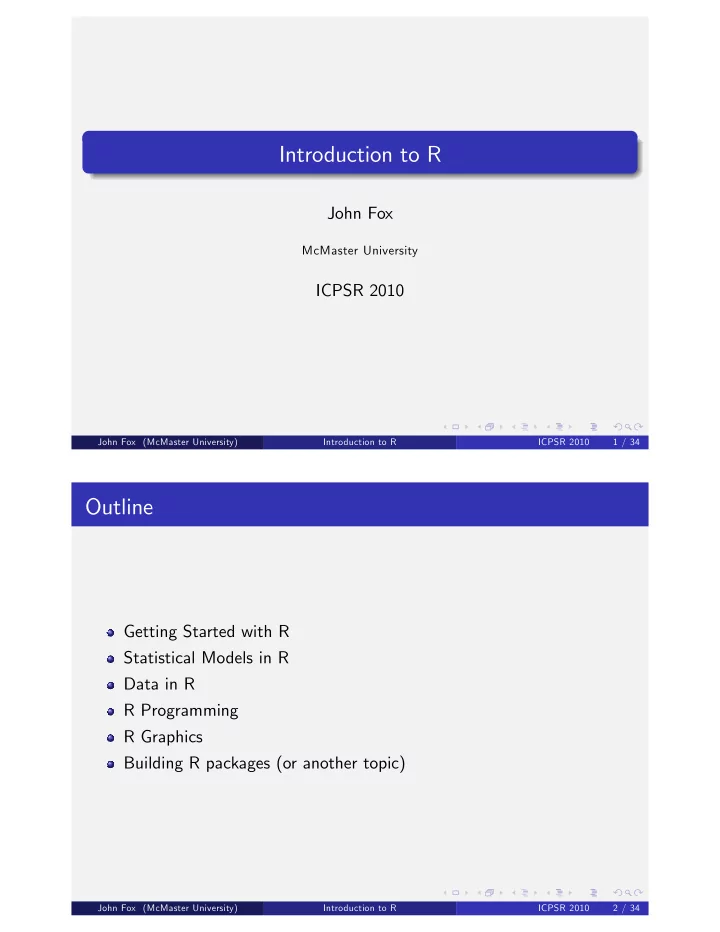
Introduction to R John Fox McMaster University ICPSR 2010 John - - PDF document

introduction to r
SMART_READER_LITE
LIVE PREVIEW

Introduction to R John Fox McMaster University ICPSR 2010 John - - PDF document

Introduction to R John Fox McMaster University ICPSR 2010 John Fox (McMaster University) Introduction to R ICPSR 2010 1 / 34 Outline Getting Started with R Statistical Models in R Data in R R Programming R Graphics Building R packages


slide-1
SLIDE 1

Introduction to R

John Fox

McMaster University

ICPSR 2010

John Fox (McMaster University) Introduction to R ICPSR 2010 1 / 34

Outline

Getting Started with R Statistical Models in R Data in R R Programming R Graphics Building R packages (or another topic)

John Fox (McMaster University) Introduction to R ICPSR 2010 2 / 34

slide-2
SLIDE 2

Getting Started With R

What is R?

A statistical programming language and computing environment, implementing the S language. Two implementations of S:

S-PLUS: commercial, for Windows and (some) Unix/Linux, eclipsed by R. R: free, open-source, for Windows, Macintoshes, and (most) Unix/Linux.

John Fox (McMaster University) Introduction to R ICPSR 2010 3 / 34

Getting Started With R

What is R?

How does a statistical programming environment di¤er from a statistical package (such as SPSS)?

A package is oriented toward combining instructions and rectangular datasets to produce (voluminous) printouts and graphs. Routine, standard data analysis is easy; innovation or nonstandard analysis is hard or impossible. A programming environment is oriented toward transforming one data structure into another. Programming environments such as R are

  • extensible. Standard data analysis is easy, but so are innovation and

nonstandard analysis.

John Fox (McMaster University) Introduction to R ICPSR 2010 4 / 34

slide-3
SLIDE 3

Getting Started With R

Why Use R?

Among statisticians, R has become the de-facto standard language for creating statistical software. Consequently, new statistical methods are often …rst implemented in R. There is a great deal of built-in statistical functionality in R, and many (literally thousands of) add-on packages available that extend the basic functionality. R creates …ne statistical graphs with relatively little e¤ort. The R language is very well designed and …nely tuned for writing statistical applications. (Much) R software is of very high quality. R is easy to use (for a programming language). R is free (in both of senses: costless and distributed under the Free Software Foundation’s GPL).

John Fox (McMaster University) Introduction to R ICPSR 2010 5 / 34

Getting Started With R

This Workshop

The purpose of this lecture series/workshop is to get participants started using R. The statistical content is largely assumed known. Much of the workshop is based on J. Fox and S. Weisberg, An R Companion to Applied Regression, Second Edition, Sage (in press). More advanced participants may prefer to read, or want to read in addition, W. N. Venables and B. D. Ripley, Modern Applied Statistics with S, Fourth Edition. New York: Springer, 2002 Additional materials and links are available on the web site for the …rst edition of the book: http://socserv.socsci.mcmaster.ca/jfox/Books/Companion/index.html The book is associated with an R package (called car) that implements a variety of methods helpful for analyzing data with linear and generalized linear models.

John Fox (McMaster University) Introduction to R ICPSR 2010 6 / 34

slide-4
SLIDE 4

Getting Started With R

This Workshop

Other references are given on the workshop web site. Workshop web site: http://socserv.socsci.mcmaster.ca/jfox/Courses/R-course/index.html

John Fox (McMaster University) Introduction to R ICPSR 2010 7 / 34

Statistical Models in R

Topics

Multiple linear regression Factors and dummy regression models Overview of the lm function The structure of generalized linear models (GLMs) in R; the glm function GLMs for binary/binomial data GLMs for count data Traditional ANOVA and MANOVA for repeated-measures designs (time permitting)

John Fox (McMaster University) Introduction to R ICPSR 2010 8 / 34

slide-5
SLIDE 5

Statistical Models in R

Arguments of the lm function

lm(formula, data, subset, weights, na.action, method = "qr", model = TRUE, x = FALSE, y = FALSE, qr = TRUE, singular.ok = TRUE, contrasts = NULL, offset, ...) formula Expression Interpretation Example A + B include both A and B income + education A - B exclude B from A a*b*d - a:b:d A:B all interactions of A and B type:education A*B A + B + A:B type*education B %in% A B nested within A education %in% type A/B A + B %in% A type/education A^k e¤ects crossed to order k (a + b + d)^2

John Fox (McMaster University) Introduction to R ICPSR 2010 9 / 34

Statistical Models in R

Arguments of the lm function

data: A data frame containing the data for the model. subset:

a logical vector: subset = sex == "F" a numeric vector of observation indices: subset = 1:100 a negative numeric vector with observations to be omitted: subset =

  • c(6, 16)

weights: for weighted-least-squares regression na.action: name of a function to handle missing data; default given by the na.action option, initially "na.omit" method, model, x, y, qr, singular.ok: technical arguments contrasts: specify list of contrasts for factors; e.g., contrasts=list(partner.status=contr.sum, fcategory=contr.poly))

  • ffset: term added to the right-hand-side of the model with a …xed

coe¢cient of 1.

John Fox (McMaster University) Introduction to R ICPSR 2010 10 / 34

slide-6
SLIDE 6

Statistical Models in R

Review of the Structure of GLMs

A generalized linear model consists of three components:

1

A random component, specifying the conditional distribution of the response variable, yi, given the predictors. Traditionally, the random component is an exponential family — the normal (Gaussian), binomial, Poisson, gamma, or inverse-Gaussian.

2

A linear function of the regressors, called the linear predictor, ηi = α + β1xi1 + + βkxik

  • n which the expected value µi of yi depends.

3

A link function g(µi) = ηi, which transforms the expectation of the response to the linear predictor. The inverse of the link function is called the mean function: g 1(ηi) = µi.

John Fox (McMaster University) Introduction to R ICPSR 2010 11 / 34

Statistical Models in R

Review of the Structure of GLMs

In the following table, the logit, probit and complementary log-log links are for binomial or binary data: Link ηi = g(µi) µi = g 1(ηi) identity µi ηi log loge µi eηi inverse µ1

i

η1

i

inverse-square µ2

i

η1/2

i

square-root

pµi

η2

i

logit loge µi 1 µi 1 1 + eηi probit Φ(µi) Φ1(ηi) complementary log-log loge[ loge(1 µi)] 1 exp[ exp(ηi)]

John Fox (McMaster University) Introduction to R ICPSR 2010 12 / 34

slide-7
SLIDE 7

Statistical Models in R

Implementation of GLMs in R

Generalized linear models are …t with the glm function. Most of the arguments of glm are similar to those of lm:

The response variable and regressors are given in a model formula. data, subset, and na.action arguments determine the data on which the model is …t. The additional family argument is used to specify a family-generator function, which may take other arguments, such as a link function.

John Fox (McMaster University) Introduction to R ICPSR 2010 13 / 34

Statistical Models in R

Implementation of GLMs in R

The following table gives family generators and default links: Family Default Link Range of yi V (yijηi) gaussian identity

(∞, +∞)

φ binomial logit 0, 1, ..., ni ni µi(1 µi) poisson log 0, 1, 2, ... µi Gamma inverse

(0, ∞)

φµ2

i

inverse.gaussian 1/mu^2

(0, ∞)

φµ3

i

For distributions in the exponential families, the variance is a function

  • f the mean and a dispersion parameter φ (…xed to 1 for the binomial

and Poisson distributions).

John Fox (McMaster University) Introduction to R ICPSR 2010 14 / 34

slide-8
SLIDE 8

Statistical Models in R

Implementation of GLMs in R

The following table shows the links available for each family in R, with the default links as : link family identity inverse sqrt 1/mu^2 gaussian

  • binomial

poisson

  • Gamma
  • inverse.gaussian
  • quasi
  • quasibinomial

quasipoisson

  • John Fox (McMaster University)

Introduction to R ICPSR 2010 15 / 34

Statistical Models in R

Implementation of GLMs in R

link family log logit probit cloglog gaussian

  • binomial
  • poisson
  • Gamma
  • inverse.gaussian
  • quasi
  • quasibinomial
  • quasipoisson
  • The quasi, quasibinomial, and quasipoisson family generators

do not correspond to exponential families.

John Fox (McMaster University) Introduction to R ICPSR 2010 16 / 34

slide-9
SLIDE 9

Statistical Models in R

GLMs for Binary/Binomial and Count Data

The response for a binomial GLM may be speci…ed in several forms:

For binary data, the response may be

a variable or an S expression that evaluates to 0’s (‘failure’) and 1’s (‘success’). a logical variable or expression (with TRUE representing success, and FALSE failure). a factor (in which case the …rst category is taken to represent failure and the others success).

For binomial data, the response may be

a two-column matrix, with the …rst column giving the count of successes and the second the count of failures for each binomial

  • bservation.

a vector giving the proportion of successes, while the binomial denominators (total counts or numbers of trials) are given by the weights argument to glm.

John Fox (McMaster University) Introduction to R ICPSR 2010 17 / 34

Statistical Models in R

GLMs for Binary/Binomial and Count Data

Poisson generalized linear models are commonly used when the response variable is a count (Poisson regression) and for modeling associations in contingency tables (loglinear models).

The two applications are formally equivalent. Poisson GLMs are …t in S using the poisson family generator with glm.

Overdispersed binomial and Poisson models may be …t via the quasibinomial and quasipoisson families.

John Fox (McMaster University) Introduction to R ICPSR 2010 18 / 34

slide-10
SLIDE 10

Statistical Models in R

ANOVA and MANOVA for Repeated-Measures

Begin by …tting a multivariate linear model using lm, with a matrix of responses on the LHS of the model formula, producing an mlm object; e.g., mod <- lm(cbind(time1, time2, time3) ~condition, data=Data) for a design with one between-subject factor, condition, and one within-subject factor, time. Create a data frame for the factor(s) in the within-subject design: idata <- data.frame(time=factor(1:3)). Specify the within-subject design to Anova via the idata and idesign arguments: Anova(mod, idata=idata, idesign= ~time). For more detail, and to get univariate tests, summarize the object returned by the Anova function: summary(Anova(mod, idata=idata, idesign= ~time)).

John Fox (McMaster University) Introduction to R ICPSR 2010 19 / 34

Data in R

Data input

From the keyboard From an ascii (plain text) …le From the clipboard Importing data (e.g., from SPSS or Excel) From an R package

The R search path Missing data Numeric variables, character variables, and factors Manipulating matrices, arrays, and lists Indexing vectors, matrices, lists and data frames

John Fox (McMaster University) Introduction to R ICPSR 2010 20 / 34

slide-11
SLIDE 11

Programming Basics

Topics

Function de…nition Control structures:

Conditionals: if, ifelse, switch Iteration: for, while, repeat

Recursion

John Fox (McMaster University) Introduction to R ICPSR 2010 21 / 34

Programming Basics

Review of MLE of the Binary Logit Model: Estimation by Newton-Raphson

1

Choose initial estimates of the regression coe¢cients, such as b0 = 0.

2

At each iteration t, update the coe¢cients: bt = bt1 + (X0Vt1X)1X0(y pt1) where

X is the model matrix, with x0

i as its ith row;

y is the response vector (containing 0’s and 1’s); pt1 is the vector of …tted response probabilities from the previous iteration, the ith entry of which is pi,t1 = 1 1 + exp(x0

ibt1)

Vt1 is a diagonal matrix, with diagonal entries pi,t1(1 pi,t1).

3

Step 2 is repeated until bt is close enough to bt1. The estimated asymptotic covariance matrix of the coe¢cients is given by

(X0VX)1.

John Fox (McMaster University) Introduction to R ICPSR 2010 22 / 34

slide-12
SLIDE 12

Programming Basics

Review of MLE of the Binary Logit Model: Estimation by General Optimization

Another approach is to let a general-purpose optimizer do the work of maximizing the log-likelihood, loge L = ∑ yi loge pi + (1 yi) loge (1 pi) Optimizers work by evaluating the gradient (vector of partial derivatives) of the ‘objective function’ (the log-likelihood) at the current estimates of the parameters, iteratively improving the parameter estimates using the information in the gradient; iteration ceases when the gradient is su¢ciently close to zero. For the logistic-regression model, the gradient of the log-likelihood is ∂ loge L ∂b

= ∑(yi pi)xi

John Fox (McMaster University) Introduction to R ICPSR 2010 23 / 34

Programming Basics

Review of MLE of the Binary Logit Model: Estimation by General Optimization

The covariance matrix of the coe¢cients is the inverse of the matrix

  • f second derivatives. The matrix of second derivatives, called the

Hessian, is ∂ loge L ∂b∂b0 = X0VX The optim function in R, however, calculates the Hessian numerically (rather than using an analytic formula).

John Fox (McMaster University) Introduction to R ICPSR 2010 24 / 34

slide-13
SLIDE 13

Debugging and Pro…ling R Code

Locating an error: traceback() Setting a breakpoint and examining the local environment of an executing function: browser() A simple interactive debugger: debug() Some other facilities: debug package, debugger() post-mortem debugger Measuring time and memory usage with system.time and Rprof

John Fox (McMaster University) Introduction to R ICPSR 2010 25 / 34

Object-Oriented Programming

The S3 Object System

S3 versus S4 objects How the S3 object system works Method dispatch, for object of class "class" : generic(object)

= ) generic.class(object) = ) generic.default(object)

For example, summarizing an object mod of class "lm": summary(mod)

= ) summary.lm(mod)

Objects can have more than one class, in which case the …rst applicable method is used.

For example, objects produced by glm() are of class c("glm", "lm") and therefore can inherit methods from class "lm".

Generic functions: generic <- function(object,

  • ther-arguments, ...)

UseMethod("generic")

For example, summary <- function(object, ...) UseMethod("summary")

John Fox (McMaster University) Introduction to R ICPSR 2010 26 / 34

slide-14
SLIDE 14

R Graphics

Topics

Traditional S graphics

points lines text axes frames arrows polygons legends curves use of colour

Trellis graphics (via the lattice package)

John Fox (McMaster University) Introduction to R ICPSR 2010 27 / 34

R Graphics

Example: Diagram of the Standard-Normal Density Function

−4 −2 2 4 0.0 0.1 0.2 0.3 0.4

The Standard Normal Density Function φ(z)

z φ(z) = 1 2π e− z2

2

⌠ ⌡

1.96 ∞ ∞

φ(z)dz = 0.025

John Fox (McMaster University) Introduction to R ICPSR 2010 28 / 34

slide-15
SLIDE 15

R Graphics

Example: Explanation of Nearest-Neighbor Kernel Regression

10000 30000 40 50 60 70 80

(a) Observations Within the Window span = 0.5

GDP per Capita Female Expectation of Life

  • x(120)

10000 30000 0.0 0.2 0.4 0.6 0.8 1.0

(b) Tricube Weights

GDP per Capita Tricube Kernel Weight

  • 10000

30000 40 50 60 70 80

(c) Weighted Average (Kernal Estimate)

GDP per Capita Female Expectation of Life

  • 10000

30000 40 50 60 70 80

(d) Complete Kernel Estimate

GDP per Capita Female Expectation of Life

John Fox (McMaster University) Introduction to R ICPSR 2010 29 / 34

R Graphics

Example: Trellis Display

Catholic Schools

SES Math Achievement

5 10 15 20 25 −4 −2 2

  • 7341
  • 8775

−4 −2 2

  • 6443
  • 5192

−4 −2 2

  • 3013
  • 9550
  • 4931
  • 3881
  • 5838

5 10 15 20 25

  • 8357

5 10 15 20 25

  • 1906
  • 8175
  • 8874
  • 9225
  • 2768
  • 2526

−4 −2 2

  • 3020
  • 6469

−4 −2 2

  • 8627

5 10 15 20 25

  • 9198

John Fox (McMaster University) Introduction to R ICPSR 2010 30 / 34
slide-16
SLIDE 16

Building R Packages

Primary reference for creating R Packages: Writing R Extensions (distributed with R). Create a source package containing “meta-information” describing the package; R code; data; documentation; and possibly other components. The source package is then checked and built into a universal .tar.gz format that can be distributed and installed under any

  • perating system on which R runs, or built into a binary package for a

particular system, such as Windows or Mac OS X. Under Windows, the ability to build packages requires installing software in addition to R: a working LaTeX, Perl, Unix-like command-line tools, and a C++ compiler, all of which are readily

  • available. See the “Windows toolset” appendix in the R Installation

and Administration manual and http://www.murdoch-sutherland.com/Rtools/.

John Fox (McMaster University) Introduction to R ICPSR 2010 31 / 34

Building R Packages

To check a package, assuming that the R bin directory is on the Windows path, and that the package subdirectory is in the current directory: R CMD check package-name To build the package, producing a tar.gz …le: R CMD build --force package-name To build a Windows binary package, producing a .zip …le: R CMD build --binary package-name To install directly: R CMD INSTALL package-name

John Fox (McMaster University) Introduction to R ICPSR 2010 32 / 34

slide-17
SLIDE 17

Building R Packages

Package Structure

An R source package consists of a directory containing:

A DESCRIPTION …le with meta information such as the package name, version, and author, and other packages on which the package depends. An optional NAMESPACE …le (for a package with a namespace), enumerating, e.g., the objects that are “exported” from the package. An R subdirectory containing .R …les with R code for creating objects such as functions. A man (“manual”) subdirectory that includes .Rd documentation …les (using LaTeX-like markup). All public objects in the package should be documented. A data subdirectory containing data objects, such as text …les that can be read as R data frames. Thus, a …le named Duncan.txt would produce a data frame named Duncan. Possibly an inst (“install”) subdirectory containing arbitrary …les and subdirectories to be installed in the package. Possibly other subdirectories (e.g., for compiled C code).

John Fox (McMaster University) Introduction to R ICPSR 2010 33 / 34

Building R Packages

The function package.skeleton creates the “skeleton” of a source package for objects that are currently in the R workspace. Example: The matrixDemos package.

John Fox (McMaster University) Introduction to R ICPSR 2010 34 / 34