(SDCL) steel bridge system: Seismic Application Atorod Azizinamini, - - PowerPoint PPT Presentation

sdcl steel bridge system seismic application
SMART_READER_LITE
LIVE PREVIEW

(SDCL) steel bridge system: Seismic Application Atorod Azizinamini, - - PowerPoint PPT Presentation

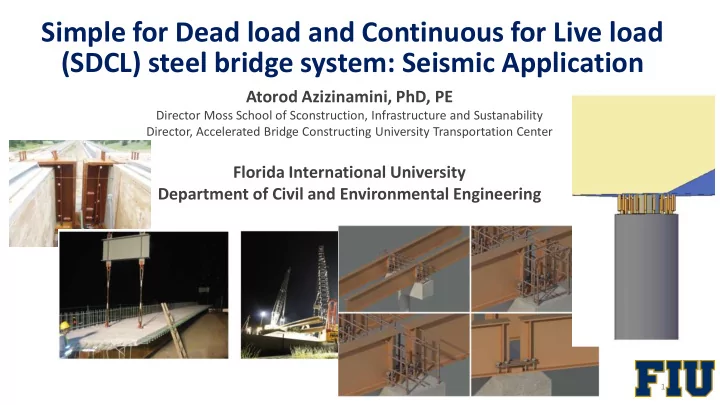
Simple for Dead load and Continuous for Live load (SDCL) steel bridge system: Seismic Application Atorod Azizinamini, PhD, PE Director Moss School of Sconstruction, Infrastructure and Sustanability Director, Accelerated Bridge Constructing


slide-1
SLIDE 1

Simple for Dead load and Continuous for Live load (SDCL) steel bridge system: Seismic Application

1

Atorod Azizinamini, PhD, PE

Director Moss School of Sconstruction, Infrastructure and Sustanability Director, Accelerated Bridge Constructing University Transportation Center

Florida International University Department of Civil and Environmental Engineering

slide-2
SLIDE 2

Brief Introduction to Simple for Dead Load and Continuous for Live Load Steel Bridge System (SDCL)

slide-3
SLIDE 3

Conventional Method

slide-4
SLIDE 4

Conventional Method

slide-5
SLIDE 5

Conventional Method

slide-6
SLIDE 6

Conventional Method

slide-7
SLIDE 7

Conventional Method

Conventional Method

slide-8
SLIDE 8

SDCL

slide-9
SLIDE 9

SDCL

slide-10
SLIDE 10

SDCL

slide-11
SLIDE 11

11

Longitudinal Reinforcement Is Placed in the Deck for Live Load Continuity

slide-12
SLIDE 12

SDCL

slide-13
SLIDE 13

13

M+ Increases M- Decreases No Bolted Connection Ease of Construction Enhanced Service life Minimized Traffic Interruption

slide-14
SLIDE 14

PIER DETAIL

slide-15
SLIDE 15

Test 1

WELDED BOTTOM FLANGE

slide-16
SLIDE 16

Test 2

NO END PREPARATION

slide-17
SLIDE 17

Test 3

END CAP PLATES

slide-18
SLIDE 18
slide-19
SLIDE 19

19

slide-20
SLIDE 20

20

FIELD DEMONSTRATION BRIDGE

slide-21
SLIDE 21
slide-22
SLIDE 22
slide-23
SLIDE 23

23

slide-24
SLIDE 24

T T C C

y x z

F Fc

c

P Pi

i

T T C C

y x z

F Fc

c

P Pi

i

slide-25
SLIDE 25

25

Mn = As fy(d − H/2) (1) Based on Research

Where: Mn = Moment Capacity As = Area of Slab Reinforcement (Tension) fy = Yield Stress of Reinforcement d = Bottom of Girder to Slab Reinforcement H = Height Steel Block

slide-26
SLIDE 26

26

Calculation for Test Specimen:

Two Span Bridge – Each Span 97 Ft Mu(LL) 34,770 in.-kip (Required) Slab Width be = 92 in. (effective) Slab Thickness t = 8.5 in. Distance to Reinforcement, d = 47.75 in. Strength reduction factor, ϕ = 0.9 W40×249 D = 43.375 in bf = 15.75 in

slide-27
SLIDE 27

27

Rearrange Capacity Equation: Using Sample Values:

slide-28
SLIDE 28

28

Bearing Check: Max Bearing Stress (Steel Block) = 1.7 Fy Equate Tension (T) and Compression (C) Components to Determine Minimum Height of Block to Resist Tension in Reinforcement

Note: Block Width = Flange Width (bf)

(2 in. used in specimen)

slide-29
SLIDE 29

Other Details Used in Practice

slide-30
SLIDE 30

30

slide-31
SLIDE 31

31

slide-32
SLIDE 32

32

slide-33
SLIDE 33

33

slide-34
SLIDE 34

SDCL Application Example Non-Seismic

slide-35
SLIDE 35

Temporary Bracings were not used

slide-36
SLIDE 36

System Greatly Reduces Falling Hazard

slide-37
SLIDE 37

SDCL: ABC Application Non-seismic

37

Girder Cope Top Flange Bearing Blocks Deck Longitudinal Reinforcement

slide-38
SLIDE 38
slide-39
SLIDE 39
slide-40
SLIDE 40
slide-41
SLIDE 41
slide-42
SLIDE 42

42

slide-43
SLIDE 43

43

slide-44
SLIDE 44

44

slide-45
SLIDE 45
slide-46
SLIDE 46
slide-47
SLIDE 47
slide-48
SLIDE 48
slide-49
SLIDE 49
slide-50
SLIDE 50
slide-51
SLIDE 51
slide-52
SLIDE 52

Moderate to High Seismic Detail: SDCL

slide-53
SLIDE 53

Types of Forces, Seismic Detail Should Resist

53

slide-54
SLIDE 54

Seismic Detail

54

slide-55
SLIDE 55

Seismic Detail

55

  • 1. Tie bars and shear studs on

the compression flange

  • 2. Steel blocks at the end of the

compression flanges

  • 3. End stiffeners
  • 4. Dowel bars
  • 5. Live load continuity

reinforcement

1 2 3 4 5

slide-56
SLIDE 56

ABC Application of SDCL Using Envisioned Connection

slide-57
SLIDE 57

Column to Cap beam Connection

Precast Cap-beam

UHPC 1 2 3

Concrete Filled UHPC Tube

slide-58
SLIDE 58

Construction Sequence

Footing and Column reinforcement Precast UHPC Shell Placing Shell as Formwork Connecting Shell to Footing (UHPC) Precast Cap beam Casting Column (Normal Concrete) Connecting Column to Cap beam (UHPC)

slide-59
SLIDE 59

59

slide-60
SLIDE 60

60

Note: Reverse Curvature for Multiple Columns

slide-61
SLIDE 61

Component test Design of Test Specimen

61 Inverted setup

slide-62
SLIDE 62

Component test

Test Setup

62

slide-63
SLIDE 63

Component test

Design of Test Specimen

63

Capacity Design using M-ϕ and finite element analysis

Col Column M-ϕ Be Bent t cap p M-ϕ in n transver erse e di directio ion Be Bent t cap p M-Δ in n longitu tudin inal l di directio ion (FE FE)

(Separate Check at Face of Cap – Dashed line)

slide-64
SLIDE 64

Component test Design of Test Specimen

AASHTO Seismic Guide Spec

64

slide-65
SLIDE 65

Component test Design of Test Specimen

AASHTO Seismic Guide Spec

65

Not shown

slide-66
SLIDE 66

Component test Design of Test Specimen

AASHTO Seismic Guide Spec

66

slide-67
SLIDE 67

Component test

Design of Test Specimen

67

Joint Shear Reinforcement Detail

Parameter Required Provided Description 𝑩𝒕𝒖 3.72 3.72 Column Longitudinal 12 #5 𝑩𝒕

𝒌𝒘

0.744 0.88 & 0.77 Vertical bars 8 #3 for area 3 and 4, 7 #3 for area 1 and 2 𝑩𝒕

𝒌𝒊

0.37 0.88 Horizontal bars 2 set of 4 #3 on each side of column 𝑩𝒕

𝒕𝒈

0.2 0.33 Side bars 3 #3 each side

slide-68
SLIDE 68

Component Test Setup

68

slide-69
SLIDE 69

Component testing (Plastic Hinge Damage)

Structures Congress 2019

Orlando, FL | April 24-27

69 1Δy 2Δy 3Δy 4Δy 5Δy 6Δy

Crushing Cracking

slide-70
SLIDE 70

Component testing

Strain and Curvature Measurements (Column)

Structures Congress 2019

Orlando, FL | April 24-27

70

  • 30
  • 20
  • 10

10 20 30 5000 10000 15000 Distance from Cap beam (cm) Strain (x10-6) 1Δy 2Δy 3Δy 4Δy

Steel yield strain

5 10 15 20 25 30

  • 0.4
  • 0.2

0.2 0.4 Distance from Cap-beam (cm) Curvature (rad/m) 1Δy 2Δy 3Δy 4Δy 5Δy

slide-71
SLIDE 71

Component testing

Strain Measurements (Cap beam)

Structures Congress 2019

Orlando, FL | April 24-27

71

500 1000 20 40 60 80 Strain (x10-6) Distance from column centerline (cm) 1Δy (Experimental) 6Δy (Experimental) 1Δy (Numerical) 6Δy (Numerical)

slide-72
SLIDE 72

Component testing

Strain Measurements (Deck)

Structures Congress 2019

Orlando, FL | April 24-27

72

slide-73
SLIDE 73

73

slide-74
SLIDE 74

74

slide-75
SLIDE 75

Conclusions:

  • Details and associated design criteria are developed to apply the SDCL

steel bridge system to moderate to high seismic areas.

  • The recommendations are verified through shake table test.
  • The suggested seismic detail is slightly different than non-seismic

detail that has been used for more than 15 years successfully.

  • The recommended design provisions matches those already in AASHTO

seismic design specifications.