Scriptable Asynchronous Multi-Copy Algorithms in NAMD via Charm++ - - PowerPoint PPT Presentation

scriptable asynchronous multi copy algorithms in namd via
SMART_READER_LITE
LIVE PREVIEW

Scriptable Asynchronous Multi-Copy Algorithms in NAMD via Charm++ - - PowerPoint PPT Presentation

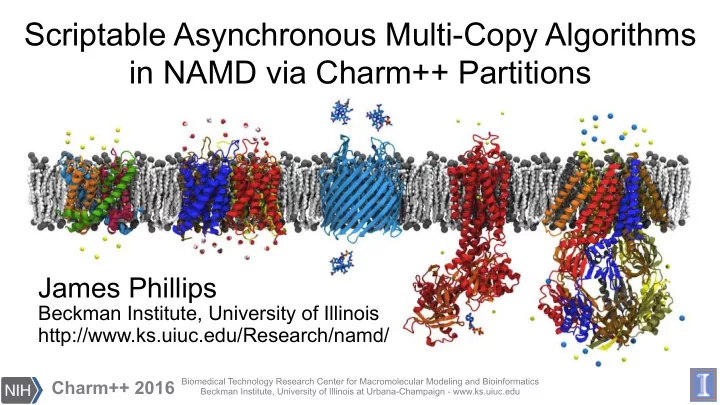
Scriptable Asynchronous Multi-Copy Algorithms in NAMD via Charm++ Partitions James Phillips Beckman Institute, University of Illinois http://www.ks.uiuc.edu/Research/namd/ Biomedical Technology Research Center for Macromolecular Modeling and


slide-1
SLIDE 1

Biomedical Technology Research Center for Macromolecular Modeling and Bioinformatics Beckman Institute, University of Illinois at Urbana-Champaign - www.ks.uiuc.edu

Charm++ 2016

Scriptable Asynchronous Multi-Copy Algorithms in NAMD via Charm++ Partitions

James Phillips

Beckman Institute, University of Illinois http://www.ks.uiuc.edu/Research/namd/

slide-2
SLIDE 2

Biomedical Technology Research Center for Macromolecular Modeling and Bioinformatics Beckman Institute, University of Illinois at Urbana-Champaign - www.ks.uiuc.edu

Charm++ 2016

Developers of the widely used computational biology software VMD and NAMD

250,000 registered VMD users 80,000 registered NAMD users 600 publications (since 1972)

  • ver 54,000 citations

5 faculty members 8 developers 1 systems administrator 17 postdocs 46 graduate students 3 administrative staff

research projects include: virus capsids, ribosome, photosynthesis, protein folding, membrane reshaping, animal magnetoreception

Tajkorshid, Luthey-Schulten, Stone, Schulten, Phillips, Kale, Mallon

NIH Biomedical Technology Research Center for Macromolecular Modeling and Bioinformatics

Achievements Built on People

Renewed 2012-2017 with 10.0 score (NIH)
slide-3
SLIDE 3

Biomedical Technology Research Center for Macromolecular Modeling and Bioinformatics Beckman Institute, University of Illinois at Urbana-Champaign - www.ks.uiuc.edu

Charm++ 2016

NAMD Mission Statement:

Practical Supercomputing for Biomedical Research

  • 80,000 users can’t all be computer experts.

– 18% are NIH-funded; many in other countries. – 24,000 have downloaded more than one version. – 5000 citations of NAMD reference papers.

  • One program available on all platforms.

– Desktops and laptops – setup and testing – Linux clusters – affordable local workhorses – Supercomputers – free allocations on XSEDE – Blue Waters – sustained petaflop/s performance – GPUs – from desktop to supercomputer

  • User knowledge is preserved across platforms.

– No change in input or output files. – Run any simulation on any number of cores.

  • Available free of charge to all.

Oak Ridge TITAN Hands-On Workshops

slide-4
SLIDE 4

Biomedical Technology Research Center for Macromolecular Modeling and Bioinformatics Beckman Institute, University of Illinois at Urbana-Champaign - www.ks.uiuc.edu

Charm++ 2016

NAMD Benefits from Charm++ Collaboration

  • Illinois Parallel Programming Lab

– Prof. Laxmikant Kale – charm.cs.illinois.edu

  • Long standing collaboration

– Since start of Center in 1992 – Gordon Bell award at SC2002 – Joint Fernbach award at SC12

  • Synergistic research

– NAMD requirements drive and validate CS work – Charm++ software provides unique capabilities – Enhances NAMD performance in many ways

slide-5
SLIDE 5

Biomedical Technology Research Center for Macromolecular Modeling and Bioinformatics Beckman Institute, University of Illinois at Urbana-Champaign - www.ks.uiuc.edu

Charm++ 2016

Charm++ Used by NAMD

  • Parallel C++ with data driven objects.
  • Asynchronous method invocation.
  • Prioritized scheduling of messages/execution.
  • Measurement-based load balancing.
  • Portable messaging layer.
slide-6
SLIDE 6

Biomedical Technology Research Center for Macromolecular Modeling and Bioinformatics Beckman Institute, University of Illinois at Urbana-Champaign - www.ks.uiuc.edu

Charm++ 2016

  • Spatially decompose data and

communication.

  • Separate but related work

decomposition.

  • “Compute objects” facilitate

iterative, measurement-based load balancing system.

NAMD Hybrid Decomposition

Kale et al., J. Comp. Phys. 151:283-312, 1999.

slide-7
SLIDE 7

Biomedical Technology Research Center for Macromolecular Modeling and Bioinformatics Beckman Institute, University of Illinois at Urbana-Champaign - www.ks.uiuc.edu

Charm++ 2016

Phillips et al., SC2002.

Offload to GPU

Objects are assigned to processors and queued as data arrives.

NAMD Overlapping Execution

slide-8
SLIDE 8

Biomedical Technology Research Center for Macromolecular Modeling and Bioinformatics Beckman Institute, University of Illinois at Urbana-Champaign - www.ks.uiuc.edu

Charm++ 2016 1990 1994 1998 2002 2006 2010 104 105 106 107 108 2014 Lysozyme ApoA1 ATP Synthase STMV Ribosome HIV capsid Number of atoms 1986

Structural data drives larger simulations

slide-9
SLIDE 9

Biomedical Technology Research Center for Macromolecular Modeling and Bioinformatics Beckman Institute, University of Illinois at Urbana-Champaign - www.ks.uiuc.edu

Charm++ 2016

NAMD Runs Large Petascale Simulations Well

0.25 0.5 1 2 4 8 16 32 64 256 512 1024 2048 4096 8192 16384 Number of Nodes 21M atoms 224M atoms Performance (ns per day) Blue Waters XK7 (GTC16) Titan XK7 (GTC16) Edison XC30 (SC14) Blue Waters XE6 (SC14)

(2fs timestep)

Topology- aware scheduler

Influenza, 210M atoms Amaro Lab, UCSD

slide-10
SLIDE 10

Biomedical Technology Research Center for Macromolecular Modeling and Bioinformatics Beckman Institute, University of Illinois at Urbana-Champaign - www.ks.uiuc.edu

Charm++ 2016

A Sampling of Petascale Projects Using NAMD

Rous Sarcoma Virus HIV Chromatophore Rabbit Hemorrhagic Disease Chemosensory Array

slide-11
SLIDE 11

Biomedical Technology Research Center for Macromolecular Modeling and Bioinformatics Beckman Institute, University of Illinois at Urbana-Champaign - www.ks.uiuc.edu

Charm++ 2016

Future NAMD Platforms

  • NERSC Cori / Argonne Theta (2016)

– Knight’s Landing (KNL) Xeon Phi – Single-socket nodes, Cray Aries network – Theta Early Science Project: “Free Energy Landscapes of Membrane Transport Proteins”

  • Oak Ridge Summit (2018)

– IBM Power 9 CPUs + NVIDIA Volta GPUs – 3,400 fat nodes, dual-rail InfiniBand network – CAAR Project “Molecular Machinery of the Brain”

  • Argonne Aurora (2018)

– Knight’s Hill (KNH) Xeon Phi Synaptic vesicle and presynaptic membrane

slide-12
SLIDE 12

Biomedical Technology Research Center for Macromolecular Modeling and Bioinformatics Beckman Institute, University of Illinois at Urbana-Champaign - www.ks.uiuc.edu

Charm++ 2016

Replica Exchange Enables Advanced Sampling

Bias-Exchange Umbrella Sampling

  • n quaternion-based order parameters

θ7 θ1

Inward Outward IF OF

Free Energy (kcal/mol)

Reaction Path (θ1+θ7) 12 replicas θ1 θ7

Efficient Reaction Path Sampling GlpT transporter in membrane

  • M. Moradi and E. Tajkhorshid, Mechanistic picture for conformational transition
  • f a membrane transporter at atomic resolution. PNAS, 110:18916 (2013).
slide-13
SLIDE 13

Biomedical Technology Research Center for Macromolecular Modeling and Bioinformatics Beckman Institute, University of Illinois at Urbana-Champaign - www.ks.uiuc.edu

Charm++ 2016

12 replicas x 40 ns (H1/H7) 50 replicas x 20 ns (10 Hs) 12 replicas x 40 ns (H1/H7) 24 replicas x 20 ns (H1/H7) 200 replicas (2D) x 5 ns 50 replicas x 20 ns 30 r x 20 ns 30 r x 20 ns 30 r x 20 ns 30 r x 20 ns 30 r x 20 ns

Mahmoud Moradi, bias-exchange umbrella sampling simulations of GlpT

150 replicas

Multi-Copy Algorithm Sophistication Increases

slide-14
SLIDE 14

Biomedical Technology Research Center for Macromolecular Modeling and Bioinformatics Beckman Institute, University of Illinois at Urbana-Champaign - www.ks.uiuc.edu

Charm++ 2016

Tcl Scripting Enables Portable Customization

  • Top-level protocols:

– Replica exchange (originally via sockets) – Minimize, heat, equilibrate – Simulated annealing

  • Long-range forces on selected atoms

– Torques and other steering forces – Adaptive bias free energy perturbation – Coupling to external coarse-grain model

  • Special boundary forces

– Applies potentially to every atom – Several optimizations for efficiency – Shrinking phantom pore for DNA

slide-15
SLIDE 15

Biomedical Technology Research Center for Macromolecular Modeling and Bioinformatics Beckman Institute, University of Illinois at Urbana-Champaign - www.ks.uiuc.edu

Charm++ 2016

Why NAMD and VMD Use Tcl

  • History: Programs are ~20 years old.
  • Maturity: Package management, portable.
  • Stability: Interfaces haven’t changed.
  • Flexibility: Encapsulates mini-languages.
  • Approachability: Looks like a simple scripting

language, doesn’t scare non-programmers.

  • Next NAMD adds optional Python interpreter.
slide-16
SLIDE 16

Biomedical Technology Research Center for Macromolecular Modeling and Bioinformatics Beckman Institute, University of Illinois at Urbana-Champaign - www.ks.uiuc.edu

Charm++ 2016

Tcl and Charm++ in NAMD

  • Tcl runs on PE 0 only

– Tcl parses config file until end or “run” – Send startup messages, run scheduler

  • Scheduler processes messages, starts run
  • At end of run, exit scheduler on quiescence

– Tcl continues parsing config file...

slide-17
SLIDE 17

Biomedical Technology Research Center for Macromolecular Modeling and Bioinformatics Beckman Institute, University of Illinois at Urbana-Champaign - www.ks.uiuc.edu

Charm++ 2016

Tcl Overview

  • Variables: $var $array($key) $array($i.field)
  • Strings: abc 123 “$sub” {$nosub} [eval this]
  • Commands: command $byvalue byname

– To create commands: proc {args} {script} – upvar and uplevel access calling namespace – Control structures are just commands

  • Simple core enables great flexibility.
slide-18
SLIDE 18

Biomedical Technology Research Center for Macromolecular Modeling and Bioinformatics Beckman Institute, University of Illinois at Urbana-Champaign - www.ks.uiuc.edu

Charm++ 2016

NAMD 2.9 Multi-Copy Tcl Interface

  • Blocking communication (MPI semantics):

– replicaSend data dest – replicaRecv source – replicaSendrecv data dest source

  • Utility functions:

– myReplica – numReplicas – replicaBarrier

slide-19
SLIDE 19

Biomedical Technology Research Center for Macromolecular Modeling and Bioinformatics Beckman Institute, University of Illinois at Urbana-Champaign - www.ks.uiuc.edu

Charm++ 2016

Replica Exchange in Tcl

while {$i_run < $num_runs} { run $steps_per_run save_array incr i_step $steps_per_run set TEMP $saved_array(TEMP) set POTENTIAL $saved_array(POTENTIAL) puts $history_file \ "$i_step $replica(index) $NEWTEMP $TEMP $POTENTIAL" if { $i_run % 2 == 0 } { set swap a; set other b } else { set swap b; set other a } set doswap 0 if { $replica(index) < $replica(index.$swap) } { set temp $replica(temperature) set temp2 $replica(temperature.$swap) set BOLTZMAN 0.001987191 set dbeta [expr ((1.0/$temp) - (1.0/$temp2)) / $BOLTZMAN] set pot $POTENTIAL set pot2 [replicaRecv $replica(loc.$swap)] set delta [expr $dbeta * ($pot2 - $pot)] set doswap [expr $delta < 0. || exp(-1.*$delta) > rand()] replicaSend $doswap $replica(loc.$swap) if { $doswap } { set rid $replica(index); set rid2 $replica(index.$swap) } } if { $replica(index) > $replica(index.$swap) } { replicaSend $POTENTIAL $replica(loc.$swap) set doswap [replicaRecv $replica(loc.$swap)] } set newloc $r if { $doswap } { set newloc $replica(loc.$swap) set replica(loc.$swap) $r } set replica(loc.$other) [replicaSendrecv \ $newloc $replica(loc.$other) $replica(loc.$other)] set oldidx $replica(index) if { $doswap } { set OLDTEMP $replica(temperature) array set replica [replicaSendrecv [array get replica] $newloc $newloc] set NEWTEMP $replica(temperature) rescalevels [expr sqrt(1.0*$NEWTEMP/$OLDTEMP)] langevinTemp $NEWTEMP } incr i_run }

slide-20
SLIDE 20

Biomedical Technology Research Center for Macromolecular Modeling and Bioinformatics Beckman Institute, University of Illinois at Urbana-Champaign - www.ks.uiuc.edu

Charm++ 2016

MPI Implementation (NAMD 2.9)

  • Charm++ initialization:

– MPI_Comm_split(MPI_COMM_WORLD, myReplicaID, my_rank_in_replica, &MPI_COMM_LOCAL); – MPI_Comm_split(MPI_COMM_WORLD, my_rank_in_replica, myReplicaID, &MPI_COMM_CROSS);

  • Direct mapping to MPI communication:

– void CmiReplicaSend(void *buf, int count, int dest) {

MPI_Send(buf, count, MPI_BYTE, dest, 1, MPI_COMM_CROSS);

}

  • Limited by performance of Charm++ MPI communication layer
slide-21
SLIDE 21

Biomedical Technology Research Center for Macromolecular Modeling and Bioinformatics Beckman Institute, University of Illinois at Urbana-Champaign - www.ks.uiuc.edu

Charm++ 2016

LRTS Implementation (NAMD 2.10)

  • Converse asynchronous messaging:

– void CmiInterSyncSendFn(int destPE, int partition int size, char *msg) – void CmiInterSyncNodeSendFn(int destNode, int partition, int size, char *msg)

  • MPI-style blocking communication in Charm++:

entry void send(Pointer srcPointer, int srcSize, int dstPart, int dst) { serial { packSend(dst,dstPart,(char*)srcPointer.data,srcSize,recv_data_idx); } when recv_ack() serial { CpvAccess(breakScheduler) = 1; } };

Credit: Nikhil Jain, NCSA funding

slide-22
SLIDE 22

Biomedical Technology Research Center for Macromolecular Modeling and Bioinformatics Beckman Institute, University of Illinois at Urbana-Champaign - www.ks.uiuc.edu

Charm++ 2016

Atom-Exchange Tcl Interface

  • replicaAtomSend dest
  • replicaAtomRecv source
  • replicaAtomSendrecv dest source
  • Needed if settings can’t be modified.
  • Direct patch-to-patch communication

– Requires “replicaUniformPatchGrids yes”

slide-23
SLIDE 23

Biomedical Technology Research Center for Macromolecular Modeling and Bioinformatics Beckman Institute, University of Illinois at Urbana-Champaign - www.ks.uiuc.edu

Charm++ 2016

NAMD Replica Exchange Limitations

  • One-to-one replicas to Charm++ partitions:

– Available hardware must match science. – Batch job size must match science. – Replica count fixed at job startup. – No hiding of inter-replica communication latency. – No hiding of replica performance divergence.

  • Can a different programming model help?
slide-24
SLIDE 24

Biomedical Technology Research Center for Macromolecular Modeling and Bioinformatics Beckman Institute, University of Illinois at Urbana-Champaign - www.ks.uiuc.edu

Charm++ 2016

Swift (swift-lang.org) programming model: all progress driven by concurrent dataflow

  • F() and G() implemented in native code or external programs
  • F() and G()run in concurrently in different processes
  • r is computed when they are both done
  • This parallelism is automatic
  • Works recursively throughout the program’s call graph

(int r) myproc (int i, int j) { int f = F(i); int g = G(j); r = f + g; }

slide-25
SLIDE 25

Biomedical Technology Research Center for Macromolecular Modeling and Bioinformatics Beckman Institute, University of Illinois at Urbana-Champaign - www.ks.uiuc.edu

Charm++ 2016

NAMD and Swift/T

Typical Swift/T Structure

MD1.c MD1.c MD2.cpp MD2.cpp viz.cpp viz.cpp SWIG-generated Tcl wrappers SWIG-generated Tcl wrappers Swift/T runtime Swift/T runtime

MPI

Top-level dataflow script exchange.swift Top-level dataflow script exchange.swift

NAMD Structure

Swift/T runtime Swift/T runtime NAMD (C++) NAMD (C++) Tcl Evaluation (uplevel-eval) Tcl Evaluation (uplevel-eval) Top-level dataflow script exchange.swift Top-level dataflow script exchange.swift

Phillips et al., Petascale Tcl with NAMD, VMD, and Swift/T. In SC'14 workshop on High Performance Technical Computing in Dynamic Languages, SC '14.

slide-26
SLIDE 26

Biomedical Technology Research Center for Macromolecular Modeling and Bioinformatics Beckman Institute, University of Illinois at Urbana-Champaign - www.ks.uiuc.edu

Charm++ 2016

Replica Exchange in Swift/T

foreach i in [0:num_replicas-1] { TEMPERATURE[i] = min_temp * exp(log(max_temp/min_temp)*(itof(i)/itof(num_replicas-1)) ); states[1][i], POTENTIAL[1][i] = run_t(ifile, i, 1, steps_per_run, TEMPERATURE[i], 300); } foreach f in [2:num_runs] { if ( f%%2 == 1 ) { sources[f][0] = 0; } if ( (num_replicas+f)%%2 == 1 ) { sources[f][num_replicas-1] = num_replicas-1; } foreach i in [f%%2+1:num_replicas-1:2] { BOLTZMAN = 0.001987191; dbeta = ((1.0/TEMPERATURE[i-1]) - (1.0/TEMPERATURE[i])) / BOLTZMAN; float delta = dbeta * (POTENTIAL[f-1][i] - POTENTIAL[f-1][i-1]); boolean doswap = (delta < 0.0) || (exp(-delta) > random()); printf("frame %d reps %d %d swap %s\n", f, i-1, i, doswap); if ( doswap ) { sources[f][i] = i-1; sources[f][i-1] = i; } else { sources[f][i] = i; sources[f][i-1] = i-1; } } foreach i in [0:num_replicas-1] { int isrc = sources[f][i]; states[f][i], POTENTIAL[f][i] = run_t(states[f-1][isrc], i, f, steps_per_run, TEMPERATURE[i], TEMPERATURE[isrc]); } }

slide-27
SLIDE 27

Biomedical Technology Research Center for Macromolecular Modeling and Bioinformatics Beckman Institute, University of Illinois at Urbana-Champaign - www.ks.uiuc.edu

Charm++ 2016

NAMD Swift/T Limitations

  • Unfamiliar language and semantics
  • Requires dedicated server process
  • Based on MPI – limits SMP performance
  • Not designed for large data objects

– Prototype writes and reads files (slow)

  • Designed for a different class of problems

– Maybe we can build something simpler

slide-28
SLIDE 28

Biomedical Technology Research Center for Macromolecular Modeling and Bioinformatics Beckman Institute, University of Illinois at Urbana-Champaign - www.ks.uiuc.edu

Charm++ 2016

In-Memory Checkpointing

  • checkpointStore key ?replica or global?
  • checkpointLoad key ?replica or global?
  • checkpointSwap key ?replica or global?
  • checkpointFree key ?replica or global?
  • One-sided – remote simulation continues running

– Patch-level storage and communcation

  • Useful for single-copy protocols as well

– Extension of existing “checkpoint” and “revert”

slide-29
SLIDE 29

Biomedical Technology Research Center for Macromolecular Modeling and Bioinformatics Beckman Institute, University of Illinois at Urbana-Champaign - www.ks.uiuc.edu

Charm++ 2016

Workflow-Enabling Commands

  • replicaEval replica script

– Evaluate script in remote partition’s interpreter – One-sided – remote simulation continues running – Returns result

  • replicaYield ?seconds?

– Could be used to break up polling loops – In practice use (blocking) replicaRecv to wait instead

  • replicaDcdFile index|off ?filename?

– Redirect trajectory output

slide-30
SLIDE 30

Biomedical Technology Research Center for Macromolecular Modeling and Bioinformatics Beckman Institute, University of Illinois at Urbana-Champaign - www.ks.uiuc.edu

Charm++ 2016

Simple Work Queue in Tcl

if { ! [myReplica] } { … proc enqueue_work_0 work { if [workers_idle] { replicaSend $work [pop_worker] } else { push_work $work } } proc dependent_set_0 {var val} { upvar #0 $var v if { [info exists v] } { error "dependency variable $var set twice: old value $v, new value $val" } set v $val } proc dependent_work_0 {known future} { if { $future == {} } { enqueue_work_0 $known return } … uplevel #0 [list trace add variable $dname write [ list dependent_trace_0 $known $future]] } ... proc enqueue_work work { replicaEval 0 [list enqueue_work_0 $work] } proc dependent_work {known future} { replicaEval 0 [list dependent_work_0 $known $future] } proc dependent_set {var val} { replicaEval 0 [list dependent_set_0 $var $val] } proc schedule_work {} { while { 1 } { set w [replicaEval 0 "dequeue_work_0 [myReplica]"] if { $w == {} } { set w [replicaRecv 0] } eval $w } } replicaBarrier schedule_work

slide-31
SLIDE 31

Biomedical Technology Research Center for Macromolecular Modeling and Bioinformatics Beckman Institute, University of Illinois at Urbana-Champaign - www.ks.uiuc.edu

Charm++ 2016

Multiplexed Replica Exchange

proc run_replica { dict rescale } { global num_runs steps_per_run … dict with dict { firsttimestep $i_step if { $checkpointname != {} } { checkpointLoad $checkpointname $checkpointloc checkpointFree $checkpointname $checkpointloc } else { # start or restart … } if { $rescale != 1.0 } { rescalevels $rescale } if { $i_run >= $num_runs } { # exit … } langevinTemp $temperature replicaDcdFile $dcdindex run $steps_per_run incr i_run; incr i_step $steps_per_run set checkpointname $i_run.$index; set checkpointloc [myReplica] checkpointStore $checkpointname $checkpointloc replica_puts $history_file "$i_step $index $temperature $TEMP $POT" if { $i_run % 2 == 1 } {set iswap $index_a } else { set iswap $index_b } } if { $index < $iswap } { dependent_work [list swap_replica $dict] [list dict.$i_run.$iswap] } elseif { $index > $iswap } { dependent_set dict.$i_run.$index $dict } else { enqueue_work [list run_replica $dict 1.0] } proc swap_replica {self swap} { set temp [dict get $self temperature]; set rid [dict get $self index] set temp2 [dict get $swap temperature]; set rid2 [dict get $swap index] set BOLTZMAN 0.001987191 set dbeta [expr ((1.0/$temp) - (1.0/$temp2)) / $BOLTZMAN] set pot [dict get $self POT]; set pot2 [dict get $swap POT] set delta [expr $dbeta * ($pot2 - $pot)] set doswap [expr $delta < 0. || exp(-1. * $delta) > rand()] if { $doswap } { set i_run [dict get $self i_run] puts stderr ”ACCEPT $rid ($temp) $rid2 ($temp2) RUN $i_run" set rescale [expr sqrt(1.0*$temp/$temp2)] set rescale2 [expr sqrt(1.0*$temp2/$temp)] dict_swap self swap checkpointname checkpointloc history_file dcdindex } else { set rescale 1.0; set rescale2 1.0 } dict with self { incr exchanges_attempted if { $doswap } { incr exchanges_accepted } } enqueue_work [list run_replica $swap $rescale2] run_replica $self $rescale }

slide-32
SLIDE 32

Biomedical Technology Research Center for Macromolecular Modeling and Bioinformatics Beckman Institute, University of Illinois at Urbana-Champaign - www.ks.uiuc.edu

Charm++ 2016

Conclusion: Multi-Copy Capabilities Evolve

  • New: Workflow algorithms

– Multiple in-memory checkpoints with inter-replica access – Global work queue, dependency-driven execution – First use: Milestoning (Lane Votapka, Amaro Lab, UCSD)

  • Improved: Replica exchange simulations

– Enhanced Tcl-based scripting of collective variables – Multiplexing replicas on smaller number of parallel partitions

  • Available in NAMD 2.11

– Released December 22, 2015

slide-33
SLIDE 33

Biomedical Technology Research Center for Macromolecular Modeling and Bioinformatics Beckman Institute, University of Illinois at Urbana-Champaign - www.ks.uiuc.edu

Charm++ 2016 Thanks to: NIH, NSF, DOE, NCSA, ALCF, OLCF, Nikhil Jain, Wei Jiang, Lei Huang, Mikolai Fajer, Yilin Meng, James Gumbart, Yun Luo, Benoit Roux, Timothy G. Armstrong, Justin M. Wozniak, Michael Wilde, and 20 years of NAMD and Charm++ developers and users.

James Phillips

Beckman Institute, University of Illinois http://www.ks.uiuc.edu/Research/namd/