
SLIDE 1
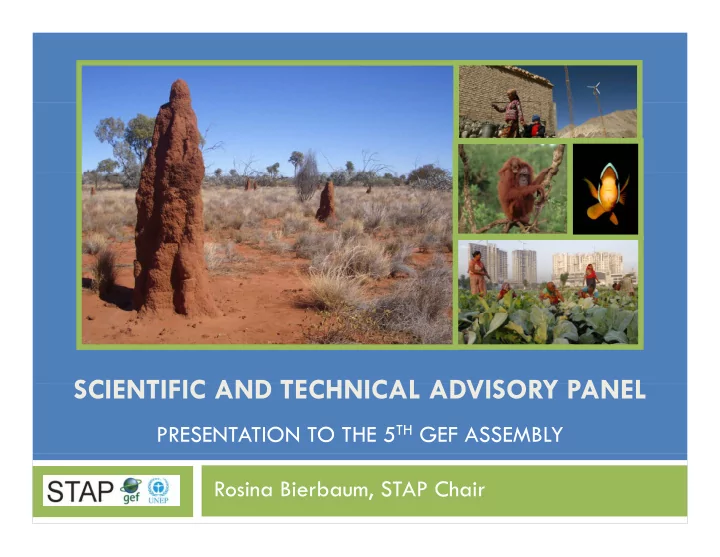
SCIENTIFIC AND TECHNICAL ADVISORY PANEL SCIENTIFIC AND TECHNICAL - - PowerPoint PPT Presentation
SCIENTIFIC AND TECHNICAL ADVISORY PANEL SCIENTIFIC AND TECHNICAL ADVISORY PANEL PRESENTATION TO THE 5 TH GEF ASSEMBLY Rosina Bierbaum, STAP Chair Delivering GEBs for Sustainable Development STAPs vision for GEF 6 STAP s vision for
STAP’s vision for GEF 6 STAP s vision for GEF-6 New areas for
Warming continues, carbon dioxide at record levels, sea level rise accelerating. Impacts already observed on food production, ecosystems, human health, water
quantity/timing/quality, & some extreme events.
Warming could reach 4°C with about 1meter of sea level rise by 2100 Warming could reach 4 C, with about 1meter of sea level rise by 2100. Projected effects include unprecedented high temperatures, inundation of coastal
areas, & loss of livelihoods.
Impacts on agriculture , fisheries, forests, coral reefs are at risk of drastic losses
before 2°C; the poor will suffer the most.
Cost effective option exist to get back near a 2°C pathway…but we are fast Cost effective option exist to get back near a 2 C pathway…but we are fast
running out of time…
IPCC, WG 1, TS-1, 2013
1.1 billion people in poverty A quarter of children
A quarter of women illiterate 1 3 billion witho t modern 1.3 billion without modern
1 billion without clean water 1 billion without clean water
Most impacts will be negative, especially for poorest, most vulnerable nations. Most impacts will be negative, especially for poorest, most vulnerable nations. Every sector will be challenged in virtually every region of the globe. International, regional, and national entities are ill-prepared to manage.
– It’s already too late to avoid substantial climate change. Adaptation measures more costly & less effective as magnitude increases
Both mitigation and adaptation are needed because:
– Adaptation measures more costly & less effective as magnitude increases. Flooding in Serbia and Bosnia, May 2014 Drought in Somalia, 2011
8
World Development Report, 2010
this will be normal temperatures by 2040s, cool by 2060s
Projections (SRES A2) 2060s Projections (SRES A2) 2003 2040s
aly oC ure anoma emperatu Te
9.
Stott et al., Nature 432: 610-613
UNEP , Global Environmental Outlook-4
2001 Baseline
2012 Progress 2001 Baseline g
Dry season in S Amazonia has lasted a week longer per decade since 1980 and annual fire season has lengthened. During a severe drought in 2005, the Amazon released the equivalent of Amazon released the equivalent of 10% of annual human emissions) to the atmosphere. The Amazon drought of 2005 could become the norm rather than the exception by the end of this century.
Source: World Bank WDR 2010
Act Now on Short-lived climate pollutants such as methane and Black Carbon
Reducing black carbon & methane in addition to carbon dioxide can put you on the green line and reduce temperature by up to 0 5 degrees temperature by up to 0.5 degrees
Act Now
Number of disasters worldwide (1980 – 2012) Disaster-related losses (US$ billion, 2012 values)
450 1200
W th l t d l 75% f Weather related disasters 75%
to Adapt
350 400 1000
All disasters Weather -related losses: 75% of all disasters costs Weather related disasters: 75%
200 250 300
All disasters
600 800
All disasters
100 150 200 400
Weather-related disasters
50 1980 1985 1990 1995 2000 2005 2010
Weather-related disasters
1980 1985 1990 1995 2000 2005 2010
These include droughts, These include droughts, Floods, severe storms…..
Act Together
Source: World Bank WDR 2010
Act Differently
Source: World Bank WDR 2010
20
Photo: Nicolas Reusens Boden
http://www.ceres.org/resources/reports/power-forward-why-the-world2019s-largest-companies-are-investing-in-renewable-energy
…to From … Protecting places and individual ecosystems, focusing particularly on Addressing global resource-demand issues as drivers of degradation W hat focusing particularly on local challenges as drivers of degradation in order to protect
ecosystem function & livelihoods
How Focus on protecting resources by regulating use Focus on aligning
environm ental
econom ic incentives
Changing systems by W ho Intervening directly,
em ission or im pact
Changing systems by working with diverse
stakeholders at key
leverage points to catalyze durable,
SOURCE: Team analysis
catalyze durable, market-driven behavior change
Environmentally
OUTCOMES
Environmentally sustainable development
OPPORTUNITIES FOR INTEGRATED ACTION
THEMATIC
Cli t Cli t O S t
AREAS
Climate change mitigation Climate change adapt. Ozone layer depletion Int. waters Chemicals Land degrad. Biodivers. Sust. forest mgmt. Nagoya Protocol
1.
2.
3.
Rosina Bierbaum Chair GEF’s Scientific and Technical Advisory Panel
t GEF www.stapGEF.org