Scientific and Technical Advisory Panel Report to the 47 th Meeting - - PowerPoint PPT Presentation

scientific and technical advisory panel
SMART_READER_LITE
LIVE PREVIEW

Scientific and Technical Advisory Panel Report to the 47 th Meeting - - PowerPoint PPT Presentation

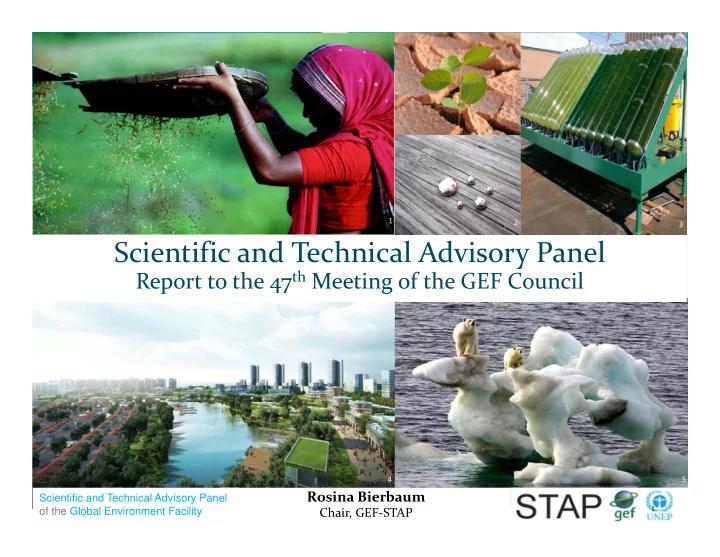
1 2 3 Scientific and Technical Advisory Panel Report to the 47 th Meeting of the GEF Council 4 5 Rosina Bierbaum Scientific and Technical Advisory Panel 1 of the Global Environment Facility Chair, GEF STAP Rosina Bierbaum, Chair Brian


slide-1
SLIDE 1

Scientific and Technical Advisory Panel

Report to the 47th Meeting of the GEF Council

Rosina Bierbaum

Chair, GEF‐STAP

Scientific and Technical Advisory Panel

  • f the Global Environment Facility

4 1 2 3 5

1

slide-2
SLIDE 2

STAP Panel Members

Brian Child, Biodiversity Ralph Sims, CC Mitigation Ricardo Barra, Chemicals & Waste Annette Cowie, Land Degradation Anand Patwardhan, CC Adaptation Jakob Granit, International Waters Rosina Bierbaum, Chair 2 Sandra Diaz, Biodiversity (former Panel Member)

slide-3
SLIDE 3

Outline of STAP’s Contributions

Roles in GEF‐6 GEF Project Cycle Work Program

  • Integrated Approach Pilots
  • Supporting Focal Areas
  • Knowledge Management
  • Emerging Global Environmental

Issues

Scientific and Technical Advisory Panel

  • f the Global Environment Facility

3

slide-4
SLIDE 4

STAP’s Role in GEF‐6

Support the GEF transition towards greater

integration and impact.

Initiate focus on a limited number of cross‐cutting

strategic areas and initiatives.

Encourage closer interaction of external scientific

and practitioner communities.

Continue to support demand driven knowledge

products.

4

slide-5
SLIDE 5

STAP’s Contribution to the GEF Project Cycle

Continue to screen all full‐size projects at entry into the

GEF project cycle ‐ rating as “Concur”, “Minor issues” or “Major issues”.

Direct higher effort towards projects with significant

components of science and innovation or with unique methodological issues.

5

slide-6
SLIDE 6

STAP will contribute to the IAPs primarily through:

Ongoing support for program design including

research needs.

Development of indicators to measure success. Engagement with IAP technical advisory groups to

support knowledge management and learning.

6

Integrated Approach Pilots (IAPs)

slide-7
SLIDE 7

7

IAP – Taking Deforestation out of Commodity Supply Chains

Components: Coordination, Production, Demand, Enabling transactions & intermediaries STAP’s role: Overall program design– review of documents Developing criteria for identifying and assessing the “right” areas for commodity production Generation of knowledge products

slide-8
SLIDE 8

IAP – Sustainable Cities: Harnessing Local Action for Global Commons

STAP’s role:

 Assess the results of the ISO 37120 20 city

pilot with the Global Cities Initiative (GCI/WCCD).

 Assist in generating 5‐7 indices to track

sustainability status (e.g., carbon footprint per capita per year).

 Assist in the design of projects to include

testing of indices in selected pilot cities.

8

slide-9
SLIDE 9

9

Objective: safeguarding ecosystem services for the long‐term sustainability and resilience of food production systems Relevant to:

 Managing land degradation  Climate change mitigation and adaptation  Biodiversity conservation  Food security  Sustaining livelihoods of the rural poor

STAP’s role:

 Input on indicators for monitoring

and assessment

 Identify needs and support strategic research

e.g., scaling‐up approaches

IAP – Sustainability and Resilience for Food Security in Sub‐Saharan Africa

slide-10
SLIDE 10

Indicators of agro‐ecosystem resilience

Living sand barrier Contour Terrace

Process to identify indicators:

  • Background papers
  • Conceptual basis for

resilience

  • Remotely‐sensed

measures of land cover and productivity

  • Expert workshop, with input

from Conventions

slide-11
SLIDE 11

 Inform Monitoring and Assessment for the IAP Complement the UNCCD progress indicators on land cover and

productivity

Relevant to UNFCCC as a measure of land‐based adaptation, and

the CBD as a measure of ecosystem resilience

Inform review of resource allocation and assessment for Land

Degradation focal area of the GEF

Encourage integrated strategies for natural resource management

Agro‐ecosystem Resilience Indicators

slide-12
SLIDE 12

Supporting Focal Areas

Biodiversity

PAs, Mainstreaming

Chemicals and Waste

Mercury Data Streamlining, POPs

elimination, Green Chemistry Mitigation

Black Carbon, Green House Gas

Accounting Adaptation

NAPs, M&E of adaptation investments

International Waters

Areas Beyond National Jurisdiction

12

slide-13
SLIDE 13

Data mining exercise of 100 completed GEF projects to

develop typology of knowledge products, processes and technologies.

Survey of knowledge management systems of GEF

agencies to identify existing models & best practices.

Propose incorporating KM outcomes into ongoing GEF

IEO‐led country portfolio evaluations.

13

STAP plans to present preliminary results at the GEF Council meeting in June 2015.

Near‐term Knowledge Management tasks

slide-14
SLIDE 14

Exploring Knowledge Management Opportunities

Learning from GEF‐6 for GEF‐7 Incorporate research and learning outcomes into IAPs Empower countries to be co‐owners of the GEF’s

knowledge management efforts

Encourage regional learning communities

14

slide-15
SLIDE 15

7 6

15

Upcoming Workshops

Agro‐ecosystem Resilience Indicators Minamata Convention on Mercury Pollution: Science for Successful Implementation (STAP/SETAC Workshop) Monitoring and Evaluation for Adaptation (STAP/PROVIA Workshop) Sydney, Australia November 2014 Vancouver, Canada November 2014 Mumbai, India January 2015

slide-16
SLIDE 16

16

Emerging Global Environmental Issues

Enhance climate resilience of GEF interventions Environmental Security and Cooperation Source to Sea Green Chemistry

slide-17
SLIDE 17

Questions and Comments

17

www.stapGEF.org

Rosina Bierbaum Chair GEF STAP