School School Nur Nursing: g: Sc Scope ope and and Standar St - - PDF document

school school nur nursing g sc scope ope and and standar
SMART_READER_LITE
LIVE PREVIEW

School School Nur Nursing: g: Sc Scope ope and and Standar St - - PDF document

Measures have been taken, by the Utah Department of Health, Bureau of Health Promotions, to ensure no conflict of interest in this activity School School Nur Nursing: g: Sc Scope ope and and Standar St andards of of Pr Practice CATHERINE


slide-1
SLIDE 1

1

Measures have been taken, by the Utah Department of Health, Bureau

  • f Health Promotions, to ensure no

conflict of interest in this activity

School School Nur Nursing: g: Sc Scope

  • pe and

and St Standar andards of

  • f Pr

Practice

CATHERINE SPARKS, MSN, RN, NCSN STATE SCHOOL NURSE CONSULTANT JUNE 2014

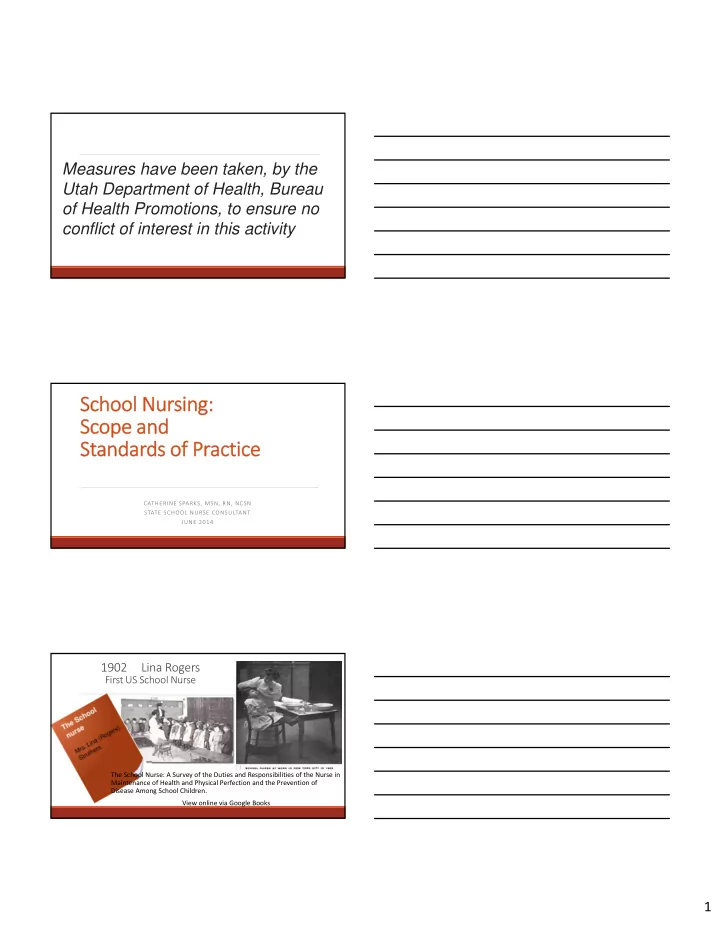
1902 Lina Rogers

First US School Nurse

The School Nurse: A Survey of the Duties and Responsibilities of the Nurse in Maintenance of Health and Physical Perfection and the Prevention of Disease Among School Children. View online via Google Books

slide-2
SLIDE 2

2 Objectives

In this session, we will:

  • Determine Scope of Practice
  • Determine purpose and importance of Scope and Standards to

School Nurse Practice

  • Examine the Standard Statements and their meaning
  • Discuss use of Standards in guiding School Nurse evaluation

Scope and Standards

  • f Practice

SCOPE describes the who, what, where, when, why and how of school nursing STANDARDS, guide our role implementation, interpretation and evaluation

Model of Professional Nursing Practice Regulation

ANA, President Daley, speaks at NASN 2011 On Scope of School Nurse Practice http://www.nursingworld.org/ScopeofPractice

SCOPE (ANA)

slide-3
SLIDE 3

3 Definition of School Nursing

School nursing is a specialized practice of professional nursing that advances the well‐being, academic success and life‐long achievement and health of students. To that end, school nurses facilitate positive student responses to normal development; promote health and safety including a healthy environment; intervene with actual and potential health problems; provide case management services; and actively collaborate with others to build student and family capacity for adaptation, self‐management, self advocacy, and learning (NASN, 2010)

SCOPE defined by Roles of the School Nurse

1. Facilitate normal development and positive student response to intervention. 2. Provides leadership in promoting health and safety, including a healthy environment. 3. Provides quality health care and intervenes with actual and potential health problems. 4. Utilizes clinical judgment in providing case management services. 5. Collaborates with others to build student and family capacity for adaptation, self‐management, self advocacy and learning.

Wh What does a School Nurse do?

Broken bones Broken Hearts Mental Health Teen Relationships Teacher with cancer the cutter STAFF TRAINING Death of a student Grieving PARENTS Eating Disorders Teen Pregnancy Life choices sexually transmitted infections USE CRITICAL THINKING SKILLS EVERY DAY Committees physicians EDUCATE Hand Washing COMMUNICATION Ethics Disease Outbreak Local Health Departments Substance abuse Cultural Competency Self‐efficacy Independence CARE Expert Leader LOVE WHAT THEY DO

slide-4
SLIDE 4

4 Primary Goal of the School Nurse

is to support student learning. This is accomplished by implementing strategies that promote student and staff health and safety.

SCOPE

Roles of the school nurse continuously expanding

The depth and breadth in which individual school nurses engage in the total scope of school nursing practice depend on education, experience, role, work environment, and the population served.

School Nursing: Scope and Standards of Practice, 2nd edition

SCOPE is determined by School Nurse to Student Ratio or Acuity?

American Academy of Pediatrics

  • One school nurse per every school building

National Association of School Nurses

  • 1 school nurse per every 750 students
  • 1 school nurse per every 250 students with special

health care needs

  • 1 school nurse per every 1 student with complex and

unpredictable health care needs

slide-5
SLIDE 5

5

ECBP‐5 Increase the proportion of elementary, middle, and senior high schools that have a full‐time registered school nurse‐to‐student ratio of at least 1:750

HTTP://HEALTHYPEOPLE.GOV/2020/TOPICSOBJE CTIVES2020/OBJECTIVESLIST.ASPX?TOPICID=11 HTTP://WWW.CDC.GOV/HEALTHYYOUTH/PROFILES/INDEX.HTM HTTP://WWW.CDC.GOV/HEALTHYYOUTH/SHPPS/INDEX.HTM

Utah (average) School Nurse to Student Ratio

2013 Public school student population 61,2551 Total FTE of around 200 school nurses 142 Utah best overall estimate school nurse to student ratio

1:4314

Disclaimer: this ratio is not equally distributed between districts or charter schools for some districts have ratios as high as 1:6700 and some as low as 1:<1000

SCOPE

The school nurse is responsible for all students in a given school, district or region The school nurse is most likely the only health care provider in the educational setting

  • This does not give the school nurse any authority in

performing medical diagnosis

slide-6
SLIDE 6

6 SCOPE is legally determined by level of professional practice

  • Licensed Practical Nurses (LPN) – 1 year of training
  • Licensed to practice under the supervision of a registered nurse or physician
  • Cannot delegate tasks to others.
  • Cannot initiate teaching with students or staff.
  • Emergency Medical Technicians ‐ (140‐1200 hours)
  • Licensed to practice under supervision of a physician or emergency protocols.
  • Limited pediatric training

Neither can make nursing assessments nor practice registered nursing without a license.

Recommended School Nurse Credentials

Leadership

  • School nurse

supervisors and administrators

  • Lead nurses
  • Team leaders
  • Advanced practice

RN

  • School nurse

consultants

NCSN information found at: http://www.nasn.org/rolecareer/ schoolnursecertification http://www.nbcsn.org/

Writing your name and credentials

Highest earned degree, mandated requirements (i.e. licensure), state designations or requirements, national certifications, awards and honors, other certifications.

Mary B. Smith, BSN, RN, CCRN Beth Mattey, MSN, RN, NCSN Terri Lipman, PhD, CRNP, FAAN

www.wocn.org/resource/resmgr/.../ana_credentials _for_the_prof.pdf

slide-7
SLIDE 7

7 E‐mail signature

Your name, credentials Job title Contact information ********** IMPORTANT MESSAGE ********** This message, including any attachments, may contain confidential information intended for a specific individual and purpose, and is protected by law. If you are not the intended recipient, delete this message, including from trash, and notify me by telephone or email. If you are not the intended recipient, any distribution or copying of this message, or the taking of any action based on its content is strictly prohibited

Standards of School Nurse Practice

  • Standards are best used as broad professional expectations that

reflect the values and priorities of the discipline (ANA, 2004)

  • Are established by a professional organization for specialty

practice

  • Are an agreed‐on level of practice developed to characterize and

guide the nurse in achieving Excellence in school nursing practice

  • Legal statutes to guide School Nurse Practice
  • When tailored to fit a specific area of school nursing, provide a

means for evaluation by describing competent levels of practice

Standards of School Nurse Practice

17 Standards divided between Two categories:

  • Standards of Practice (6)
  • Standards of Professional

Performance (11)

slide-8
SLIDE 8

8 Standards of Practice

  • 1. Assessment
  • 2. Diagnosis
  • 3. Outcomes Identification
  • 4. Planning
  • 5. Implementation
  • 6. Evaluation

The first six standards encompass the Nursing Process

Use of standards in developing an evaluation tool

http://www.nasn.org/Portals/0/positions/2013pssupervision.pdf

slide-9
SLIDE 9

9 Standards: developing an evaluation tool Standards of Professional Performance

7: Ethics 8: Education 9: Evidence‐Based Practice and Research 10: Quality of Practice 11: Communication 12: Leadership 13: Collaboration 14: Professional Practice Evaluation 15: Resource Utilization 16: Environmental Health 17: Program Management

  • 7. Ethics:

The school nurse practices ethically.

  • Legal requirement to be an advocate for your students (clients)
  • Putting the client and family before oneself or one’s employer
  • Follows the nursing code of ethics for nurses with interpretive

statements for the school nurse (NASN, 2010)

  • Care is delivered in a manner that protects client autonomy, dignity,

and rights, and confidentiality

  • Professional role boundaries , nurse‐client relationships are

maintained

slide-10
SLIDE 10

10 Evaluating Ethics (CO)

http://www.cde.state.co.us/sites/default/files/2013‐09‐15%20Nurse%20Rubric.pdf

  • 8. Education:

The school nurse attains knowledge and competency that reflects current nursing practice.

  • School nurses have the responsibility for keeping themselves current
  • Involve oneself in local, state and national school nursing
  • rganizations
  • Keep an awareness that you are a medical

professional working in an educational setting where student health is not a main priority

9: Evidence‐Based Practice and Research:

The school nurse integrates evidence and research findings into practice “ nursing actions are based on sound theory and research” (Adams, 2009) Case studies Expert opinions Scientifically collected data that has been analyzed (Adams & McCarthy, 2007)

slide-11
SLIDE 11

11

http://ncees.ncdpi.wikispaces.ne t/file/view/School%20Nurses%20 Eval%20Users%20Guide.pdf/441 364212/School%20Nurses%20Ev al%20Users%20Guide.pdf

North Carolina: School Nurse Evaluation Process

10: Quality of Practice:

The school nurse contributes to quality of nursing practice. The school nurse must monitor and critically evaluate the effectiveness of individual nurse practice and the whole of the school health program This standard is usually coupled with Standard 17: Program Management

http://www.oasn.

  • rg/files/resource

smodule/5269948 3011a1/OASN_SN ES_11_9_13.pdf

Ohio Association of School Nurses SCHOOL NURSE EVALUATION SYSTEM (OASN/SNES)

slide-12
SLIDE 12

12 11: Communication:

The school nurse communicates effectively in a variety of formats in all areas of nursing practice. The ability to effectively communicate in the professional setting has been shown to be key to effective school nursing proactive with children, professional staff, and parents (Stevenson, 2010)

12: Leadership:

The school nurse demonstrates leadership in the professional practice setting and the profession.

"Control is not leadership; management is not leadership; leadership is leadership. If you seek to lead, invest at least 50%

  • f your time in leading yourself—your own purpose, ethics,

principles, motivation, conduct. Invest at least 20% leading those with authority over you and 15% leading your peers." — Dee Hock, Founder and CEO Emeritus, Visa

Evaluating Leadership (OH)

slide-13
SLIDE 13

13 13: Collaboration:

The school nurse collaborates with the healthcare consumer, the family and others in the conduct of nursing practice.

14: Professional Practice Evaluation:

The school nurse evaluates one’s own nursing practice in relation to professional practice standards and guidelines, relevant statutes, rules and regulations.

When there is no Formal Evaluation Tool, use:

  • Position description
  • District policies
  • National, state, or local role statements
  • State and federal law
  • Evaluation instruments that closely reflect

your practice situation found on line Difficulties

  • Work alone
  • Supervised by a non‐nurse
  • School administration

assumes that a nurse is a nurse

  • Begin practice with little or

no orientation

15: Resource Utilization:

The school nurse utilizes appropriate resources to plan and provide nursing services that are safe, effective, and financially responsible. Cost containment Efficacy of service Client safety

slide-14
SLIDE 14

14 16: Environmental Health:

The school nurse practices in an environmentally safe and healthy manner.

What is a healthy school environment? Air quality, available clean water, allergens, pets in classroom, bees in the playing field, School nursing is rooted in public health. What comes to mind when you think of public health in the school setting? Communicable disease, Immunizations, health screenings, access to care, insurance Is your school Emotionally healthy? Diverse population? Are your students protected from outside influences such as drugs and violence?

Evaluating Environmental Health (OH) 17: Program Management:

SCHOOL NURSE MANAGES SCHOOL HEALTH SERVICES

Each local educational agency that participates in the National School Lunch Program or other federal Child Nutrition programs is required by Federal law to establish a local school wellness policy for all schools under its jurisdiction. http://www.fns.usda.gov/tn/local‐school‐wellness‐policy

Local School Wellness Policy

slide-15
SLIDE 15

15

Is no longer an issue of being at the table, we are in position to lead the discussion at the table School nurses are on the Front lines of Public health Are you involved enough in your schools that you could be the next Mary Papus (NY)? Need for better data collection and analysis

Better data provides evidence of the work we do, it helps policy makers better understand the value we bring to our constituents and clients.

Lina Rogers, our nations first school nurse, used data over 100 years ago to make the case for having a nurse in the school

References

American Nurses Association. Assuring Safe, High Quality Health Care in Pre‐K Through 12 Educational Settings [Position Paper]. Silver Spring, MD: American Nurses Association, 2007. National Association of School Nurses (NASN). School Nurse Supervision/Evaluation. [Position Paper]. Silver Spring, MD: NASN, 2003. Southern Regional Education Board. Curriculum and Faculty Development in Community‐ Based Care: School Nurses And Nurse Educators Collaborate, 2000. E. Aiken, Atlanta, GA. American Nurses Association (ANA) and National Association of School Nurses (NASN). School Nursing: Scope and Standards of Practice. 2nd Edition. Silver Spring, MD: ANA and NASN, 2011. Benner, P.; Tanner, C. and Chesla, C. Expertise in Nursing Practice: Caring, Clinical Judgment and Ethics. Springer, pp. 37‐43, 1996. Benner, P. From Novice to Expert: Excellence and Power in Clinical Nursing Practice. Menlo Park, CA: Addison‐Wesley, pp. 13‐34, 1984.
slide-16
SLIDE 16

16

Reference

Bobo, N.; Adams, V. and Cooper, L. Excellence in school nursing practice: developing a national perspective on school nurse competencies. The Journal of School Nursing: Vol. 18, No. 5, pp. 277–285. Silver Spring, MD: National Association of School Nurses, 2002. Florida Atlantic University. Community Practice Guided by a Nursing Model, M. Parker and C. Barry. Nurs Sci Q.1999; 12: 125‐131, 1999. National Council of State Boards of Nursing, Inc., NCSBN. Assuring Competence: A Regulatory Responsibility. Chicago: NCSBN, 2011. U.S. Department of Education, Office of the Deputy Secretary. No Child Left Behind: A Toolkit for Teachers. Washington, DC: U.S. Department of Education, 2009.