School of Nursing and Healthcare Leadership RN to BSN Capstone - - PowerPoint PPT Presentation

school of nursing and healthcare leadership rn to bsn
SMART_READER_LITE
LIVE PREVIEW

School of Nursing and Healthcare Leadership RN to BSN Capstone - - PowerPoint PPT Presentation

School of Nursing and Healthcare Leadership RN to BSN Capstone Project Presentations Schedule WebEx Spring Sem ester, 20 16 Nursing 4 73 Professional Pathways Faculty Barbara Matthees, PhD, RN, CNE Alicia Swanson, MSN, RN, PHN Day One: Friday


slide-1
SLIDE 1

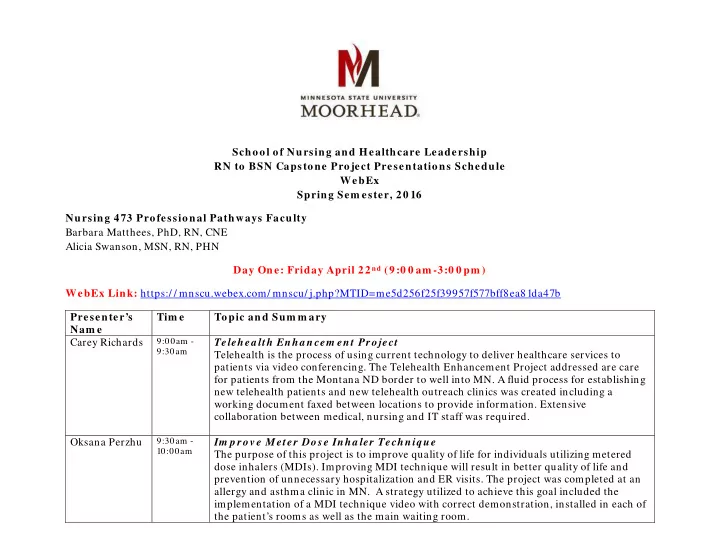
School of Nursing and Healthcare Leadership RN to BSN Capstone Project Presentations Schedule WebEx Spring Sem ester, 20 16 Nursing 4 73 Professional Pathways Faculty Barbara Matthees, PhD, RN, CNE Alicia Swanson, MSN, RN, PHN Day One: Friday April 22 nd (9 :0 0 am -3:0 0 pm ) WebEx Link: https:/ / mnscu.webex.com/ mnscu/ j.php?MTID=me5d256f25f39957f577bff8ea81da47b Presenter’s Nam e Tim e Topic and Sum m ary Carey Richards

9:00am - 9:30am

Telehea lth Enha ncem ent Project Telehealth is the process of using current technology to deliver healthcare services to patients via video conferencing. The Telehealth Enhancement Project addressed are care for patients from the Montana ND border to well into MN. A fluid process for establishing new telehealth patients and new telehealth outreach clinics was created including a working document faxed between locations to provide information. Extensive collaboration between medical, nursing and IT staff was required. Oksana Perzhu

9:30am - 10:00am

Im p rov e Meter Dose Inha ler Techniq ue The purpose of this project is to improve quality of life for individuals utilizing metered dose inhalers (MDIs). Improving MDI technique will result in better quality of life and prevention of unnecessary hospitalization and ER visits. The project was completed at an allergy and asthma clinic in MN. A strategy utilized to achieve this goal included the implementation of a MDI technique video with correct demonstration, installed in each of the patient’s rooms as well as the main waiting room.

slide-2
SLIDE 2

Jennifer Graham

10:00am - 10:30am

Im p rov ing Menta l Hea lth Ca re for Child ren/ Ad olescents in the E.D. The purpose of this project is for children and adolescents with autism spectrum disorders, and mental health disorders, to receive high level emergency department

  • care. This will be achieved through providing patients with appropriate diversional

activities, using anger/ stress charts, and through providing educational materials to emergency department staff. The group involved consists of a mentor, the emergency department manager, and emergency department nurses. The project will not be able to be completed within the timeframe of this course, currently funds are being requested from the hospital foundation for supplies, and a work order has been placed for mental health room improvements. Lindsey Meyer

10:30am - 11:00am

Im p rov ing Discha rg e Ed uca tion Ma teria ls My project focused on the effects that simplification of educational material used in discharge teaching can have upon patient comprehension and adherence. The main goal was to develop material that was easy to understand for patients of all literacy levels, yet still thorough enough to get all necessary information to the patient. The group worked with consisted of cataract surgical patients, the majority of which were elderly. The project has gone very well so far and is progressing well towards the goals set prior to implementation. Ginger Wesbrook

11:00am - 11:30am

Decrea sing Anxiety a nd Stress in the Pre/ Post Op Area The purpose of this project is to decrease staff, patient/ family anxiety and stress in the Preoperative/ Postoperative unit by adding additional pet therapy visits. Pets Assisting with Healing (PAWH) is relatively new program to the unit and only allotted limited visits per month. A visit consists of one volunteer along with their dog, eight times a

  • month. The groups that have been involved in this project are: Volunteer Services,

PAWH, Center for Professional Development and Practice, Preoperative/ Postoperative staff, patients and families. Barbara Gardiner

11:30am - 12:00pm

Im p rov ing Inp a tient End of Life Exp erience The purpose of this project is to improve the quality of inpatients’ end-of -life experience by addressing barriers such as communication, optimal after death care, RN advocacy, and collaboration. These barriers will be addressed through education of nursing staff; collaboration with Social Work Services, Hospital Chaplain, Hospice nurse, and Perinatal Loss Coordinator in the development of resource tools and communication materials; and mentorship of one new Medical Surgical RN on her EOL concerns.

slide-3
SLIDE 3

Jodi Larson

12:00pm - 12:30pm

CAUTI Prev ention in Long Term Ca re Catheter Associated Urinary Tract Infections (CAUTIs) have been associated with increased morbidity, mortality, healthcare costs, and length of stay. The purpose of this project is to decrease the CAUTI rate in a Long Term Care Facility. Collaboration occurred with front line staff, infection prevention department, providers and senior management. A CAUTI prevention policy was written and is currently going through the approval

  • process. Staff education will not be completed by the end of this course, but will be
  • ngoing.

Katelyn Swenson

12:30pm - 1:00pm

Im p rov ing Continuity of Ca re w ith Com m unity Menta l Hea lth Based on best practice and community needs, a point of access algorithm was developed to address and guide access to mental health services within the community and across the healthcare continuum for individuals in crisis to reduce barriers to mental health services. The algorithm is to be available to be utilized by community stakeholders, key facilitators and partners. Current evidence-based literature regarding mental health services, entry points, and current algorithms were used to assist in the development of the algorithm. Katie Ziminske

1:00pm - 1:30pm

Fa lls in Menta l Hea lth The goal of this project was to reduce falls on the inpatient adult psychiatric unit by identifying at least two specific risk factors relating to falls and by improving the quality of the fall risk assessment. The unit currently uses the Hendrich II fall risk assessment which does not address mental health risk factors such as medications and environment. The goal is to identify a new fall risk assessment with a future plan of how to implement it onto the unit. Nikole Thein

1:30pm- 2:00pm

Qua lity a nd Sa fety for IDDM in the School Setting School nursing practice is highly independent in standard nursing policy and protocol. Often times school nurses are expected to utilize whatever tools are presented by the guardian and/ or school, even if the safety of such items don’t meet Universal Precautions set by Occupational Safety and Health Administration (OSHA) standards. Insulin Dependent Diabetes Mellitus (IDDM) is a student condition that requires the use of sharps devices that pose a potential safety risk for both nursing staff and students. This improvement project seeks to identify safety issues related to sharps use for IDDM in the school setting and standard safe practice policy and procedure. Elementary school health

  • ffices should require the use of retractable needles with injectable pens for subcutaneous

insulin administration in order to decrease the risk of needle stick injury (NSI) for staff and students. This project required collaboration with our district LSN, administration, and the students and their families.

slide-4
SLIDE 4

Heather McNeill

2:00pm- 2:30pm

Com m unica tion Ha nd offs in the Surgica l Setting Evidence-based research demonstrates the effect patient communication handoffs have on patient safety. Communication handoffs in the surgical setting at Unity Hospital were not

  • ccurring. A consistent method for communication handoffs from the pre-operative to
  • perating room nurse was created and implemented in order to improve patient safety,

prevent adverse events, and improve intra-departmental communication. Sara Dukart

2:30pm- 3:00pm

Menta l Hea lth Resource Fly er for Loca l Em erg ency Dep a rtm ents My project used Evidence-based research that correlates to show there is a gap between when patients are seen in the emergency department for a mental health crisis, to getting the follow up care they need. Patients have expressed lack of communication and lack of resources as a source to the problem. The purpose of the project was to develop and implement a flyer that had local long term and short-term resources with phone numbers and websites to be handed out in the three local emergency departments when a patient is discharged after a mental health crisis. This project was done through the collaboration of teamwork from the Cass County Public health, Sanford health, Essentia Health and the Veterans Affairs hospital.

slide-5
SLIDE 5

Day Two: Monday, April 25th (9 :0 0 am -4 :0 0 pm ) WebEx Link: https:/ / mnscu.webex.com/ mnscu/ j.php?MTID=m3cad26a76df7e1fb9029952b0be65da9 Presenter’s Nam e Tim e Topic Bethany Bailly

9:00am - 9:30am

Im p lem enta tion of Sensitiv ity Tra ining Using the Virtua l Dem entia Tour The purpose of this project was to enhance nursing staff understanding of sensory impairments in residents with dementia to improve quality of care in long term care. The patented Virtual Dementia Tour was implemented to increase staff sensitivity and understanding towards residents living with dementia. Staff had a hands-on simulation to experience potential patient sensory impairments. The project included collaboration with many providers who interact with residents living with dementia. Katherine Olsen

9:30am - 10:00am

Red ucing Hosp ita liza tions rela ted to Peritonitis Ev ents The proposed problem for this presentation involves high rates of peritonitis events in peritoneal dialysis patients that end in a hospitalization. Peritonitis infections are preventable, can be detected early with proper knowledge and training and can be treated

  • utpatient; avoiding hospitalization. Nosocomial infections as well as unnecessary cost

and time away from a patient’s daily living can be avoided. This project focuses on increased communication between the peritoneal dialysis RN's and the patients to aid in prevention and early detection on peritonitis symptoms. The interdisciplinary team has been involved and the patients have responded well to the increased communication. Jennifer Schneider

10:00am - 10:30am

Ca r Sea t Sa fety Ed uca tion The purpose of this project was to improve current education and resources for both the health care providers and parents and caregivers at Fairview Northland Medical

  • Center. This included obtaining current evidence based resources and tools, creating a

checklist for use, by the health care team, that provides suggestions and guidelines for appropriate car seat styles, and obtaining educational resources to be given to caregivers

  • f children of seat belt age and height. The group or team I worked with included certified

passenger seat safety technician, nurse manager of the facilities clinic, doctors, nurses and medical assistants.

slide-6
SLIDE 6

Suzanne Masterson

10:30am - 11:00am

Sha red Med ica l Ap p ointm ents The purpose of this project is to develop best practices aimed at shared medical appointments for type 2 diabetics to help educate patients and expose residents to chronic medical conditions. Medical residents and health care staff will utilize evidence based practice in a shared medical appointment setting by educating type 2 diabetics on their disease to promote patient centered care, teamwork, quality improvement, and patient

  • safety. Development of a checklist which outlines the structure of a shared medical

appointment, how many patients will be involved, and which healthcare team members will be involved is complete. Implementation of this project is tentatively planned for the end of this year. Cathy Woods

11:00am - 11:30am

Discha rg e Checklist for Oncolog y Pa tients Evidence-based research confirms transitions from hospital to home are a complex

  • process. Patients are vulnerable to medical errors as a result of inadequate discharge

planning and teaching, miscommunications, and incomplete information. The purpose of this project was to develop and implement an evidence-based discharge checklist with prompts for initiating discharge planning early in a hospitalization to improve safety and quality of care with transitions to home. Project champions included the unit manager, care coordinators, and shared governance council from the oncology unit along with the manager from the Care Coordination & Utilization Review Department. Implementation

  • f the project has been successful. Staff nurses have recognized this checklist benefits our

patients and facilitates the discharge process. Amanda Roerick

11:30am - 12:00pm

W orkp la ce Sa fety for Hom e Visiting Nurses My project focused on workplace safety for home visiting nurses at Morrison County Public Health department. The main goal of my project was to help improve the safety of nurses when on home visits, by using the best practice prevention strategies. The group that I was able to work with was the family home visiting staff, the maternal child health supervisor, and local law enforcement. Implementation of the project has gone well. Two different training's have been provided to the home visitors by local law enforcement and an officer from the drug task force. A toolkit is available for nurses to use as checklist to help ensure safety when on home visits, and the referral process has changed so the safety starts from the beginning. All family home visiting nurses, two case management nurses and a couple of social workers were able to attend the training's. So far the reaction from the nurses is very positive!

slide-7
SLIDE 7

Joseph Carter

12:00pm - 12:30pm

Decrea sing Com p lica tions w ith Tra cheostom y a nd PEG Tub es The purpose of this project is to identify and address complications associated with tracheostomy and percutaneous endoscopic gastrostomy tubes. Through the implementation of a nursing bundle we hope to decrease the frequency of major complications associated with these procedures. Reducing complications will have benefits including decreased costs and increasing patient satisfaction. Jan Schuck

12:30pm - 1:00pm

Mentoring to Im p rov e Sta ff Retention in Long Term Ca re The purpose of this project is to develop a mentoring program for a nursing department in an effort to increase not only recruitment, but retention and job/ career

  • satisfaction. The project takes place at a 66 bed long term care facility with a history of

poor nursing staff retention rates. A ‘mentor’ job description has been developed, a mentoring guide created and mentors for both licensed and unlicensed staff have been

  • chosen. The goal of the project is to increase retention by 1-2% in the first year of the

program; however, the project outcomes will not be able to be evaluated within the time frame of the course.

1:00pm - 1:30pm

BREAK Melissa Rubie

1:30pm- 2:00pm

W orkp la ce Violence in the Em erg ency Dep a rtm ent A nationwide increase of workplace violence is occurring. There are reported cases, and unreported cases. What can the healthcare providers do increase their safety, and what can providers do if they are put in a potentially dangerous situation? Staff safety is a specific concern, especially with the lack of security at the facility. The purpose of this project is to educate staff in the emergency department on safety measures to protect themselves and others as it relates to workplace violence. Effective communication interventions was provided, as well as increased awareness and the need to fill out safety reports and track incidents and time, to support the budget to potentially add security. Kimberlie Larson

2:00pm- 2:30pm

Im p rov ing Discha rg e Pra ctices to Decrea se Cong estiv e Hea rt Fa ilure Rea d m issions The purpose of the project was to investigate the current discharge process, find areas that could be improved upon and incorporate them into the patient discharge process resulting in less hospital readmissions for patients with congestive heart failure. As evidenced-based research was evaluated, a discharge checklist, and heart failure education handouts were developed to increase patient education in an effort to reduce

  • readmissions. The discharge coordinator, dietician, and manager all participated in

revising, approving, and assisting in writing a new policy to put this improved discharge practice into play.

slide-8
SLIDE 8

Anneta Tangness

2:30pm- 3:00pm

Im p lem enta tion of Electronic DISCUS/ AIMS in Pra ctice The purpose of this pathways project was to improve quality and safety of delivered care through development and implementation of electronic DISCUS (Dyskinesia Identification System: Condensed User Scale) and AIMS (Abnormal Involuntary Movement Scale) assessment scale. It also included development of the inter agency procedure specifying frequency of the assessment and monitoring and outlining responsibilities of ACT team member as related to implementation of systematic electronic standardized side effect assessment. This project was accomplished and implemented through a collaboration between I.T (Information Technology) specialist, nursing, clinical leadership and psychiatric clinicians. This project was successfully implemented in practice as planned. Clarrissa Schwartz

3:00pm- 3:30pm

Conv ersion from Short Acting to Long Acting Ery throp oietin Stim ula ting Ag ents The purpose of my project was to convert the entire clinic from a short-acting Erythropoietin Stimulating Agent (ESA) to a long acting ESA. This included staff and patient education and implementation of a new corporate algorithm. The purpose of this transition is to approve anemia outcome in patients with End Stage Renal Disease (ESRD) whom are also on hemodialysis. I worked with group three. Sheralyn Mattson

3:30pm- 4:00pm

Prev ention of Pressure Ulcers The purpose of this Capstone Project was to implement processes in the prevention of pressure ulcers. My project implementation was with the nursing staff at Golden Living Center in Henning. The process included evaluating literature to determine tools and techniques that have been proven to help reduce the pressure ulcers. These tools included consistent utilization of tissue tolerance testing and Braden Risk assessment, utilizing a specialty draw sheet (brand name of Swift sheets) and positioning tools such as wedges on residents at higher risk due to mobility issues, and using a silicone based barrier cream on residents with the greatest risk of suffering skin breakdown due to incontinence.

slide-9
SLIDE 9

Day Three: Wednesday, April 27th (12:0 0 pm -7:0 0 pm ) WebEx Link: https:/ / mnscu.webex.com/ mnscu/ j.php?MTID=m3be039df4507b0cc78e699850facfa68 Presenter’s Nam e Tim e Topic Kari Solberg

12:00pm - 12:30pm

Discha rg e Ed uca tiona l Vid eos in the Neona ta l Intensiv e Ca re Unit Discharge education in the Neonatal Intensive Care Unit (NICU) starts during the admission process and must accommodate the individual needs of the patient, parents/ family, and caregivers. Parents need to have consistent education when they are discharged from the NICU and throughout the patients stay. Nurses have several different sources for discharge information in the unit and there is need for a consistent education process. Therefore, the discharge committee approved educational videos on a hand held computer in the NICU so parents can watch the educational videos when it is convenient for them. Videos were reviewed and a checklist was created so that nurses can be assured they are getting adequate education prior to discharge. Danielle Cerwinske

12:30pm - 1:00pm

Red ucing ICU Delir ium The purpose of this project is to decrease delirium in the ICU setting by increasing delirium awareness, prevention, and appropriate assessments, which will ultimately improve patient care and patient outcomes. The project takes place in a Vascular/ Thoracic Surgical ICU. The main objectives of the project include determining the cause of delirium in the ICU setting; assuring the CAM-ICU assessment tool is properly utilized and implemented; and identify interventions to help reduce

  • delirium. The goal of this project is to incorporate and utilize the CAM-ICU delirium

tool to reduce delirium in the ICU setting. The project will not be able to be evaluated within the timeframe of this class. Nathaniel Wilson-Grady

1:00pm - 1:30pm

Im p rov ing Tim ely Pa in Rea ssessm ent through Ed uca tion a nd Peer Coa ching The purpose of this project was to improve pain reassessment within one hour of analgesic administration. The project was conducted at a large metro area hospital. Leveraging interpersonal relationship skills, the team used educational and peer- coaching strategies to attempt to improve the on time pain reassessment rate toward the goal 90% or greater documented. Although the project did not meet the stated goals during the intervention period, the team and the staff described the coaching interactions as a positive experience. This project provided the groundwork for future intervention.

slide-10
SLIDE 10

Denise Foss- Baker

1:30pm- 2:00pm

Feta l Dem ise Orienta tion The purpose of this project was to develop a training package, based on best practices related to management of a fetal demise labor, to be used as part of an obstetric (OB) nurse orientation process. The work group included three OB nurses, one social worker, two healthcare workers with histories of personal fetal demise births, the OB nurse manager, and two OB physicians. The project was completed with minor adjustments to the original training goal dates and six staff members have completed fetal demise

  • rientation.

LuAnne Johnson

2:00pm- 2:30pm

Dev elop m ent a nd Im p lem enta tion of a Hea d Injury Protocol for Schools Awareness of concussions and traumatic brain injury has been increasing in recent years and is often a topic of news stories and even Hollywood movies. As this awareness increases so does the need for an evidence based head injury protocol to be used in the school health office. The purpose of this project was to develop and implement such a protocol for a large suburban school district. This project utilized the CDCs Heads up program and collaboration with the district's Licensed School Nurses and Health Services Director. Ashley Altstadt

2:30pm- 3:00pm

Increa se Successful Brea stfeed ing w ith New Mothers The purpose of this project was to increase the number of mothers successfully breastfeeding through utilization of resources, health professional support, referrals, prenatal teaching, and increased breastfeeding knowledge in maternity nurses. The project was completed at a rural hospital and clinic system, under the guidance of the International Board Certified Lactation Consultant and Lactation Educator. The project is nearing its completion, but one component that is taking a bit more time is organizing a community support group for the breastfeeding mother. Alison Lesteberg

3:00pm- 3:30pm

SMART Goa ls in the Med ica l Hom e This purpose of this project is to improve the Medical Home enrolled patient’s quality of life and health outcomes through setting personalized SMART goals with the patient. The use of the evidence-based SMART acronym to guide goal writing for patients was introduced to the nurses in a Medical Home program in a clinic setting in order to be utilized in their everyday practice, and improve the goal writing process. The project involved working with the Director of Patient Care Services, Medical Home Coordinator and Medical Home nurses.

slide-11
SLIDE 11

Angela Cordner

3:30pm- 4:00pm

Im p rov ing the Floa t Process The purpose of this project is to improve the float process by increasing the Nurse’s confidence and competency while they are floated to the Rehabilitation unit. Many nurses shared their feelings of concerns when they learn they will be floated to another

  • unit. A short survey was filled out by nurses on Ortho, Rehab, Palliative care, Psych and

Med / surg overflow to identify questions and concerns. Once this was identified a Rehab unit specific information packet was developed so float nurses have reference to the daily routines, important contact information, unit specific information and access codes. The packet also includes a short end of shift survey to see how their experience was and if they had concerns. BREAK

4:00pm- 4:30pm

BREAK Amanda Turner

4:30pm- 5:00pm

Fluid Ba la nce Docum enta tion The purpose of this project was to improve the accuracy of fluid balance records on a medical/ surgical floor in an acute care setting. This involved the manager, patient care supervisor, and floor staff. Interventions were implemented to help improve current practice relating to intake and output documentation, and daily weight

  • documentation. The process of implementation took longer than expected, as parts of

the interventions needed more time to be completed, but now all interventions have been initiated on the unit. Kayla Hertenstein

5:00pm- 5:30pm

Decision Tree in Ja il Hea lth The purpose of this project is to create a decision tree for jail staff to use when deciding to contact on-call nursing regarding chemical withdrawal. Too often officers are not contacting the on-call nurse for things such as withdrawal or urgent concerns instead they are calling for matters that are not urgent. The overall goal of this project is to protect the officers from making inappropriate medical/ nursing decisions and having an emergent situation arise. Crystal Holloway

5:30pm- 6:00pm

Holistic Ba sed Interv entions to Ma na g e Nega tiv e Beha v iors The purpose of this project is to educate staff on appropriate non pharmacological interventions to utilize and to make a change that will be maintained after the completion of the project. The goal is for caregivers at Skyview Assisted Living to utilize evidence based practice non pharmacological interventions instead of pharmacological interventions to manage negative behaviors in client who have a diagnosis of dementia.

slide-12
SLIDE 12

Sarah Thacker

6:00pm- 6:30pm

Tim ely Initia tion of Hosp ice Hospice involves an interdisciplinary approach to the end of life that helps people physically, emotionally, and spiritually. Benefits of hospice include better pain management, fewer hospitalizations, lower healthcare costs, and higher family satisfaction at end of life. Many people start hospice services late in their disease process. The project goal identified is for patients to elect hospice earlier in their disease trajectory than currently. Education of nursing students and raising awareness among the community will be implemented. Briana Janssen

6:30pm- 7:00pm

Im p rov ing Pa tient Exp erience in Ped ia tric Ca rd iolog y The purpose of this project was to improve patient experience within the pediatric cardiology department. This improvement was addressed with improved use of electronic health records and decreases in the time results were entered in the chart and available to the patient with holter monitor use. Following implementation of a new process in providing results and reading/ resulting holter monitors, immediate improvement was seen and the patient experience was improved. Rebecca Kjolberg

7:00pm- 7:30pm

Decrea sing Rea d m issions in Menta l Hea lthca re Review of a statistical report put out by Agency for Healthcare Research and Quality (AHRQ) reports in 2011 the most common readmission condition for Medicaid patients was mood disorder and costing $286 million. Decreasing 30-day readmissions to less than 5%. Literature has been reviewed and suggests some reasons for readmissions prior to 30 days are lack of outpatient support and medication regimens. The purpose

  • f my project is to bridge the gap between psychiatric hospitalization to home by

implementing a checklist to be used from time of admission, discharge, and post discharge.