Scheduling, part 2 Other advanced scheduling issues Real-time - - PDF document

scheduling part 2
SMART_READER_LITE
LIVE PREVIEW

Scheduling, part 2 Other advanced scheduling issues Real-time - - PDF document

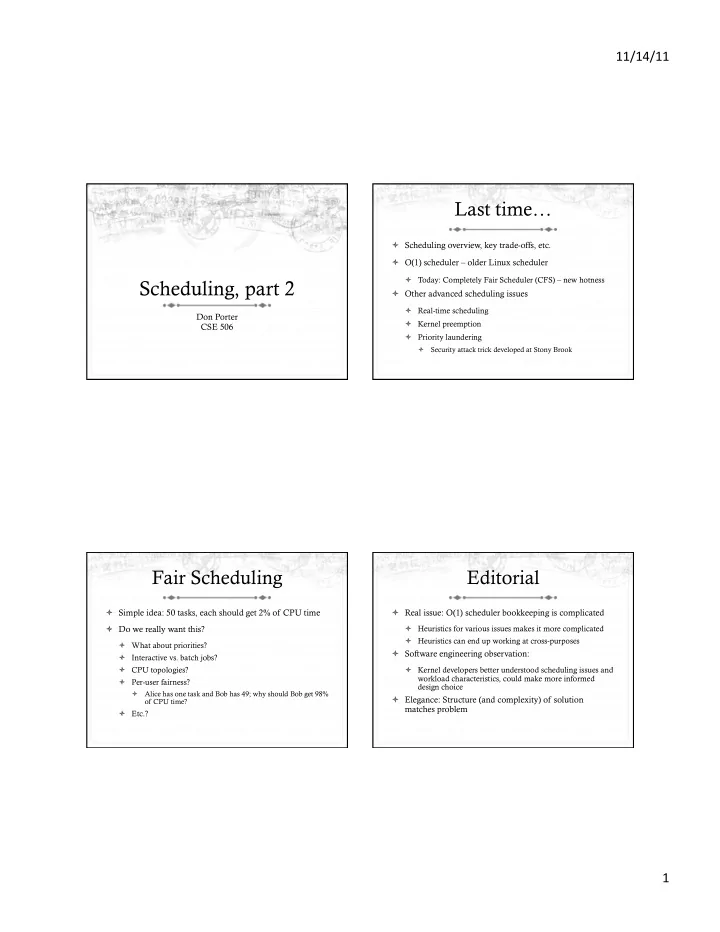
11/14/11 Last time Scheduling overview, key trade-offs, etc. O(1) scheduler older Linux scheduler Today: Completely Fair Scheduler (CFS) new hotness Scheduling, part 2 Other advanced scheduling issues


slide-1
SLIDE 1

11/14/11 ¡ 1 ¡

Scheduling, part 2

Don Porter CSE 506

Last time…

ò Scheduling overview, key trade-offs, etc. ò O(1) scheduler – older Linux scheduler

ò Today: Completely Fair Scheduler (CFS) – new hotness

ò Other advanced scheduling issues

ò Real-time scheduling ò Kernel preemption ò Priority laundering

ò Security attack trick developed at Stony Brook

Fair Scheduling

ò Simple idea: 50 tasks, each should get 2% of CPU time ò Do we really want this?

ò What about priorities? ò Interactive vs. batch jobs? ò CPU topologies? ò Per-user fairness?

ò Alice has one task and Bob has 49; why should Bob get 98%

  • f CPU time?

ò Etc.?

Editorial

ò Real issue: O(1) scheduler bookkeeping is complicated

ò Heuristics for various issues makes it more complicated ò Heuristics can end up working at cross-purposes

ò Software engineering observation:

ò Kernel developers better understood scheduling issues and workload characteristics, could make more informed design choice

ò Elegance: Structure (and complexity) of solution matches problem

slide-2
SLIDE 2

11/14/11 ¡ 2 ¡

CFS idea

ò Back to a simple list of tasks (conceptually) ò Ordered by how much time they’ve had

ò Least time to most time

ò Always pick the “neediest” task to run

ò Until it is no longer neediest ò Then re-insert old task in the timeline ò Schedule the new neediest

But lists are inefficient

ò Duh! That’s why we really use a tree

ò Red-black tree: 9/10 Linux developers recommend it

ò log(n) time for:

ò Picking next task (i.e., search for left-most task) ò Putting the task back when it is done (i.e., insertion) ò Remember: n is total number of tasks on system

Details

ò Global virtual clock: ticks at a fraction of real time

ò Fraction is number of total tasks

ò Each task counts how many clock ticks it has had ò Example: 4 tasks

ò Global vclock ticks once every 4 real ticks ò Each task scheduled for one real tick; advances local clock by one tick

More details

ò Task’s ticks make key in RB-tree

ò Fewest tick count get serviced first

ò No more runqueues

ò Just a single tree-structured timeline

slide-3
SLIDE 3

11/14/11 ¡ 3 ¡

Edge case 1

ò What about a new task?

ò If task ticks start at zero, doesn’t it get to unfairly run for a long time?

ò Strategies:

ò Could initialize to current time (start at right) ò Could get half of parent’s deficit

What happened to priorities?

ò Priorities let me be deliberately unfair

ò This is a useful feature

ò In CFS, priorities weigh the length of a task’s “tick” ò Example:

ò For a high-priority task, a virtual, task-local tick may last for 10 actual clock ticks ò For a low-priority task, a virtual, task-local tick may only last for 1 actual clock tick

ò Result: Higher-priority tasks run longer, low-priority tasks make some progress

Interactive latency

ò Recall: GUI programs are I/O bound

ò We want them to be responsive to user input ò Need to be scheduled as soon as input is available ò Will only run for a short time

GUI program strategy

ò Just like O(1) scheduler, CFS takes blocked programs out

  • f the timeline

ò Virtual clock continues ticking while tasks are blocked

ò Increasingly large deficit between task and global vclock

ò When a GUI task is runnable, generally goes to the front

ò Dramatically lower vclock value than CPU-bound jobs ò Reminder: “front” is left side of tree

slide-4
SLIDE 4

11/14/11 ¡ 4 ¡

Other refinements

ò Per group or user scheduling

ò Real to virtual tick ratio becomes a function of number of both global and user’s/group’s tasks

ò Unclear how CPU topologies are addressed

CFS Summary

ò Simple idea: logically a queue of runnable tasks, ordered by who has had the least CPU time ò Implemented with a tree for fast lookup, reinsertion ò Global clock counts virtual ticks ò Priorities and other features/tweaks implemented by playing games with length of a virtual tick

ò Virtual ticks vary in wall-clock length per-process

Real-time scheduling

ò Different model: need to do a modest amount of work by a deadline ò Example:

ò Audio application needs to deliver a frame every nth of a second ò Too many or too few frames unpleasant to hear

Strawman

ò If I know it takes n ticks to process a frame of audio, just schedule my application n ticks before the deadline ò Problems? ò Hard to accurately estimate n

ò Interrupts ò Cache misses ò Disk accesses ò Variable execution time depending on inputs

slide-5
SLIDE 5

11/14/11 ¡ 5 ¡

Hard problem

ò Gets even worse with multiple applications + deadlines ò May not be able to meet all deadlines ò Interactions through shared data structures worsen variability

ò Block on locks held by other tasks ò Cached file system data gets evicted ò Optional reading (interesting): Nemesis – an OS without shared caches to improve real-time scheduling

Simple hack

ò Create a highest-priority scheduling class for real-time process

ò SCHED_RR – RR == round robin

ò RR tasks fairly divide CPU time amongst themselves

ò Pray that it is enough to meet deadlines ò If so, other tasks share the left-overs

ò Assumption: like GUI programs, RR tasks will spend most of their time blocked on I/O

ò Latency is key concern

Next issue: Kernel time

ò Should time spent in the OS count against an application’s time slice?

ò Yes: Time in a system call is work on behalf of that task ò No: Time in an interrupt handler may be completing I/O for another task

Timeslices + syscalls

ò System call times vary ò Context switches generally at system call boundary

ò Can also context switch on blocking I/O operations

ò If a time slice expires inside of a system call:

ò Task gets rest of system call “for free”

ò Steals from next task

ò Potentially delays interactive/real time task until finished

slide-6
SLIDE 6

11/14/11 ¡ 6 ¡

Idea: Kernel Preemption

ò Why not preempt system calls just like user code? ò Well, because it is harder, duh! ò Why?

ò May hold a lock that other tasks need to make progress ò May be in a sequence of HW config options that assumes it won’t be interrupted

ò General strategy: allow fragile code to disable preemption

ò Cf: Interrupt handlers can disable interrupts if needed

Kernel Preemption

ò Implementation: actually not to bad

ò Essentially, it is transparently disabled with any locks held ò A few other places disabled by hand

ò Result: UI programs a bit more responsive

Priority Laundering

ò Some attacks are based on race conditions for OS resources (e.g., symbolic links)

ò Generally, these are privilege-escalation attacks against administrative utilities (e.g., passwd)

ò Can only be exploited if attacker controls scheduling

ò Ensure that victim is descheduled after a given system call (not explained today) ò Ensure that attacker always gets to run after the victim

Problem rephrased

ò At some arbitrary point in the future, I want to be sure task X is at the front of the scheduler queue

ò But no sooner ò And I have some CPU-intensive work I also need to do

ò Suggestions?

slide-7
SLIDE 7

11/14/11 ¡ 7 ¡

Dump work on your kids

ò Strategy:

ò Create a child process to do all the work

ò And a pipe

ò Parent attacker spends all of its time blocked on the pipe

ò Looks I/O bound – gets priority boost!

ò Just before right point in the attack, child puts a byte in the pipe

ò Parent uses short sleep intervals for fine-grained timing

ò Parent stays at the front of the scheduler queue

SBU Pride

ò This trick was developed as part of a larger work on exploiting race conditions at SBU

ò By Rob Johnson and SPLAT lab students ò An optional reading, if you are interested

ò Something for the old tool box…

Summary

ò Understand:

ò Completely Fair Scheduler (CFS) ò Real-time scheduling issues ò Kernel preemption ò Priority laundering