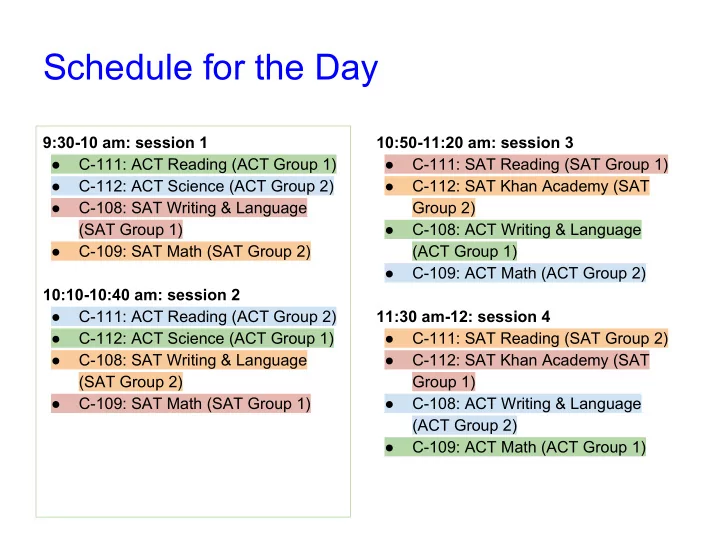
SLIDE 1 Schedule for the Day
9:30-10 am: session 1
- C-111: ACT Reading (ACT Group 1)
- C-112: ACT Science (ACT Group 2)
- C-108: SAT Writing & Language
(SAT Group 1)
- C-109: SAT Math (SAT Group 2)
10:10-10:40 am: session 2
- C-111: ACT Reading (ACT Group 2)
- C-112: ACT Science (ACT Group 1)
- C-108: SAT Writing & Language
(SAT Group 2)
- C-109: SAT Math (SAT Group 1)
10:50-11:20 am: session 3
- C-111: SAT Reading (SAT Group 1)
- C-112: SAT Khan Academy (SAT
Group 2)
- C-108: ACT Writing & Language
(ACT Group 1)
- C-109: ACT Math (ACT Group 2)
11:30 am-12: session 4
- C-111: SAT Reading (SAT Group 2)
- C-112: SAT Khan Academy (SAT
Group 1)
- C-108: ACT Writing & Language
(ACT Group 2)
- C-109: ACT Math (ACT Group 1)
SLIDE 2
ACT?
SLIDE 3 The Basics Day of the Test
CHECKLIST FOR TEST DAY:
- Admission Ticket (should receive in the mail 2 to 3 weeks
before your test date)
- No. 2 Pencils and Erasers
- Approved Calculator and batteries (TI 84 or TI 84+)
- ID Form
- wrist watch
Optional:
SLIDE 4 What Exactly is On the ACT?
- 3 hours and 25 minutes - total
- English=70 questions in 45 minutes
- Math= 60 questions in 60 minutes
- Critical Reading= 40 questions in 35
minutes
- Science= 40 questions in 35 minutes
SLIDE 5 What is a “Good Score” on the ACT?
- Each section is on a scale of 1 to 36
- Perfect combined score of an avg of 36
- Harvard: 32
- UT: 28
- A&M: 30
- UH: 18 English, 21 Reading, 22 Mathematics and 24 Science
- Scores can typically be found on the college or
universities websites
- You will get your raw score and a percentile
ranking score
SLIDE 6 Getting in Gear
- 1. Set A Score Goal
- 2. Block Out Time in Your Schedule
- 3. Study with Friends
- 4. Treat It Like the Real Thing
SLIDE 7
Alvin Junior High aadame@alvinisd.net 281-245-2782
SLIDE 8 ACT- (1) 60 minute section pg 6 of practice book
- 60 questions -NO GRIDDABLES
- Must memorize formulas
- Number and Quantity 7-10%
- Algebra 12-15%
- Functions 12-15%
- Geometry 12-15%
- Statistics and Probability 8-12%
- Integrating Essential Skills 40-43%
- Modeling 25%
SLIDE 9 Know your directions!
- Each section will begin by showing where
you should be on your answer sheet.
- The directions will be the same in practice
as they are on the test. Don’t take the time to read directions.
Math Section
SLIDE 10 Calculators
- Know how to use your calculator.
- Know your arithmetic.
- Know your squares
- TI-84 is allowed on both SAT and ACT
- TI-89 and up are not allowed.
All problems can be solved without a calc, so if you find yourself without outrageuous responces, they are probably wrong
SLIDE 11
Skipping Questions
Don’t think you will get it right Might get it right if you have time Answered, but not sure if correct
SLIDE 12
Formula Activity
Knowledge of basic formulas and computational skills are assumed as background knowledge. Extensive computation is not required
SLIDE 13
Vocabulary
SLIDE 14 PEMDAS----Don’t expect something super simple, expect fractions and multiple parenthesis
see example on separate handout
SLIDE 15
Dividing Fractions: Expect to also use PEMDAS
see example of separate handout
SLIDE 16
Word Problems
How to change confusing words into easy to understand numbers and symbols.
SLIDE 17 Rule 1: Of usually means multiply
Ex: ½ of y Means: ½ x y
SLIDE 18 Rule 2: Exceeds by or is greater than means subtract(or add)
Example: X exceeds y by 7 Means: x - y = 7 or y + 7 = X
Exceeds =
SLIDE 19 Rule 3: Percent (%) usually goes with of.
Percent means per (of) hundred
Example: 25% of y
Means: 25 of 100 of y
= fraction
SLIDE 20
Rule 4: But wait, there’s more. Percent can be made trickier with the word more. Example: Sue has 25% more apples than John Means: Sue has the same as John plus 25%
more = same +
SLIDE 21
Rule 5: Percent increase or decrease means subtract or add. Example: Jim invests $50. It increases 10%. Means: $50 + (10% of $50) = investment increase = decrease =
SLIDE 22
Rule 6: Ratio A ratio is a comparison. Example: The ratio of y to x is 5 Means: y/x = 5; y is being compared to x
SLIDE 23 Rule 7: Chance or probability is a type
Chance or probability means
number of times the particular thing could happen number of times any of the things could happen
SLIDE 24
6 Rules of Guessing
You are taking the same test that 11th and 12th graders are taking, there WILL be questions you do not know….I’m going to train you on some tips for increasing your chances of accuracy.
SLIDE 25
SLIDE 26 Rule 1 of Guessing
- One of these things is MOST like
the others…..
If you have no idea what the correct answer is, chose the one that looks MOST like all the
SLIDE 27 Rule 2 of Guessing: Problems INCREASE in difficulty as you go along
- If you are on one of the last questions in the
math section and you arrive at your answer with a simple calculation, the answer is probably wrong.
SLIDE 28 Rule 3 of Guessing: THREE’s a crowd
- When 20 different test were sampled, there
were only 9 sets of triplets..
- There were no instances when the same
letter choice occurred 4 times in a row
SLIDE 29
Rule 4 of Guessing Choose an answer that contains the number represented in the most answer choices
See example on separate handout
SLIDE 30 Rule 5 of Guessing Pick “non answers” at the beginning, not at the end
- If at the beginning of the test there is a choice
that says, “Answer not listed” there is 50% chance this is the correct answer
- However, if it is offered near the end of the
test, it’s probably wrong
- (probably, but not always, if you think it’s the
right answer, then choose it)
SLIDE 31 Rule 6 of Guessing Beware of answer choices that express an opinion too strongly or that makes an absolute statement
- This occurs more in reading
SLIDE 32 MOST IMPORTANTLY
answer, don’t guess a different answer
SLIDE 33
Reading
Britney Campbell Manvel Junior High Advanced Academic Specialist bwhitehead@alvinisd.net
SLIDE 34 Reading Test Dichotomous Key Challenge
- For the challenge,/ you will be use the
Reading Section (p. 32-39) in your packet.
- Once you have worked your way
through the dichotomous key, write down your group’s response on an index card.
SLIDE 35
ACT Reading Section
O 35 minute section O 40 questions O 4 passages w/ 10 questions
SLIDE 36 What’s on the test?
1 A Passage 1 is a Prose Fiction excerpt. Go to 2 1 B Passage 1 is a Social Science excerpt. Go to 3 2A Passage 2 is a Social Science excerpt. Go to 4 2B Passage 2 is a Humanities excerpt. Go to 5 5A Passage 4 is a Science excerpt. College Ready 5B Passage 4 is about “The Jaws That Jump . ” Duke TIP
SLIDE 37 Format of the Test
3A The answer choices for questions are A, B, C, D Go to 6 3B The answer choices for questions are F, G, H, J Go to 7 4A Passage 2 has you compare two passages (A & B) Go to 8 4B Passage 3 has you compare two passages (A & B) Go to 9
SLIDE 38
Format of the Test
SLIDE 39
Types of Questions Activity
SLIDE 40
SLIDE 41 watch your time 8/9 minutes per passage 35 s/?
answer in this order 1st: vocabulary 2nd: line specific 3rd: specific detail 4th: inferred or implied 5th: main idea or primary purpose
Know the directions Reading Rules
do NOT read the passage first 1. Read & underline ?’s 2. Scan the for what ?’s are asking
SLIDE 42
SLIDE 43 Think about it this way…
IMAGINE TWO CHILDREN PLAYING TAG IN A DEEP, DARK forest. Who’s gonna win? A speed demon from the big city who doesn’t know his way around and keeps tripping and falling? Or a slower-footed tyke who grew up in the forest and knows every root, twist, and cranny of the forest? Here’s the point: Knowing the landscape can be very helpful. If the ACT’s the forest, you’ll have to know the nooks and crannies
Source: http://www.sparknotes.com/testprep/books/newsat/chapter6.rhtml
SLIDE 44 ACT English
klee@alvinisd.net Rodeo Palms Jr. High
SLIDE 45 ACT English: what’s on the test?
❏ The ACT English section is a 75-question, 45-minute test. ❏ That comes out to just 36 seconds per question! ❏ Each English test has five essays or passages, each of which is accompanied by a sequence of multiple-choice questions. ❏ Spelling and vocabulary aren’t tested on ACT English.
SLIDE 46 ACT English: What’s on the test?
❏ ACT English tests two broad content areas. ❏ The first is Usage and Mechanics(including punctuation, grammar usage, and sentence structure). ❏ Usage and Mechanics will require fine-tuned punctuation and grammar knowledge. ❏ The second is Rhetorical Skills (including strategy,
❏ Rhetorical Skills focuses on your comprehending of the passage as a whole and your ability to maximize the passage's organization and style.
SLIDE 47 ACT English: What’s on the test?
Want more tips?
https://edpuzzle.com/media/580f5656d171f3f33 e114541
SLIDE 48 ACT English
How to tackle the English section:
- 1. Skim the passage as if it were a regular piece of
writing (you will NOT have time to read the entire piece)
- 2. Correct or circle mistakes before looking at
choices
- 3. “No change” is often the answer
- 4. If you are not sure which concept is being tested,
look at the answer choices for a clue
SLIDE 49
ACT English
*Let’s take a look at what the ACT English section looks like… *Grab a packet and begin looking at the various types of questions. *What do you notice about the questions? Passages?
SLIDE 50
ACT English
Knowing your grammar and revision rules are very important in this section! Let’s practice! Take out your device and prepare to play Kahoot!
SLIDE 51
ACT English
Kahoot: If you do not have a device, you may work with a friend. https://create.kahoot.it/?_ga=1.72844435.122 4761066.1465476799&deviceId=61812370-6a 56-498c-9ceb-8f863f5c426c#quiz/5eb96d49-5 ea7-4dc8-b57f-50cc4af27cd5
SLIDE 52
SLIDE 53 Science
Harby Junior High 281-245-2886 asmith@alvinisd.net
SLIDE 54 ACT Science Reasoning
- 40 Questions in 35 minutes
- Contains 7 reading passages.
- Each passage is equal in length and difficulty.
- Answer easiest first. (Within a passage, the
easiest questions are first,followed by moderate, and then difficult.)
- You should avg. about 5 minutes per passage.
Does not test Science knowledge.
- Tests ability to read and interpret information
displayed in tables, graphs, and charts.
SLIDE 55
Best ACT Science Prep Strategies Part #1
Tips and Tricks Video
SLIDE 56 Primary Question Types
Reading & interpreting information from tables, graphs, or illustrations
- Research Summaries: drawing conclusions & predicting
results based on data collected from several experiments
- Conflicting Viewpoints: Comparing opposing views or
comparing different experiments with two to three theories to explain a scientific observation
SLIDE 57
Table Trends Exercise
SLIDE 58
Ways to Reason
Problem/Situation: You have to get from point A to Point B as fast as you possibly can. You are offered two means of transportation that start from the same position. Option A-Jet plane that can transport you at 700mph. Option B- Ferrari that can transport you at speeds close to 200mph. What would be the best way to get from Point A to Point B?
SLIDE 59
- Why did you choose your answer?
- What factors might be considered in order to
determine the correct answer?
- What would some factors be that might
cause you to change your initial answer?
- What did you learn from this?
SLIDE 60 Table Trends
Directions: Identify the trends in the tables
- below. Place arrows or symbols by each
column header to represent the trend.
increasing decreasing constant
SLIDE 61
Taking Notes
Passage Notes As the temperature increased, the pressure increased.
T ↑ = P ↑
SLIDE 62
Best ACT Science Prep Strategies Part #2
Video - Use Your Finger
SLIDE 63 Tips
Use these four steps while tackling the Science Reasoning section:
- 1. Read the question and restate it if necessary
- 2. Refer back to the passage
- 3. Formulate your answer without looking at the
choices
- 4. Match your answer to the choices given
SLIDE 64 Know Your Directions
Don’t waste time reading directions. Directions: There are several passages in this
- test. Each passage is followed by several
- questions. After reading a passage, choose the
best answer to each question and fill in the corresponding oval on your answer document. You may refer to the passages as often as
- necessary. You are NOT permitted to use a
calculator.
SLIDE 65 Science Testing Strategies
- Stay Focused.
- Don’t read the directions.
- Preview the associated graphs and tables.
- Identify critical elements in passages.
(Underline or Circle, make notes)
- Don’t Waste Time on Confusing or Long
Words.
- Don’t take too much time on any question.
- Eliminate the wrong answers first.
- The least wrong answer will be correct.
SLIDE 66
Best ACT Science Prep Strategies Part #3
Science Strategies Part #3
SLIDE 67 SAT/ACT Prep Online Guides and Tips
Factual Questions in ACT Science:
How to Read Graphs, Tables, and Data
http://tinyurl.com/act-graphs-tables-data
(http://blog.prepscholar.com/factual-questions-in-act-science-tips-and-strategies-how-to-read-graphs-tables-and-data)
SLIDE 68
Questions???
*Attend sessions offered at your junior high. *Utilize online sites for helpful strategies. *Read the ACT Practice Booklet you have been given. *Take the practice tests.
GOOD LUCK!!!