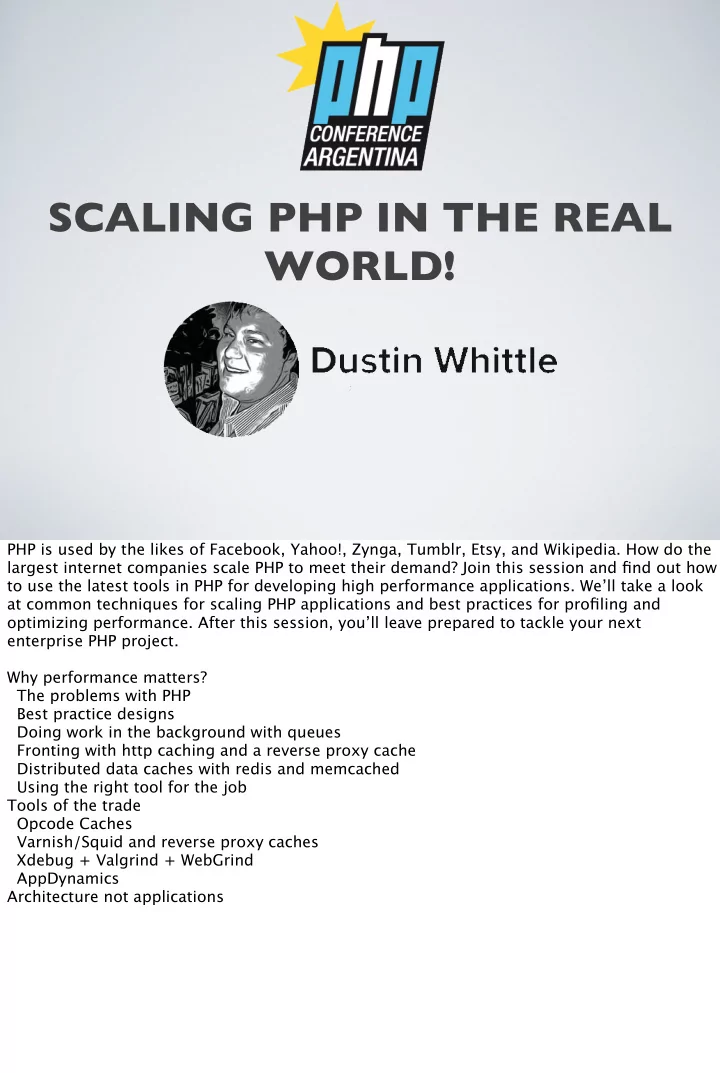
SCALING PHP IN THE REAL WORLD! PHP is used by the likes of - - PDF document

scaling php in the real world
SMART_READER_LITE
LIVE PREVIEW

SCALING PHP IN THE REAL WORLD! PHP is used by the likes of - - PDF document

SCALING PHP IN THE REAL WORLD! PHP is used by the likes of Facebook, Yahoo!, Zynga, Tumblr, Etsy, and Wikipedia. How do the largest internet companies scale PHP to meet their demand? Join this session and find out how to use the latest tools in


slide-1
SLIDE 1

SCALING PHP IN THE REAL WORLD!

PHP is used by the likes of Facebook, Yahoo!, Zynga, Tumblr, Etsy, and Wikipedia. How do the largest internet companies scale PHP to meet their demand? Join this session and find out how to use the latest tools in PHP for developing high performance applications. We’ll take a look at common techniques for scaling PHP applications and best practices for profiling and

  • ptimizing performance. After this session, you’ll leave prepared to tackle your next

enterprise PHP project. Why performance matters? The problems with PHP Best practice designs Doing work in the background with queues Fronting with http caching and a reverse proxy cache Distributed data caches with redis and memcached Using the right tool for the job Tools of the trade Opcode Caches Varnish/Squid and reverse proxy caches Xdebug + Valgrind + WebGrind AppDynamics Architecture not applications

slide-2
SLIDE 2

Dustin Whittle

  • dustinwhittle.com
  • @dustinwhittle
  • Technologist, Pilot, Skier, Diver,

Sailor, Golfer

slide-3
SLIDE 3

What I have worked on

  • Developer Evangelist @
  • Consultant & Trainer @
  • Developer Evangelist @
slide-4
SLIDE 4

Did you know Facebook, Yahoo, Zynga, Tumblr, Etsy, and Wikipedia were all built on PHP?

slide-5
SLIDE 5

Why does performance matter?

http://www.stevesouders.com/blog/2013/05/09/how-fast-are-we-going-now/ http://www.appdynamics.com/blog/2013/07/04/tools-of-the-trade-for-performance-and- load-testing/ The majority of Americans are said to wait in line (in a real shop) for no longer than 15 minutes. 1 out of 4 customers will abandon a webpage that takes more than 4 seconds to load. http://www.scribd.com/doc/16877317/Shopzillas-Site-Redo-You-Get-What-You-Measure http://velocityconf.com/velocity2010/public/schedule/detail/13019 http://www.aberdeen.com/Aberdeen-Library/5136/RA-performance-web-application.aspx http://blog.mozilla.org/metrics/2010/04/05/firefox-page-load-speed-%E2%80%93-part-ii/

slide-6
SLIDE 6

Microsoft found that Bing searches that were 2 seconds slower resulted in a 4.3% drop in revenue per user

http://velocityconf.com/velocity2009/public/schedule/detail/8523

slide-7
SLIDE 7

When Mozilla shaved 2.2 seconds off their landing page, Firefox downloads increased 15.4%

https://blog.mozilla.org/metrics/2010/04/05/firefox-page-load-speed-%E2%80%93-part-ii/ (60 million more downloads)

slide-8
SLIDE 8

Making Barack Obama’s website 60% faster increased donation conversions by 14%

http://kylerush.net/blog/meet-the-obama-campaigns-250-million-fundraising-platform/

slide-9
SLIDE 9

Amazon and Walmart increased revenue 1% for every 100ms of improvement

http://www.globaldots.com/how-website-speed-afgects-conversion-rates/

slide-10
SLIDE 10

Amazon and Walmart increased revenue 1% for every 100ms of improvement http://www.strangeloopnetworks.com/web-performance-infographics/

slide-11
SLIDE 11

Performance directly impacts the bottom line

slide-12
SLIDE 12

http://www.strangeloopnetworks.com/web-performance-infographics/

slide-13
SLIDE 13

http://www.strangeloopnetworks.com/web-performance-infographics/

slide-14
SLIDE 14

PHP is slower than Java, C++, Erlang, Scala, and Go!

slide-15
SLIDE 15

...but there are ways to scale to handle high traffic applications

slide-16
SLIDE 16

http://phpsadness.com/

Notice how many issues are getting resolved as the PHP team iterates and releases.

slide-17
SLIDE 17

PHP is not your problem!

slide-18
SLIDE 18

What version of PHP do you run?

slide-19
SLIDE 19

Upgrade your PHP environment to 2013!

One of the easiest improvements you can make to improve performance and stability is to upgrade your version of PHP. PHP 5.3.x was released in 2009. If you haven’t migrated to PHP 5.4, now is the time! Not only do you benefit from bug fixes and new features, but you will also see faster response times immediately. See PHP.net to get started. Installing the latest PHP on Linux - http://php.net/manual/en/install.unix.debian.php Installing the latest PHP on OSX - http://php.net/manual/en/install.macosx.php Installing the latest PHP on Windows - http://php.net/manual/en/install.windows.php Once you’ve finished upgrading PHP, be sure to disable any unused extensions in production such as xdebug or xhprof.

slide-20
SLIDE 20

Nginx + PHP-FPM

http://nginx.org/ http://php-fpm.org/

slide-21
SLIDE 21

Use an opcode cache!

PHP is an interpreted language, which means that every time a PHP page is requested, the server will interpet the PHP file and compile it into something the machine can understand (opcode). Opcode caches preserve this generated code in a cache so that it will only need to be interpreted on the first request. If you aren’t using an opcode cache you’re missing out on a very easy performance gain. Pick your flavor: APC, Zend Optimizer, XCache, or

  • Eaccellerator. I highly recommend APC, written by the creator of PHP, Rasmus Lerdorf.
slide-22
SLIDE 22

PHP 5.5 has Zend OpCache

slide-23
SLIDE 23

APC

http://php.net/manual/en/book.apc.php

slide-24
SLIDE 24

Use autoloading and PSR-0

Many developers writing object-oriented applications create one PHP source file per class

  • definition. One of the biggest annoyances in writing PHP is having to write a long list of

needed includes at the beginning of each script (one for each class). PHP re-evaluates these require/include expressions over and over during the evaluation period each time a file containing one or more of these expressions is loaded into the runtime. Using an autoloader will enable you to remove all of your require/include statements and benefit from a performance improvement. You can even cache the class map of your autoloader in APC for a small performance improvement.

slide-25
SLIDE 25

Symfony2 ClassLoader Component with APC Caching

http://symfony.com/doc/master/components/class_loader.html

slide-26
SLIDE 26

Scaling beyond a single server in PHP

slide-27
SLIDE 27

Optimize your sessions!

While HTTP is stateless, most real life web applications require a way to manage user data. In PHP, application state is managed via sessions. The default configuration for PHP is to persist session data to disk. This is extremely slow and not scalable beyond a single server. A better solution is to store your session data in a database and front with an LRU (Least Recently Used) cache with Memcached or Redis. If you are super smart you will realize you should limit your session data size (4096 bytes) and store all session data in a signed or encrypted cookie.

slide-28
SLIDE 28

The default in PHP is to persist sessions to disk

http://www.php.net/manual/en/book.session.php

slide-29
SLIDE 29

It is better to store sessions in a database

http://php.net/manual/en/function.session-set-save-handler.php

slide-30
SLIDE 30

Even better is to store in a database with a shared cache in front

http://php.net/manual/en/memcached.sessions.php

slide-31
SLIDE 31

The best solution is to limit session size and store all data in a signed

  • r encrypted cookie

http://www.hardened-php.net/suhosin/configuration.html#suhosin.session.encrypt

slide-32
SLIDE 32

Leverage an in- memory data cache

Applications usually require data. Data is usually structured and organized in a database. Depending on the data set and how it is accessed it can be expensive to query. An easy solution is to cache the result of the first query in a data cache like Memcached or Redis. If the data changes, you invalidate the cache and make another SQL query to get the updated result set from the database. I highly recommend the Doctrine ORM for PHP which has built-in caching support for Memcached or Redis. There are many use cases for a distributed data cache from caching web service responses and app configurations to entire rendered pages.

slide-33
SLIDE 33

Memcached.org

http://memcached.org/

slide-34
SLIDE 34

Redis.io

http://redis.io/

slide-35
SLIDE 35
  • Any data that is expensive to

generate/query and long lived should be cached

  • Web Service Responses
  • HTTP Responses
  • Database Result Sets
  • Configuration Data
slide-36
SLIDE 36

Guzzle HTTP client has built-in support for caching web service requests

slide-37
SLIDE 37

Doctrine ORM for PHP has built-in caching support for Memcached and Redis

http://docs.doctrine-project.org/projects/doctrine-orm/en/latest/reference/caching.html

slide-38
SLIDE 38
slide-39
SLIDE 39

Do blocking work in background tasks via queues

Often times web applications have to run tasks that can take a while to complete. In most cases there is no good reason to force the end-user to have to wait for the job to finish. The solution is to queue blocking work to run in background jobs. Background jobs are jobs that are executed outside the main flow of your program, and usually handled by a queue or message system. There are a lot of great solutions that can help solve running backgrounds

  • jobs. The benefits come in terms of both end-user experience and scaling by writing and

processing long running jobs from a queue. I am a big fan of Resque for PHP that is a simple toolkit for running tasks from queues. There are a variety of tools that provide queuing or messaging systems that work well with PHP:

slide-40
SLIDE 40
  • Resque
  • Gearman
  • RabbitMQ
  • Kafka
  • Beanstalkd
  • ZeroMQ
  • ActiveMQ
slide-41
SLIDE 41

Resque

https://github.com/chrisboulton/php-resque https://github.com/kamisama/php-resque-ex/ https://github.com/kamisama/ResqueBoard/

slide-42
SLIDE 42
  • Any process that is slow and not

important for the http response should be queued

  • Sending notifications + posting to

social accounts

  • Analytics + Instrumentation
  • Updating profiles and discovering

friends from social accounts

  • Consuming web services like

Twitter Streaming API

slide-43
SLIDE 43

http://kamisama.me/2012/10/09/background-jobs-with-php-and-resque-part-1- introduction/

slide-44
SLIDE 44

http://kamisama.me/2012/10/09/background-jobs-with-php-and-resque-part-2-queue- system/ http://kamisama.me/2012/10/09/background-jobs-with-php-and-resque-part-3- installation/

slide-45
SLIDE 45

http://kamisama.me/2012/10/12/background-jobs-with-php-and-resque-part-4- managing-worker/ http://kamisama.me/2012/10/13/background-jobs-with-php-and-resque-part-5-creating- jobs/

slide-46
SLIDE 46

http://kamisama.me/2012/10/22/background-jobs-with-php-and-resque-part-7- manage-workers-with-fresque/ http://kamisama.me/2012/10/22/background-jobs-with-php-and-resque-part-8-a- glance-at-php-resque-ex/ http://resqueboard.kamisama.me/

slide-47
SLIDE 47

Leverage HTTP caching

HTTP caching is one of the most misunderstood technologies on the Internet. Go read the HTTP caching specification. Don’t worry, I’ll wait. Seriously, go do it! They solved all of these caching design problems a few decades ago. It boils down to expiration or invalidation and when used properly can save your app servers a lot of load. Please read the excellent HTTP caching guide from Mark Nottingam. I highly recommend using Varnish as a reverse proxy cache to alleviate load on your app servers. http://tomayko.com/writings/things-caches-do

slide-48
SLIDE 48
slide-49
SLIDE 49

http://tomayko.com/writings/things-caches-do There are difgerent kinds of HTTP caches that are useful for difgerent kinds of things. I want to talk about gateway caches -- or, "reverse proxy caches" -- and consider their efgects on modern, dynamic web application design. Draw an imaginary vertical line, situated between Alice and Cache, from the very top of the diagram to the very bottom. That line is your public, internet facing interface. In other words, everything from Cache back is "your site" as far as Alice is concerned. Alice is actually Alice's web browser, or perhaps some other kind of HTTP user-agent. There's also Bob and Carol. Gateway caches are primarily interesting when you consider their efgects across multiple clients. Cache is an HTTP gateway cache, like Varnish, Squid in reverse proxy mode,Django's cache framework, or my personal favorite: rack-cache. In theory, this could also be a CDN, like Akamai. And that brings us to Backend, a dynamic web application built with only the most modern and sophisticated web framework. Interpreted language, convenient routing, an ORM, slick template language, and various other crap -- all adding up to amazing developer

  • productivity. In other words, it's horribly slow and bloated...and awesome! There's probably
slide-50
SLIDE 50

Expires or Invalidation

http://tomayko.com/writings/things-caches-do

slide-51
SLIDE 51

Expiration

Most people understand the expiration model well enough. You specify how long a response should be considered "fresh" by including either or both of the Cache-Control: max-age=N or

Expires headers. Caches that understand expiration will not make the same request until the

cached version reaches its expiration time and becomes "stale". A gateway cache dramatically increases the benefits of providing expiration information in dynamically generated responses. To illustrate, let's suppose Alicerequests a welcome page:

slide-52
SLIDE 52

http://tomayko.com/writings/things-caches-do Since the cache has no previous knowledge of the welcome page, it forwards the request to the backend. The backend generates the response, including a Cache-Control header that indicates the response should be considered fresh for ten minutes. The cache then shoots the response back to Alice while storing a copy for itself. Thirty seconds later, Bob comes along and requests the same welcome page:

slide-53
SLIDE 53

http://tomayko.com/writings/things-caches-do The cache recognizes the request, pulls up the stored response, sees that it's still fresh, and sends the cached response back to Bob, ignoring the backend entirely. Note that we've experienced no significant bandwidth savings here -- the entire response was delivered to both Alice and Bob. We see savings in CPU usage, database round trips, and the various other resources required to generate the response at the backend.

slide-54
SLIDE 54

Validation

Expiration is ideal when you can get away with it. Unfortunately, there are many situations where it doesn't make sense, and this is especially true for heavily dynamic web apps where changes in resource state can occur frequently and unpredictably. The validation model is designed to support these cases. Again, we'll suppose Alice makes the initial request for the welcome page:

slide-55
SLIDE 55

http://tomayko.com/writings/things-caches-do The Last-Modified and ETag header values are called "cache validators" because they can be used by the cache on subsequent requests to validate the freshness of the stored response without requiring the backend to generate or transmit the response body. You don't need both validators -- either one will do, though both have pros and cons, the details of which are

  • utside the scope of this document.

So Bob comes along at some point after Alice and requests the welcome page:

slide-56
SLIDE 56

http://tomayko.com/writings/things-caches-do The cache sees that it has a copy of the welcome page but can't be sure of its freshness so it needs to pass the request to the backend. But, before doing so, the cache adds the If-

Modified-Since and If-None-Match headers to the request, setting them to the original

response's Last-Modified and ETag values, respectively. These headers make the request

  • conditional. Once the backend receives the request, it generates the current cache validators,

checks them against the values provided in the request, and immediately shoots back a 304

Not Modified response without generating the response body. The cache, having validated the

freshness of its copy, is now free to respond to Bob. This requires a round-trip with the backend, but if the backend generates cache validators up front and in an effjcient manner, it can avoid generating the response body. This can be extremely significant. A backend that takes advantage of validation need not generate the same response twice.

slide-57
SLIDE 57

Expiration and Invalidation

The expiration and validation models form the basic foundation of HTTP caching. A response may include expiration information, validation information, both, or neither. So far we've seen what each looks like independently. It's also worth looking at how things work when they're combined. Suppose, again, that Alice makes the initial request:

slide-58
SLIDE 58

http://tomayko.com/writings/things-caches-do The backend specifies that the response should be considered fresh for sixty seconds and also includes the Last-Modified cache validator. Bob comes along thirty seconds later. Since the response is still fresh, validation is not required; he's served directly from cache:

slide-59
SLIDE 59

http://tomayko.com/writings/things-caches-do But then Carol makes the same request, thirty seconds after Bob:

slide-60
SLIDE 60

http://tomayko.com/writings/things-caches-do The cache relies on expiration if at all possible before falling back on validation. Note also that the 304 Not Modified response includes updated expiration information, so the cache knows that it has another sixty seconds before it needs to perform another validation request.

slide-61
SLIDE 61
  • Varnish
  • Squid
  • Nginx Proxy Cache
  • Apache Proxy Cache

The basic mechanisms shown here form the conceptual foundation of caching in HTTP -- not to mention the Cache architectural constraint as defined by REST. There's more to it, of course: a cache's behavior can be further constrained with additional Cache-Control directives, and the Vary header narrows a response's cache suitability based on headers of subsequent

  • requests. For a more thorough look at HTTP caching, I suggest Mark Nottingham's excellent

Caching Tutorial for Web Authors and Webmasters. Paul James's HTTP Caching is also quite good and bit shorter. And, of course, the relevant sections of RFC 2616 are highly recommended. http://www.mnot.net/cache_docs/

slide-62
SLIDE 62

Use Varnish as a reverse proxy cache to alleviate load on your app servers.

slide-63
SLIDE 63

Optimize your framework!

Deep diving into the specifics of optimizing each framework is outside of the scope of this post, but these principles apply to every framework: Stay up-to-date with the latest stable version of your favorite framework Disable features you are not using (I18N, Security, etc) Enable caching features for view and result set caching

slide-64
SLIDE 64
slide-65
SLIDE 65
  • Stay up-to-date with the latest stable

version of your favorite framework

  • Disable features you are not using (I18N,

Security, etc)

  • Always use a data cache like

Memcached/Redis

  • Enable caching features for view and

database result set caching

  • Always use a http cache like Varnish
slide-66
SLIDE 66

Sharding

slide-67
SLIDE 67

Taking a large problem and making it into manageable smaller problems

slide-68
SLIDE 68
slide-69
SLIDE 69

In short, sharding means splitting the dataset, but a good sharding function would make sure that related information is located on the same server (strong locality), since that drastically simply things. A bad sharding function (splitting by type) would create very weak locality, which will drastically impact the system performance down the road.

slide-70
SLIDE 70

Service Oriented Architecture Java/Scala/Erlang/Go/Node backend PHP or pure JavaScript frontend

slide-71
SLIDE 71

Companies of great scale move away from PHP or create their own variant

slide-72
SLIDE 72

Yahoo! & yPHP

slide-73
SLIDE 73

Facebook & HipHop

HipHop 1.0 - HPHPc - Transformed subset of PHP code to C++ for performance HipHop 2.0 - HHVM - Virtual Machine, Runtime, and JIT for PHP https://github.com/facebook/hiphop-php https://github.com/facebook/hiphop-php/wiki

slide-74
SLIDE 74

Learn to how to profile code for PHP performance

Xdebug is a PHP extension for powerful debugging. It supports stack and function traces, profiling information and memory allocation and script execution analysis. It allows developers to easily profile PHP code. WebGrind is an Xdebug profiling web frontend in PHP5. It implements a subset of the features

  • f kcachegrind and installs in seconds and works on all platforms. For quick-and-dirty
  • ptimizations it does the job. Here’s a screenshot showing the output from profiling.

XHprof is a function-level hierarchical profiler for PHP with a reporting and UI layer. XHProf is capable of reporting function-level inclusive and exclusive wall times, memory usage, CPU times and number of calls for each function. Additionally, it supports the ability to compare two runs (hierarchical DIFF reports) or aggregate results from multiple runs. XHprof XHGui AppDynamics is application performance management software designed to help dev and ops troubleshoot problems in complex production apps.

slide-75
SLIDE 75

Xdebug + WebGrind

slide-76
SLIDE 76

http://xdebug.org/ https://github.com/jokkedk/webgrind http://valgrind.org/info/tools.html#callgrind

slide-77
SLIDE 77
slide-78
SLIDE 78

http://appdynamics.com/

slide-79
SLIDE 79
slide-80
SLIDE 80
slide-81
SLIDE 81
slide-82
SLIDE 82
slide-83
SLIDE 83
slide-84
SLIDE 84
slide-85
SLIDE 85

Don’t forget to

  • ptimize the client

side

PHP application performance is only part of the battle Now that you have optimized the server-side, you can spend time improving the client side! In modern web applications most of the end-user experience time is spent waiting on the client side to render. Google has dedicated many resources to helping developers improve client side performance.

slide-86
SLIDE 86

In modern web applications most of the latency comes from the client side

In modern web applications most of the end-user experience time is spent waiting on the client side to render.

slide-87
SLIDE 87

Google PageSpeed

https://developers.google.com/speed/docs/best-practices/rules_intro Google PageSpeed Insights – PageSpeed Insights analyzes the content of a web page, then generates suggestions to make that page faster. Reducing page load times can reduce bounce rates and increase conversion rates. Google ngx_pagespeed – ngx_pagespeed speeds up your site and reduces page load time. This open-source nginx server module automatically applies web performance best practices to pages, and associated assets (CSS, JavaScript, images) without requiring that you modify your existing content or workflow. Google mod_pagespeed – mod_pagespeed speeds up your site and reduces page load time. This open-source Apache HTTP server module automatically applies web performance best practices to pages, and associated assets (CSS, JavaScript, images) without requiring that you modify your existing content or workflow.

slide-88
SLIDE 88

Google PageSpeed Insights

https://developers.google.com/speed/pagespeed/

slide-89
SLIDE 89

https://developers.google.com/speed/pagespeed/

slide-90
SLIDE 90
slide-91
SLIDE 91

Google PageSpeed API

Available as a service Extensions/Modules for Apache/Nginx to automatically improve end user experience times

slide-92
SLIDE 92

curl "https://www.googleapis.com/ pagespeedonline/v1/runPagespeed? url=http://dustinwhittle.com/&key=xxx"

https://developers.google.com/speed/docs/insights/v1/getting_started#familiarize

slide-93
SLIDE 93

Scalability is about the entire architecture, not some minor code optimizations.

Use the right tool for the right job!

slide-94
SLIDE 94

Questions?

slide-95
SLIDE 95

Find these slides on SpeakerDeck https://speakerdeck.com/ dustinwhittle

https://speakerdeck.com/dustinwhittle

slide-96
SLIDE 96