SAVING NEWBORN LIVES - Searching for Solutions Dr. Armida Fernandez - - PowerPoint PPT Presentation

saving newborn lives
SMART_READER_LITE
LIVE PREVIEW

SAVING NEWBORN LIVES - Searching for Solutions Dr. Armida Fernandez - - PowerPoint PPT Presentation

SAVING NEWBORN LIVES - Searching for Solutions Dr. Armida Fernandez Retd. Dean and Prof. Neonatology LTMM College, Sion, Mumbai Founder Trustee, SNEHA The beginning IAP Conference Srinagar, J&K, 1976 Why do newborns die Old


slide-1
SLIDE 1

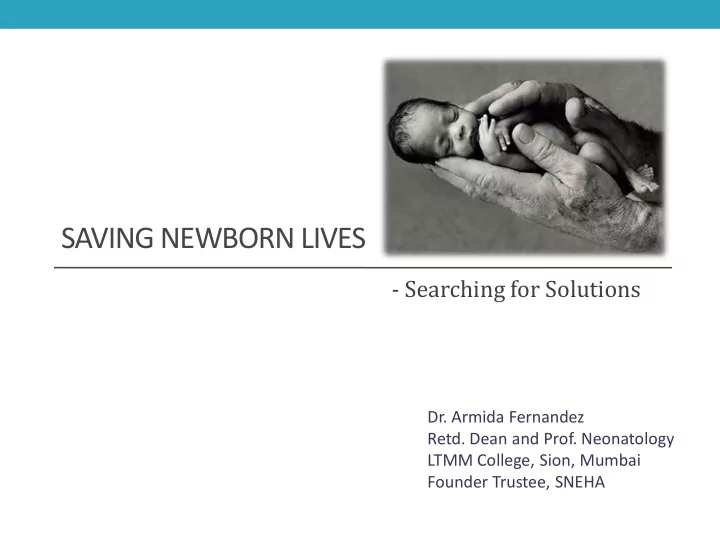
SAVING NEWBORN LIVES

  • Searching for Solutions
  • Dr. Armida Fernandez
  • Retd. Dean and Prof. Neonatology

LTMM College, Sion, Mumbai Founder Trustee, SNEHA

slide-2
SLIDE 2
slide-3
SLIDE 3

The beginning…

IAP Conference

Srinagar, J&K, 1976

slide-4
SLIDE 4

Why do newborns die

slide-5
SLIDE 5

Old Incubators

slide-6
SLIDE 6

Washbasins in the unit

slide-7
SLIDE 7

Lack of nurses

slide-8
SLIDE 8

Infant feeding practices

  • Formula feeds
  • Use of bottles for feeding
slide-9
SLIDE 9

Washbasins outside the unit and use of hand towels

slide-10
SLIDE 10

Heaters

slide-11
SLIDE 11

Table Lamps

slide-12
SLIDE 12

Oil application

slide-13
SLIDE 13

Involving Mothers in the Care of Their Babies...

slide-14
SLIDE 14
slide-15
SLIDE 15
slide-16
SLIDE 16

Evidence for Policy changes in the unit

  • Simple studies
  • Prelacteal feeds
  • Temperature of babies in the labour room
  • Feeding practices of babies in the postnatal OPD
slide-17
SLIDE 17

The Result

– Reduced Mortality and many newborn lives saved

slide-18
SLIDE 18

Advanced technological solutions

slide-19
SLIDE 19

Well Preterm Care Unit - 14Beds Transitional Care Unit - 16 Beds NICU : 12Beds

slide-20
SLIDE 20

Newborns - beyond the boundaries of the hospital

slide-21
SLIDE 21
slide-22
SLIDE 22

Can we dream of an India where every woman and child counts?

Society for Nutrition, Education and Health Action 1999 - 2015

slide-23
SLIDE 23

Our Vision

Healthy women and children for a healthy urban world

slide-24
SLIDE 24

Core beliefs

  • To create models on in urban slums on issues of health of

women and children

  • Strong research base to create evidence
  • Ensure sustainability
  • Advocacy for women and child issues in urban health
  • To impact policy
slide-25
SLIDE 25

How we work

Improve Health care Seeking Behavior

Educate Groups

  • f

Women Sakhis

Improve Quality

  • f Care

Train Health Facility Staff Develop Protocols

Communities Facilities

slide-26
SLIDE 26

Cluster-randomised controlled trial in Mumbai slums to improve care during pregnancy, delivery, postpartum and for the newborn City Initiative of Newborn Health 2004 - 2009

slide-27
SLIDE 27

Purpose

To test an intervention that mobilises communities for better health care, in which loal woe’s groups uild a uderstadig of their potential to improve maternal and infant health and develop and implement strategies to do so

slide-28
SLIDE 28

48 slum clusters in 6 wards Estimated population 283,000

slide-29
SLIDE 29

48 slum clusters vital event surveillance system

Stratified random selection of 8 clusters per ward

6 Municipal wards 92 vulnerable slum clusters

Random allocation in wards

24 slum clusters intervention 24 slum clusters Control

Trial design

slide-30
SLIDE 30
slide-31
SLIDE 31
slide-32
SLIDE 32

Strategy for change in health facilities

APPRECIATIVE INQUIRY + ACTION GROUPS

  • ANC, PNC, Neonatal

clinics

  • Protocols, training,

equipment upgrade

  • Community outreach
  • Clinical & Referral

protocols

  • Training
  • Partograph use
  • Telephone connectivity
  • Referral protocols
  • Training
  • Regional referral link
  • Telephone connectivity

Health Posts Maternity Hospitals Peripheral Hospitals

Tertiary Hospitals

slide-33
SLIDE 33

Training of hospital staff

slide-34
SLIDE 34

PATH SURESTART

2007-2011 To significantly increase individual, household and community action that directly and indirectly improves maternal and neonatal health.

slide-35
SLIDE 35

Project Location

Location: N Ward Population: 1,96,000

slide-36
SLIDE 36

Surestart - Home visit based model

Menstrual surveillance BCC Home visits Group Meetings Campaigns

slide-37
SLIDE 37

Outcomes

Indicator Aug 2008 (Baseline) Jan 2009 May 2010 Early Registration 29.8% 43.77% 90.44% 4 Pregnancy Check-ups 1.4 % 73% 80.61% 2 TT Injections 47% 98.5% 99.48% 100 IFA Consumption 53% 67.26% 73.97% Breastfeeding within 1 hour of birth 20.6% 79.5% 91.62% 2 Postnatal Care Visits

  • 34.75%

63.63% Benefited from JSY 6% 13.84% 89.79%

slide-38
SLIDE 38

Table 3. Primary analysis of mortality outcomes over 3 y, comparing intervention and control arms. Mortality Outcomes Intervention Control Unadjusted OR (95% CI) Adjusted for Baseline Mortality Rate OR (95% CI) Adjusted for Baseline Mortality Rate, Muslim Faith, and Asset Score OR (95% CI) Stillbirths 73/9,155 85/9,042

  • Rate per 1,000

7.97 9.40 0.86 (0.60–1.22) 0.86 (0.60–1.21) 0.66 (0.46–0.93) Neonatal deaths 132/7,944 88/7,759

  • Rate per 1,000

16.62 11.34 1.48 (1.06–2.08) 1.44 (1.03–2.01) 1.42 (0.99–2.04) Extended perinatal deaths 205/9,155 173/9,042

  • Rate per 1,000

22.39 19.13 1.19 (0.90–1.57) 1.16 (0.88–1.51) 1.01 (0.78–1.31)

CM Trial Impact Paper

slide-39
SLIDE 39

Location of antenatal and delivery care for births in Mumbai

Location of care % antenatal % delivery Public sector 50 61 Health post 1 Urban health centre 3 3 Maternity home 15 15 Municipal general hospital 19 24 Government hospital 3 3 Tertiary hospital 9 16 Private sector 50 39 Private hospital 29 39 Private practitioner 21 Total 100 100

slide-40
SLIDE 40

Reasons given for home delivery in 48 Mumbai slums

Reason Frequency (%) Custom 480 (28) Labour too quick to reach institution 230 (13) Nobody to accompany woman to institution 136 (8) Fear of institution staff 117 (7) Convenience 104 (6) Hospital far from home 101 (6) Family constraints (permission, nobody to look after children) 93 (5) Not registered for institutional delivery 57 (3) Financial barriers 49 (3) Lack of transport 48 (3) Asked to return to institution later, but delivery ensued 38 (2) Poor perception of institutional care 25 (1) Not admitted to institution because of insufficient documents 8 (0) Other 92 (5) Missing data 130 (8) Total 1708 (100)

Das S, More NS, Bapat U, L Chordhekar, Joshi W, Osrin D. Prospective study of determinants and costs of home births in Mumbai slums. BMC Pregnancy and Childbirth 2010; 10:38.

slide-41
SLIDE 41

32 5 63 20 40 60 80 100 Deciding to seek care Reaching a health facility Receiving appropriate care

Three delays model for maternal deaths (%)

slide-42
SLIDE 42

0% 20% 40% 60% 80% 100% Quartile 1 Quartile 2 Quartile 3 Quartile 4 Socioeconomic score Private sector Public sector

Site of postnatal care

Shah More, N., Bapat,U., Das,S., Barnett,S., Costello,A., Fernandez,A., Osrin,D. (2009). Inequalities in maternity care and newborn outcomes:

  • ne-year surveillance of births in vulnerable slum communities in Mumbai. International Journal of Equity in Health. 2009; 8 (21)
slide-43
SLIDE 43

Births, stillbirths and neonatal deaths, by cluster socioeconomic quartile group, for women who gave birth in urban slum communities under surveillance, Mumbai 2005-06

Quartile group Least poor All 1st 2nd 3rd 4th RR (95% CI) poorest (95% CI) Births 5687 1816 1253 1391 1227 Stillbirths 86 31 13 28 14 Live births 5601 1785 1240 1363 1213 Neonatal deaths 117 45 27 25 20 Stillbirth rate per 1000 births 16.5 18.3 10.1 22.4 15.2 1.02 (0.74-1.40) 0.83 (0.28-2.44) Neonatal mortality rate per 1000 live births 20.9 25.2 21.8 18.3 16.5 0.88 (0.71-1.08) 0.67 (0.32-1.39)

Shah More, N., Bapat,U., Das,S., Barnett,S., Costello,A., Fernandez,A., Osrin,D. (2009). Inequalities in maternity care and newborn outcomes: one-year surveillance of births in vulnerable slum communities in Mumbai. International Journal of Equity in Health. 2009; 8 (21)

slide-44
SLIDE 44
slide-45
SLIDE 45

Associations of violence during maternity with a range

  • f speculative indicators

Did not report violence (N 1766) Reported violence (N 373) aOR (95% CI) Place of delivery Institutional delivery 1591 (90) 333 (89) 1 Home delivery 175 (10) 40 (11) 0.866 (0.57, 1.31) Preterm index infant Term 1708 (97) 358 (96) 1 Preterm 49 (3) 12 (3) 1.218 (0.61, 2.42) Missing 9 (<1) 3 (1) Birth weight of index infant * Normal 1292 (73) 251 (67) 1 Low birth weight 295 (17) 77 (21) 1.246 (0.92, 1.68) Missing 179 (10) 45 (12) Sex of index infant Boy 916 (52) 197 (53) 1 Girl 841 (48) 173 (47) 0.924 (0.73, 1.17) Missing 9 (<1) 3 (<1) Total 1766 (100) 373 (100)

Das,S., Bapat,U, More, N.S, Alcock G, Joshi W, Pantvaidya S and Osrin,D, Intimate partner violence against women during and after pregnancy: a cross-sectional study in Mumbai slums, BMC Public Health, 2013; 13:817.

slide-46
SLIDE 46
slide-47
SLIDE 47

Verbal autopsy

Stillbirth Fresh All Count (%) Count (%) Associated with obstetric complication 41 (63) 50 (48) Multiple pregnancy 3 (5) 9 (8) Prematurity 4 (6) 4 (4) Accident or external condition 2 (3) 3 (3) Congenital anomalies 1 (2) 3 (3) Other 2 (3) 4 (4) Unclassifiable 12 (18) 32 (30) Total 65 (100) 105 (100) Neonatal death Early Late All Count (%) Count (%) Count (%) Asphyxia 21 (24) (0) 21 (18) Asphyxia associated with obstetric complication 11 (13) 1 (3) 12 (10) Prematurity 27 (31) (0) 27 (23) Severe infection 5 (6) 20 (69) 25 (22) Congenital anomalies 5 (6) 2 (7) 7 (6) Other 10 (11) (0) 10 (9) Unclassifiable 8 (9) 6 (21) 14 (12) Total 87 (100) 29 (100) 116 (100) Table 1. Causes of stillbirth and newborn death, based on clinician review of verbal autopsy

Bapat U, Alcock G, More N, Das S, Joshi W, Osrin D. Stillbirths and newborn deaths in slum settlements in Mumbai, India: a prospective verbal autopsy study. BMC Pregnancy and Childbirth. 2012; 12:39.

slide-48
SLIDE 48

Our learnings

slide-49
SLIDE 49

A newborn doesn’t stand alone…

Women’s status in Society

Maternal Health

Violence against Women Adolescent Health Newborn Health Sexual Reproductive Health

Child Health and nutrition

slide-50
SLIDE 50

Programs at SNEHA

Maternal and Newborn Health

Assisted over 21,000 referred pregnant women with potential complications to deliver safely through SNEHA-initiated referral networks

Child Health and Nutrition

Screened about 24,000 children under 3 years for malnutrition in Dharavi

Sexual and Reproductive Health

Provided health and life skills education to over 10,000 adolescents and youth

Prevention of Violence Against Women and Children

Addressed over 6000 cases of violence

slide-51
SLIDE 51

COMMUNITY RESOURCE CENTRES TO IMPROVE THE HEALTH OF WOMEN AND CHILDREN IN MUMBAI SLUMS

2011-2016

A cluster randomized controlled trial of a complex intervention

slide-52
SLIDE 52

40 slum clusters

Selection of clusters based on vulnerability scores Random allocation in wards

20 slum clusters intervention 20 slum clusters Control 2 Municipal wards 300 slum clusters identified

Trial design

slide-53
SLIDE 53

SNEHA 2015

slide-54
SLIDE 54

SNEHA Coverage

Greater Mumbai SNEHA’s outreach Dharavi 300,000 Ghatkopar 4,000 Kandivali 125,000 M/E Ward 60,000 Santa Cruz 50,000 Malvani 15,000 Parel 50,000 Neighboring Regions SNEHA’s outreach Kalyan Dombivali 63,000 Mira Bhayander 34,000 Thane 63,000

Our outreach - 760,000 disadvantaged people in Mumbai Metropolitan Region

slide-55
SLIDE 55

Access to Primary Care

Working with four municipal corporations Community and Facilities

Referrals to higher level centers of care Improvement of care-seeking behaviour in high-priority vulnerable slums Facilitating provision of quality primary care for pregnant women in the public system Promotion of referrals of high- risk pregnant women to appropriate public care centres Enhancing clinical skills of public care providers

Key Intervention Areas

Community Level Facility Level

slide-56
SLIDE 56

Maternal and Newborn Health

What we have achieved:

  • Assisted over 21,000 referred pregnant women with potential complications to

deliver safely through SNEHA-initiated referral networks

  • Reached out to nearly 4,500 pregnant women through home visits, providing

periodic counselling during pregnancy and after childbirth

  • Trained over 3,000 public healthcare providers( doctors and nurses) on clinical

aspects of maternal and neonatal care and effective communication

  • Trained over 2,900 government outreach workers over the years to address

maternal and neonatal health in communities

  • Policy changes for primary health care, training and referral
  • Inter corporation and inter government department coordination

meetings

  • Public, private and corporate partnerships - PPPP

Improving Public Infrastructure

slide-57
SLIDE 57

Recommendations

  • Saving newborn lives is still not a high priority in Mumbai
  • Need to improve availability and quality of care of normal mother and

newborn at the primary level

  • Quality of care to be monitored, both in the public and private sector
  • Need to establish a robust system of referral and emergency obstetric

care services

  • Directory of neonatal beds to be made available to ensure care of every

sick newborn

  • Capacity building of community health workers for
  • intensive outreach of vulnerable communities for behaviour change
  • Facilitating community group and volunteer actions
  • Public private partnership to support the gaps in healthcare services
slide-58
SLIDE 58

Society for Nutrition, Education and Health Action SNEHA, EHA, Mumbai ai

Photo: Michael Austin

slide-59
SLIDE 59

Publications

  • Fernandez A, Osrin D. The city Initiative for Newborn Health. Plos Medicine 2006; Vol. 3, 9:e339.
  • More, N.S., Bapat,U., Das,S., Patil,S., Porel,M., Vaidya,L., Koriya,B., Barnett,S., Costello,A.,.

Fernandez,A, Osrin,D. (2008). Cluster-randomised controlled trial of community mobilisation in Mumbai slums to improve care during pregnancy, delivery, postpartum and for the newborn. Trials 9, 7. ISSN: 1745-6215

  • Shah More, N., Alcock,G., Bapat,U., Das,S., Joshi,W., Osrin,D. (2009). Tracing pathways from antenatal

to delivery care for women in Mumbai, India: cross-sectional study of maternity in low-income areas. International Health 1, 71-77

  • Shah More, N., Bapat,U., Das,S., Barnett,S., Costello,A., Fernandez,A., Osrin,D. (2009). Inequalities in

maternity care and newborn outcomes: one-year surveillance of births in vulnerable slum communities in Mumbai. International Journal of Equity in Health 8(1)

  • More N, Bapat U, Das S, Osrin, D, et al. Community Mobilization in Mumbai Slums to Improve Perinatal

Care and Outcomes: A Cluster Randomized Controlled Trial. PLoS Med 9(7): e1001257.

  • Alcock,G.A., More, N.S., Patil,S., Porel,M., Vaidya,L., Osrin,D. (2009). Community-based health

programmes: role perceptions and experiences of female peer facilitators in Mumbai's urban slums. Health Educ Res. Epub ahead of print.

  • Das S, More NS, Bapat U, L Chordhekar, Joshi W, Osrin D. Prospective study of determinants and costs of

home births in Mumbai slums. BMC Pregnancy and Childbirth 2010, 10:38.

  • Shah More N, Alcock G, Das S, Bapat U, Joshi W, Osrin D. Spoilt for choice? Cross-sectional study of

care-seeking for health problems during pregnancy in Mumbai slums. Global Public Health 2010.

  • Skordis-Worrall J, Pace N, Bapat U, Das S, More NS, Joshi W, Pulkki-Brannstrom AM, Osrin D.

Maternal and neonatal health expenditure in Mumbai slums (India): a cross sectional study. BMC Public
  • Health. 2011;11:150.
slide-60
SLIDE 60
  • Osrin D, Das S, Bapat U, Alcock G, Joshi W, Shah More N. A rapid assessment scorecard to identify

informal settlements at higher maternal and child health risk in Mumbai. International Journal of Urban Health, ISUH.

  • Bapat U, Alcock G, More N, Das S, Joshi W, Osrin D. Stillbirths and newborn deaths in slum

settlements in Mumbai, India: a prospective verbal autopsy study. BMC Pregnancy and Childbirth. 2012; 12:39.

  • Das,S., Bapat,U, More, N.S, Alcock G, Joshi W, Pantvaidya S and Osrin,D. Intimate partner violence

against women during and after pregnancy: a cross-sectional study in Mumbai slums, BMC Public Health, 2013; 13:817.

  • More N, Osrin D, et al. Community resource centres to improve the health of women and children in

Mumbai slums: study protocol for a cluster randomized controlled trial. Trials 2013; 14:132

  • Neuman A, Alcock G, Azad K, et al. Prevalence and determinants of caesarean section in private and

public health facilities in underserved South Asian communities: cross-sectional analysis of data from Bangladesh, India and Nepal. BMJ Open2014;4:e005982.

  • Bentley A, Das S, Alcock G, et al. Malnutrition and infant and young child feeding in informal

settlements in Mumbai, India: findings from a census. Food Sci Nutr 2015;3(3):257-71.

Publications

slide-61
SLIDE 61

Community Interventions

slide-62
SLIDE 62

Training programs

slide-63
SLIDE 63

Events

Individual home visits

slide-64
SLIDE 64
slide-65
SLIDE 65