Satellite-based solar resource data: Model validation statistics - - PowerPoint PPT Presentation

satellite based solar resource data model validation
SMART_READER_LITE
LIVE PREVIEW

Satellite-based solar resource data: Model validation statistics - - PowerPoint PPT Presentation

Satellite-based solar resource data: Model validation statistics versus users uncertainty Marcel Suri and Tomas Cebecauer GeoModel Solar, Slovakia geomodelsolar.eu SOLAR 2014 Conference, San Francisco, 7-9 July 2014 SOLAR 2014 Conference,


slide-1
SLIDE 1

SOLAR 2014 Conference, San Francisco, 7-9 July 2014 [1]

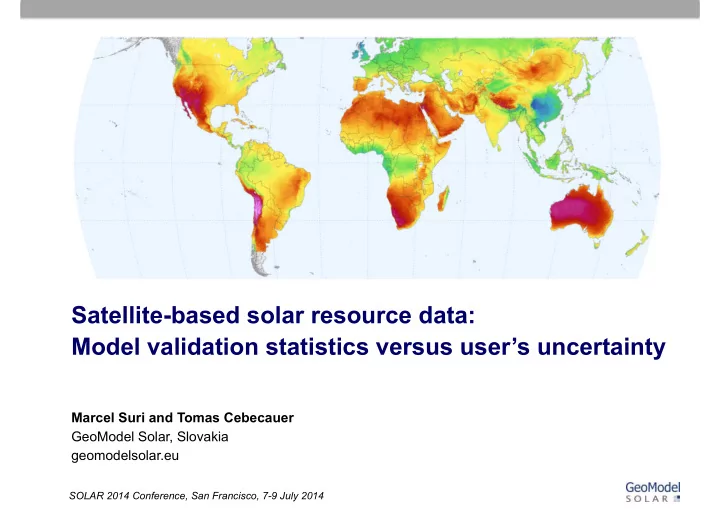
Satellite-based solar resource data: Model validation statistics versus user’s uncertainty

Marcel Suri and Tomas Cebecauer GeoModel Solar, Slovakia geomodelsolar.eu

SOLAR 2014 Conference, San Francisco, 7-9 July 2014

slide-2
SLIDE 2

SOLAR 2014 Conference, San Francisco, 7-9 July 2014 [2]

About GeoModel Solar

Development and operation of SolarGIS online system

  • Solar resource and meteo database
  • PV simulation software
  • Data services for solar energy and PV:
  • Planning
  • Monitoring
  • Forecasting

Consultancy and expert services

  • Solar resource assessment
  • PV yield and performance assessment
  • Country studies

http://solargis.info

slide-3
SLIDE 3

SOLAR 2014 Conference, San Francisco, 7-9 July 2014 [3]

Topics

  • 1. Satellite-based models
  • 2. On-site measurements
  • 3. Measures of model uncertainty
  • 4. User’s uncertainty
  • 5. Conclusions
slide-4
SLIDE 4

SOLAR 2014 Conference, San Francisco, 7-9 July 2014 [4]

Observa(ons ¡

  • Measured ¡data ¡are ¡by ¡default ¡considered ¡more ¡accurate ¡than ¡the ¡

modeled ¡values ¡

  • In ¡many ¡cases ¡solar ¡measuring ¡sta7ons ¡are ¡operated ¡by ¡staff ¡ ¡

with ¡limited ¡experience ¡and ¡knowledge ¡

  • Interannual ¡variability ¡is ¡s7ll ¡not ¡fully ¡understood ¡
  • Concept ¡of ¡data ¡uncertainty ¡is ¡not ¡clear ¡in ¡solar ¡industry ¡

¡

slide-5
SLIDE 5

SOLAR 2014 Conference, San Francisco, 7-9 July 2014 [5]

How ¡to ¡acquire ¡solar ¡resource ¡data ¡

Satellite-­‑based ¡models ¡

  • Extensive ¡geographical ¡coverage ¡and ¡con7nuity ¡
  • Historical ¡availability ¡(12 ¡to ¡20+ ¡years ¡available) ¡
  • Spa7al ¡and ¡temporal ¡stability ¡

¡ On-­‑site ¡measurements ¡

  • Accuracy ¡
  • Frequency ¡of ¡measurements ¡

¡

Source: GeoSUN Africa Source: SolarGIS

slide-6
SLIDE 6

SOLAR 2014 Conference, San Francisco, 7-9 July 2014 [6]

Satellite-­‑based ¡models ¡

Models ¡based ¡on ¡sound ¡theore(cal ¡grounds ¡

  • Best ¡available ¡approaches ¡ ¡

(clear-­‑sky, ¡cloud, ¡components, ¡terrain, ¡transposi7on) ¡

  • Regionally ¡and ¡temporally ¡consistent ¡ ¡
  • Fast ¡and ¡computa7onally ¡stable ¡

¡ Input ¡data: ¡satellite, ¡aerosols, ¡water ¡vapor, ¡... ¡

  • Global ¡data ¡sets ¡
  • "High" ¡resolu7on ¡(spa7al ¡and ¡temporal) ¡
  • Systema7cally ¡updated ¡
  • Quality ¡controlled ¡and ¡validated ¡

¡ Support ¡data ¡and ¡algorithms ¡

slide-7
SLIDE 7

SOLAR 2014 Conference, San Francisco, 7-9 July 2014 [7]

Satellite-­‑based ¡models ¡− ¡accuracy ¡

Regionally ¡variable: ¡

  • satellite ¡viewing ¡geometry ¡
  • specific ¡high ¡albedo ¡surfaces ¡(snow, ¡salty ¡lakes, ¡white ¡sand ¡deserts,…) ¡
  • tropical ¡cloud ¡forma7ons ¡
  • high ¡polluted ¡areas, ¡quality ¡of ¡aerosol ¡inputs ¡
  • … ¡

Regional ¡paTerns ¡have ¡systema7c ¡character ¡– ¡space ¡for ¡improvement ¡ ¡

slide-8
SLIDE 8

SOLAR 2014 Conference, San Francisco, 7-9 July 2014 [8]

Satellite-­‑based ¡models ¡− ¡interannual ¡variability ¡

Availability ¡of ¡satellite ¡data: ¡

  • Data ¡for ¡15+ ¡(12+) ¡and ¡20+ ¡years ¡available ¡
  • Large ¡volcano ¡erup7ons ¡not ¡considered ¡ ¡

(stratosferic ¡aerosols) ¡ ¡ Limited ¡availability ¡of ¡atmospheric ¡data ¡ (MACC-­‑II ¡from ¡2003, ¡satellite ¡based ¡from ¡2000) ¡ ¡

PRIME IODC GOES ¡East Pacific GOES ¡West 0° 57.5°

  • ­‑75°

145°

  • ­‑135°

2013 2012 2011 2010 2009 2008 2007 2006 2005 2004 2003 2002 2001 2000 1999 1998 1997 1996 1995 1994 GOES ¡10, ¡11, ¡15 MSG ¡1,2,3 MFG ¡4-­‑7 MFG ¡5,7 GOES ¡8,12,13,14 MTSAT ¡1,2 GOES ¡9 GMS ¡5

Standard ¡devia7on ¡of ¡yearly ¡ GHI ¡from ¡the ¡longterm ¡ average: ¡2% ¡to ¡12% ¡
slide-9
SLIDE 9

SOLAR 2014 Conference, San Francisco, 7-9 July 2014 [9]

On-­‑site ¡(ground) ¡measurements ¡

¡ ¡

¡ Instruments ¡and ¡their ¡accuracy1 ¡

¡

¡ ¡ ¡ ¡ Pyrheliometers ¡ RSR2 ¡ SPN1 ¡ Secondary ¡standard ¡ First ¡class ¡ ¡ ¡ ¡ ¡ Direct ¡Normal ¡ Irradiance, ¡DNI ¡ ±0.5% ¡ ±1.0% ¡ ±4.5% ¡ ±5% ¡ ¡ ¡ ¡ ¡ Pyranometers ¡ RSR2 ¡ SPN1 ¡ Secondary ¡standard ¡ First ¡class ¡ Second ¡class ¡ ¡ ¡ ¡ ¡ GHI ¡ ±2% ¡ ±5% ¡ ±10% ¡ ±4.5% ¡ ±5% ¡

1 ¡Daily ¡summaries, ¡at ¡95% ¡confidence ¡level ¡in ¡laboratory ¡condi7ons; ¡ ¡

¡ ¡in ¡real ¡condi7ons ¡assuming ¡rigorous ¡opera7on ¡and ¡maintenance ¡prac7ces ¡

2 ¡A`er ¡post ¡processing ¡

slide-10
SLIDE 10

SOLAR 2014 Conference, San Francisco, 7-9 July 2014 [10]

On-­‑site ¡measurements ¡− ¡situa(on ¡today ¡

  • Theore7cal ¡knowledge ¡not ¡fully ¡adopted ¡
  • Best ¡available ¡technologies ¡are ¡not ¡mainstream ¡
  • Lack ¡of ¡experience ¡and ¡unclear ¡standards ¡ ¡
  • Site ¡selec7on, ¡sta7on ¡set-­‑up ¡
  • Cleaning, ¡calibra7on, ¡maintenance, ¡gaps ¡
  • Quality ¡control ¡is ¡not ¡always ¡implemented ¡
  • Performance ¡in ¡extreme ¡climate ¡unknown ¡
slide-11
SLIDE 11

SOLAR 2014 Conference, San Francisco, 7-9 July 2014 [11]

Measures ¡of ¡model ¡accuracy ¡

  • Bias: ¡systema'c ¡model ¡devia'on ¡
  • Root ¡Mean ¡Square ¡Devia7on ¡(RMSD) ¡and ¡Mean ¡Average ¡Devia7on ¡

(MAD): ¡spread ¡of ¡error ¡for ¡instantaneous ¡values ¡

  • Correla7on ¡coefficient ¡
  • Kolmogorov-­‑Smirnoff ¡index ¡(KSI): ¡representa'veness ¡of ¡distribu'on ¡of ¡

values ¡ ¡ Best-­‑accuracy ¡ground ¡measurements ¡are ¡to ¡be ¡used ¡ Data ¡for ¡one ¡single ¡site ¡cannot ¡be ¡used ¡for ¡characteriza7on ¡of ¡a ¡model: ¡

  • Microclimate ¡
  • Poten7al ¡issues ¡in ¡the ¡measured ¡data ¡
slide-12
SLIDE 12

SOLAR 2014 Conference, San Francisco, 7-9 July 2014 [12]

Sta(s(cal ¡indicators ¡of ¡the ¡model ¡performance ¡

Es(mate ¡of ¡longterm ¡yearly ¡values: ¡ ¡ Mean ¡bias ¡(MB) ¡

  • Systema7c ¡bias ¡of ¡the ¡model ¡
  • Shows ¡tendency ¡of ¡the ¡model ¡to ¡overes7mate ¡or ¡to ¡underes7mate ¡ ¡

Standard ¡devia(on ¡of ¡bias ¡values ¡(STDB) ¡

  • Range ¡of ¡devia7on ¡of ¡the ¡model ¡es7mates ¡
  • Shows ¡spa7al ¡stability ¡of ¡the ¡model ¡performance ¡

¡

slide-13
SLIDE 13

SOLAR 2014 Conference, San Francisco, 7-9 July 2014 [13]

Example: ¡independent ¡evalua(on ¡

MB STDB MB STDB

Ineichen ¡P., ¡2013. ¡Long ¡term ¡satellite ¡hourly, ¡daily ¡and ¡monthly ¡global, ¡beam ¡and ¡ ¡ diffuse ¡irradiance ¡valida7on. ¡interannual ¡variability ¡analysis. ¡University ¡of ¡Geneva, ¡IEA ¡Task ¡46. ¡

slide-14
SLIDE 14

SOLAR 2014 Conference, San Francisco, 7-9 July 2014 [14]

User’s ¡uncertainty ¡– ¡longterm ¡es(mate ¡

At sites with no measurements

  • Standard deviation of bias values for all validation sites (STDEV)
  • Regional aspects should be considered

Probabilistic approach (normal distribution) for uncertainty:

  • 80% occurrence of values (90% exceedance, P90)

solar industry standard, 1.282*STDEV

  • 95% occurrence of values (97.5% exceedance, P97.5)

standard in meteo instruments, 1.960*STDEV

slide-15
SLIDE 15

SOLAR 2014 Conference, San Francisco, 7-9 July 2014 [15]

User’s ¡uncertainty ¡– ¡longterm ¡es(mate ¡

  • Uncertainty of the model relative to the measurements
  • Uncertainty of measurements
  • Uncertainty due to interannual variability*

* Interannual variability is not in the scope of this presentation

slide-16
SLIDE 16

SOLAR 2014 Conference, San Francisco, 7-9 July 2014 [16]

User’s ¡uncertainty ¡– ¡longterm ¡es(mate ¡

Model uncertainty Uncertainty

  • f the model and

measurements Annual value GHI DNI GHI DNI

  • Uncert. of instruments*
  • 2.0

1.0 Number of sites 189 134 189 134 Standard deviation 3.0 6.0 3.6 6.0 Uncertainty (probability

  • f occurrence)

80% P90 3.9 7.6 4.4 7.7 90% P95 5.0 9.8 5.4 9.9 95% P97.5 5.9 11.7 6.3 11.7 99% P99.5 7.8 15.4 8.1 15.4

* Vuilleumier et al., 2014. Performance evaluation of radiation sensors for the solar energy sector. MACC–II OSC, Brussels.

SolarGIS global performance: estimate of yearly GHI and DNI

slide-17
SLIDE 17

SOLAR 2014 Conference, San Francisco, 7-9 July 2014 [17]

GHI DNI

±4.4%* ±7.7%*

User’s uncertainty − SolarGIS

* 80% occurrence

slide-18
SLIDE 18

SOLAR 2014 Conference, San Francisco, 7-9 July 2014 [18]

GHI DNI

±4.4%* ±7.7%*

User’s uncertainty − SolarGIS

* 80% occurrence

slide-19
SLIDE 19

SOLAR 2014 Conference, San Francisco, 7-9 July 2014 [19]

Hourly values Daily Monthly Yearly

SolarGIS: Uncertainty of Global Horizontal Irradiance

The uncertainty for ground sensors considers that they are well maintained, calibrated and data are quality controlled

Uncertainty of annual values for probability of exceedance: P99: 8.1% P95: 6.3% P90: 4.4%

SolarGIS high uncertainty

  • high latitudes
  • high mountains
  • high and changing aerosols
  • reflecting desert surfaces
  • snow and ice
  • tropical regions

SolarGIS low uncertainty

  • arid and semiarid regions
  • low and medium aerosols
slide-20
SLIDE 20

SOLAR 2014 Conference, San Francisco, 7-9 July 2014 [20]

Hourly values Daily Monthly Yearly

Uncertainty of yearly values for probability of exceedance: P99: 15.4% P95: 11.7% P90: 7.7%

SolarGIS: Uncertainty of Direct Normal Irradiance

SolarGIS high uncertainty

  • high latitudes
  • high mountains
  • high and changing aerosols
  • reflecting desert surfaces
  • snow and ice
  • tropical regions

SolarGIS low uncertainty

  • arid and semiarid regions
  • low and medium aerosols
slide-21
SLIDE 21

SOLAR 2014 Conference, San Francisco, 7-9 July 2014 [21]

Conclusions ¡1 ¡

Components of user’s uncertainty (longterm estimate):

  • Uncertainty of the model relative to the measurements
  • Uncertainty of measurements
  • Uncertainty due to interannual variability

The highest contribution to the uncertainty is by the model and input data, assuming that:

  • High quality instruments are used
  • Satellite data cover at least 12 years
slide-22
SLIDE 22

SOLAR 2014 Conference, San Francisco, 7-9 July 2014 [22]

Conclusions ¡2 ¡

Valida7on ¡sta7s7cs ¡is ¡good ¡for ¡a ¡model ¡developer ¡ ¡ Sta(s(cs ¡for ¡an ¡individual ¡site ¡is ¡influenced ¡by ¡

  • Microclimate ¡
  • Data ¡issues ¡(both ¡measured ¡and ¡model) ¡

¡ Standard ¡devia(on ¡of ¡bias ¡values ¡is ¡a ¡good ¡indica7on ¡for ¡model ¡quality ¡ ¡ Uncertainty ¡can’t ¡go ¡below ¡uncertainty ¡of ¡instrument ¡+ ¡interannual ¡uncertainty ¡ ¡ Uncertainty ¡has ¡probabilis7c ¡nature ¡ ¡ Ground ¡measurements ¡may ¡have ¡similar ¡uncertainty ¡as ¡satellite ¡data ¡(GHI) ¡