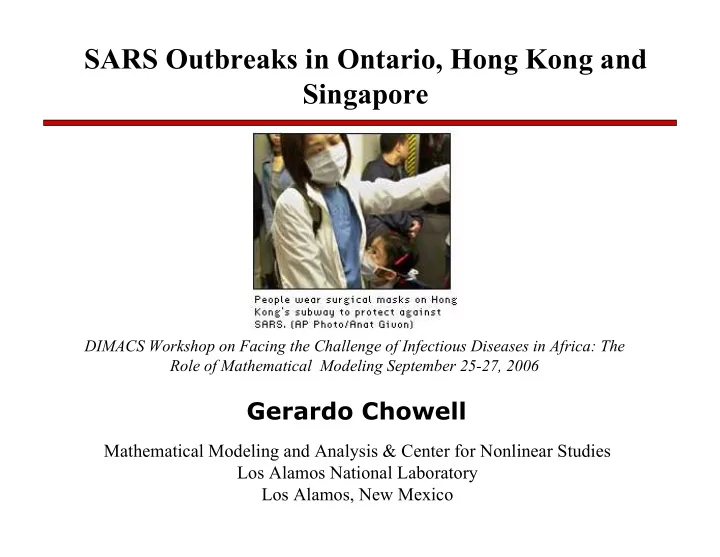
SLIDE 1
Gerardo Chowell
Mathematical Modeling and Analysis & Center for Nonlinear Studies Los Alamos National Laboratory Los Alamos, New Mexico
SARS Outbreaks in Ontario, Hong Kong and Singapore
DIMACS Workshop on Facing the Challenge of Infectious Diseases in Africa: The Role of Mathematical Modeling September 25-27, 2006
SLIDE 2
Outline
SARS and its epidemiology A mathematical model for SARS The dynamics of SARS in Toronto, Hong Kong and Singapore Estimates of the basic reproduction number for SARS Comparison of the reproduction number with that of seasonal and pandemic influenza Conclusions
SLIDE 3 SARS
- Severe acute Respiratory Syndrome
(SARS) is a new respiratory disease which was first identified in Guangdong’s province of China.
- The outbreak of SARS was first
identified in Vietnam by Dr. Carlo Urbani, a WHO expert in communicable diseases who succumbed to the disease.
- The causative agent of SARS is a new
coronavirus (Drosten et al. And Ksiazek et al. 2003)
- WHO for the first time in history issued
a global warning about the disease in March 2003.
Coronavirus from SARS isolated in FRhK-4 cells. Department of Microbiology, The University of Hong Kong and the Government Virus Unit. The public image of SARS in Hong Kong
SLIDE 4 Epidemiology of SARS
- SARS is believed to be transmitted by close contact with an
infectious individuals (droplets).
- An individual exposed to SARS may become infectious after an
incubation period of 2-7 days.
- Infectious individuals experience similar symptoms to
pneumonia including high fever, shortness of breath, dry cough, headache, stiff or achy muscles, fatigue and diarrhea.
- Most infected individuals recover typically after 7-10 days.
- The case fatality rate for patients younger than 60 years is
13.2% while for patients ages 60 or older is 43.3%.
SLIDE 5 Modeling the transmission dynamics of SARS
- To account for differences in susceptibility in the population,
we introduce two susceptibles classes: S1 and S2. S1 is the most susceptible class and S2 is less so. For the case of Hong Kong, this can be illustrated with the following graph: Age distribution of residents in Hong Kong (blue) and age-specific SARS incidence (red). Donnelly et al. (2003)
SLIDE 6 S1 S2 E I D J C R
) ( N lJ qE I + +
( N lJ qE I p + +
Asymptomatic, possibly infectious individuals.
- I (infectious). Infected,
symptomatic not yet diagnosed individuals.
(hospitalized) individuals.
- R (recovered). Individuals
who recovered from the disease.
- D (dead). Individuals who
died from the disease.
Compartmental model
Chowell et al. (2003), Lipsitch et al. (2003), Riley et al. (2003), Gumel et al. (2004), Lloyd-Smith (2004), Hsie et al. (2004).
SLIDE 7
Parameter definitions and estimates
Parameter definitions and values that fit the cumulative number of “diagnosed” cases for Hong Kong.
SLIDE 8 Intervention measures
- Rapid diagnosis of patients
- Strict isolation procedures
Before After Diagnostic period ~ 6 days Infectious individuals were not being properly isolated in hospitals Diagnostic period ~ 3 days Isolation effectiveness was roughly 10 times better!
The image of SARS in hospitals
SLIDE 9 Isolation effectiveness (l)
- is a measure of the effectiveness of the
isolation procedures implemented in hospital wards (i.e appropriate nursing-barrier techniques, etc.)
- 94% of SARS cases in Taiwan occurrred in
hospital wards.
1 < < l
l = 0
(Perfect isolation)
Actual isolation effectiveness l = 1
(no isolation)
SLIDE 10
The cases of Hong Kong and Singapore
Data Model
SLIDE 11
The case of Toronto
Data Model Slow diagnosis and effective isolation Fast diagnosis but imperfect isolation Interventions Fast diagnosis & effective isolation
SLIDE 12
The Basic reproduction number R0
The number of secondary cases generated by a primary infectious case during its period of infectiousness in an entirely susceptible population is known as the basic reproduction number R0. A more practical quantity is the reproduction number (R) which measures the transmissibility in a partially immune population, where a fraction of individuals is effectively protected against infection before the start of the epidemic, because of residual immunity from previous exposure to influenza, or vaccination. For example, if a proportion p of a completely susceptible population is successfully immunized prior to an epidemic, the relation between the basic and the effective reproductive number is R = (1-p) R0.
SLIDE 13 R0 for SARS
- Following the second generation approach
(Diekmann and Heesterbeek, 2000), we can obtain the following expression for the basic reproductive number:
- For Hong Kong R0 = 1.2 and R0 = 1.1 for
Singapore.
SLIDE 14 Parameter distributions (Donnelly et al. 2003)
Uncertainty analysis for R0
- Under perfect isolation, 25%
- f the R0 distribution lies at
R0 > 1. This highlights the importance of simultaneously applying more than one method of control.
(0.5, 2.5) and R0 = 1.7 (0.4, 2.3) for Singapore.
- Lipstich et al. (2003), Riley
et al. (2003) R0 ~ 2-3, assuming an exponential epidemic growth phase (may
- verestimate initial growth
rate, Razum et al. 2003).
Chowell, Castillo-Chavez, Fenimore, Kribs-Zaleta, Arriola, Hyman, Emerging Infectious Diseases (2004).
SLIDE 15 Seasonal influenza
reproduction numbers for inter-pandemic influenza in the three countries: 1.3 in the US (95% Confidence Interval (CI) 1.2-1.4), [Wilcoxon test for between country differences, P>0.87].
reproduction number using morbidity data for France and the greater Paris area are in close agreement with those obtained using mortality data.
Chowell, Miller, Viboud. Transmission of Seasonal Influenza in the United States, France, and Australia, and prospects for control (in revision).
SLIDE 16 US mortality in 20th century
Source: CDC
Spanish Flu (1918)
SLIDE 17 2.0 83.0 0.09 3.75 3.25 2nd wave 2.0 59.7 0.02 1.49 0.7 1st wave
Reporting (%) S.D. R R Case fatality (%) Flu wave
Chowell, Ammon, Hengartner, Hyman, J Theor Biol (2006).
Influenza pandemic in Geneva, Switzerland
SLIDE 18 Influenza pandemic in San Francisco, California
Chowell, Nishiura, Bettencourt,
- J. Royal Society Interface (to appear)
- Mills et al., Nature
(2004). R ~ 2-3 around 10 major US cities.
- Gani et al. Emerg.
- Inf. Dis. (2005) in
the UK estimated R ~12. R ~ 2-3 using four different methods.
SLIDE 19 Conclusions
- A model that considers the effect of average infectiousness in an
heterogeneous population has been introduced to explore the role of patient isolation and diagnostic rate in controlling a SARS outbreak.
- By examining two cases with relatively clean exponential growth
curves we are able to calibrate the SEIJR model. We then use our SEIJR model to study the non-exponential dynamics of the Toronto Outbreak where the rapid slowing in the growth of new recognized cases, robustly constrain the SEIJR model by requiring that and days-1.
- The fitting of data shows that initial rates of SARS growth are
quite similar in most regions leading to mean estimates of R0 1.7-1.8
05 .
3 / 1 >
SLIDE 20
- In our model "good control" means (a) at least a factor of 10
reduction in l (effectiveness of isolation) and (b) simultaneously a maximum diagnostic period of 3 days. The model is sensitive to these parameters, so they should be treated as absolutely minimal requirements: better is better.
- The reproduction number of the Spanish Flu pandemic is
approximately twice larger than that of seasonal flu (R~R0).
- The reproduction number of the first (herald) pandemic wave is
in agreement with that of seasonal flu.
Conclusions, cont’