SLIDE 1 1
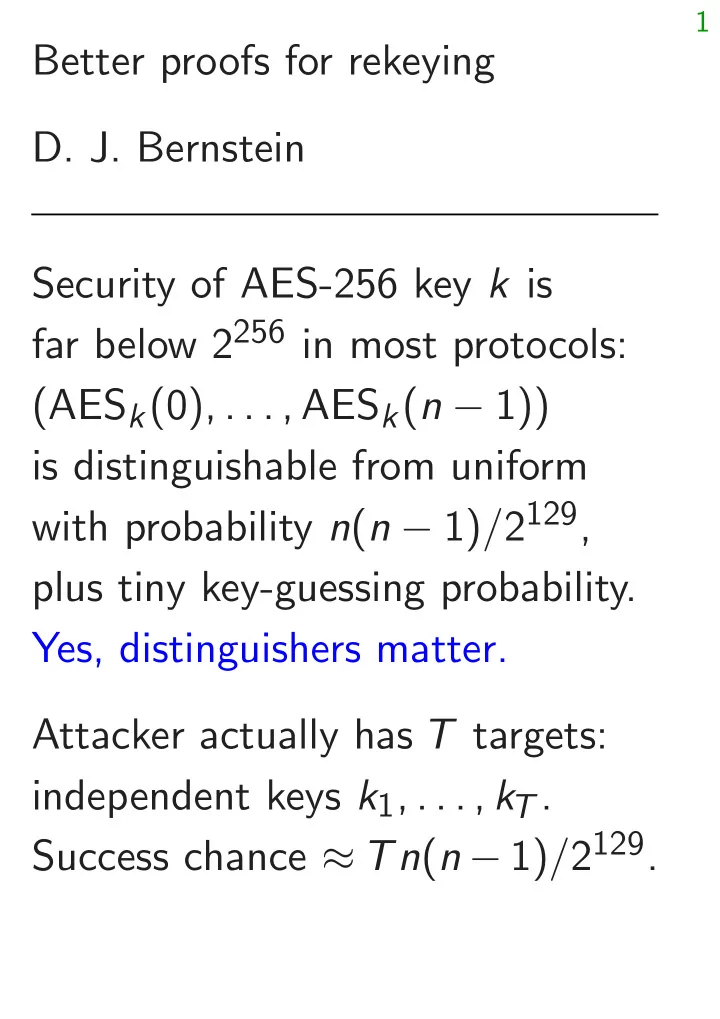
Better proofs for rekeying
Security of AES-256 key k is far below 2256 in most protocols: (AESk(0); : : : ; AESk(n − 1)) is distinguishable from uniform with probability n(n − 1)=2129, plus tiny key-guessing probability. Yes, distinguishers matter. Attacker actually has T targets: independent keys k1; : : : ; kT . Success chance ≈ Tn(n − 1)=2129.
SLIDE 2
2
“Rekeying” seems less dangerous. Expand k into F(k) = (AESk(0); : : : ; AESk(999999)). Split F(k) into 500000 “subkeys”. Output F(k′) for each subkey k′: i.e., F(AESk(0); AESk(1)); F(AESk(2); AESk(3)); : : : F(AESk(999998); AESk(999999)).
SLIDE 3
2
“Rekeying” seems less dangerous. Expand k into F(k) = (AESk(0); : : : ; AESk(999999)). Split F(k) into 500000 “subkeys”. Output F(k′) for each subkey k′: i.e., F(AESk(0); AESk(1)); F(AESk(2); AESk(3)); : : : F(AESk(999998); AESk(999999)). Repeat for k1; : : : ; kT . What is attacker’s success chance pT ?
SLIDE 4
2
“Rekeying” seems less dangerous. Expand k into F(k) = (AESk(0); : : : ; AESk(999999)). Split F(k) into 500000 “subkeys”. Output F(k′) for each subkey k′: i.e., F(AESk(0); AESk(1)); F(AESk(2); AESk(3)); : : : F(AESk(999998); AESk(999999)). Repeat for k1; : : : ; kT . What is attacker’s success chance pT ? Intuitively clear that pT ≤ Tp1. So let’s analyze p1.
SLIDE 5
3
Attack strategy 1: Attack the master key k. Distinguish F(k) from a uniform random string. Years of cryptanalysis say: hard to distinguish AES outputs from uniform string of distinct blocks. Distinctness loses ≈1=289.
SLIDE 6
3
Attack strategy 1: Attack the master key k. Distinguish F(k) from a uniform random string. Years of cryptanalysis say: hard to distinguish AES outputs from uniform string of distinct blocks. Distinctness loses ≈1=289. Attack strategy 2: Attack a subkey k′. Distinguish F(k′) from uniform, assuming k′ is uniform.
SLIDE 7
3
Attack strategy 1: Attack the master key k. Distinguish F(k) from a uniform random string. Years of cryptanalysis say: hard to distinguish AES outputs from uniform string of distinct blocks. Distinctness loses ≈1=289. Attack strategy 2: Attack a subkey k′. Distinguish F(k′) from uniform, assuming k′ is uniform. Intuition: No other attacks exist. But where is this proven?
SLIDE 8
4
FOCS 1996 Bellare–Canetti– Krawczyk claims to prove security of ‘-level “cascade”. 2-level cascade: key k; input (N1; N2); output S(S(k; N1); N2).
SLIDE 9
4
FOCS 1996 Bellare–Canetti– Krawczyk claims to prove security of ‘-level “cascade”. 2-level cascade: key k; input (N1; N2); output S(S(k; N1); N2). Example: Define S(k; N) = (AESk(2N); AESk(2N + 1)), with N ∈ {0; 1; : : : ; 499999}. S expands AES-256 key k into (AESk(0); : : : ; AESk(999999)).
SLIDE 10
4
FOCS 1996 Bellare–Canetti– Krawczyk claims to prove security of ‘-level “cascade”. 2-level cascade: key k; input (N1; N2); output S(S(k; N1); N2). Example: Define S(k; N) = (AESk(2N); AESk(2N + 1)), with N ∈ {0; 1; : : : ; 499999}. S expands AES-256 key k into (AESk(0); : : : ; AESk(999999)). Paper credits 1986 Goldwasser– Goldreich–Micali for 1-bit Ni: S expands k into S(k; 0); S(k; 1).
SLIDE 11 5
Theorem statement is wrong:
- mits factor q. Fixed in 2005.
Here q is the number of queries. The intuition didn’t notice q; why does q matter for the proof?
SLIDE 12 5
Theorem statement is wrong:
- mits factor q. Fixed in 2005.
Here q is the number of queries. The intuition didn’t notice q; why does q matter for the proof? Proof outline: Take any cascade attack A using at most q queries. Proof has q + 1 steps.
SLIDE 13 5
Theorem statement is wrong:
- mits factor q. Fixed in 2005.
Here q is the number of queries. The intuition didn’t notice q; why does q matter for the proof? Proof outline: Take any cascade attack A using at most q queries. Proof has q + 1 steps. Step 0: Replace outputs from master key k with independent uniform random outputs. Distinguisher for this step ⇒ attack against S.
SLIDE 14
6
Step 1: Replace cascade outputs for first subkey with independent uniform random outputs. Distinguisher for this step ⇒ attack against S.
SLIDE 15
6
Step 1: Replace cascade outputs for first subkey with independent uniform random outputs. Distinguisher for this step ⇒ attack against S. Step 2: Replace cascade outputs from next (distinct) subkey. : : : Step q: Replace cascade outputs from qth (distinct) subkey. Could skip steps if q > #{N}.
SLIDE 16
6
Step 1: Replace cascade outputs for first subkey with independent uniform random outputs. Distinguisher for this step ⇒ attack against S. Step 2: Replace cascade outputs from next (distinct) subkey. : : : Step q: Replace cascade outputs from qth (distinct) subkey. Could skip steps if q > #{N}. Further complications in proof to monolithically handle ‘ levels. 2011 Bernstein: simpler to compose better 2-level theorem.
SLIDE 17
7
Not happy with cascade proofs? A different proof appears in Crypto 1996 Bellare–Canetti– Krawczyk NMAC/HMAC paper.
SLIDE 18
7
Not happy with cascade proofs? A different proof appears in Crypto 1996 Bellare–Canetti– Krawczyk NMAC/HMAC paper. Given key k and input (N1; N2), NMAC computes S(S(k; N1); N2), where S is a stream cipher “compression function”. (Tweaks: output is encrypted; no prefix-free requirement.)
SLIDE 19
7
Not happy with cascade proofs? A different proof appears in Crypto 1996 Bellare–Canetti– Krawczyk NMAC/HMAC paper. Given key k and input (N1; N2), NMAC computes S(S(k; N1); N2), where S is a stream cipher “compression function”. (Tweaks: output is encrypted; no prefix-free requirement.) Proof has weird assumptions. Crypto 2006 Bellare proof: more reasonable-sounding assumptions.
SLIDE 20
8
Complicated; error-prone. 2012 Koblitz–Menezes: Bellare’s assumptions are wrong.
SLIDE 21
8
Complicated; error-prone. 2012 Koblitz–Menezes: Bellare’s assumptions are wrong. 2012 Katz–Lindell: public denials.
SLIDE 22
8
Complicated; error-prone. 2012 Koblitz–Menezes: Bellare’s assumptions are wrong. 2012 Katz–Lindell: public denials. 2012 Bernstein–Lange: Bellare’s assumptions are wrong.
SLIDE 23
8
Complicated; error-prone. 2012 Koblitz–Menezes: Bellare’s assumptions are wrong. 2012 Katz–Lindell: public denials. 2012 Bernstein–Lange: Bellare’s assumptions are wrong. 2013 Pietrzak: fixed theorem from Koblitz–Menezes is wrong.
SLIDE 24
8
Complicated; error-prone. 2012 Koblitz–Menezes: Bellare’s assumptions are wrong. 2012 Katz–Lindell: public denials. 2012 Bernstein–Lange: Bellare’s assumptions are wrong. 2013 Pietrzak: fixed theorem from Koblitz–Menezes is wrong. 2013 Pietrzak, 2013 Koblitz– Menezes, 2014 Ga˘ zi–Pietrzak– Ryb´ ar: another NMAC proof, as complicated as cascade proof.
SLIDE 25 9
- Hmmm. CCS 2005 Barak–Halevi
“A model and architecture for pseudo-random generation with applications to /dev/random”? RNG outputs F(k), F(G(k)), etc. Another complicated proof.
SLIDE 26 9
- Hmmm. CCS 2005 Barak–Halevi
“A model and architecture for pseudo-random generation with applications to /dev/random”? RNG outputs F(k), F(G(k)), etc. Another complicated proof. How about 2006 Campagna “Security bounds for the NIST codebook-based deterministic random bit generator”? Doesn’t prove anything about rekeying.
SLIDE 27 9
- Hmmm. CCS 2005 Barak–Halevi
“A model and architecture for pseudo-random generation with applications to /dev/random”? RNG outputs F(k), F(G(k)), etc. Another complicated proof. How about 2006 Campagna “Security bounds for the NIST codebook-based deterministic random bit generator”? Doesn’t prove anything about rekeying. 2017 AES-GCM-SIV bounds? Big errors found by Iwata–Seurin.
SLIDE 28
10
A simple tight new proof Remember the goal: analyze pT . There are T keys. Cipher 1: key → many subkeys. Cipher 2: subkey → outputs.
SLIDE 29
10
A simple tight new proof Remember the goal: analyze pT . There are T keys. Cipher 1: key → many subkeys. Cipher 2: subkey → outputs. New proof has just two steps.
SLIDE 30
10
A simple tight new proof Remember the goal: analyze pT . There are T keys. Cipher 1: key → many subkeys. Cipher 2: subkey → outputs. New proof has just two steps. Step 1. Replace all subkeys. Distinguisher ⇒ T-target attack against cipher 1.
SLIDE 31
10
A simple tight new proof Remember the goal: analyze pT . There are T keys. Cipher 1: key → many subkeys. Cipher 2: subkey → outputs. New proof has just two steps. Step 1. Replace all subkeys. Distinguisher ⇒ T-target attack against cipher 1. Step 2. Replace all outputs. Distinguisher ⇒ (T · many)-target attack against cipher 2.
SLIDE 32 11
multi-target two-level security single-target two-level security
security new, easy
- induct
- X
- single-target
- ne-level
security
- harder
- induct
- multi-target
many-level security single-target many-level security
- X: FOCS 1996 Bellare–Canetti–
Krawczyk Lemma 3.2. Harder; not suitable for induction.