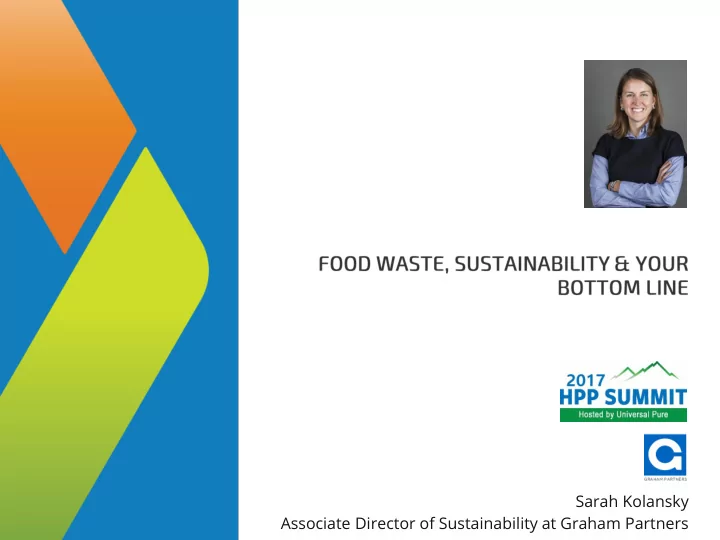
SLIDE 1 Sarah Kolansky Associate Director of Sustainability at Graham Partners
SLIDE 2 Sarah Kolansky
Associate Director of Sustainability at Graham Partners
- Joined the Graham Partners Sustainability team in February 2017
- From 2010-2017: Climate Change and Sustainability for ICF
- Led Inventory of GHG emissions for Yard Trimmings and
Food Scraps for EPA
- Worked with USDA Climate Change Division to create tools
to emissions from food production, including Animal Agriculture, Crop Management
- Worked on EPA’s WARM model which estimates changes to
emissions from different waste management decisions
- B.S. in Civil and Environmental Engineering degree from Bucknell
University
- Master of Environmental Studies degree from the University of
Pennsylvania
SLIDE 3
- Introduction
- Evolution of America’s Relationship with Food
- Impacts of Food Waste
- New Demands for Discarded Produce
- How Does this Affect a Company’s Bottom Line?
- Breakout into Groups
- Q&A
Outline for Today
SLIDE 4
The Extraordinary Life and Times of a Strawberry
SLIDE 5
How Much Food is Actually Wasted?
Every day, America wastes enough food to fill the seats at the Rose Bowl Stadium
SLIDE 6
EVOLUTION OF AMERICA’S RELATIONSHIP WITH FOOD
SLIDE 7
Our Value of Food has Changed
SLIDE 8
Our Value of Food has Changed
SLIDE 9
Our Value of Food has Changed
SLIDE 10
Our Value of Food has Changed
SLIDE 11
And Our View of Food has Changed
Food and calories are fast…
SLIDE 12
And Our View of Food has Changed
And cheap!
SLIDE 13
And Our View of Food has Changed
Customers expect perfect produce
SLIDE 14
IMPACTS OF FOOD WASTE
SLIDE 15 Key Food Waste Facts
133 billion pounds of the 430 billion pounds of food produced in the U.S. in 2010 was not available for human consumption at the retail and consumer levels. Equal to:
- $161.6 billion (as purchased
at retail prices)
- 31 percent of food produced
- 141 trillion calories per year,
- r 1,249 calories per capita
per day
SLIDE 16 Social Impacts
We waste roughly 30% of food produced, yet, in the US,
- 50 million people (13% of the
population) lived in food insecure households in 2011
- Over 35% of Americans are
- bese and over 70% of
Americans are overweight or
This doesn’t add up!
SLIDE 17 Environmental Impacts
Agriculture uses:
- 70% of freshwater for irrigation
- 38% of ice-free land
- ≈30% of global energy consumption
(agricultural machinery, fertilizer, transport, drying, cooling, processing, manufacturing, packaging, retail, domestic refrigeration, cooking, etc.)
US annual food wastage represents:
- 300 million barrels of oil (4% of total US
- il consumption)
- ¼ of annual U.S. freshwater
consumption
SLIDE 18
Climate Change Impacts
Food waste that is sent to a landfill creates methane gas If it is not captured by the landfill, then the methane is released into the atmosphere Methane (CH4) is 23 times as potent of a greenhouse gas (GHG) than CO2 Accounts for 25% of U.S. methane emissions
SLIDE 19
Environmental Impacts
SLIDE 20
Future Impacts
By 2050, the world population will be 9.725 billion… How will we feed a billion more people?
SLIDE 21
Food Waste Hierarchy
Source Reduction is the best thing that you can do to reduce impact from food waste. Perception that composting is the best practice, but there are many uses above composting that should be pursued. Wide consensus that landfilling should be the last resort, not the default.
SLIDE 22
Food Waste In the Supply Chain
All types of food are wasted throughout each phase of the supply chain
SLIDE 23
NEW DEMANDS FOR DISCARDED PRODUCE
SLIDE 24 The Market is Creating a Demand for Food Waste
Source: ReFED Food Waste Innovators Database
Number of Food Waste Innovation Organizations
SLIDE 25
Companies are Sprouting Up
SLIDE 26
And All Over the World
Whole Foods, Walmart, and dozens of start-ups are finding new markets for imperfect produce?
SLIDE 27
And Over the US
SLIDE 28
Some with Social Missions
SLIDE 29
Others that are for Profit
SLIDE 30
HOW DOES THIS AFFECT A COMPANY’S BOTTOM LINE?
SLIDE 31
Consumers are Seeking Socially Responsible Companies
SLIDE 32 Sustainability and Shareholder Value
- In the end, companies have a responsibility to shareholders to create value
- The fastest-growing cause for shareholders is sustainability
- High environment, social governance (ESG) ratings correlates to:
- Lower cost of capital in 100% of the studies
- Market-based outperformance in 89%
- Accounting-based outperformance in 85%
SLIDE 33 Wasted Food = Wasted $$$
processing, and retail means dollars wasted
- Finding a market for this
shrink can mean that this is not written off as a loss
company who donates in good faith
SLIDE 34
BREAKOUT INTO GROUPS
SLIDE 35 Breakout Into Groups
- How does your organization think about sustainability?
- A. Responding to customer/consumer demands
- B. Environmental impact (e.g., energy/water/waste efficiency)
- C. More of a corporate social responsibility (CSR) effort, based around
corporate citizenship
- Is there buy-in from top-level management on sustainability?
- Where is the shrink in your supply chain? What do you do to with this waste?
How much does that cost you/the supply chain to dispose of it?
- Think back to the food waste hierarchy. Are there better uses for the food than
the status quo?
- How does HPP fit in with these sustainability goals? Can HPP help to achieve
goals by extending shelf life and therefore reducing food waste?
SLIDE 36
Q&A
SLIDE 37
Sarah Kolansky Email: skolansky@grahampartners.net Twitter: @skolansky
Thanks For Participating
SLIDE 38
- http://www.foodwastemovie.com/
- http://www.adcouncil.org/Our-Campaigns/Family-Community/Reducing-Food-Waste
- https://www.usda.gov/oce/foodwaste/
- https://www.epa.gov/sustainable-management-food
- https://www.nrdc.org/sites/default/files/wasted-food-IP.pdf
- https://today.law.harvard.edu/food-law-and-policy-clinic-releases-short-film-on-food-waste-in-america/
- https://www.nrdc.org/sites/default/files/dating-game-report.pdf
- https://www.refed.com/downloads/ReFED_Report_2016.pdf
- https://www.ers.usda.gov/webdocs/publications/43833/43680_eib121.pdf?v=41817
Other, more technical information
- https://www.epa.gov/sites/production/files/2017-02/documents/2017_chapter_7_waste.pdf
- https://www.epa.gov/smm/advancing-sustainable-materials-management-facts-and-figures
Food Waste Resources
SLIDE 39
THANK YOU!