San Mateo Smart Corridor Incident and Daily Activity Management - - PowerPoint PPT Presentation

san mateo smart corridor incident and daily activity
SMART_READER_LITE
LIVE PREVIEW

San Mateo Smart Corridor Incident and Daily Activity Management - - PowerPoint PPT Presentation

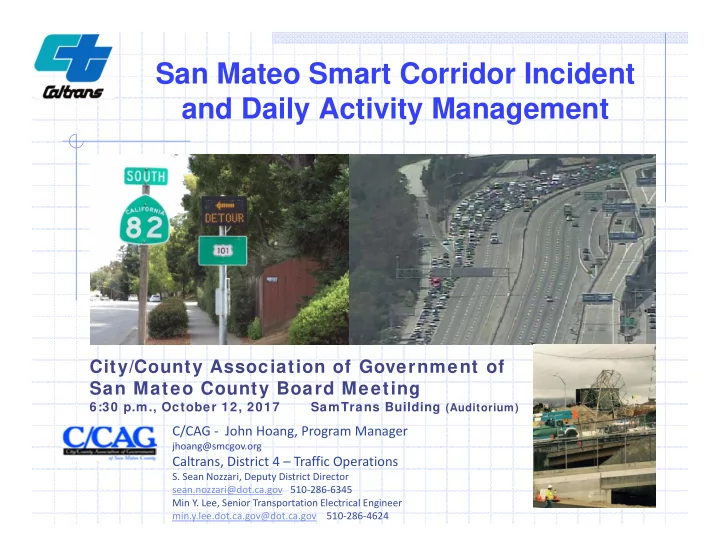
San Mateo Smart Corridor Incident and Daily Activity Management City/County Association of Government of San Mateo County Board Meeting 6:30 p.m., October 12, 2017 SamTrans Building (Auditorium) C/CAG - John Hoang, Program Manager


slide-1
SLIDE 1

San Mateo Smart Corridor Incident and Daily Activity Management

City/County Association of Government of San Mateo County Board Meeting

6:30 p.m., October 12, 2017 SamTrans Building (Auditorium)

C/CAG - John Hoang, Program Manager

jhoang@smcgov.org

Caltrans, District 4 – Traffic Operations

  • S. Sean Nozzari, Deputy District Director

sean.nozzari@dot.ca.gov 510-286-6345 Min Y. Lee, Senior Transportation Electrical Engineer min.y.lee.dot.ca.gov@dot.ca.gov 510-286-4624

slide-2
SLIDE 2

San Mateo Smart Corridor Background

Needs, Goals and Objectives

Process Taken and Implementation

Caltrans’ Mobility Focus Areas San Mateo Smart Corridor Briefing

Incident Management

 PG&E High Voltage Tower Collapse  Recreational Vehicle Fire  Police Action near Routes 92

Day-to-Day Usage

Moving Forward

Questions

Outline

slide-3
SLIDE 3

San Mateo County Smart Corridor Project

Background

slide-4
SLIDE 4

San Mateo County Smart Corridor

Needs

  • Coordinate operations and

sharing of resources between Caltrans and Local Agencies to address recurrent congestion

  • Remote management

capability of traffic signals from City and Caltrans TMC

  • Ability to monitor traffic

conditions and collect traffic data along corridor

4

slide-5
SLIDE 5

San Mateo County Smart Corridor

Goals

Implement Intelligent Transportation Systems (ITS) solutions and strategies for countywide traffic management Establish cross jurisdictional coordination and cooperation Enable cities and Caltrans to proactively manage day-to-day traffic, during special events, and facilitate traffic impacts due to major incidents on the freeway Implement infrastructure that allows for expansion to meet future demands, capabilities, and integration with new technology

5

slide-6
SLIDE 6

San Mateo County Smart Corridor

Objectives

Enable ability to monitor real time traffic conditions and adjust signal timing remotely Enable shared control and operation Improve traffic flow, Improve mobility, Optimize vehicle throughput, Reduce traffic delays, Improve travel time reliability

6

slide-7
SLIDE 7

San Mateo County Smart Corridor

Process Taken

Assembled Working Group (2007)

 City traffic engineers, Law Enforcement, Fire, Caltrans

Together established Alternative Routes Inter-Agency Agreements

 MOU on ownership and maintenance of equipment  Coop Agreements between Caltrans and cities

Established Stakeholder Working Group (All cities

  • n the corridor are represented)

 Reviewed and approved incident response plan  Continue to meet (quarterly)  Improve communication on the ground level  Continue to fine-tune incident response practice  Share lessons learned

7

slide-8
SLIDE 8

San Mateo County Smart Corridor Project Background

Implementation

8

Phases I, II, and III

 25 miles of interconnected communication

network Next Step: Portions of Phase IV and Phase V (South San Francisco, Brisbane, Daly City, Colma)

slide-9
SLIDE 9

San Mateo County Smart Corridor Project Background

Constructed Phase

  • Stakeholders identified alternate routes known as

“Smart Corridor Routes”

Smart Corridor Route

9

slide-10
SLIDE 10

San Mateo County Smart Corridor Project Background

What We Have Done

Deploy infrastructure along major arterials corridors parallel to freeways

Install fiber optics communication network

Implement new signal system software integrating city-owned and Caltrans traffic signals

Install CCTV cameras, signage, vehicle detection

TMC Regional Communications System Integration

10

slide-11
SLIDE 11

San Mateo County Smart Corridor Project Field Elements:

Traffic Signal Controller Upgrades

11

slide-12
SLIDE 12

San Mateo County Smart Corridor Project Field Elements:

Trailblazer Signs

  • Alternate route guidance
  • Installed at decision

points

12

slide-13
SLIDE 13

San Mateo County Smart Corridor Project Field Elements:

Arterial Dynamic Message Signs

  • Additional traveler

information

  • Route guidance
  • Lane closures
  • Travel times
  • Incidents
  • El Camino Real @

84, 92, 380

13

slide-14
SLIDE 14

San Mateo County Smart Corridor Project Field Elements:

CCTV Cameras

  • At Critical

Locations

  • Connected to

Video Management System

14

slide-15
SLIDE 15

San Mateo County Smart Corridor Project Field Elements:

Vehicle Detection Stations

  • Collect

traffic data

  • Help detect

congestion incidents

15

slide-16
SLIDE 16

San Mateo County Smart Corridor Project

San Mateo Hub and TMC’s

  • San Mateo Hub (in San Mateo Police Department)
  • Communications equipment
  • Servers
  • City TMC
  • Connected to San Mateo Hub via fiber
  • Operator Workstation
  • Caltrans TMC
  • Connected to San Mateo Hub
  • BART fiber (future)

16

slide-17
SLIDE 17

San Mateo County Smart Corridor Project

Incident Response Process

Operator Monitors Conditions and Adjusts Strategy

START:

Incident Detection Operator Confirms Incident

  • n

Freeway System Offers Strategies

  • r Operator

Looks-up Strategies Operator Confirms

  • r

Modifies Strategy Operator Deploys Strategy and Notifies Affected Local Agencies

END:

Resume Normal Operations

  • Turn ON

Trailblazers and DMS

  • Monitor

CCTV at Critical Locations

  • Implement

preapproved signal timing plans

Incident

17

slide-18
SLIDE 18

Caltrans’ Mobility Focus Areas

18

slide-19
SLIDE 19

19

  • Transportation Management System
  • Build-out (TMS)
  • Adaptive Ramp Metering
  • Emergency Management
  • System Monitoring & Performance Measurement
  • Incident Management & Disaster Planning
  • Traveler Information (Regional & Statewide)
  • Integrated Corridor Management
  • Integrated Freeway & Arterial Operations
  • Transit/Rail, Pedestrians, & Bicyclists
  • Operational Improvements &

System Completion

  • Managed Lanes (High Occupancy Vehicle/Toll Lanes)
  • Strategic Improvements
  • Embrace New Technology
  • Connected/Automated Vehicles & Infrastructure

Transportation System Management & Operations (TSMO)

Mobility Focus Areas

slide-20
SLIDE 20

San Francisco Bay Area: Integrated Corridor Management

I-80 Smart Corridor

X

Incident

Freeway: Electronic signs on overhead gantries turn ON upstream of an incident, and immediately past.

Open Merge Blocked Open

Activations: 308 WB I-80: 220 EB I-80: 88

  • Typ. Duration: 30’

8/25/16 to 8/31/17

Arterial: Trailblazer Signs turn ON and signal “flush plan” implemented along main arterial to guide traffic back to freeway

Freeway Information Display Board

22

slide-21
SLIDE 21

21

San Francisco Bay Area: Integrated Corridor Management

State Route 4 Smart Corridor

  • Approximately 30 miles from I-80 to SR-160 through seven cities
  • In planning stage
  • 18 month schedule: Prepare Concept of Operations & High Level

System Requirements for:

  • Corridor Ramp Metering
  • Incident Management
  • Travel Demand Management
slide-22
SLIDE 22

22

San Francisco Bay Area Integrated Corridor Management

32 miles Alameda I-880 Smart Corridor Oakland – San Jose 25 miles Contra Costa I-680 Smart Corridor Benicia Bridge-Alameda Co. Line)

slide-23
SLIDE 23

San Mateo Smart Corridor Briefing

23

slide-24
SLIDE 24

We used the Smart Corridor for the incidents below

 PG&E High Voltage Tower Collapse in Burlingame on

August 28, 2015

 Recreational Vehicle Fire in San Carlos on October 20,

2016

 Police action near Route 92 in San Mateo on April 28,

2017.

Incident Management

24

slide-25
SLIDE 25

Incident Management

PG&E Power Transmission Tower Collapse

Construction contractor hit PG&E Tower causing it to collapse on Friday night in both directions August 28, 2015. Southbound lanes were reopened the next day. Northbound lanes were reopened on Monday at 4:15 a.m. Broadway over crossing was reopened

  • n Monday at 9:00 a.m.

25

slide-26
SLIDE 26

Incident Management

Police Action near Route 92

Police action on April 28, 2017 closed northbound US 101 around 6:15 p.m. Friday evening Drivers were diverted

  • ff the freeway at

Ralston Ave. Freeway reopened on Saturday at 12:45 a.m.

26

slide-27
SLIDE 27

Incident Management

RV Fire Freeway Closure

Northbound drivers were diverted at Woodside Rd. Southbound US 101 was reopened at 6:24 p.m. and two northbound left lanes reopened at 6:58 p.m. At 9:00 p.m., US 101 was fully opened. US101 was closed at 5:15 p.m. in San Carlos on October 20, 2016 due to a fully engulfed recreational vehicle carrying 50 gallon propane tank, and 5 to 10 pound model rockets. Northbound drivers were diverted at Woodside Rd. Southbound drivers were diverted at Holly St.

27

slide-28
SLIDE 28

US 101 Typical Day Congestion (4:00 p.m. to 9:00 p.m., October 13, 2016)

Northbound Southbound

Millbrae Ave. Route 92 University Ave.

28

slide-29
SLIDE 29

US 101 RV Fire Day Congestion (4:00 p.m. to 9:00 p.m., October 20, 2016)

Millbrae Ave.

Northbound Southbound

Route 92 University Ave. INCIDENT

29

slide-30
SLIDE 30

El Camino Real Typical Day Congestion (4:00 p.m. – 9:00 p.m., October 13, 2016)

Northbound Southbound

Millbrae Ave. Route 92 University Ave.

30

slide-31
SLIDE 31

El Camino Real RV Fire Day (4:00 p.m. to 9:00 p.m., October 20, 2016)

Northbound Southbound

Millbrae Ave. Route 92 University Ave.

31

slide-32
SLIDE 32

Day-to-Day Applications

32

slide-33
SLIDE 33

Day-to-Day Applications

Typical Monitor traffic conditions Update signal timing remotely Coordinate signals with local agencies Address complaints

33

slide-34
SLIDE 34

Day-to-Day Applications

Recent Examples

Ralston Ave. and El Camino Real southbound left turn complaint. Coordinating of two closely spaced signals

  • f Harbor Blvd. with El Camino Real and Old

County Rd. Northbound and southbound US 101 off ramps to Marsh Rd. Half Moon Bay retiming.

34

slide-35
SLIDE 35

Day-to-Day Applications

Historical Intersection Timing (HIT) Report

With the Smart corridor, we are able to view intersection operation remotely and see how the intersection operates 24 hours a day, everyday, to pinpoint problems and address them quickly.

Green Times Each Cycle Time of Day Green Times by Phase and Cycle Lengths in Seconds

35

slide-36
SLIDE 36

Moving Forward

Next Steps

 Encourage agencies to add signals to the system.

Additional Uses beyond current Smart Corridor

 Work with agencies to use elements for special events.  Enhance communication between local agencies during

freeway incident.

 Partner with researchers and auto manufacturers to utilize

Smart Corridor for autonomous vehicles/ connective applications.

Expand the Smart Corridor to the Cities of Daly City, Colma, South San Francisco and Brisbane.

36

slide-37
SLIDE 37

Questions?

Thank you!

Safety Mobility