
SLIDE 1
San Mateo County Energy & Water Strategy 2025
Peninsula Clean Energy
Citizens Advisory Committee September 12, 2019
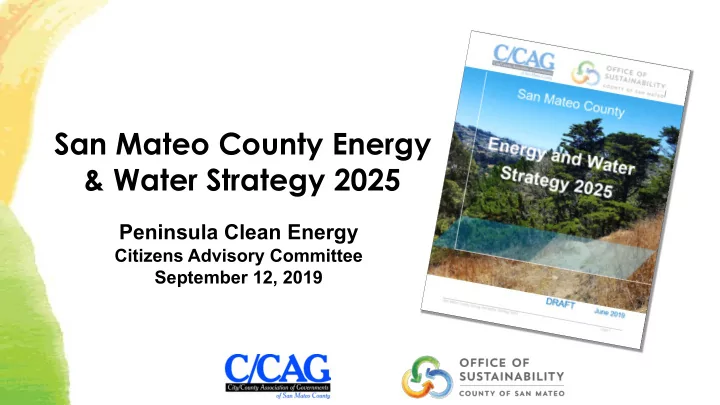
San Mateo County Energy & Water Strategy 2025 Peninsula Clean - - PowerPoint PPT Presentation
San Mateo County Energy & Water Strategy 2025 Peninsula Clean Energy Citizens Advisory Committee September 12, 2019 Background Update to the San Mateo County Energy Strategy (2008) Focused on addressing future energy and water
Peninsula Clean Energy
Citizens Advisory Committee September 12, 2019
– Update to the San Mateo County Energy Strategy (2008) – Focused on addressing future energy and water needs in San Mateo County – Supported by RMCP Committee – Encourages collaboration among local governments, utility providers, non-profits and the private sector
Original Energy Strategy – Focused on efficiency and conservation – Written by USTF committee and consultant – Final Draft adopted by BOS in December 2008 – Adopted by every city/town in 2009
§ New state goals § PCE established § Micro and smart grid § Electrified transportation
§ Drought § National attention on water quality § Automated Metering Infrastructure (AMI) § Water recycling and groundwater sustainability
CY 2018
draft content
CY 2019
feedback
Stakeholder Working Groups – Two groups made up of professionals in the energy and water sectors – Held 5 half day workshops to develop guiding principles and the organizing framework – Provided detailed technical expertise
Energy Stakeholder Group Seat Organization Community Choice Aggregator Peninsula Clean Energy County County - OOS Nonprofit - Energy/ Microgrid Clean Coalition Vehicle/ Bus Manufacturer Proterra Public Transportation SamTrans Electric Utility PG&E Community College SMC CCD City/ Town Council South San Francisco Energy Code Consultant Public Works Staff City of San Mateo Health Care District Kaiser Equity DAC El Concilio Nonprofit - Energy/ Solar Sunwork
Water Stakeholder Group Seat Organization Countywide Water BAWSCA County County - OOS Water Agency Cal Water Waste Water Treatment Silicon Valley Clean Water Health Department County - EH RCD/Land RCD Water Code Consultant
not pose a hazard for any community
carbon footprint for delivered and consumed energy and water
socioeconomic status and considering existing inequities
needs
all when needed
ensure that energy and water is there when you need it, especially for vulnerable communities
economically stable
Energy Goals:
Energy
Water Goals:
Goals
3 Energy 3 Water
Strategies
13 Energy 9 Water
Actions
56 Energy 34 Water
Strategy E2.1: Support rapid community shift to 100% GHG-free electricity
Actions
SMC City PCE PG&E Other
1.
Create partnerships, awareness campaigns and incentives to maximize opportunities for local rooftop PV and carport PV systems combined with energy storage for residential and commercial buildings. For the agricultural sector, promote solar- powered pumps (for water).
RCD
2.
Enhance building reach codes to support community scale smart solar projects with energy storage, and multifamily dwelling units’ electric vehicle charging infrastructure.
3.
Encourage all consumers to move towards 100% renewable energy, through PCE’s ECO100 supply option and its 100% renewable energy by 2025, as well as regional power purchase agreements and bulk buy programs.
4.
Partner with a local university or national lab to research and develop appropriate response plans to ensure seasonal and time dependent impacts on grid are addressed.
5.
Plan for regional or municipal emergency centers to site battery storage, and/or use renewable energy microgrids, especially in vulnerable communities.
audience
– Local government staff – Sustainability councils – Community groups – Environmental groups
– Regulatory agencies
themes
– Compiling survey data – Mapping comments to Strategy – Following up with clarification questions
“We appreciate and support the overall bold vision that [the Strategy] lays out.” – PG&E Grid Edge “Overall, this is very exciting and looks detailed and comprehensive across the policy areas.”
Which principles are most important to you or your organization?
– Resilience
– Groundwater recharge – Actions that include taxes can create equity issues
Kim Springer
Resource Conservation Programs Manager County of San Mateo, Office of Sustainability kspringer@smcgov.org 650-599-1412
John Allan
Resource Conservation Specialist County of San Mateo, Office of Sustainability jallan@smcgov.org 650-363-4071
Advancing safer, healthier and more affordable homes Update for PCE Citizens Advisory Committee Sept 2019
18
Rafael Reyes, Director of Programs
Phillip Kobernick, Programs Manager
Alejandra Posada, Programs Specialist
Peter Ambiel, Programs Specialist
Shraddha Mutyal, Programs Manager
19
Program Status New EV Dealer Incentive 3-year program (2019-2021)
$1000 for BEV, $700 for PHEV, opens October 1st 7 dealerships: Nissan, Chevrolet, Ford, Honda, Chrysler, BMW, and Toyota
Ride & Drive Program 3-year program (2019-2021)
9 events completed, 1509 experiences Next: Burlingame Fall Fest – Oct 26/27
DriveForward Electric 2-year program (2019-2020)
13 purchases to date. Working on integration with state and regional programs (CVAP, BAAQMD, etc)
Resilient Solar on Critical Facilities
Gathered site information from participating cities. Scoping study in-progress.
Low-Power EV Charging Pilot
Initiated pilot to develop requirements, assess technology in market, and pilot technology to address charging in older, power-constrained apartments.
EV Charging Incentives 4-year program (2010-2023)
Secured $12M from CEC to complement PCE funds for workplace, multi-unit and DCFC charging. Program to open mid-2020 under State CALeVIP program. Award made to CLEAResult to offer outreach and technical assistance.
20
21
combustion
to address at new construction
San Mateo Co “fuel” savings by reaching 45,000 EVs in 2025
avoided per year for every home
22
asthma risk by 42%
carbon monoxide poisoning
when not in-use, eliminating a leading cause of house fires
23
24
25
Code Element Approach Building Electrification
Electric Vehicle Readiness
PCE will provide funding support for affordable housing to address EV measures
27
University of California- All-Electric New Construction
2017 Study
28
Residential Building Electrification in California, E3, April 2019
29
All-Electric New Residential Bay Area Conservative Case
Residential Building Electrification in California, E3, April 2019
30
30 EV Capable EV Ready EV Capable EV Ready EV Capable EV Ready
Investing in EV infrastructure during new construction saves 40-400% of costs compared to retrofitting it later.
31
32
Date/Timeframe Activity
PCE, SVCE and County of San Mateo initiate reach code initiative January Reach Code kickoff event for city staff February Statewide Cost-Effectiveness study March Building Reach Code Workshops April 11 and 24 Draft Model Reach Codes Measures available April & May City-specific stakeholder engagements 15-May Last input into model code measures June 30 Final model reach code language shared Summer & Fall Outreach and adoption technical assistance Summer & Fall City Councils vote on desired reach codes Q4 – Q1 Submit Code Packet for CEC approval
Potential for reach code to go into effect at the same time as state code update 2020-2022 Opportunities to adopt reach code throughout three year code cycle, PCE and County to provide training and support for code implementation
33
Lead Staff City PCE / SVCE LOI Council Briefing Community Stakeholder mtg Council Reading Council Vote Atherton PCE Carlos De Melo Belmont PCE 10/8 or 10/22 Adrienne Etherton Brisbane PCE Yes Oct 3 Joe McCluskey Burlingame PCE Yes Sep 3 Brian Dossey Colma PCE Jul 10 9/25? County of San Mateo PCE Yes Daly City PCE Sep 3 Oct 8? Nov 5? Jose Martinez East Palo Alto PCE Yes Foster City PCE Half Moon Bay PCE Aug 12 Tim Anderson Hillsborough PCE BOD "Yes" Jul 16 Aug 27 Sept 10 Rebecca Lucky Menlo Park PCE Yes Jul 23 Mike Cully Millbrae PCE Yes Jul 8 10/14 or 11/11 Tina Wehrmeister Pacifica PCE Yes Portola Valley PCE Yes Sep 25 Oct 9 Oct 23 Chris Dacumos Redwood City PCE Yes Sept 23 Oct 28 San Bruno PCE Adam Lokar San Carlos PCE Oct 14 Andrea Chow San Mateo PCE Yes Jun 3 Aug-19 Sep-3 Phillip Perry South San Fransisco PCE Joanne Kurz Woodside PCE Oct 8 County of SM PCE Joel Paulson Campbell SVCE Yes Oct 15 Tonya Veitch County of Santa Clara SVCE Sept 10 Gillee Corral Cupertino SVCE Yes tbd Oct 14 TBD TBD Christina Villareal Gilroy SVCE Yes tbd Nov 4 Anthony CarneseccaLos Altos SVCE Yes Oct 22 Nov 12 Los Altos Hills SVCE Yes Sept 19 Los Gatos SVCE Yes Oct 15 Bill Tott Milpitas SVCE Yes Sept 12; 10am- 10/15/2019 Oct Rob Queirolo Monte Sereno SVCE BOD "Yes" Aug 6 Sept 11; 6pm Sept 18 Anthony Eulo Morgan Hill SVCE Yes Sept 4 Oct 23 Nov 6 Erin Brewster Mountain View SVCE Yes 9/19/2019 - 10a Oct 22 Nov 12 Keith Weiner Saratoga SVCE tbd Amber Blizinski Sunnyvale SVCE Yes tbd
ADOPTED
BUILDING ELECTRIFICATION Proposed Reach Code Single Family and Duplex Two compliance pathways: 1)All-electric 0% 2)Mixed-fuel +15% compliance Office Use Two compliance pathways: 1)All-electric 0% 2)Mixed-fuel +10% compliance
35
MANDATORY SOLAR 2019 State Code Proposed Reach Code Single Family, Duplex, and Multifamily (3 stories or less) Solar PV installation required to offset annual electricity usage None Multifamily (4 stories or more) No requirement Minimum 3 kW PV system or solar thermal Non-residential (<10,000 SF) No requirement Minimum 3 kW PV system or solar thermal Non-residential (>10,000 SF) No requirement Minimum 5 kW PV system or solar thermal
36
ELECTRIC VEHICLE READINESS 2019 State Code Proposed Reach Code One- and two-family dwellings + town- houses 1 EV Capable space Requires installation of a receptacle (outlet) Multifamily 10% EV Capable 15% EV Capable Non-residential with at least 10 parking spaces 6% EV Capable 10% EV Capable 5% Level 2 EVSE (EV Supply Equipment) installed
37
CURRENT RECOMMENDATION SUMMARY
39
Building types Requirements New residential buildings (single family and three stories or less multifamily) Require to build nearly all-electric building (except stoves and fireplaces)
fireplaces are used.
CURRENT RECOMMENDATION SUMMARY
40
Building types Requirements New nonresidential buildings and high-rise multifamily buildings (three stories and greater) Require to: 1.Build an all-electric building that uses electricity as the source of energy for all appliances
and allowing appeal for restaurants to use gas stoves or cooking appliance. Natural gas appliance locations must be electrically pre-wired for future electric appliance installation.
body, such as Planning Commission or Environmental Quality Commission 2.Install a minimum amount of on-site solar based on square footage: a.Less than 10,000 square feet requires a minimum of three kilowatt photovoltaic system b.Greater than or equal to 10,000 square feet requires a minimum of five kilowatt photovoltaic system
42
Electric Buildings - Single and Two-family New Construction
2016 Energy Code 2019 CALGreen PCE/SVCE Proposed All-Electric Mixed-Fuel
Single-Family Two-Family Townhome
Meet Title 24 Energy Requirements using:
modelling) or
Meet Title 24 Energy Requirements using:
Meet Title 24 Energy Requirements using:
Exceed Title 24 Energy Requirements using:
points)
measures) Solar generation ready zone in subdivisions with ten or more buildings Requires solar generation Requires solar generation Requires solar generation +
Required adjacent outlet for future electric replacement:
Use electric appliances Required adjacent outlet for future electric replacement:
43
Electric Buildings – Multifamily (≤ Stories)New Construction
2016 Energy Code 2019 CALGreen PCE/SVCE Proposed All-Electric Mixed-Fuel
Single-Family Two-Family Townhome
Meet Title 24 Energy Requirements using:
modelling) or
Meet Title 24 Energy Requirements using:
Meet Title 24 Energy Requirements using:
Exceed Title 24 Energy Requirements using:
points)
measures) Solar generation ready zone Requires solar generation Requires solar generation Requires solar generation +
Required adjacent outlet for future electric replacement:
Use electric appliances Required adjacent outlet for future electric replacement:
44
Electric Buildings – Nonresidential
2016 Energy Code 2019 CALGreen PCE/SVCE Proposed All-Electric Mixed-Fuel
Single-Family Two-Family Townhome
Meet Title 24 Energy Requirements using:
modelling) or
Meet Title 24 Energy Requirements using:
Meet Title 24 Energy Requirements using:
Exceed Title 24 Energy Requirements using:
compliance margin)
measures) Solar generation ready zone Required adjacent outlet for future electric replacement:
Use electric appliances Required adjacent outlet for future electric replacement:
Solar generation ready zone Solar generation ready zone Solar generation ready zone
45
45
Performance Path Prescriptive Path
home will be all electric, OR Build All Electric. Meet 2019 Title 24 Part 6.
Building shall be at least 10 EDR points less than the Total Energy Design Rating calculated for the Standard Design Building, OR Mixed Fuel Building
system.
and water heating, gas cooking and/or clothes drying). Proposed Design Building shall be at least 2 EDR points less than the Energy Efficiency Design Rating calculated for the Standard Design Building, OR Electrically Heating Building
“Menu options” are formatted with green highlights
1 + 2 OR 1 + 2 + 2A
46
46
Performance Path Prescriptive Path
home will be all electric, OR Build All-Electric and Meet 2019 Title 24 Part 6.
Building shall be at least 10 EDR points less than the Total Energy Design Rating calculated for the Standard Design Building, OR Mixed Fuel Building
water heating system.
and water heating, gas cooking and/or clothes drying). Proposed Design Building shall be less than the Energy Efficiency Design Rating calculated for the Standard Design Building Electrically Heated Building Meet 2019 Title 24 Part 6
“Menu options” are formatted with green highlights
1 + 2 OR 1 + 2 + 2A
47
47
Performance Path Prescriptive Path
building will be all electric, OR Build All Electric and meet 2019 Title 24 Part 6.
Demonstrate that the energy use of the proposed building is 9% more efficient than the 2019 State Energy Code, OR Mixed Fuel Building
(10%)
AND 2) Institutional Tuning
Demonstrate that the energy use of the proposed building is 15% more efficient than the 2019 State Energy Code Mixed Fuel Building
Tuning AND 3) Occupant sensing in open plan offices
1 + 2 + 2A 1 + 2 OR
48
48
Level 1 “Trickle Charging”
Standard household outlet 15-20 Amp, 120v AC Driving distance provided: 3-4 miles/hour
Level 2 “Standard Charging”
Equivalent to a dryer outlet. 40+ Amp, 208/240v AC Driving distance provided (standard charging): 25-30 miles/hour
Level 3 “DC Fast Charging / SuperCharging”
24-350kW Driving distance provided 72-1,200 miles/hour
49
49
EV Capable - Some Assembly Required
Panel capacity, raceway (conduit) only at critical areas (underground, pinch points, etc.) Definition is less stringent than CALGreen 2019
EV Ready - Plug & Play
Panel capacity, raceway (conduit), overcurrent protection device (breaker), wire, receptacle & signage. Can refer to Level 1 or Level 2
EV Charging Station (EVCS) - Level 2 Charge!
Charging station fully installed. All the equipment needed to deliver electrical energy from an electricity source to the EV at Level 2
ELECTRIC VEHICLE OUTLET
50
2016 CALGreen 2019 CALGreen PCE/SVCE Proposed Mandatory Mandatory
Single Family Two-Family Townhome (1) Level 2 EV Capable for one parking space per dwelling unit 2 EV spaces total:
ELECTRIC VEHICLE OUTLET
51
2016 CALGreen 2019 CALGreen PCE/SVCE Proposed Mandatory Mandatory Multi-Family 3% 10% 25% 75% ≤20 dwelling units >20 dwelling units 100%
ELECTRIC VEHICLE OUTLET
3% Level 2 EV Capable for buildings with ≥17 units 10% Level 2 EV Capable ≤20 units: One Level 2 EV Ready per dwelling >20 units: Of all dwelling units,
52
2016 CALGreen 2019 CALGreen PCE/SVCE Proposed Mandatory Mandatory Non-Residential
6% 10% 10% 30%
80kW DC Fast Charger per 100 spaces
6% 5% ELECTRIC VEHICLE OUTLET
~6% Level 2 EV Capable (for buildings with at least 10 parking spaces) Office building:
Commercial: Of all parking spaces,