-Samples [AB98] Hyp: domain S is a smooth curve or surface. S 1 - - PowerPoint PPT Presentation

samples
SMART_READER_LITE
LIVE PREVIEW

-Samples [AB98] Hyp: domain S is a smooth curve or surface. S 1 - - PowerPoint PPT Presentation

-Samples [AB98] Hyp: domain S is a smooth curve or surface. S 1 -Samples [AB98] Hyp: domain S is a smooth curve or surface. S E 1 -Samples [AB98] Hyp: domain S is a smooth curve or surface. S E 1 -Samples [AB98] Hyp: domain S


slide-1
SLIDE 1

ε-Samples

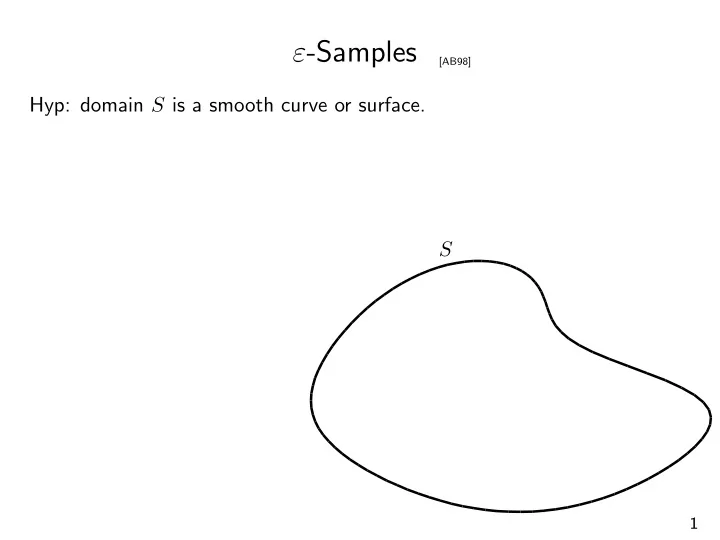
Hyp: domain S is a smooth curve or surface.

[AB98]

S

1
slide-2
SLIDE 2

ε-Samples

Hyp: domain S is a smooth curve or surface.

[AB98]

S

1

E

slide-3
SLIDE 3

ε-Samples

Hyp: domain S is a smooth curve or surface.

[AB98]

S

1

E

slide-4
SLIDE 4

ε-Samples

Hyp: domain S is a smooth curve or surface.

[AB98]

S

1

Del|S(E) E

slide-5
SLIDE 5

ε-Samples

Hyp: domain S is a smooth curve or surface. Def E ⊂ S is an ε-sample of S if ∀p ∈ S, d(p, E) ≤ ε

[AB98]

p q

S

1

Del|S(E) E Theorem If E is an ε-sample of S, with ε < 0.16 rch(S), then Del|S(E) ≈ S and lies at Hausdorff distance O(ε2) of S.

slide-6
SLIDE 6

Given S and E,

  • which points should be added

to E, to make it an ε-sample?

  • for which values of ε is E an

ε-sample of S?

Curve/Surface Meshing and ε-samples

2

slide-7
SLIDE 7

Let V be the set of the edges of Vor(E) Def E ⊂ S is a loose ε-sample of S if ∀p ∈ V ∩ S, d(p, E) ≤ ε

candidate [BO04]

Loose ε-Samples

Hyp: S is C1,1, E ⊂ S 3

slide-8
SLIDE 8

Let V be the set of the edges of Vor(E) Def E ⊂ S is a loose ε-sample of S if ∀p ∈ V ∩ S, d(p, E) ≤ ε

candidate

Theorem 1 ε-samples are loose ε-samples

[BO04]

Loose ε-Samples

Hyp: S is C1,1, E ⊂ S 3

slide-9
SLIDE 9

Let V be the set of the edges of Vor(E) Def E ⊂ S is a loose ε-sample of S if ∀p ∈ V ∩ S, d(p, E) ≤ ε

candidate

Theorem 1 ε-samples are loose ε-samples ! The contraposal is false... ε

[BO04]

Loose ε-Samples

Hyp: S is C1,1, E ⊂ S 3

slide-10
SLIDE 10

Let V be the set of the edges of Vor(E) Def E ⊂ S is a loose ε-sample of S if ∀p ∈ V ∩ S, d(p, E) ≤ ε

candidate

Theorem 1 ε-samples are loose ε-samples ! The contraposal is false... Theorem 2 For ε ≤ 0.16 rch(S), loose ε-samples are ε

  • 1 +

ε rch(S)

  • samples,

loose ̺rch(S)-samples are ̺ (1 + ̺) rch(S)- samples (̺ = ε/rch(S))

[BO04]

Loose ε-Samples

... but true asymptotically

Hyp: S is C1,1, E ⊂ S 3

slide-11
SLIDE 11

Let d = max{d(p, E) | p ∈ V ∩ S} → ∀ε < d, E is not an ε-sample (Thm 1) → ∀ε ≥ d

  • 1 +

d rch(S)

  • , E is an ε-sample (Thm 2)

⇒ d ≤ ε0 ≤ d

  • 1 +

d rch(S)

  • d

[BO04]

Loose ε-Samples

  • What is the smallest value ε0 of ε such that E is an ε-sample?

4

slide-12
SLIDE 12

while there are far away candidates > ε

[BO04]

Loose ε-Samples

  • How to enrich E so that it becomes a (sparse) ε-sample?

5

slide-13
SLIDE 13

while there are far away candidates insert one far away candidate in E ;

[BO04]

Loose ε-Samples

  • How to enrich E so that it becomes a (sparse) ε-sample?

5

slide-14
SLIDE 14

while there are far away candidates insert one far away candidate in E ; update Vor(E) and the list of candidates ; end while

[BO04]

Loose ε-Samples

  • How to enrich E so that it becomes a (sparse) ε-sample?

5

slide-15
SLIDE 15

Theorem The process terminates and inserts O

  • Area(S)

ε2

  • points in E

Upon termination, E is a loose ε-sample (≈ ε-sample) of S while there are far away candidates insert one far away candidate in E ; update Vor(E) and the list of candidates ; end while

[BO04]

Loose ε-Samples

  • How to enrich E so that it becomes a (sparse) ε-sample?

5

slide-16
SLIDE 16

Theorem The process terminates and inserts O

  • Area(S)

ε2

  • points in E

Upon termination, E is a loose ε-sample (≈ ε-sample) of S while there are far away candidates insert one far away candidate in E ; update Vor(E) and the list of candidates ; end while

[BO04]

Loose ε-Samples

  • How to enrich E so that it becomes a (sparse) ε-sample?

5 Space complexity: O(n log n) Time complexity: O(n log2 n)

slide-17
SLIDE 17

6

slide-18
SLIDE 18

6

slide-19
SLIDE 19

6

slide-20
SLIDE 20

6

slide-21
SLIDE 21

6

slide-22
SLIDE 22

6

slide-23
SLIDE 23

6

slide-24
SLIDE 24

6

slide-25
SLIDE 25

6

slide-26
SLIDE 26

6

slide-27
SLIDE 27

6

slide-28
SLIDE 28

6

slide-29
SLIDE 29

6

slide-30
SLIDE 30

Curve/Surface meshing: a brief survey

7

  • Marching Cubes [LC87, Ch95]
  • Surface mesher based on Delaunay refinement [Ch93]
  • Implicit surface mesher based on subdivision [Bl94]
  • Implicit surface mesher based on critical points theory [HS97]
  • Our variant of Chew’s algorithm [BO03]
  • Implicit surface mesher based on critical point theory [BCV04]
  • Surface mesher based on the Closed Ball Property [CDRR04]
  • Variant of Marching Cubes with adaptive grid [PV04]
slide-31
SLIDE 31

Geometric predicates

  • 1. Is the sphere passing through 4 given points of E empty?

(Delaunay/Voronoi)

  • 2. Does a given segment intersect S?

(restricted Delau- nay/candidates) → little prior knowledge of S is required

8

slide-32
SLIDE 32

Implicit surfaces 9

slide-33
SLIDE 33

Implicit surfaces Level-sets 9

slide-34
SLIDE 34

Implicit surfaces Level-sets Point sets 9

slide-35
SLIDE 35

Implicit surfaces Level-sets Point sets Molecules 9

slide-36
SLIDE 36

What if S is unknown and unsampled?

Curve and surface probing [BGO05]

Idea Discover the (rest of the) shape by means of a tool, called a probing device P Ω ∂Ω S O

  • input
  • a convex compact set Ω ⊇ O
  • a point o ∈ O

tool a probing device P, able to

  • move freely outside O
  • cast rays and detect their first

intersection point with O goal

  • command the probing device
  • process the outcomes of

probes

10

slide-37
SLIDE 37

Strategy Use our sampling algorithm, with the probing device as oracle Theorem Upon termination, ˆ S = Del|S(E) ⇒ E is a loose ε-sample of S

  • probes are issued along Voronoi

edges, from reachable Voronoi vertices

  • a subset ˆ

S of Del|S(E) is main- tained

11

What if S is unknown and unsampled?

Curve and surface probing [BGO05]

slide-38
SLIDE 38
  • Convex polytopes: finger probes, hyperplane probes, X-ray probes

[CY84, DEY86, Sk89]

  • Polyhedra with no coplanar facets: enhanced finger probes [BY92]

Exact probing Approximate probing

  • Planar convex smooth objects: hyperplane probes

[LB94, Ri97, Ro92]

  • Non-convex smooth objects in 2D/3D [BGO05]

Surface Probing: a brief survey

12