Safety of mobility scooters footpath (6 km/h), bicycle path and - - PDF document

safety of mobility scooters
SMART_READER_LITE
LIVE PREVIEW

Safety of mobility scooters footpath (6 km/h), bicycle path and - - PDF document

Mobility scooter In NL: - Mostly 15-17 km/h - Allowed on: Safety of mobility scooters footpath (6 km/h), bicycle path and road Ragnhild Davidse ICTCT 2018 Porto, 25-26 October Traffic fatalities in 2015 Concerns about the safety of


slide-1
SLIDE 1

Ragnhild Davidse

ICTCT 2018 – Porto, 25-26 October

Safety of mobility scooters

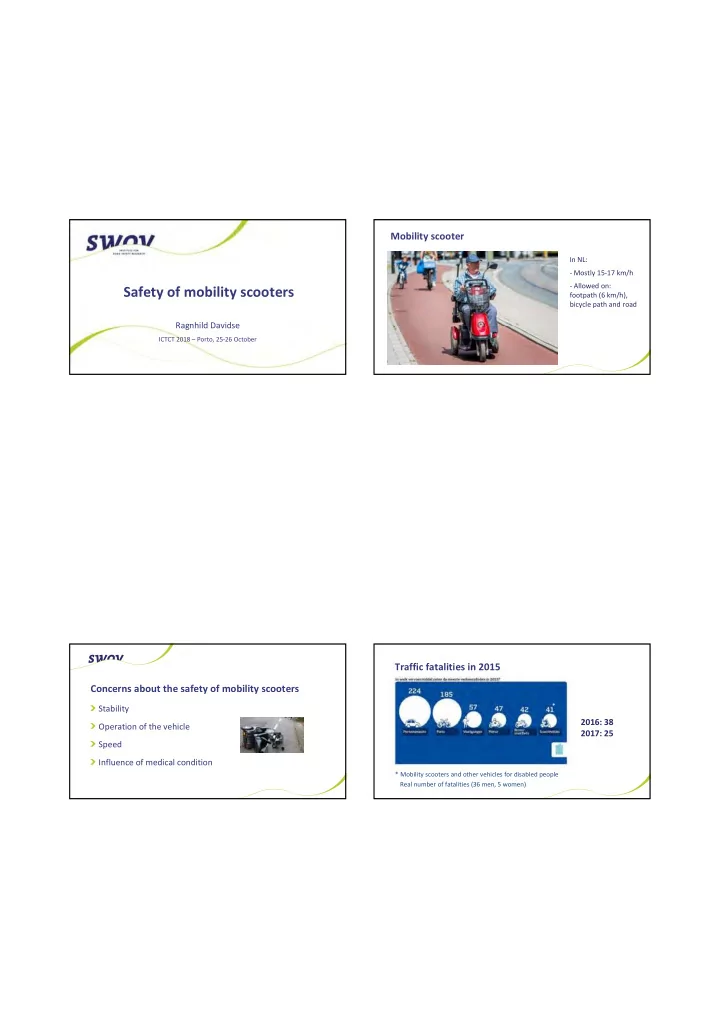
Mobility scooter

In NL:

  • Mostly 15-17 km/h
  • Allowed on:

footpath (6 km/h), bicycle path and road

Concerns about the safety of mobility scooters

Stability Operation of the vehicle Speed Influence of medical condition

Traffic fatalities in 2015

* Mobility scooters and other vehicles for disabled people Real number of fatalities (36 men, 5 women)

2016: 38 2017: 25

*

slide-2
SLIDE 2

Insight in accidents involving mobility scooters

In-depth study of traffic accidents (2015-2017) Survey among riders of mobility scooters “Scootmobiel experience” Literature review Interviews with manufacturers and suppliers Meeting with stakeholders

Insight in accidents involving mobility scooters

In-depth study of traffic accidents (2015-2017) Survey among riders of mobility scooters “Scootmobiel experience” Literature review Interviews with manufacturers and suppliers Meeting with stakeholders

SWOV in-depth research

Focused on one type of accidents Detailed data collection Soon after the accident Multidisciplinary team Analysis of each accident (30 – 40) Scenarios of similar accidents

slide-3
SLIDE 3

Aim and focus

How do these accidents develop? Discover the interplay of factors (accident and injury) Find leads for measures to prevent similar crashes in future

Total set of investigated accidents

35 accidents, of which 7 ended in water Mobility scooter riders:

14 men, 21 women 50% above 75 yrs Mostly riding on a 3-wheel mobility scooter Most of them quite experienced

Injury severity:

9 fatalities 10 hospitalized

Total set of investigated accidents

Type of accidents:

Single vehicle, although other road user often played a role Obstacle Collision with another vehicle, mostly motorized traffic

General circumstances:

Daylight Inside urban areas (50% on bicycle facility, rest on pavement or road)

Four accident scenario’s

Rider wants to brake but accelerates Rider looses his balance after hitting an obstacle Rider swerves to avoid a collision and falls Rider collides with motorised traffic while crossing the street

slide-4
SLIDE 4

Operational mistake leads to a fall

Accelerates when he wants to break (reflex) Many accidents end in the water Mostly younger riders (< 75 years) Injury severity is less severe than average (MAIS 1)

Operational mistake leads to a fall

Accident factors:

Operation of the accelerator and brake is counterintuitive Recent change of mobility scooter or unexperienced rider Grasps the steering wheel to retain balace

Injury reduction:

Rescued by people who passed by

Promising measures:

Accelerator and brake should be seperated. Minimum requirement of an emergency button to stop the vehicle.

slide-5
SLIDE 5

Tipping over after hitting an obstacle

The kerb is hit when the rider takes a turn Loss of balance, vehicle tips over and rider falls Average rider (age and gender) Average injury severity (MAIS 1-2)

Tipping over after hitting an obstacle

Accident factors:

Lateral position close to the edge of the bicycle path Bicycle path too narrow (according to guidelines) Curve radius too narrow Low obstacle next to the bicycle path Medical condition of the rider Mobility scooter is instable on an uneven surface

Promising measures:

Improve compliance with design guidelines (minimum width of and curve radius on bicycle paths) Improve the stability of mobility scooters (4 wheels, larger wheels with suspension)

slide-6
SLIDE 6

Swerve leads to a fall

Sudden steering manoeuvre to avoid a collision Mostly while crossing the road Swerving is the only option left (late observation) Mobility scooter tips over Mostly younger riders (< 75 years) Average injury severity (MAIS 1-2)

Swerve leads to a fall

Accident factors: Other road user did not yield or thought the MSR was waiting Traffic lights do not rule out conflicts Rider has little time and space to act Mobility scooter is an instable vehicle

Promising measures:

Traffic lights should prevent conflicts, and be adjusted to the speed and reaction time of older road users and scooter riders Mobility scooters should have a brake that can be operated by the rider

slide-7
SLIDE 7

Collision with motorised traffic while crossing

Type A: scooter rider crosses without right-of-way Type B: turning vehicle does not give right-of-way Not noticed or wrong expectations Older riders (> 75 yrs) Male riders More severe injuries (many fatalities)

Collision with motorised traffic while crossing

Accident factors: Crossed without right-of-way (running red light) Other road user did not notice scooter rider in time Obstructed view or attention focused on other road user Injury factor: Trapped beneath other vehicle or between two vehicles

Promising measures:

Traffic lights should prevent conflicts, and be adjusted to the speed and reaction time of older road users and scooter riders Improvement of the conspicuity of scooter riders and crossings

slide-8
SLIDE 8

Other recommendations

Remove obstacles from the bicycle path Fit mobility scooters with airbags Change vehicle regulation (more requirements) Improve registration of mobility scooters and accidents involving mobility scooters

Dilemma’s

Safety versus Retaining independent mobility Vehicle on public road versus Medical device Costs of providing scooters versus Savings in medical care No data on the number of vehicles and accidents

Please share information on the regulation and use of mobility scooters in your country

davidse@swov.nl

swov.nl

Thank you!