SLIDE 1
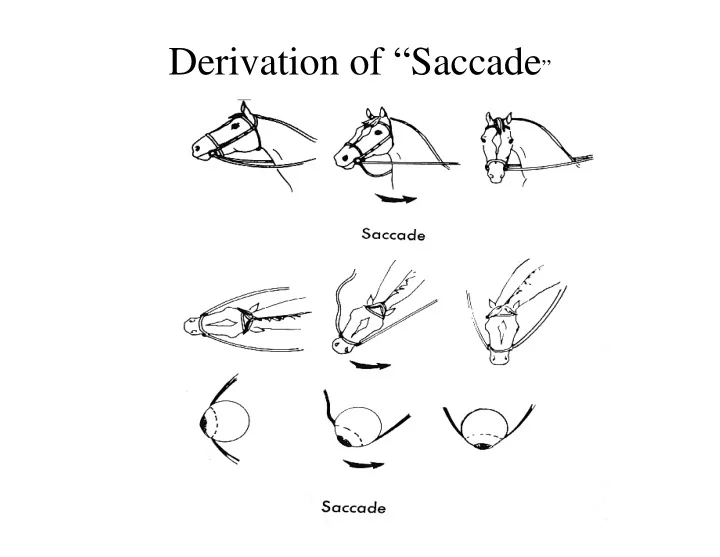
Derivation of “Saccade”
SLIDE 2
Saccade Tasks
SLIDE 3
Visual Search Saccades
SLIDE 4
Micro-Fixation Saccades
SLIDE 5
Reading Gaze Shifts
SLIDE 6
Reading Gaze Shifts
SLIDE 7
Catch-up Saccades
SLIDE 8
Saccadic Fast Phase
SLIDE 9 Ballistic nature of saccades. Pulse and step are pre-programmed Prediction can reduce saccade latency to zero.
Latency = 250 msec
SLIDE 10
Vision During Saccades is very reduced. Demo:Watch eye movements in a mirror Explination: Smearing of the retinal image Shearing of the retina Backward masking- second target erases the first
SLIDE 11
Saccades are characterized by their high velocity that comes at the cost additional force to needed to overcome muscle viscosity. Analogous to stealing second base in baseball. A pulse component of the saccade provides this extra force that is absorbed by the muscle. Pulse height sets velocity and width sets amplitude. A step component follows the pulse to hold the eye in its new position. This force counteracts the spring force of the antagonist.
SLIDE 12
Pulse and Step Innervation
Reciprocal innervation Agonist innervation Antagonist innervation
SLIDE 13 Pulse-Slide-Step components of saccade generation
Time in msec Time in msec
Eye Position IR Motoneuron
SLIDE 14
Muscle innervation increases the spring constant (K) or muscle stiffness. This increases the restoring force applied to the eye and antagonist muscle. Step innervation changes muscle stiffness maintains eye position
SLIDE 15
Hooke’s Law: Force exerted by a spring equals the product of its length (L) and spring- stiffness constant (K) or elasticity. F = L x K Innervation increases the spring stiffness and force of the agonist against the antagonist. The length of the antagonist increases when stretched by the agonist until their forces become equal. Force exerted by the agonist and antagonist is smallest in primary position.
SLIDE 16
X1 * K1 = F = X2 * K2
SLIDE 17
X1 * K1 = F = X2 * K2
SLIDE 18 Pause Cell determine the duration of a saccade Triggers the burst cell activity like a car clutch Burst Cell determine the velocity of a saccade Overcome viscosity to achieve high velocity Neural Integration transforms burst activity into tonic cell activity Tonic cells maintain the new eye position at the end
SLIDE 19 Pause, Burst and Integration circuit
Pause Cell Burst Cell Neural Integration Oculomotor Neuron Eye position Pre-motor sites include PPRF and Prepositus for horizontal saccades & riMLF and nucleus of Cajal for vertical saccades
SLIDE 20
Brainstem Burst and Integrator regions H Integrator H Burst V Burst V Integrator
SLIDE 21
Brainstem burst and pause cell areas- Schematic
SLIDE 22
Amplitude of a saccade is determined by the duration and amplitude of the pulse.
SLIDE 23
Main sequence diagram plots velocity or duration as a function Of saccade amplitude. 10 deg saccade lasts 50 msec. Saccades are rarely longer than 100 msec Main sequence reflects the activity of Burst neurons.
SLIDE 24
Main Sequence Curve- peak velocity
SLIDE 25
Main Sequence Curve- Saccade duration
SLIDE 26
Supra-nuclear sites Frontal eye fields (Area 8) Superior Colliculus
SLIDE 27
Frontal Eye Fields
SLIDE 28
Cortical Projections
SLIDE 29
Saccade Pathways Schematic
SLIDE 30 Saccade amplitude abnormalities related to pulse and step
Normal Saccade Hypometric Saccade Slow Saccade-Glissade Gaze-evoked Nystagmus (leaky integrator) Pulse-Step mismatch Innervation Motor response
SLIDE 31
Inappropriate Saccades Saccadic Oscillations- Dysmetria, Jerks and Flutter Dysmetria- (inaccurate size) Macrosaccadic Oscillations Square Wave Jerks Macro Square Wave Jerks Ocular Flutter
SLIDE 32
Parinaud’s Syndrome- no downward vertical saccades
SLIDE 33
Square Wave Jerks
SLIDE 34
Slow Saccades
SLIDE 35
Macro Saccadic Oscillations
SLIDE 36
Hypermetric Saccades
SLIDE 37
Adult Opsoclonus Movie
SLIDE 38
Infant Opsoclonus Movie
SLIDE 39
Spasmus Nutans
SLIDE 40 Saccade measured with coils and dual-Purkinje trackers Horizontal Vertical Degrees
<- Coils dual-Purkinje -> <- Difference
SLIDE 41
SLIDE 42
SLIDE 43
SLIDE 44
SLIDE 45
Spasmus Nutans