S Space-in-Time and Time-in-Space Self-Organizing Maps i Ti d Ti - - PowerPoint PPT Presentation

s space in time and time in space self organizing maps i
SMART_READER_LITE
LIVE PREVIEW

S Space-in-Time and Time-in-Space Self-Organizing Maps i Ti d Ti - - PowerPoint PPT Presentation

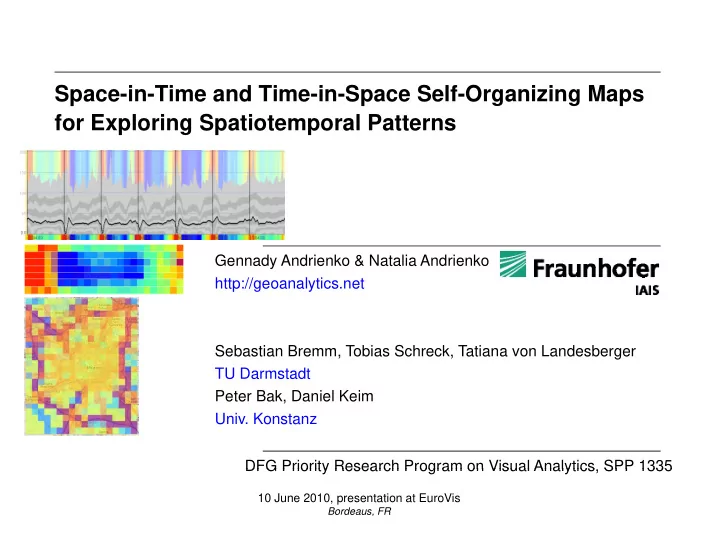
S Space-in-Time and Time-in-Space Self-Organizing Maps i Ti d Ti i S S lf O i i M for Exploring Spatiotemporal Patterns Gennady Andrienko & Natalia Andrienko http://geoanalytics.net htt // l ti t Sebastian Bremm, Tobias Schreck,


slide-1
SLIDE 1

S i Ti d Ti i S S lf O i i M Space-in-Time and Time-in-Space Self-Organizing Maps for Exploring Spatiotemporal Patterns

Gennady Andrienko & Natalia Andrienko htt // l ti t http://geoanalytics.net Sebastian Bremm, Tobias Schreck, Tatiana von Landesberger TU Darmstadt Peter Bak, Daniel Keim

  • Univ. Konstanz

DFG Priority Research Program on Visual Analytics SPP 1335

10 June 2010, presentation at EuroVis

Bordeaus, FR

DFG Priority Research Program on Visual Analytics, SPP 1335

slide-2
SLIDE 2

S ti l Ti S i D t St t Spatial Time Series: Data Structure

Spatial references: states of the USA Spatial references: states of the USA Temporal references: years from 1960 till 2000 (41) Attributes: population + various crime rates Attributes: population + various crime rates

2

Gennady Andrienko 10 June 2010, presentation at EuroVis http://geoanalytics.net Bordeaux, FR

slide-3
SLIDE 3

S ti l Vi li ti i t d di Spatial Visualizations: animated maps, diagram maps

3

Gennady Andrienko 10 June 2010, presentation at EuroVis http://geoanalytics.net Bordeaux, FR

slide-4
SLIDE 4

T l i li ti Temporal visualizations

4

Gennady Andrienko 10 June 2010, presentation at EuroVis http://geoanalytics.net Bordeaux, FR

slide-5
SLIDE 5

S l bilit bl Scalability problem

  • What if we have
  • Multiple attributes
  • Many places

L ti i

  • Long time series
  • Interactive visualization is not sufficient
  • We need grouping in space and time => Clustering

5

Gennady Andrienko 10 June 2010, presentation at EuroVis http://geoanalytics.net Bordeaux, FR

slide-6
SLIDE 6

D t t Data sets

  • Cars in Milan, Italy
  • 175,890 trajectories of 17,241 cars over 7 days
  • 2,075,216 records <id,x,y,t,speed>

A t d 18 22 1k

2

t l i

  • Aggregated over 18x22 1km2 rectangular regions

and 7x24 hourly intervals

  • USA crime statistics
  • 7 crime attributes
  • 52 states
  • 52 states
  • 41 years

6

Gennady Andrienko 10 June 2010, presentation at EuroVis http://geoanalytics.net Bordeaux, FR

slide-7
SLIDE 7

A h Approach

7

Gennady Andrienko 10 June 2010, presentation at EuroVis http://geoanalytics.net Bordeaux, FR

slide-8
SLIDE 8

A h Approach

2) Group time intervals by similarity of spatial situations: clustering “Space in Time” 1) Group places by ) G oup p aces by similarity of temporal dynamics: l t i clustering “Time in Space”

8

Gennady Andrienko 10 June 2010, presentation at EuroVis http://geoanalytics.net Bordeaux, FR

slide-9
SLIDE 9

SOM SOM

  • Self-Organizing Map (Kohonen 2001) is a neural network type vector projection and

quantization algorithm.

  • By means of a competitive, iterative training process, a network of prototype vectors

(or neurons, or cells) is trained (adjusted) to the input vector data. ( ) ( j ) p

  • The output of the algorithm is a network of vectors that is approximately topology

preserving w.r.t. the input data. Th t k b i t t d t f l t d i lt l t

  • The network can be interpreted as a set of clusters and simultaneously as a map to

lay out the input data elements (e.g., in the nearest neighbor sense w.r.t. the prototypes).

  • Typically, two-dimensional rectangular or hexagonal prototype vector networks are

assumed.

  • The capability of SOM to arrange input data in a regular network structure provides

good opportunities for visualization.

9

Gennady Andrienko 10 June 2010, presentation at EuroVis http://geoanalytics.net Bordeaux, FR

slide-10
SLIDE 10

S i Ti d Ti i S SOM i li ti Space-in-Time and Time-in-Space SOMs: visualization

1.

Bars on top of a cell show number of objects inside

2.

Shading of borders between cells reflects similarity of features

3.

Similarity of colors also reflects similarity of the features C l j t d th

4.

Colors are projected on other displays: maps (if grouping places) and and time graphs (if grouping time intervals)

10

Gennady Andrienko 10 June 2010, presentation at EuroVis http://geoanalytics.net Bordeaux, FR

slide-11
SLIDE 11

Ti i S SOM f d i i d Time-in-Space SOM of driving speeds

11

Gennady Andrienko 10 June 2010, presentation at EuroVis http://geoanalytics.net Bordeaux, FR

slide-12
SLIDE 12

Ti i S SOM f d i i d Time-in-Space SOM of driving speeds

Inside cells:

index images (what is grouped)

12

Gennady Andrienko 10 June 2010, presentation at EuroVis http://geoanalytics.net Bordeaux, FR

slide-13
SLIDE 13

Ti i S SOM f d i i d Time-in-Space SOM of driving speeds

Inside cells:

feature images (what are the features)

13

Gennady Andrienko 10 June 2010, presentation at EuroVis http://geoanalytics.net Bordeaux, FR

slide-14
SLIDE 14

Ti i S SOM f d i i d Time-in-Space SOM of driving speeds

Inside cells:

index images (what is grouped) feature images (what are the features)

14

Gennady Andrienko 10 June 2010, presentation at EuroVis http://geoanalytics.net Bordeaux, FR

slide-15
SLIDE 15

Ti i S SOM d t il Time-in-Space SOM: details

15

Gennady Andrienko 10 June 2010, presentation at EuroVis http://geoanalytics.net Bordeaux, FR

slide-16
SLIDE 16

Ti i S SOM d t il Time-in-Space SOM: details

16

Gennady Andrienko 10 June 2010, presentation at EuroVis http://geoanalytics.net Bordeaux, FR

slide-17
SLIDE 17

S i ti SOM (i d i ) Space-in-time SOM (index images)

17

Gennady Andrienko 10 June 2010, presentation at EuroVis http://geoanalytics.net Bordeaux, FR

slide-18
SLIDE 18

S i ti SOM (i d & f t i ) Space-in-time SOM (index & feature images)

18

Gennady Andrienko 10 June 2010, presentation at EuroVis http://geoanalytics.net Bordeaux, FR

slide-19
SLIDE 19

S i ti SOM ( l f ti i t l ) Space-in-time SOM (colours of time intervals)

19

Gennady Andrienko 10 June 2010, presentation at EuroVis http://geoanalytics.net Bordeaux, FR

slide-20
SLIDE 20

S i ti SOM ( l f ti i t l ) Space-in-time SOM (colours of time intervals)

20

Gennady Andrienko 10 June 2010, presentation at EuroVis http://geoanalytics.net Bordeaux, FR

slide-21
SLIDE 21

D t t th t d Detect the expected

  • One more data set about Milan:

mobile phone calls for 9 days aggregated by hours and regions

  • We expect high periodicity and clear regionalization of the calling activity

21

Gennady Andrienko 10 June 2010, presentation at EuroVis http://geoanalytics.net Bordeaux, FR

slide-22
SLIDE 22

Ti i S Time-in-Space SOM of mobile phone calls

22

Gennady Andrienko 10 June 2010, presentation at EuroVis http://geoanalytics.net Bordeaux, FR

slide-23
SLIDE 23

S i Ti Space-in-Time SOM of mobile phone calls

23

Gennady Andrienko 10 June 2010, presentation at EuroVis http://geoanalytics.net Bordeaux, FR

slide-24
SLIDE 24

Di th t d Discover the unexpected

  • USA crime statistics
  • 7 crime attributes
  • 52 states

41

  • 41 years

Problems Problems:

  • Different ranges of attributes
  • Outliers

Outliers

24

Gennady Andrienko 10 June 2010, presentation at EuroVis http://geoanalytics.net Bordeaux, FR

slide-25
SLIDE 25

C i tt ib t Crime attributes

25

Gennady Andrienko 10 June 2010, presentation at EuroVis http://geoanalytics.net Bordeaux, FR

slide-26
SLIDE 26

C i tt ib t li d Crime attributes: normalized

26

Gennady Andrienko 10 June 2010, presentation at EuroVis http://geoanalytics.net Bordeaux, FR

slide-27
SLIDE 27

Si il it f t t b i d i Similarity of states by crime dynamics

27

Gennady Andrienko 10 June 2010, presentation at EuroVis http://geoanalytics.net Bordeaux, FR

slide-28
SLIDE 28

Si il it f ti i d b it ti Similarity of time periods by situations

28

Gennady Andrienko 10 June 2010, presentation at EuroVis http://geoanalytics.net Bordeaux, FR

slide-29
SLIDE 29

C l i Conclusions

  • Interactive and animated maps and graphs are not sufficient for analyzing large and

complex space-time data. Visual methods need to be augmented by computations.

  • With space-in-time and time-in-space SOMs we consider data from two different

perspectives: p p

  • places grouped by similar attribute dynamics
  • time intervals grouped by similar spatial distributions of attribute values
  • Colours of the groups reflect their similarity
  • Case studies demonstrate the value of the approach
  • for detecting the expected
  • for detecting the expected
  • for discovering the unexpected
  • Current work: non-tabular data, other clustering/projection methods

Live demo is possible

29

Gennady Andrienko 10 June 2010, presentation at EuroVis http://geoanalytics.net Bordeaux, FR