Neural Networks Neural Networks can be : - Biological models MSE - - PDF document

neural networks
SMART_READER_LITE
LIVE PREVIEW

Neural Networks Neural Networks can be : - Biological models MSE - - PDF document

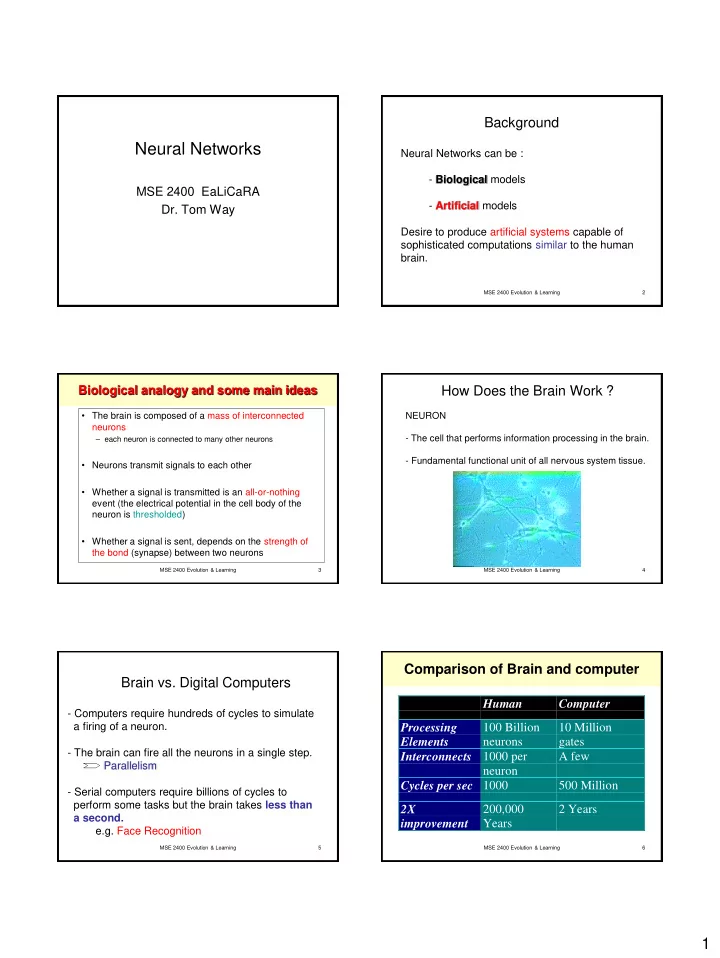
Background Neural Networks Neural Networks can be : - Biological models MSE 2400 EaLiCaRA - Artificial models Dr. Tom Way Desire to produce artificial systems capable of sophisticated computations similar to the human brain. MSE 2400


slide-1
SLIDE 1

1

Neural Networks

MSE 2400 EaLiCaRA

  • Dr. Tom Way

Background

Neural Networks can be :

  • Biological models
  • Artificial models

Desire to produce artificial systems capable of sophisticated computations similar to the human brain.

MSE 2400 Evolution & Learning 2

Biological analogy and some main ideas

  • The brain is composed of a mass of interconnected

neurons

– each neuron is connected to many other neurons

  • Neurons transmit signals to each other
  • Whether a signal is transmitted is an all-or-nothing

event (the electrical potential in the cell body of the neuron is thresholded)

  • Whether a signal is sent, depends on the strength of

the bond (synapse) between two neurons

MSE 2400 Evolution & Learning 3

How Does the Brain Work ?

NEURON

  • The cell that performs information processing in the brain.
  • Fundamental functional unit of all nervous system tissue.

MSE 2400 Evolution & Learning 4

Brain vs. Digital Computers

  • Computers require hundreds of cycles to simulate

a firing of a neuron.

  • The brain can fire all the neurons in a single step.

Parallelism

  • Serial computers require billions of cycles to

perform some tasks but the brain takes less than a second. e.g. Face Recognition

MSE 2400 Evolution & Learning 5

Comparison of Brain and computer

Human Computer Processing Elements 100 Billion neurons 10 Million gates Interconnects 1000 per neuron A few Cycles per sec 1000 500 Million 2X improvement 200,000 Years 2 Years

MSE 2400 Evolution & Learning 6

slide-2
SLIDE 2

2

Biological neuron

  • A neuron has

– A branching input (dendrites) – A branching output (the axon)

  • The information circulates from the dendrites to the

axon via the cell body

  • Axon connects to dendrites via synapses

– Synapses vary in strength – Synapses may be excitatory or inhibitory

axon cell body synapse nucleus dendrites MSE 2400 Evolution & Learning 7

What is an artificial neuron ?

  • Definition : Non linear, parameterized function

with restricted output range

       

  1 1 n i i ix

w w f y

x1 x2 x3 w0 y

MSE 2400 Evolution & Learning 8

Learning in Neural Networks

  • The procedure that consists in estimating the parameters
  • f neurons so that the whole network can perform a

specific task

  • 2 types of learning

– The supervised learning – The unsupervised learning

  • The Learning process (supervised)

– Present the network a number of inputs and their corresponding

  • utputs

– See how closely the actual outputs match the desired ones – Modify the parameters to better approximate the desired outputs

MSE 2400 Evolution & Learning 9

Supervised learning

  • The desired response of the neural

network in function of particular inputs is well known.

  • A “Professor” may provide examples and

teach the neural network how to fulfill a certain task

MSE 2400 Evolution & Learning 10

Unsupervised learning

  • Idea : group typical input data in function of

resemblance criteria un-known a priori

  • Data clustering
  • No need of a professor

– The network finds itself the correlations between the data – Examples of such networks :

  • Kohonen feature maps

MSE 2400 Evolution & Learning 11

Zipcode Example

Examples of handwritten postal codes drawn from a database available from the US Postal service

MSE 2400 Evolution & Learning 12

slide-3
SLIDE 3

3

Character recognition example

  • Image 256x256 pixels
  • 8 bits pixels values

(grey level)

  • Necessary to extract

features

images different 10 2

158000 8 256 256

  MSE 2400 Evolution & Learning 13

Neural Networks

  • A mathematical model to solve engineering problems

– Group of highly connected neurons to realize compositions of non linear functions

  • Tasks

– Classification – Discrimination – Estimation

  • 2 types of networks

– Feed forward Neural Networks – Recurrent Neural Networks

MSE 2400 Evolution & Learning 14

Feed-forward Networks

  • Arranged in layers.
  • Each unit is linked only in the unit in next layer.
  • No units are linked between the same layer, back to

the previous layer or skipping a layer.

  • Computations can proceed uniformly from input to
  • utput units.
  • No internal state exists.

MSE 2400 Evolution & Learning 15

Feed Forward Neural Networks

  • Information is propagated

from inputs to outputs

  • Can pass through one or

more hidden layers

x1 x2 xn ….. 1st hidden layer 2nd hidden layer Output layer

MSE 2400 Evolution & Learning 16

Feed-Forward Example

I1

I2

t = -0.5 W24= -1

H4

W46 = 1 t = 1.5

H6

W67 = 1 t = 0.5

I1

t = -0.5 W13 = -1

H3

W35 = 1 t = 1.5

H5 O7

W57 = 1 W25 = 1 W16 = 1 MSE 2400 Evolution & Learning 17

Recurrent Network (1)

  • The brain is not and cannot be a feed-forward network.
  • Allows activation to be fed back to the previous unit.
  • Internal state is stored in its activation level.
  • Can become unstable
  • Can oscillate.

MSE 2400 Evolution & Learning 18

slide-4
SLIDE 4

4

Recurrent Network (2)

  • May take long time to compute a stable output.
  • Learning process is much more difficult.
  • Can implement more complex designs.
  • Can model certain systems with internal states.

MSE 2400 Evolution & Learning 19

Recurrent Neural Networks

  • Can have arbitrary topologies
  • Can model systems with

internal states (dynamic ones)

  • Delays are associated to a

specific weight

  • Training is more difficult
  • Performance may be

problematic

– Stable Outputs may be more difficult to evaluate – Unexpected behavior (oscillation, chaos, …) x1 x2 1 1 1

MSE 2400 Evolution & Learning 20

Multi-layer Networks and Perceptrons

  • Have one or more

layers of hidden units.

  • With two possibly

very large hidden layers, it is possible to implement any function.

  • Networks without hidden

layer are called perceptrons.

  • Perceptrons are very

limited in what they can represent, but this makes their learning problem much simpler.

MSE 2400 Evolution & Learning 21

Perceptrons

  • First studied in the late 1950s.
  • Also known as Layered Feed-Forward Networks.
  • The only efficient learning element at that time was

for single-layered networks.

  • Today, used as a synonym for a single-layer,

feed-forward network.

MSE 2400 Evolution & Learning 22 MSE 2400 Evolution & Learning 23

Perceptrons

MSE 2400 Evolution & Learning 24

slide-5
SLIDE 5

5

What can Perceptrons Represent?

Some complex Boolean function can be represented.

For example:

Majority function - will be covered in this lecture. Perceptrons are limited in the Boolean functions they can represent.

MSE 2400 Evolution & Learning 25

Need for hidden units

  • If there is one layer of enough hidden

units, the input can be recoded (perhaps just memorized)

  • This recoding allows any mapping to be

represented

  • Problem: how can the weights of the

hidden units be trained?

MSE 2400 Evolution & Learning 26

Backpropagation

  • In 1969 a method for learning in multi-layer network,

Backpropagation, was invented by Bryson and Ho.

  • The Backpropagation algorithm is a sensible approach

for dividing the contribution of each weight.

  • Works basically the same as perceptrons

MSE 2400 Evolution & Learning 27

Backpropagation flow

MSE 2400 Evolution & Learning 28

Backpropagation Network training

  • 1. Initialize network with random weights
  • 2. For all training cases (called examples):

– a. Present training inputs to network and calculate output – b. For all layers (starting with output layer, back to input layer):

  • i. Compare network output with correct output

(error function)

  • ii. Adapt weights in current layer

This is what you want

MSE 2400 Evolution & Learning 29

Backpropagation Algorithm – Main Idea – error in hidden layers

The ideas of the algorithm can be summarized as follows :

  • 1. Computes the error term for the output units using the
  • bserved error.
  • 2. From output layer, repeat
  • propagating the error term back to the previous layer

and

  • updating the weights between the two layers

until the earliest hidden layer is reached.

MSE 2400 Evolution & Learning 30

slide-6
SLIDE 6

6

How many hidden layers?

  • Usually just one (i.e., a 2-layer net)
  • How many hidden units in the layer?

– Too few ==> can’t learn – Too many ==> poor generalization

MSE 2400 Evolution & Learning 31

How big a training set?

  • Determine your target error rate, e
  • Success rate is 1- e
  • Typical training set approx. n/e, where n is the

number of weights in the net

  • Example:

– e = 0.1, n = 80 weights – training set size 800 trained until 95% correct training set classification should produce 90% correct classification

  • n testing set (typical)

MSE 2400 Evolution & Learning 32 MSE 2400 Evolution & Learning 33

Summary

  • Neural network is a computational model that

simulate some properties of the human brain.

  • The connections and nature of units determine

the behavior of a neural network.

  • Perceptrons are feed-forward networks that can
  • nly represent linearly separable (very simple)

functions.

MSE 2400 Evolution & Learning 34

Summary (cont’d)

  • Given enough units, any function can be

represented by Multi-layer feed-forward networks.

  • Backpropagation learning works on multi-

layer feed-forward networks.

  • Neural Networks are widely used in

developing artificial learning systems.

MSE 2400 Evolution & Learning 35