
SLIDE 1
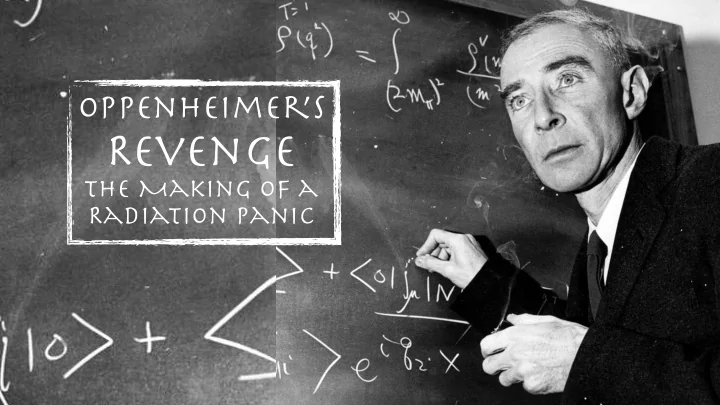
s Oppenheimer Revenge The Making of a Radiation Panic Share of - - PowerPoint PPT Presentation
s Oppenheimer Revenge The Making of a Radiation Panic Share of Global Energy from Clean, Zero-Emission Sources 14% 13% Hydro Nuclear 11% Wind Solar 10% 8% 7% 6% 4% 3% 1% 0% 1965 1968 1971 1974 1977 1980 1983 1986 1989 1992
0% 1% 3% 4% 6% 7% 8% 10% 11% 13% 14% 1965 1968 1971 1974 1977 1980 1983 1986 1989 1992 1995 1998 2001 2004 2007 2010 2013 2016
Hydro Nuclear Wind Solar
Source: BP Statistical Review, 2018
500 1000 1500 2000 1965 1968 1971 1974 1977 1980 1983 1986 1989 1992 1995 1998 2001 2004 2007 2010 2013 2016
Source: World Health Organization, 2016. http://www.who.int/ mediacentre/news/releases/2016/air-pollution-estimates/en/
Source: Pushker Kharecha and James Hansen, “Prevented Mortality and Greenhouse Gas Emissions from Historical and projected nuclear power,” Environmental Science and Technology,” 2013
Global Support for Various Forms of Energy
(PLEASE SELECT SINGLE RESPONSE FOR EACH ITEM) Base: All Respondents (n=18,713)
Total FAVOURABLE
Solar power Wind power Hydroelectric (water) Natural gas Bio-fuels (like ethanol) Clean Coal Oil/Petroleum Nuclear power Coal 25% 28% 30% 43% 53% 60% 78% 78% 85%
Denmark, 2013
Credit: YouTube
Do you support or oppose the use of nuclear power to generate electricity in the United States?
20 40 60 80 Support Oppose Don't Know
19 36 45 6 20 74
Men Women
Morning Consult, 2015
Capacity (GW) 100 200 300 400
At Risk Under Construction/Planned
Source & Methods: EP Energy Progress Assessment, 2017. Plant-specific rankings based on economic and energy trend analysis, political and societal assessment, and expert elicitations. Longer methodology discussion can be found at environmentalprogress.org/research Last updated March 2, 2017. Email info@environmentalprogress.org for more information.
Very High High Medium Very Low Low
Under Construction High Likelihood Medium Likelihood Low Likelihood
“It was the leading physicists responsible for inventing nuclear weapons, having realized how dangerous were their inventions, who instigated the fear of small doses. In their noble, wise and highly ethical endeavor to stop preparations for atomic war, and the ‘hysterical’ amassment of enormous arsenals of nuclear weapons, they were soon followed by many scientists from
and all things nuclear.” — Zbignew Jaworowski, 2009
“A race which could transmute matter would have little need to earn its bread by the sweat of its brow. Such a race could transform a desert continent, thaw the frozen poles, and make the whole world one smiling Garden of Eden.”
— Frederick Soddy, The Interpretation of Radium, 1908
“Atomic bombs… puffs of luminous radio-active vapor…” (1913)
“The safety of this nation… cannot lie wholly or even primarily in its scientific
based on making future wars impossible.” — Oppenheimer to Stimpson, 1945
“[A]ges in which the dominant weapon is expensive or difficult to make will tend to be ages of despotism, whereas when the dominant weapon is cheap and simple, the common people have a chance… We may be heading not for general breakdown but for an epoch as horribly stable as the slave empires of antiquity… a permanent state of ‘cold war’ with its neighbors…. If [the bomb] is a rare and costly object as difficult to produce as a battleship, it is likelier to put an end to large-scale wars at the cost of prolonging indefinitely a ‘peace that is no peace’.”
George Orwell, “You and the Atomic Bomb,” October 19, 1945
— U.N. control of nuclear fuel cycle — “Without world government there could be no permanent peace” — Nations would need to agree to “partial renunciation” — “Denatured uranium.”
1946
“[Nuclear power] is a dangerous engineering undertaking” — Oppenheimer, 1949
“He wanted to be on good terms with the Washington generals and to be a savior of humanity at the same time.” — Freeman Dyson
“Everybody dead on both sides with no hope anywhere…. Is this all we can do for our children?” — Eisenhower
— President Dwight D. Eisenhower, December 1953
“We are speaking on this occasion, not as members of this or that nation, continent, or creed, but as human beings, members of the species Man, whose continued existence is in doubt…. “A war with H-bombs might possibly put an end to the human race… We have found that the men who know most are the most gloomy… “The abolition of war will demand distasteful limitations of national sovereignty.” (1955)
January 1957
“Just last week you proposed the establishment of a sperm-bank. Now according to your plan, healthy male sperm would be stored like blood is stored now, so that in case of a nuclear war we would be able to propagate the human race with healthy sperm rather than with sperm that has been exposed to radiation. Sperm which might breed deformed infants.” — Mike Wallace, 1957
“Let me point out it is the difference between relative and absolute numbers. For example, if I say that the risk of inducing leukemia in a population is 100th of 1
percent by a total population of two billion eight hundred million, then you see we have a very large number of people.” — Ralph Lapp, “CBS: The Mike Wallace Interview,” 1957
Wallace: Suppose, conceivably science could invent an instrument, a source of fantastic energy that would be a great good to mankind, but that also, might enable the scientist literally to destroy the entire world with the push
force? LAPP: I would not. I think this is the case where we are finding that scientists are coming more... are becoming more and more socially conscious.
David Brower, Executive Director, Sierra Club David Pesonen, Sierra Club
“It was a turning point in my
enormousness of what we were fighting; it was anti-life. I began to see it as the ultimate brutality, short of nuclear weapons.” — David Pesonen
Hazel Mitchell
“If you’re trying to get people aroused about what is going on… you use the most emotional issue you can find.”
— Doris Sloan, anti-nuclear activist
Source: Thomas Wellock, Critical Masses: Opposition to Nuclear Power in California, 1958-1988, 1998, University of Wisconsin Press
“All the elements of classic displacement were indeed present. There was persistent anxiety about nuclear war. There was an inability to dispel the anxiety in the only genuine way, by getting rid of the bombs. Finally, there was a target toward which the frustrated feelings could redirect themselves, and all the more easily because
and reactors.” — Spencer Weart
Cheap energy in unlimited quantities is
rapidly growing population to set aside wildlands, open space and lands of high- scenic value. Even our capacity and leisure to enjoy this luxury is linked to the existence of cheap energy. — Will Siri, Sierra Club President, 1966
Source: Thomas Wellock, Critical Masses: Opposition to Nuclear Power in California, 1958-1988, 1998, University of Wisconsin Press
— Amory Lovins, 1977 (emphasis in the
Source: Mother Earth News, Plowboy Interview, 1977, http://www.motherearthnews.com/renewable-energy/ amory-lovins-energy-analyst-zmaz77ndzgoe
— Paul Ehrlich, Stanford University
“Modern technology…puts to nature the unreasonable demand that it supply energy which can be extracted and stored as such… Air is now set upon to yield nitrogen, the earth to yield ore, ore to yield uranium…to yield atomic energy…” — Martin Heidegger, “The Question of Technology,” 1954
"All of the solar energy technologies that can replace fossil fuels are in hand, some are already economically competitive with conventional sources, and many are rapidly approaching that point.” — Barry Commoner, 1975
“The difference between us and the AEC is that we are not willing to play Russian roulette with human lives… [Relaxing radiation standards will result in a 30% increase in cancer.] There is no morality and there is not a shred of honesty in any of them…This is legalized murder, the only question is how many murders.” — John Gofman, Lawrence Livermore Laboratory, 1970
“Our campaign stressing the hazards
rationale for increasing regulation… and add to the cost of the industry…”
— Sierra Club Executive Director, Michael McCloskey, 1974
Source: Sheldon Novick, The Electric War: The Fight Over Nuclear Power, Sierra Club Books, 1976
[A] million people die in the Northern Hemisphere now, because of plutonium from atmospheric [weapons] testing.” — David Brower
Q: You don't want [the nuclear waste] problem solved until the industry -- A: No, because it'll just try to prolong the industry, and expand the second generation of nuclear plants subsidized by the tax payer.
— Ralph Nader, 1997, PBS Frontline, “Nuclear Reaction”
“[O]n every level of human thought radioactive wastes — in association with weapons — were seen as filthy insults against the proper order of things.”
— Spencer Weart
''The critics of our society are using nature in the old primitive way: impurities in the physical world or chemical carcinogens in the body are directly traced to immoral forms
— Mary Douglas
New York Times, “Public fears over nuclear hazards are increasing,” 1979
“We cannot remain in our laboratories,
learning to teach people through love, not hate…. What I do now is to appeal to their goodness as human beings on the radiation issue. They've got children, they've got bodies. I try to appeal to their emotions… Have the people who build these weapons ever seen a child die of leukemia? I have.” — Helen Caldicott, NYT, 1979
Nuclear Energy Institute, 2016
Capacity factor (%) 40 55 70 85 100 1973 1976 1979 1982 1985 1988 1991 1994 1997 2000 2003 2006 2009 2012 2015
Improved efficiency of U.S. nuclear plants
Source: U.S. Energy Information Administration (EIA). 2017. Monthly Energy Review. https://www.eia.gov/totalenergy/data/monthly/#nuclear.
Overnight Capital Cost ($/kW) 2750 5500 8250 11000
OCC/kWFast breeder reactor Fast Breeder Reactor w/o Monju Gas-cooled Boiling water Heavy water Pressurized water
Source: Lovering, J. R., Yip, A., & Nordhaus, T. 2016. Historical construction costs of global nuclear power reactors. Energy Policy, 91, 371-382. Accessed March 7, 2017. http://www.sciencedirect.com/science/article/pii/S0301421516300106
“Imagine the consequences from a fertilizer truck bomb detonated next to a “containment-lite” [molten-salt] reactor… truly a nuclear nightmare.” (2001) — David Lochbaum, Union of Concerned Scientists
Kent Presents 2016 They polled the audience before I was interviewed on stage…
Kent Presents 2016 …they polled them again after I was interviewed
Professor Bum-Jin Chung persuades South Korea’s “citizens jury”
Fear-mongering about radiation has long been ideologically motivated Radiation panic started by previously powerful left-wing scientists who resented loss of power to military & industry Demonization of weapons preceded demonization of energy Scientists had power because of a) allegedly humanistic motives and b) scientific credibility Radiation panic promoted by pro-scarcity Malthusian anti-humanists
Pro-nuclear forces reinforced interpretive frames of themselves as: — more concerned about machines than people — robotic, soul-less, and emotion- less Vulcans — insensitive men — egghead scientists oblivious to human concerns
Recommendations: Emphasize “why” you care Emphasize need for nuclear Humanize and familiarize radiation Foreground caring women and mothers as advocates Call out the hidden ideological agendas and fear-mongering